Agentic AI Development

Agentic AI development for coordinated workflows

Our agentic AI development work focuses on coordinating agents for complex workflows. Error handling, shared state, cost limits and human oversight help turn a demonstration into a system you can evaluate for production.

Free 30-minute consultation
Fixed-scope pilots
U.S.-based team
Custom, not off-the-shelf
SOC 2-aligned practices
ROI tracked in writing
What is agentic AI?

Agentic AI describes systems where language models plan and execute sequences of actions toward a goal with some degree of autonomy, calling tools and reacting to results rather than following a fixed script. Multi-agent systems coordinate several such agents, each with a defined role, on tasks too complex for one agent to handle reliably.

7+
Years building AI systems
240+
Projects delivered
4.8
Avg. months to payback
38
U.S. states served
The Problem

Agentic systems fail in ways single calls do not

A single model call either works or does not. An agentic system can complete four steps correctly, fail the fifth, and leave your data in a state that neither the old nor the new process expects.

Add multiple agents and it compounds: agents that loop passing work between each other, costs that spiral because nothing bounded the number of steps, and failures nobody can diagnose because there is no trace of what each agent decided and why.

Our Approach

Bounded, traced and recoverable

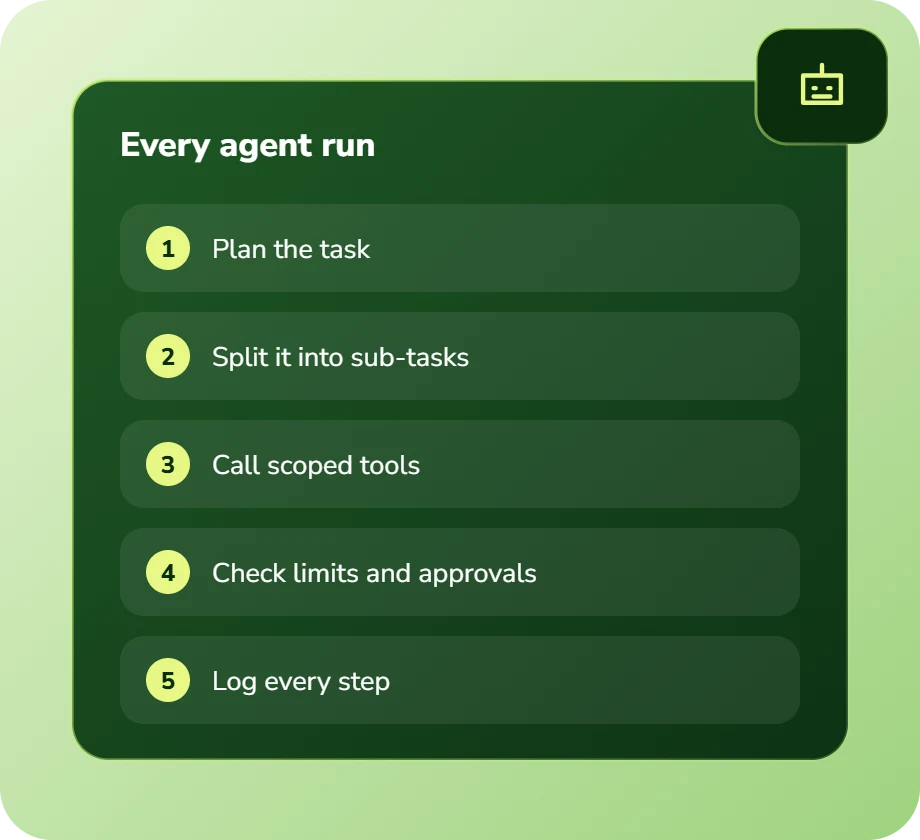
Every agent gets explicit limits: which tools it may call, how many steps it may take, how much it may spend, and what it must escalate rather than decide.

Every step is traced. Every state-changing action is idempotent or has a compensating rollback. And any action that is expensive, irreversible or customer-facing sits behind a human gate as a matter of architecture rather than policy.

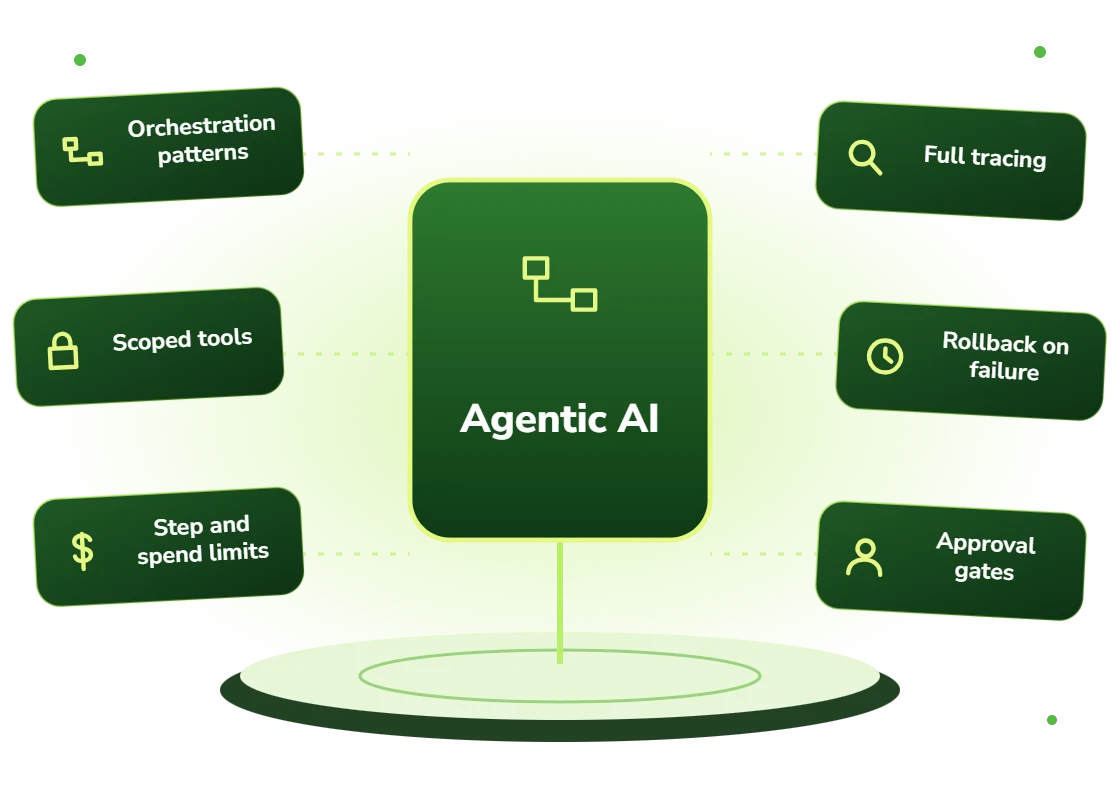
Diagram of a central AI agent connected to six external components
Service Overview

Agentic AI development: scope and deliverables

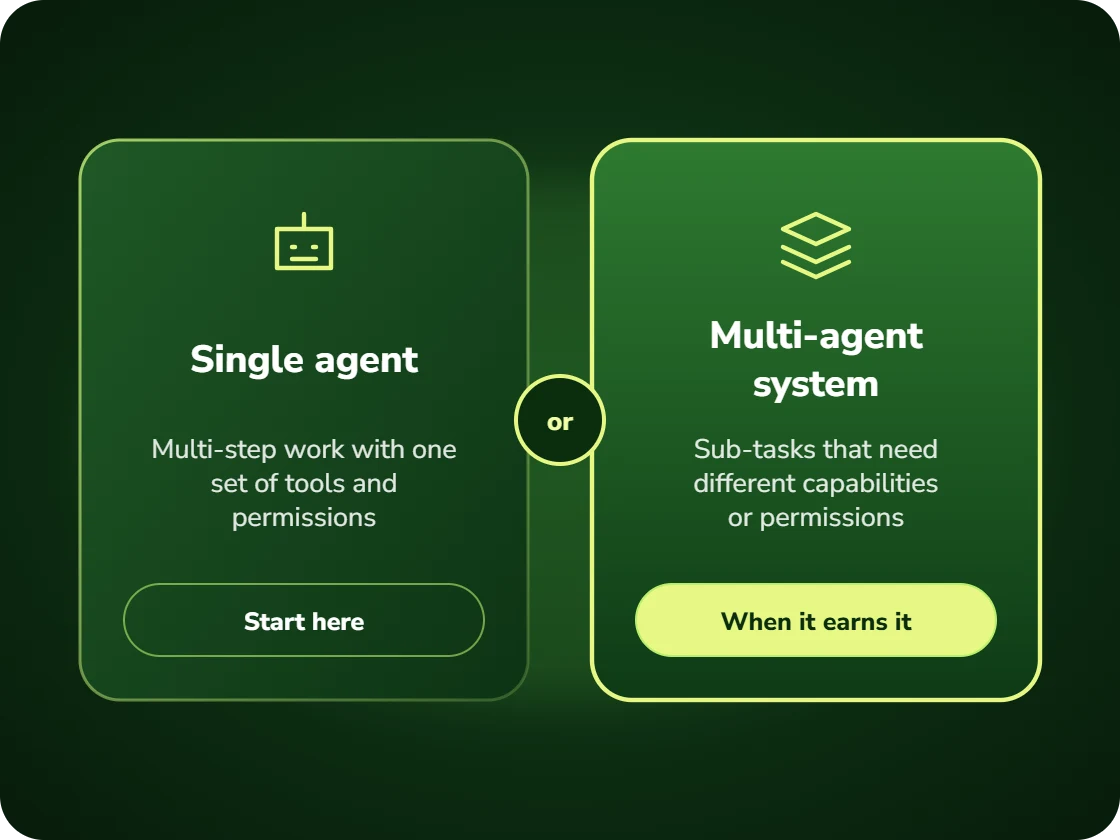
Multi-agent architectures are frequently over-applied. Splitting a task across five agents adds coordination overhead, latency and failure modes, and for most problems a single well-designed agent with good tools performs better.

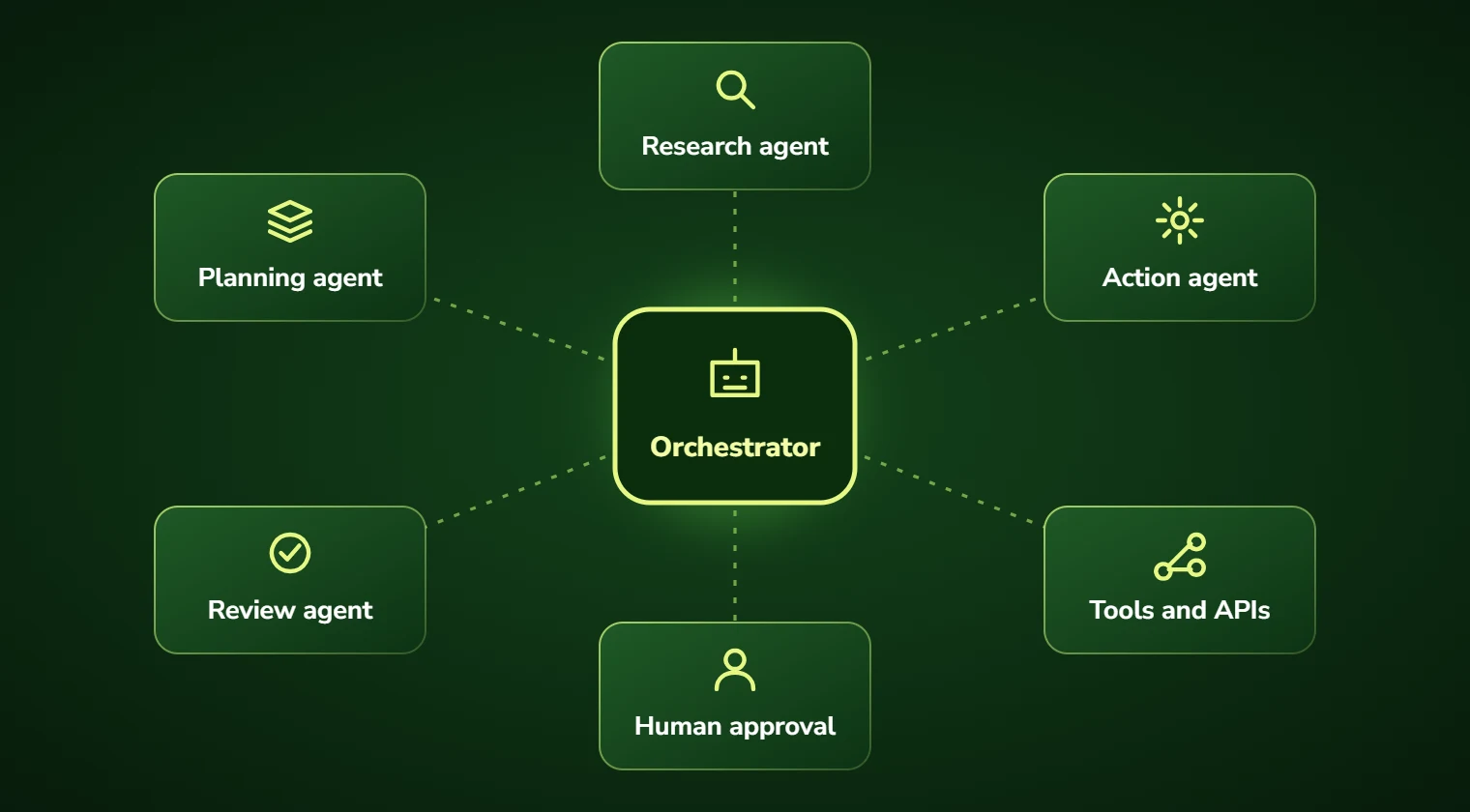
The genuine cases are where sub-tasks need materially different capabilities, tools or permissions, a research agent that only reads, a drafting agent that only writes, a review agent that checks the other two and has no ability to modify anything.

Separation of permissions is often the real justification. An agent that cannot write cannot corrupt anything, and having the checking agent be structurally unable to modify what it checks is a stronger guarantee than instructing it not to.

  • Orchestration patterns: single agent, supervisor, or peer collaboration
  • Per-agent tool scoping and permission boundaries
  • Step, depth and spend limits enforced at the framework level
  • Full step-level tracing across every agent in a run
  • Idempotent actions and compensating rollback for partial failures
  • Human approval gates on irreversible or high-consequence actions

For a single agent completing a bounded task, see AI agent development services. This page focuses on coordinating multiple agents, their shared state and their handoffs.

Right Fit

Where agentic systems are warranted

Work that genuinely requires planning: where the correct next step depends on what the previous step discovered, and the path cannot be enumerated in advance.

If the process can be drawn as a flowchart, build the flowchart. Deterministic automation is cheaper to run, easier to audit and more reliable, and we recommend it whenever it suffices.

  • Tasks where the next step depends on what the previous step found
  • Research and analysis work following a method rather than a script
  • Processes needing several distinct capabilities and permission scopes
  • Operations where exception paths are too varied to enumerate as rules
  • Workflows currently requiring a specialist purely to navigate systems
  • High-volume work where the per-task cost of an agent still beats a person
Benefits

Benefits of agentic AI development

Handles genuine variation

Work where the path cannot be predetermined, which is exactly where rules engines accumulate exceptions and break.

Permissions enforced structurally

A review agent that cannot write is a stronger guarantee than a review agent instructed not to.

Costs that cannot run away

Step, depth and spend limits enforced by the framework, so a looping agent stops rather than billing all night.

Failures you can diagnose

Full step-level traces across every agent, so a bad outcome can be reconstructed rather than guessed at.

Recoverable partial failures

Idempotent actions and compensating rollback so a failure at step five does not leave inconsistent data.

Human oversight by design

Approval gates on consequential actions built into the architecture rather than added after an incident.

Problems We Solve

Business challenges agentic AI solves

01

Agents looping indefinitely

Work passed back and forth without converging. Depth and step limits with escalation stop it.

02

Runaway costs overnight

An unbounded run consuming a month of budget. Spend caps enforced per run and per agent.

03

Partial failures corrupting state

Four steps applied, fifth failed. Idempotency and compensating rollback make runs recoverable.

04

No way to explain an outcome

Opaque multi-agent decisions. Step-level tracing makes every run reconstructable.

05

Over-engineered agent swarms

Five agents where one would do better. We recommend the simplest architecture that works.

06

Autonomy without oversight

Systems taking consequential actions unchecked. Approval gates on anything irreversible.

What's Included

Features and deliverables

Everything below is in scope on a standard engagement. Nothing here is an upsell discovered halfway through the build.

01

Architecture design

Orchestration pattern, agent roles, tool allocation and permission boundaries designed and signed off before build.

02

Tool and permission scoping

Per-agent tool access with least-privilege defaults, so capability is granted deliberately rather than broadly.

03

Planning and decomposition

Task decomposition with explicit bounds on depth, branching and retry, preventing unbounded exploration.

04

State management

Durable run state so a long-running task survives restarts, with resumption from the last completed step.

05

Guardrails and limits

Spend caps, step limits, output validation, prompt-injection defences and escalation triggers on every agent.

06

Observability and tracing

Full traces of every agent decision, tool call and result, with cost and latency attributed per step.

07

Human-in-the-loop workflow

An approval queue surfacing gated actions with the agent’s plan and reasoning for a fast decision.

08

Evaluation harness

Regression suites over real scenarios measuring end-to-end task success, not just individual model outputs.

Technology Stack

Technologies we use for agentic AI development

We are not tied to one vendor. Model and infrastructure choices are made on accuracy, cost per task, latency, and where your data is allowed to live.

Language Models
C
Claude (Anthropic)
G
GPT (OpenAI)
G
Gemini (Google)
L
Llama
M
Mistral
A
Azure OpenAI Service
Agent & Orchestration
M
Model Context Protocol
L
LangGraph
L
LangChain
L
LlamaIndex
T
Temporal
C
Celery
Vector & Retrieval
P
Pinecone
W
Weaviate
Q
Qdrant
p
pgvector
E
Elasticsearch
A
Amazon OpenSearch
Cloud & Infrastructure
A
AWS Bedrock
G
Google Vertex AI
M
Microsoft Azure
D
Docker
K
Kubernetes
T
Terraform
How We Work

Our AI development process

The same five stages on every engagement, so you always know what happens next and what you get at the end of it.

01

Discovery

We interview the people doing the work, map the workflow end to end, and audit the systems and data behind it.

02

AI Strategy

Every opportunity gets scored on cost to build, time to value, and annual savings, then ranked.

03

Pilot Build

We ship the top-ranked automation as a fixed-scope pilot so you see real output before committing further budget.

04

Implementation

Integration with your live systems, staff training, human-in-the-loop review gates, and a documented rollback path.

05

Optimization

Monthly accuracy reviews, prompt and retrieval tuning, and a written report on hours and dollars saved.

Timeline

How long it takes

A typical first engagement, week by week. Complex integrations and regulated environments extend this, and we say so during discovery rather than after.

Weeks 1 to 2

Architecture and scoping

Agent roles, tools, permissions, escalation rules and failure paths designed and agreed.

Weeks 3 to 4

Single-agent prototype

The core capability proven with one agent before adding coordination complexity.

Weeks 5 to 9

Full system build

Orchestration, tool integration, guardrails, state management and approval workflow.

Weeks 10 to 12

Reliability engineering

Failure injection, rollback testing, cost bound verification and evaluation suite build.

Weeks 13 to 14

Supervised launch

Live with every run reviewed initially, autonomy widened per category as evidence accumulates.

Who We Work With

Industries we deliver agentic AI development for

SaaS & Technology

AI features inside your product, support deflection, onboarding assistants, and usage analytics.

Financial Services

Document extraction, reconciliation, KYC support, and audit-ready reporting with full traceability.

Logistics & Supply Chain

Document processing, carrier communication, exception handling, and inventory rebalancing.

Insurance

First-notice-of-loss intake, claims triage, policy Q&A, and fraud signal detection.

Professional Services

Proposal drafting, timesheet capture, research synthesis, and client reporting at scale.

Manufacturing

Quality inspection, maintenance prediction, supplier communication, and production scheduling.

Healthcare

Intake, prior authorization, clinical documentation, and revenue-cycle workflows built to respect HIPAA boundaries.

Retail & E-commerce

Product data enrichment, demand forecasting, support deflection, and personalized merchandising.

Use Cases

Real-world agentic AI use cases

01

Multi-system operations resolution

An agent gathering context across systems, diagnosing, and executing a fix within defined limits.

02

Research and analysis workflows

Agents following a repeatable research method across sources and synthesizing a cited output.

03

Complex claims assessment

Specialist agents handling documents, coverage and calculation, with an adjuster approving the recommendation.

04

Procurement and sourcing

Agents gathering quotes, checking contract compliance and preparing purchase recommendations for approval.

05

Code review and remediation

Agents analysing changes, proposing fixes and preparing pull requests for human approval.

06

Data quality remediation

Agents finding inconsistencies across systems, investigating causes, and proposing or applying bounded corrections.

Why DevSolutionsAI

Why choose DevSolutionsAI for agentic AI development

Business case before build

Every recommendation carries an estimated cost, timeline, and annual savings figure. If the math does not work, we say so before you spend.

Vendor-neutral by design

We resell nothing and take no platform commissions. Model and infrastructure choices are made on fit, cost, and your data-residency rules.

Fixed-scope pilots

The first engagement is a defined deliverable at a defined price, not an open-ended retainer that quietly grows each quarter.

Built for handover

You own the code, the prompts, the infrastructure, and the documentation. No lock-in to a proprietary wrapper you cannot leave.

Human-in-the-loop where it counts

Anything customer-facing, clinical, financial, or legal gets a review gate, a confidence threshold, and a logged audit trail.

Security reviewed early

Data flow diagrams, retention rules, and access boundaries are agreed in week one, not retrofitted after your security team objects.

Get Started

Find out what agentic AI development would cost you, before you commit to anything

Every engagement is quoted after a short discovery, so you get a fixed written price built around your actual volumes rather than a rate card that assumes someone else’s business.

The first call is thirty minutes and free. Bring one workflow. We will tell you what it is likely costing you each year, roughly what automating it would take, and whether we think it is worth doing at all.

  • A written savings estimate before any paid work
  • Fixed scope and fixed price, agreed up front
  • Full ownership of everything we build for you
  • An honest recommendation when the numbers do not work
What clients typically see
Across recent projects
Staff hours saved each week
31
Months to payback
4.8
Client retention
94%
Response to enquiries
4 hrs

Figures are internal measurements across recent engagements, reported to every client monthly in writing.

Illustrative project scenario

Illustrative project scenario

Freight brokerage · 40,000 shipments/month

Agents handling exceptions, with humans keeping the money decisions

Challenge. A freight brokerage handled roughly 3,000 shipment exceptions monthly, delays, damages, address failures, capacity shortfalls. Each required gathering information across four systems, contacting parties, and deciding a resolution. Paths varied too much for rules; a previous rules engine had accumulated 400 conditions and still missed cases.

What we built. A supervisor agent triaging exceptions to three specialists: an investigation agent with read-only access across systems, a communication agent that drafts but cannot send without approval, and a resolution agent that can apply fixes below a defined value threshold. Anything involving customer credit, carrier penalties or amounts above the threshold routes to a human with the full investigation attached.

Outcome. Around 71% of exceptions now resolve without human involvement, all within the value threshold. Median resolution time fell from 4.2 hours to 24 minutes. No financial decision above the threshold has ever been taken autonomously, which was the condition of deployment.

71%
Exceptions auto-resolved
4.2h → 24m
Median resolution
0
Unapproved financial decisions
3,000
Exceptions handled monthly

Illustrative project scenario. The figures demonstrate how a project could be scoped and evaluated; they are not verified client results or an audited average.

Client Feedback

What clients say about working with us

31
Avg. staff hours saved weekly
4.8
Avg. months to payback
94%
Client retention
4
Hour response to enquiries
Common Questions

Agentic AI Development FAQs

Usually one, and this is the most common over-engineering we see. Splitting work across five agents adds coordination overhead, latency and failure modes. Multiple agents genuinely help when sub-tasks need materially different tools or permissions, particularly when you want structural separation, such as a review agent that is physically unable to modify what it reviews. Otherwise a single agent with good tools performs better.
Hard limits enforced by the framework rather than requested in a prompt: maximum steps per run, maximum recursion depth, and a spend cap per run and per agent. When a limit is hit the run stops and escalates to a human rather than continuing. This is enforced in code, because an instruction to “be efficient” is not a control.

It is designed for explicitly. State-changing actions are made idempotent where possible so a retry does not double-apply, and sequences that cannot be made idempotent get a compensating rollback path. Run state is durable, so a task can resume from the last completed step rather than restarting. Failures are traced, alert an owner, and surface for review.

Start with almost none and widen it with evidence. Our standard approach is that every run is human-reviewed at launch, and autonomy is enabled per action category once measured success on that category justifies it. Irreversible, financial and customer-facing actions typically keep a permanent approval gate regardless of how well the agent performs, because the downside is asymmetric.

It depends on the requirement. We work with LangGraph, the Model Context Protocol, and purpose-built orchestration where a framework adds more complexity than it removes. For many production systems the right answer is relatively plain code with explicit state management rather than a framework, because frameworks optimize for expressiveness and production optimizes for predictability.

End-to-end task success on real scenarios, not just individual model outputs. We build a regression suite of actual cases with known correct outcomes and score whether the agent completed the task properly, including whether it escalated when it should have. We also run failure injection, making tools fail mid-run, to verify recovery paths work rather than assuming they do.

Service Areas

Agentic AI Development across the United States

We deliver agentic ai development remotely to clients nationwide, with on-site workshops available in major metros.

Ready to scope your agentic AI development project?

Book a free 30-minute consultation. Bring one workflow and leave with a realistic estimate of what it would cost to automate and what it would save.

Free 30-minute consultation
Fixed-scope pilots
U.S.-based team
Custom, not off-the-shelf
SOC 2-aligned practices
ROI tracked in writing
Free 30-minute AI consultation