
Claude AI integration for long documents and genuine tool use
Our Claude AI integration work gives you document analysis and tool-driven workflows, measured on your own tasks before launch. We then build in access controls, cost limits and human review, so you control both risk and spend.
We reply within 4 business hours.
What is Claude AI and when should you use it?
Claude is a family of large language models from Anthropic. You can access it via the Anthropic API, Amazon Bedrock or Google Vertex AI. It is particularly strong at reasoning over long documents, following complex multi-step instructions, and reliable tool use in agentic systems. That makes it a common choice for contract analysis, research synthesis and agent workflows.
Models are not interchangeable, whatever the benchmarks suggest
Teams often pick a model once and use it for everything. Benchmark tables encourage this by implying a single ranking. However, real workloads differ enough that the ranking rearranges depending on the task.
Long-document work is a clear example. A model that performs well on short prompts can lose coherence across a two-hundred-page agreement. The failure is subtle, too: it does not error, it just quietly misses the clause on page 140.
Match the model to the work
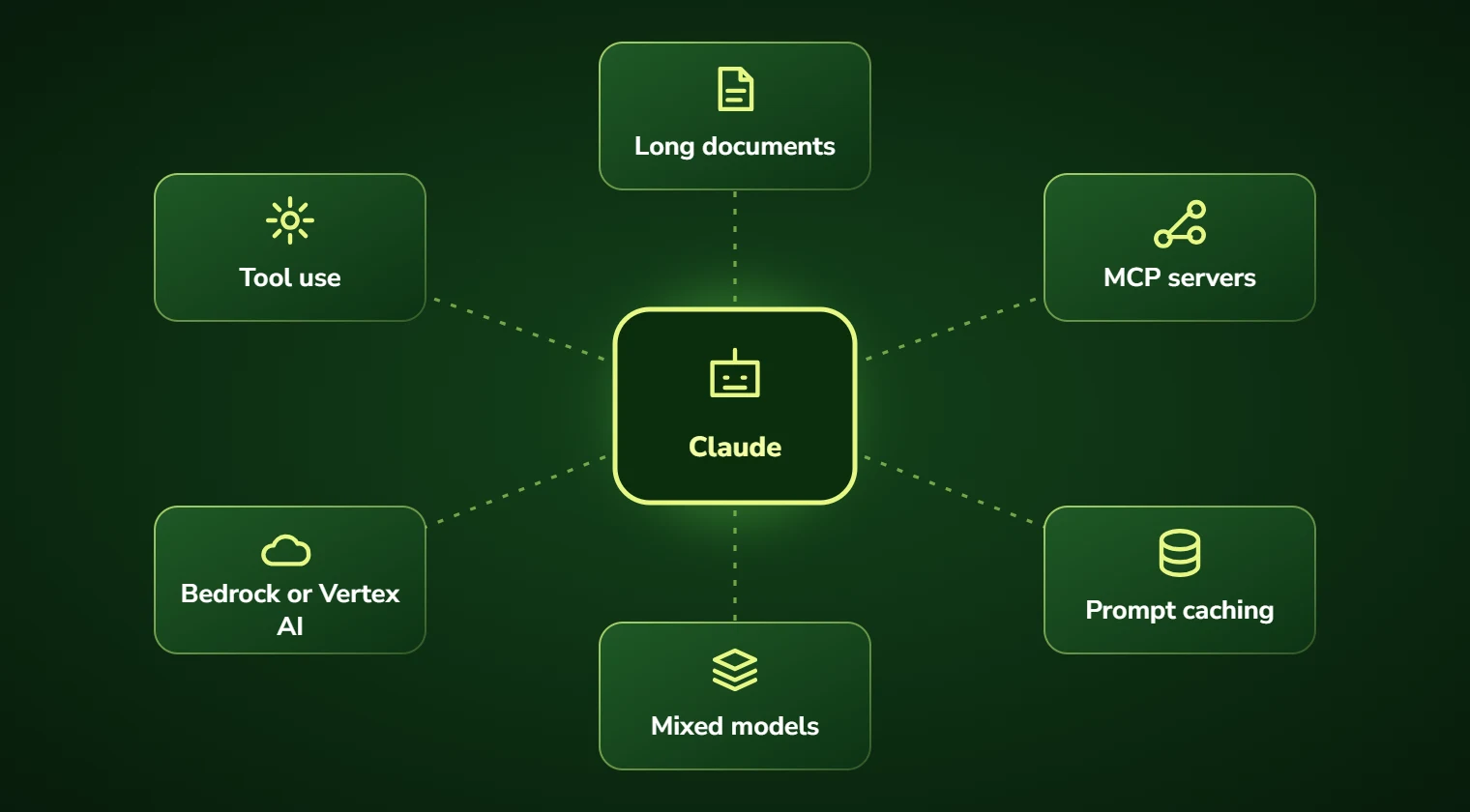
We select models per task on measured performance against your own cases. Claude is frequently the right choice for long-document reasoning, complex instruction-following and agentic tool use. In those cases, we build the system around it.
For other tasks in the same system a different model may be better or cheaper, and mixing them is normal. What matters is that the choice is measured rather than defaulted.
What our Claude AI integration includes
The long context window is genuinely useful when a document must be reasoned about as a whole. Retrieval works well for finding a specific fact. However, it works less well for questions like “are any obligations in this agreement mutually inconsistent”. Those require holding the whole document at once.
Tool use is the second area. Agentic systems depend on a model reliably deciding which function to call and with what arguments. The model must also interpret what came back correctly. Claude performs strongly here, which matters more for agent reliability than raw benchmark scores.
Anthropic also authored the Model Context Protocol, an open standard for connecting models to tools and data sources. Where a client is building several AI systems, MCP gives a consistent integration layer rather than bespoke wiring per application.
Our Claude API integration and Anthropic Claude integration cover Claude AI for document processing, Claude MCP integration and Claude AI application development, deployed through the route that suits your cloud.
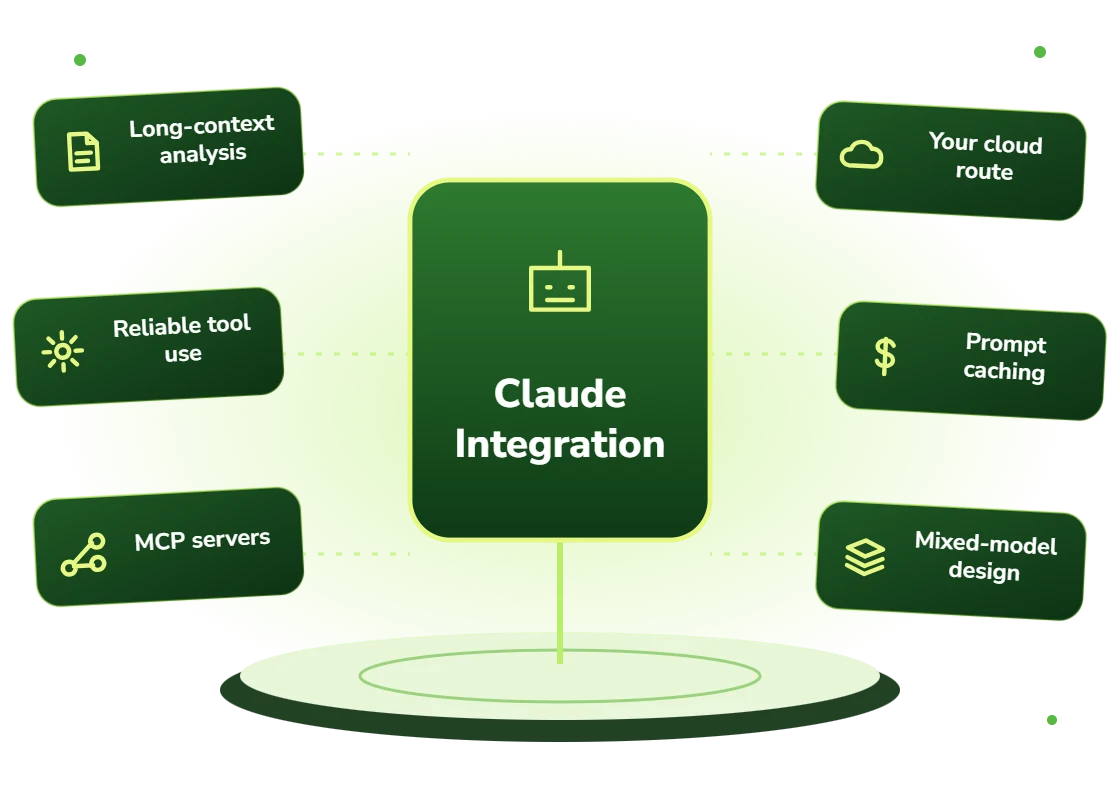
- Long-context analysis over full documents rather than retrieved fragments
- Agentic tool use with reliable function selection and result interpretation
- Model Context Protocol servers exposing your systems to AI applications consistently
- Deployment via Anthropic API, Amazon Bedrock or Google Vertex AI
- Prompt caching to reduce cost substantially on repeated long contexts
- Mixed-model architectures using Claude where it measures best
Is Claude AI integration right for your business?
Document-heavy work where the whole document matters: contract analysis, regulatory review, research synthesis, technical specification comparison.
And agentic systems where reliability of tool use determines whether the thing works at all. An agent that calls the wrong function occasionally is worse than no agent.
Claude AI workflow automation suits work that involves long documents or several tools, where accuracy and careful reasoning matter more than raw speed.
- Legal and contract analysis requiring whole-document reasoning
- Agent systems where reliable multi-step tool use is critical
- Regulated industries valuing a conservative refusal posture
- Teams building on AWS Bedrock or Google Vertex AI
- Organizations standardizing tool integration through MCP
- Research and analysis workflows over long technical documents
What Claude AI integration can do for your business
Whole-document reasoning
Analysis across a full agreement or specification rather than whichever fragments retrieval happened to surface.
Reliable tool use
Consistent function selection and result interpretation, which is what actually determines whether an agent works.
Prompt caching savings
Repeated long contexts cached, which cuts cost dramatically on document workflows that re-analyze the same material.
Conservative by default
A refusal posture that suits regulated work, where a confident wrong answer costs more than an unhelpful one.
Cloud-native deployment
Available through Bedrock and Vertex AI, so it fits existing AWS or Google Cloud commitments and compliance boundaries.
MCP for consistent integration
One standard for exposing your systems to AI applications rather than bespoke wiring per project.
Problems Claude AI integration solves
Retrieval missing cross-document logic
Questions needing the whole document, not fragments. Long context handles what retrieval cannot.
Agents calling the wrong tools
Unreliable function selection breaking workflows. Model choice materially affects agent reliability.
Long-context costs
Repeatedly sending large documents. Prompt caching cuts the cost of re-analyzing the same material substantially.
Integration rebuilt per project
Bespoke tool wiring each time. MCP servers are built once and reused across applications.
Overconfident answers in regulated work
Models that guess rather than decline. A conservative posture is an asset where errors carry liability.
Cloud commitment constraints
Needing to stay within AWS or Google Cloud. Bedrock and Vertex deployment keeps data in your boundary.
What every Claude AI integration engagement includes
Everything below is in scope on a standard engagement. Nothing here is an upsell discovered halfway through the build.
Model selection benchmarking
Candidate models measured against your actual tasks and documents, with the results documented rather than asserted.
Long-context pipelines
Document workflows exploiting large context windows, with chunking used only where it genuinely helps.
Agentic tool integration
Tool definitions, permission scoping and result handling built for reliable multi-step execution.
MCP server development
Model Context Protocol servers exposing your databases, APIs and document stores to AI applications through one standard.
Prompt caching
Caching configured for repeated long contexts, typically the largest cost lever in document-heavy workloads.
Bedrock and Vertex deployment
Deployment through AWS or Google Cloud where existing commitments or data residency rules require it.
Evaluation suites
Regression tests over real documents and cases so model or prompt changes are validated before shipping.
Mixed-model architecture
Provider abstraction so Claude handles what it does best while other models handle high-volume cheap tasks.
Which AI models and tools do we use for Claude AI integration?
We are not tied to one vendor. Model and infrastructure choices are made on accuracy, cost per task, latency, and where your data is allowed to live.
How we deliver Claude AI integration, step by step
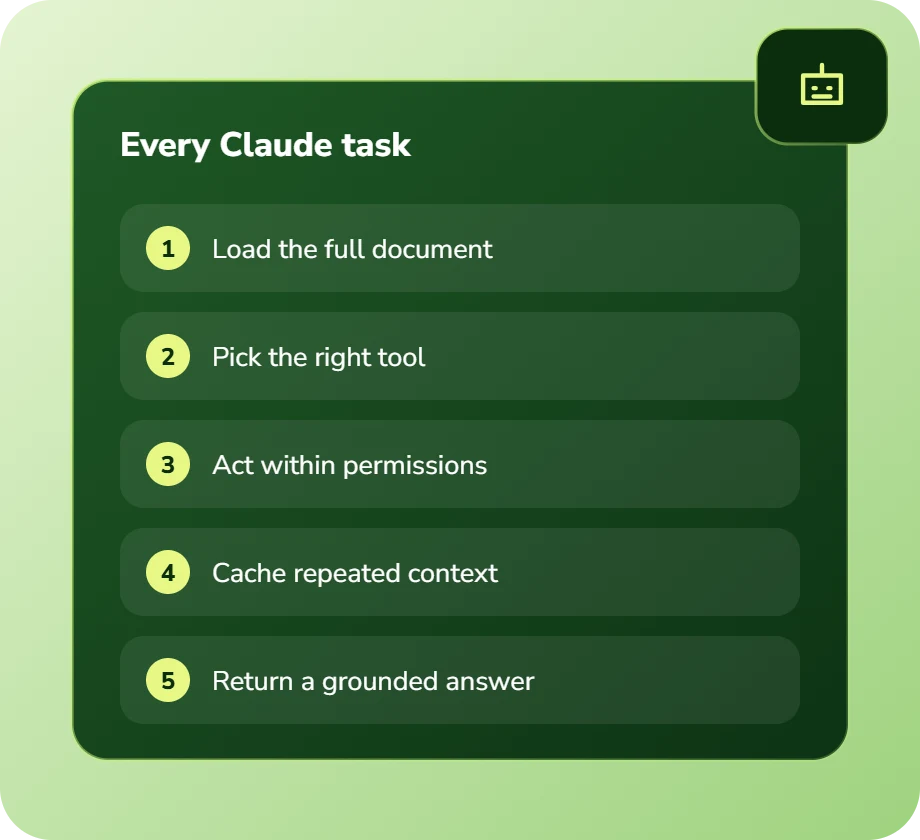
Every Claude integration runs through the same five stages. You will know what is next and what it produces.
Discovery
First, we gather your real documents and tasks, map the workflow, and audit the systems the model will touch.
AI Strategy
Next, we benchmark candidate models on those cases and rank use cases by cost, time to value and savings.
Pilot Build
Then we ship the top-ranked use case as a fixed-scope pilot, with an evaluation suite over real documents.
Implementation
After that, we deploy via the Anthropic API, Bedrock or Vertex AI, with review gates and staff training.
Optimization
Finally, we tune prompts and caching monthly, rerun the evaluation suite, and report hours and dollars saved.
How is a Claude AI integration project priced?
Claude AI integration is priced on the documents and systems involved, how Claude is deployed and how much it needs to do with tools. You get a fixed written price before we start, and running costs are modeled up front, including savings from prompt caching.
Book a free 30-minute call and tell us what you want Claude to read or do. We will tell you whether Claude is the right model for it and the most cost-effective way to deploy it.
- A written savings estimate before any paid work
- Fixed scope and fixed price, agreed up front
- Full ownership of everything we build for you
- An honest recommendation when the numbers do not work
Figures are internal measurements across recent engagements, reported to every client monthly in writing.
Claude AI integration FAQs
When should we use Claude rather than GPT or Gemini?
Generalizing is risky because relative performance shifts with each release. Still, the durable pattern is that Claude tends to be strong on sustained reasoning over long documents. It also tends to do well on complex instruction-following and reliable tool use in agentic systems. It is also often preferred in regulated contexts for its conservative refusal behavior. We benchmark candidates on your actual tasks rather than relying on published tables. The ranking frequently differs on real workloads.
What is MCP and do we need it?
The Model Context Protocol is an open standard, authored by Anthropic, for connecting AI models to tools and data sources. It matters if you are building more than one AI application. Rather than wiring each application to your systems separately, you build MCP servers once and every application uses them. For a single application it is optional; for an organization building several it substantially reduces duplicated integration work.
Can we run Claude on AWS or Google Cloud?
Yes. Claude is available through Amazon Bedrock and Google Vertex AI as well as the Anthropic API directly. That matters for enterprises with existing cloud commitments or data residency requirements. It also helps where procurement is easier through an established cloud vendor. We build the same integration code against any of the three.
How does prompt caching reduce cost?
Sometimes you send the same large context repeatedly, for example when analyzing one long contract across twenty different questions. Caching means the model processes that context once rather than twenty times. The cached portion also costs substantially less. On document-heavy workloads, it is typically the single largest cost lever available. For example, on a recent legal engagement it cut per-document cost for repeat analysis by roughly 80%.
Should long context replace our retrieval system?
Usually not, they solve different problems and work well together. Retrieval is far cheaper and better for finding a specific fact across a hundred thousand documents. Long context is better for questions requiring a whole document at once, like internal consistency or cross-clause interaction. Most well-designed systems use retrieval to select the relevant documents and long context to reason about them.
Is our data used to train Anthropic's models?
Data submitted through the Anthropic API is not used to train models by default under the commercial terms. Deployment through Bedrock or Vertex keeps data within your AWS or Google Cloud boundary under those providers’ terms. As with any provider, we confirm the current terms during design rather than relying on what was accurate previously. We also document the data flow for your compliance team.
Ready to scope your Claude AI integration project?
Book a free 30-minute consultation. Bring one workflow. In return, you get a realistic estimate of what it would cost to automate and what it would save.