AI sales automation that gives your reps their selling time back
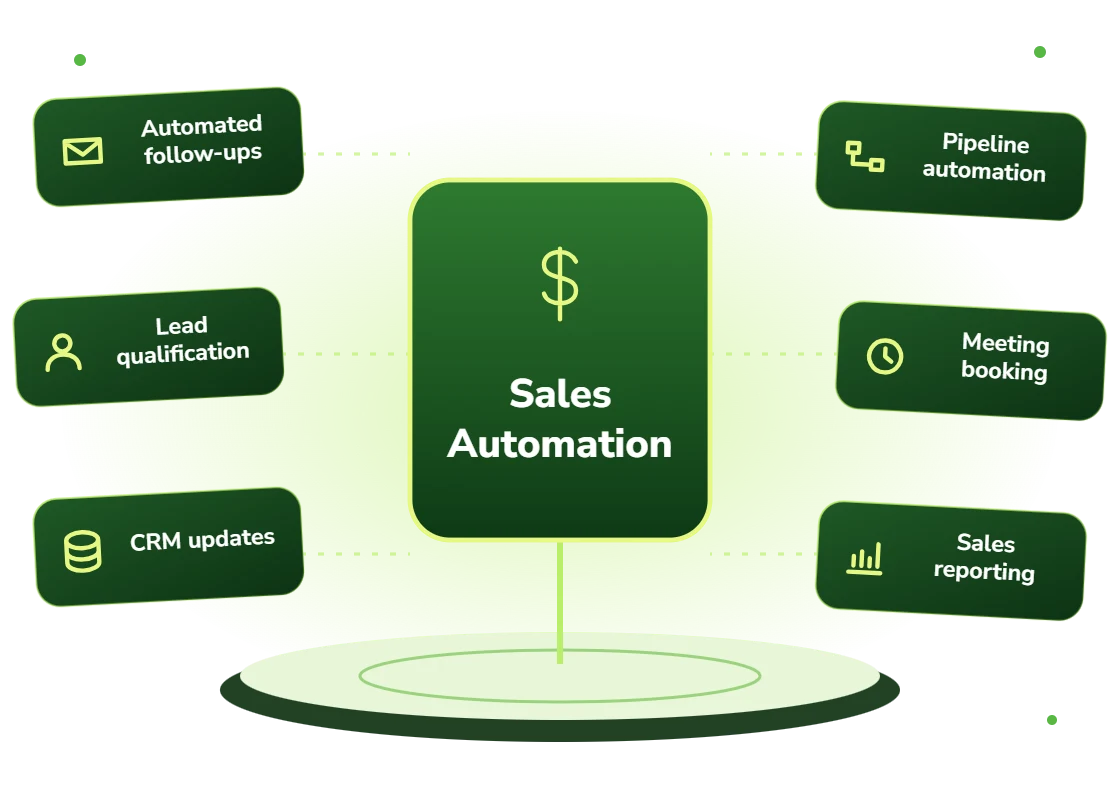
AI sales automation supports CRM updates, lead qualification, follow-up drafting and call preparation. We identify repetitive administrative tasks and track the effect of changes on response time and pipeline activity.
AI sales automation uses language models to handle the administrative work around selling: updating CRM records from calls and emails, researching and qualifying inbound leads, preparing call briefings, drafting follow-ups and generating pipeline reports. The objective is raising the share of a rep’s week spent in front of customers rather than replacing selling activity.
The CRM is a tax on the people it was bought to help
Every sales organization has the same tension. Leadership needs pipeline data, so reps are asked to log activity. Reps log the minimum that avoids trouble, so the data is incomplete, so leadership asks for more detail.
The result is a CRM that is simultaneously a burden on reps and unreliable for forecasting, which is close to the worst possible outcome for an expensive system.
Capture activity automatically instead of asking for it
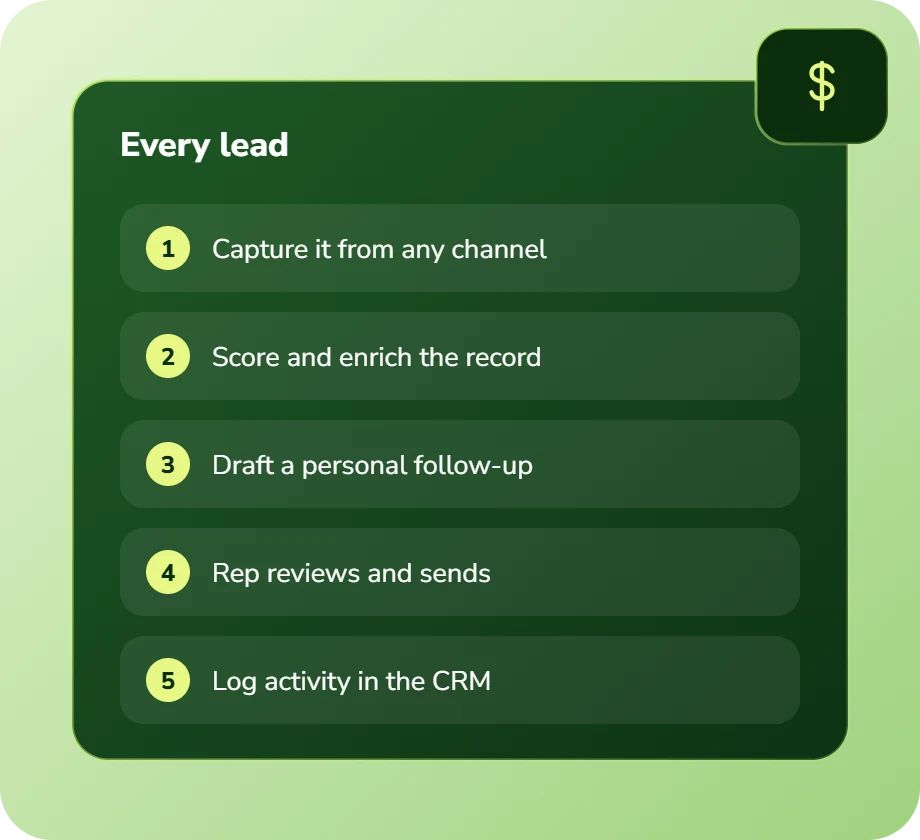
Calls and emails already contain the information the CRM needs. We extract it automatically, next steps, competitors mentioned, budget signals, decision-maker changes, and write it to the right fields.
Reps stop being data entry clerks, and the data quality improves at the same time because it no longer depends on someone remembering to type it after a call.
AI sales automation: scope and deliverables
Activity capture is the highest-return starting point. It removes the most-hated task and improves forecast data simultaneously, which is rare.
Research and preparation is the second. A rep walking into a call with a briefing assembled from the CRM, past correspondence, public sources and product fit performs measurably better than one who skimmed the account name in the car park.
Then follow-up: drafted, contextual, and tracked, so opportunities do not go quiet because nobody remembered the next touch.
- CRM activity capture from calls, meetings and email without rep effort
- Inbound lead research, enrichment and qualification scoring
- Pre-call briefings assembled from CRM, correspondence and public sources
- Follow-up drafting with real context, reviewed before sending
- Pipeline hygiene: stale opportunity detection and next-step prompting
- Forecast support: risk signals extracted from actual conversation content
Sales teams that benefit most
Teams with more than a handful of reps where CRM compliance is a recurring management problem. The larger the team, the more the administrative tax compounds.
Also organizations with long, consultative sales cycles where preparation quality genuinely affects outcomes, and where a rep may be running fifteen opportunities across different industries.
- Sales teams where CRM data quality is a persistent management issue
- Organizations with long, consultative or technical sales cycles
- Teams handling high inbound lead volume with inconsistent qualification
- Companies where reps sell across varied industries or product lines
- Sales operations spending significant time assembling reports manually
- Businesses where opportunities routinely stall from missed follow-up
Benefits of sales automation
More time in front of customers
Administrative work removed rather than redistributed, which is the only thing that reliably raises selling time.
CRM data that is actually complete
Captured automatically from real activity rather than depending on a rep remembering after the call.
Better-prepared calls
Briefings assembled from every available source, so preparation quality stops depending on how busy the morning was.
Faster inbound response
Leads researched, scored and routed within minutes, which correlates strongly with conversion.
Fewer stalled opportunities
Follow-up prompted and drafted, so deals stop going quiet because a touch was forgotten.
Forecasts grounded in evidence
Risk signals extracted from what was actually said, rather than from rep optimism.
Business challenges this solves
Reps refusing to update the CRM
Data entry resented and skipped. Automatic capture removes the task rather than enforcing it.
Unreliable forecasts
Pipeline data too incomplete to trust. Automatic capture improves the input quality directly.
Slow inbound response
Leads sitting hours before qualification. Automated research and routing cuts it to minutes.
Reps unprepared for calls
No time to research before back-to-back meetings. Briefings assembled automatically beforehand.
Opportunities going quiet
Deals lost to forgotten follow-up rather than to competitors. Prompting and drafting keeps them moving.
Sales ops building reports by hand
Days each month assembling pipeline analysis. Automated reporting frees the function for actual analysis.
Features and deliverables
Everything below is in scope on a standard engagement. Nothing here is an upsell discovered halfway through the build.
Call and meeting capture
Transcription and extraction of next steps, objections, competitors, budget signals and stakeholder changes into CRM fields.
Email activity extraction
Relevant detail pulled from email threads and logged against the right opportunity automatically.
Lead research and enrichment
Inbound leads enriched from public sources and your CRM, scored against your ICP criteria, and routed by territory.
Pre-call briefing generation
Briefings assembled from account history, prior correspondence, open items, product fit and recent public news.
Follow-up drafting
Contextual follow-up emails drafted after each interaction, reviewed by the rep before sending.
Pipeline hygiene automation
Stale opportunity detection, missing next-step prompting and data quality flagging.
Deal risk signals
Conversation content analysed for stalling patterns, competitor mentions and stakeholder disengagement.
Automated reporting
Pipeline, activity and forecast reports generated and distributed without sales ops assembling them.
Technologies we use for sales automation
We are not tied to one vendor. Model and infrastructure choices are made on accuracy, cost per task, latency, and where your data is allowed to live.
Our AI development process
The same five stages on every engagement, so you always know what happens next and what you get at the end of it.
Discovery
We interview the people doing the work, map the workflow end to end, and audit the systems and data behind it.
AI Strategy
Every opportunity gets scored on cost to build, time to value, and annual savings, then ranked.
Pilot Build
We ship the top-ranked automation as a fixed-scope pilot so you see real output before committing further budget.
Implementation
Integration with your live systems, staff training, human-in-the-loop review gates, and a documented rollback path.
Optimization
Monthly accuracy reviews, prompt and retrieval tuning, and a written report on hours and dollars saved.
How long it takes
A typical first engagement, week by week. Complex integrations and regulated environments extend this, and we say so during discovery rather than after.
Discovery and scoping
Process observation, systems audit, data review, and a written estimate of cost and expected saving before anything is built.
Design sign-off
Architecture, data handling rules, review thresholds and success measures agreed in writing.
Build and integration
Development against your real data, connected to your live systems, with weekly demos rather than a single reveal.
Parallel run and testing
The system runs alongside the existing process so accuracy can be compared directly before anyone depends on it.
Launch and handover
Cutover with a rollback path, staff training, full documentation, then 30 days of included tuning.
Industries we deliver sales automation for
SaaS & Technology
AI features inside your product, support deflection, onboarding assistants, and usage analytics.
Manufacturing
Quality inspection, maintenance prediction, supplier communication, and production scheduling.
Professional Services
Proposal drafting, timesheet capture, research synthesis, and client reporting at scale.
Real Estate
Lead qualification, listing content, transaction coordination, and 24/7 inquiry response.
Financial Services
Document extraction, reconciliation, KYC support, and audit-ready reporting with full traceability.
Logistics & Supply Chain
Document processing, carrier communication, exception handling, and inventory rebalancing.
Insurance
First-notice-of-loss intake, claims triage, policy Q&A, and fraud signal detection.
Construction
Bid takeoffs, submittal review, RFI drafting, and field-report summarization.
Real-world use cases
Post-call CRM updates
Every call producing a structured record without the rep typing, improving both compliance and data quality.
Inbound lead qualification
Web enquiries researched, scored and routed within minutes rather than sitting in a queue.
Account research at scale
Territory accounts researched and prioritized so reps focus on the ones showing genuine signal.
Proposal drafting
First-draft proposals assembled from prior approved content and the specific opportunity context.
Renewal and expansion prompting
Usage and engagement signals surfacing renewal risk and expansion opportunity before the renewal window.
Sales coaching support
Call analysis identifying coaching themes across a team rather than from the two calls a manager listened to.
Why choose DevSolutionsAI for sales automation
Business case before build
Every recommendation carries an estimated cost, timeline, and annual savings figure. If the math does not work, we say so before you spend.
Vendor-neutral by design
We resell nothing and take no platform commissions. Model and infrastructure choices are made on fit, cost, and your data-residency rules.
Fixed-scope pilots
The first engagement is a defined deliverable at a defined price, not an open-ended retainer that quietly grows each quarter.
Built for handover
You own the code, the prompts, the infrastructure, and the documentation. No lock-in to a proprietary wrapper you cannot leave.
Human-in-the-loop where it counts
Anything customer-facing, clinical, financial, or legal gets a review gate, a confidence threshold, and a logged audit trail.
Security reviewed early
Data flow diagrams, retention rules, and access boundaries are agreed in week one, not retrofitted after your security team objects.
Find out what sales automation would cost you, before you commit to anything
Every engagement is quoted after a short discovery, so you get a fixed written price built around your actual volumes rather than a rate card that assumes someone else’s business.
The first call is thirty minutes and free. Bring one workflow. We will tell you what it is likely costing you each year, roughly what automating it would take, and whether we think it is worth doing at all.
- A written savings estimate before any paid work
- Fixed scope and fixed price, agreed up front
- Full ownership of everything we build for you
- An honest recommendation when the numbers do not work
Figures are internal measurements across recent engagements, reported to every client monthly in writing.
Illustrative project scenario
Raising selling time from 34% to 51% of the week
Challenge. A manufacturer’s field sales team was measured at 34% of working hours spent in customer-facing activity. Time analysis showed CRM administration, call preparation and internal reporting consumed most of the balance. CRM data was incomplete enough that forecasting was largely guesswork.
What we built. Automatic capture from calls and email writing structured updates to the CRM, pre-call briefings generated the evening before from account history and public sources, drafted follow-ups after each interaction, and automated pipeline reporting replacing manual assembly by sales operations.
Outcome. Customer-facing time rose from 34% to 51% within two quarters. CRM field completeness on tracked opportunities went from 47% to 93%. Forecast accuracy improved measurably, which sales leadership attributed mainly to having complete data rather than to better judgement.
Illustrative project scenario. The figures demonstrate how a project could be scoped and evaluated; they are not verified client results or an audited average.
What clients say about working with us
Sales Automation FAQs
Will reps actually use this?
Adoption is unusually easy here because the system removes work rather than adding it. The most common failure mode in sales tooling is asking reps to do something extra for a benefit that accrues to management. Automatic capture inverts that: reps stop doing the task they resent most, and leadership gets better data as a side effect. Resistance is typically low.
Does it work with our CRM?
We build into Salesforce, HubSpot, Microsoft Dynamics, Pipedrive and most other platforms rather than replacing them. Where a CRM has limited API coverage we work within its constraints and tell you upfront what will and will not be possible, rather than discovering it mid-build.
Do you record and transcribe sales calls?
Where you want that capability, yes, and consent handling matters. Recording consent requirements vary by state, and several states require all-party consent. We build the consent flow to match the states you operate in, and some clients prefer extraction from rep-written notes or email rather than recordings, which works less well but avoids the question entirely.
Will it send emails to customers automatically?
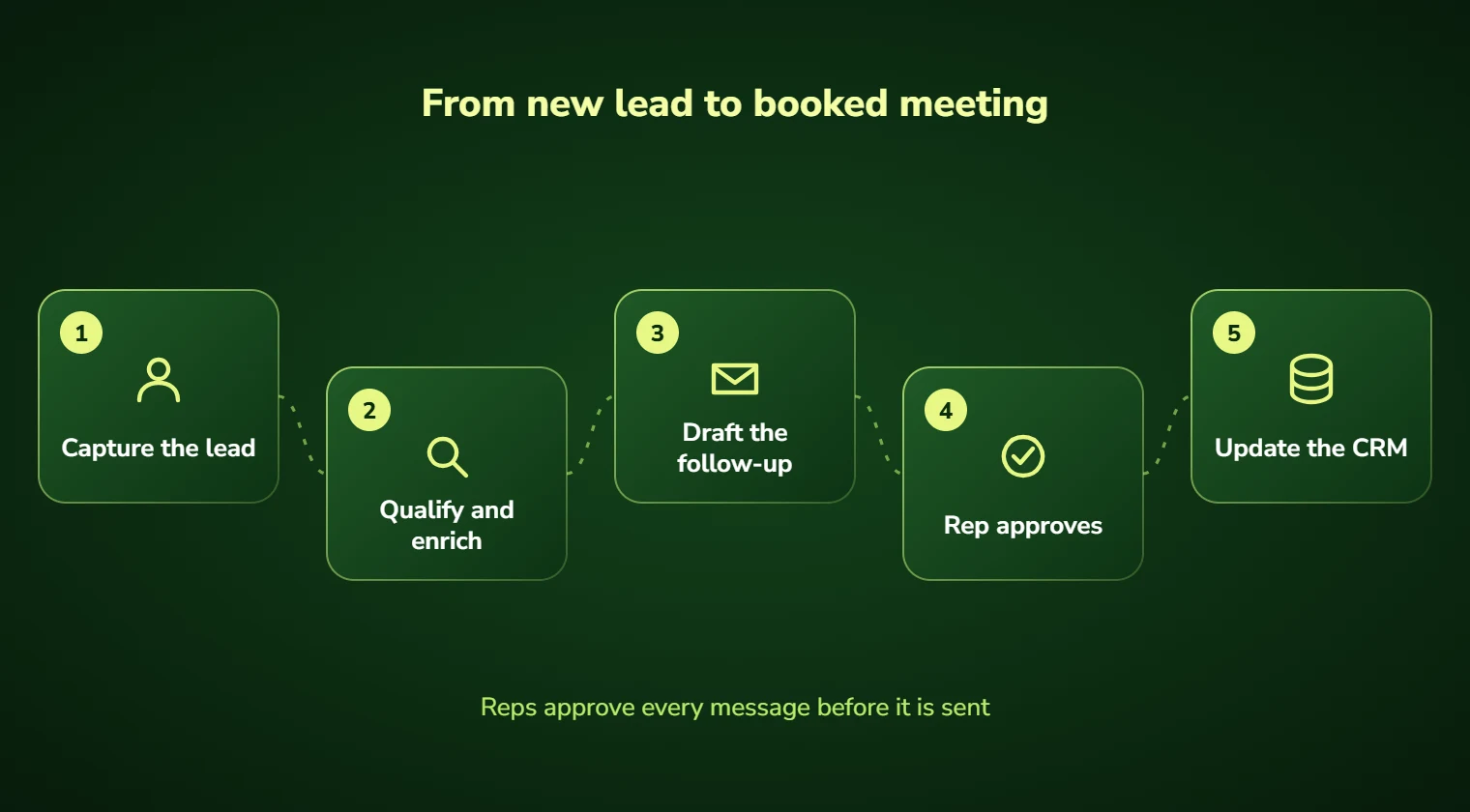
Not by default. Follow-ups are drafted with real context and presented for the rep to review and send. Some clients later enable automatic sending for narrow low-risk categories such as meeting confirmations, but customer-facing communication in a sales context generally benefits from the rep’s judgement.
How much does sales automation cost?
A focused implementation covering CRM capture and lead qualification typically runs $28,000 to $55,000. A fuller programme adding briefings, follow-up drafting and reporting runs higher. For a team of twenty or more reps, payback is usually four to eight months measured on recovered selling time, and we produce that estimate from your own activity data during discovery.
Can it improve our forecasting?
Indirectly and significantly. Most forecast inaccuracy comes from incomplete pipeline data rather than poor judgement, so automatic capture improves the input. We also extract risk signals from actual conversation content, stalling language, competitor mentions, stakeholder disengagement, which gives leadership evidence rather than rep optimism to work with.
Services that pair well with this one
Most clients combine two or three of these. We will tell you the right sequence during discovery.
Ready to scope your sales automation project?
Book a free 30-minute consultation. Bring one workflow and leave with a realistic estimate of what it would cost to automate and what it would save.