
AI agent development services for work that takes more than one step
Our AI agent development services give you agents that finish a defined task using the tools in your own systems. An agent can look up records, check a policy and prepare updates, while consequential actions wait for your approval.
We reply within 4 business hours.
What is an AI agent?
An AI agent is a system that uses a language model to plan and execute a sequence of actions toward a goal. Along the way, it calls tools and APIs rather than only generating text. Where a chatbot replies, an agent reads records, applies rules, updates systems and reports the outcome, operating within permissions and approval gates you define.
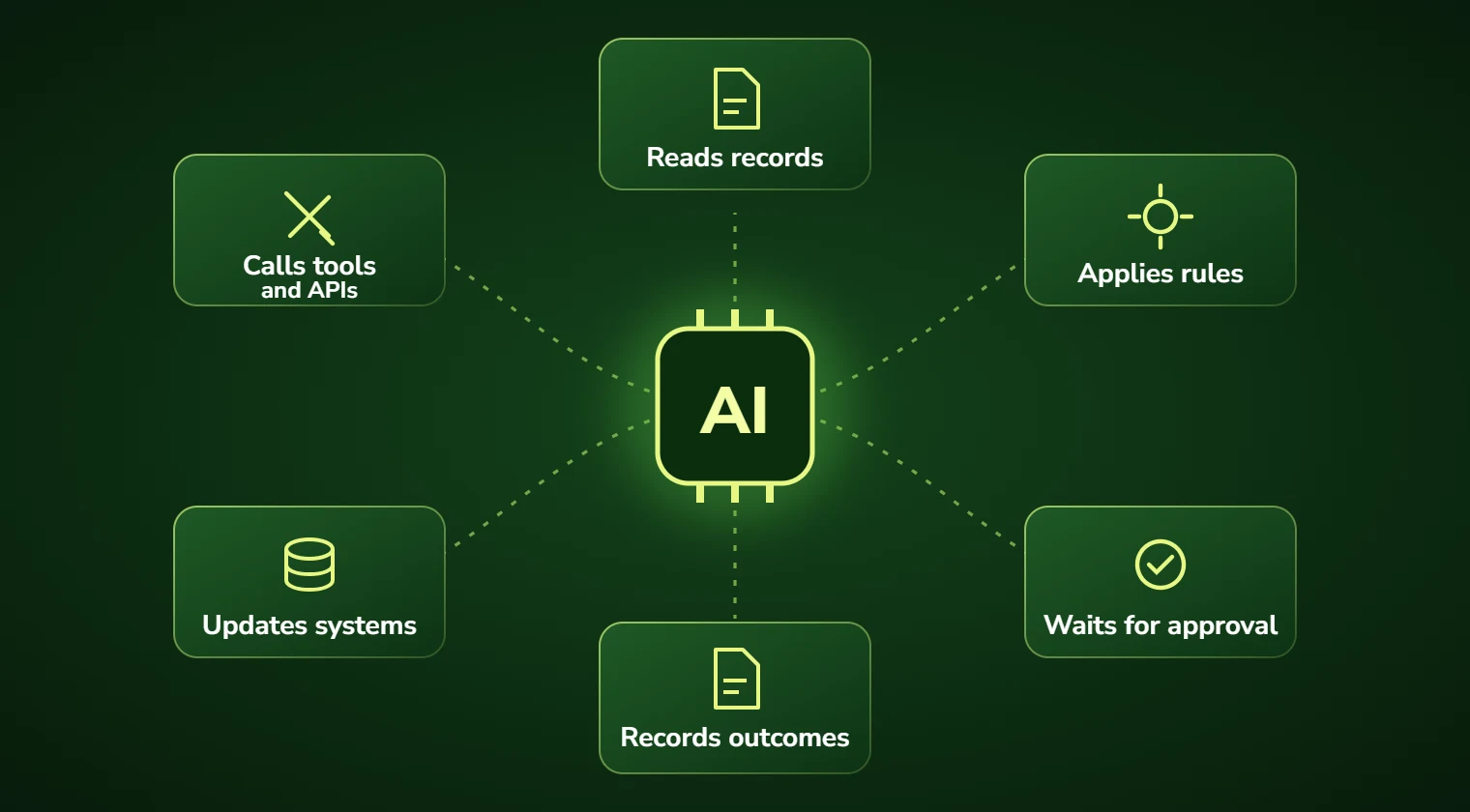
Most "AI" stops at generating text
The first wave of business AI produced systems that write things. Useful, but the bottleneck was rarely writing. It was the twenty minutes of looking things up, cross-checking and updating that surrounded the writing.
Getting a model to actually do that work is a different engineering problem. That work needs tools, permissions and memory across steps. It also needs a plan for when step four fails after steps one through three already changed your data.
Agents with tools, limits and an audit trail
Through our AI agent development services, we build agents that call real functions in your systems: query a database, check inventory, create a ticket, send a document for signature. Each tool has explicit permissions and an explicit blast radius.
Every agent we ship is bounded. It can do exactly the things you approved and nothing else. High-impact actions pause for human approval. In addition, we log every step with its inputs and reasoning, so you can reconstruct what happened.
What our AI agent development services include
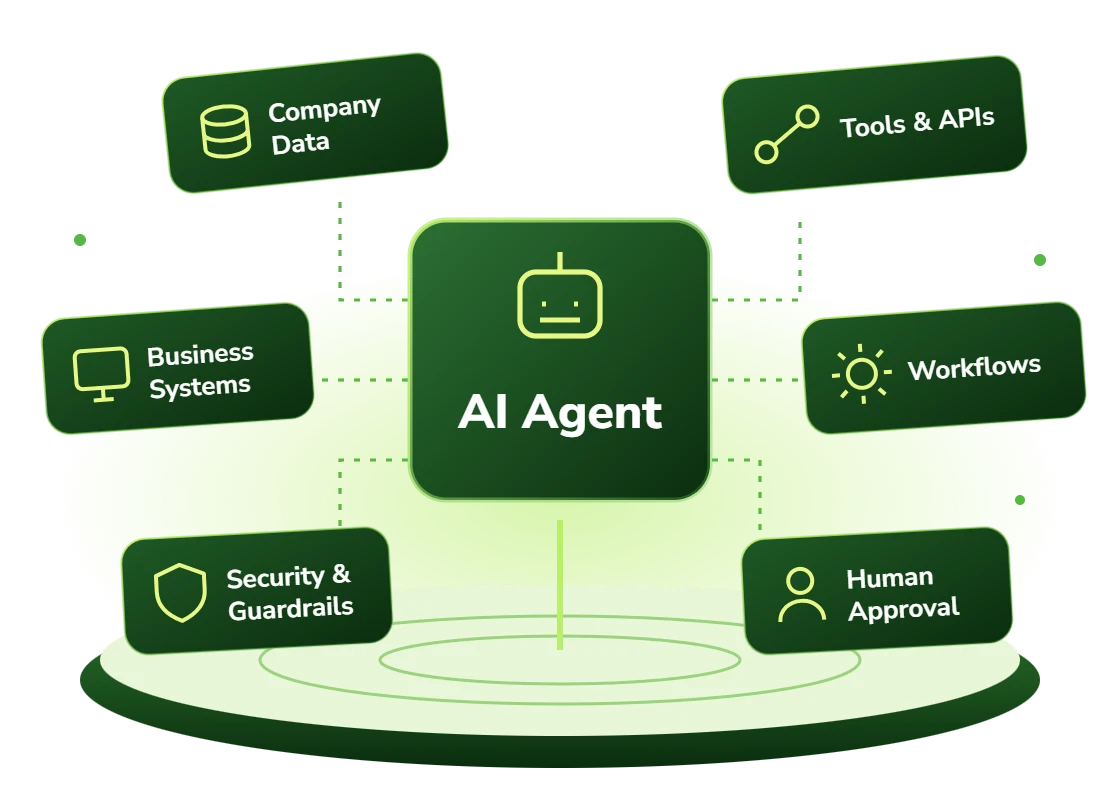
An agent is mostly not the model. The model is a commodity you can swap. The engineering is in the tools it can call and the data it can see. It is also in the guardrails around what it may do unsupervised, and the recovery path when something goes wrong halfway through.
Our AI agent development services scope each agent by the decisions it may make, not by the technology. An agent that drafts a response for approval is a fundamentally different risk profile from one that issues a refund. As a result, they get different architectures, even if the underlying model is identical.
Reversibility drives the design. We give agents reversible actions wherever possible, and irreversible ones sit behind a human gate. That single rule prevents most of the failure modes people worry about.
As an AI agent development company, we handle custom AI agent development from the first workflow to enterprise AI agent development across departments. Every agent is designed for AI agent integration with your existing systems, so it works inside the tools your team already uses.
- Tool and function definitions giving the agent scoped access to your systems
- Retrieval over your own documentation so answers cite your policies, not the internet
- Planning and step decomposition with limits on loop depth and spend
- Approval gates on any action that is expensive, irreversible or customer-facing
- Full step-level logging: inputs, tool calls, reasoning and outcomes
- Failure recovery, including rollback for partially completed sequences
If the workflow requires several specialized agents to coordinate, compare agentic AI development. Start with one bounded agent when it can complete the task without that added coordination.
When is an AI agent the right answer?
Agents suit work that is multi-step, requires looking things up across systems, and follows judgment rather than a fixed rule. If you can write the task as a flowchart, deterministic automation is cheaper, faster and easier to audit. In that case, we will recommend it instead of selling you AI agent development services.
The economics work best where volume is high enough to justify the build and each instance genuinely varies. A hundred near-identical cases a day is automation. A hundred cases a day that each need a slightly different lookup path is an agent.
AI agents for business work best on multi-step tasks with clear limits. We build autonomous workflow agents for the routine paths and human-in-the-loop AI agents wherever a decision is costly, regulated or customer-facing.
- Tasks requiring information from three or more systems to complete
- Work where the correct next step depends on what the previous step found
- Processes with many valid variations that rules cannot practically enumerate
- Support or operations queues where context gathering takes longer than the resolution
- Research and analysis tasks that follow a repeatable method but not a fixed script
- Internal requests that currently require a specialist purely because they know where to look
What an AI agent can do for your team
Whole tasks, not fragments
The agent finishes the job rather than handing a draft back for someone to complete, which is where most AI time savings quietly evaporate.
Bounded by design
Explicit tool permissions and spend limits. The agent can do exactly what you approved and has no path to anything else.
Approval where it matters
Irreversible or customer-facing actions pause for a person, with the full reasoning presented for a quick yes or no.
Reconstructable decisions
Every step logged with inputs, tool calls and reasoning, so “why did it do that?” has an answer months later.
Model-portable
The agent logic is separate from the model, so you can swap in a cheaper or better model without rebuilding.
Handles the long tail
Cases too varied for rules but too routine for a specialist, the band where most operational cost actually sits.
Operational problems an AI agent solves
Context gathering eats the day
Specialists spending longer finding information than acting on it. Agents do the gathering and present the decision.
Rules engines that never cover enough
Hundreds of rules and still constant exceptions. An agent handles variation without enumerating every case in advance.
Work stuck behind one expert
A queue that only one person can clear because only they know the systems. We encode that navigation knowledge in the agent.
Fear of autonomous systems
Legitimate concern about unsupervised action. Approval gates and reversible-by-default design make the risk explicit and bounded.
Demos that fail in production
Agents that work on clean examples and collapse on real data. We build against your actual records from week one.
No way to debug a failure
Opaque systems nobody can diagnose. Step-level logging makes every run reconstructable.
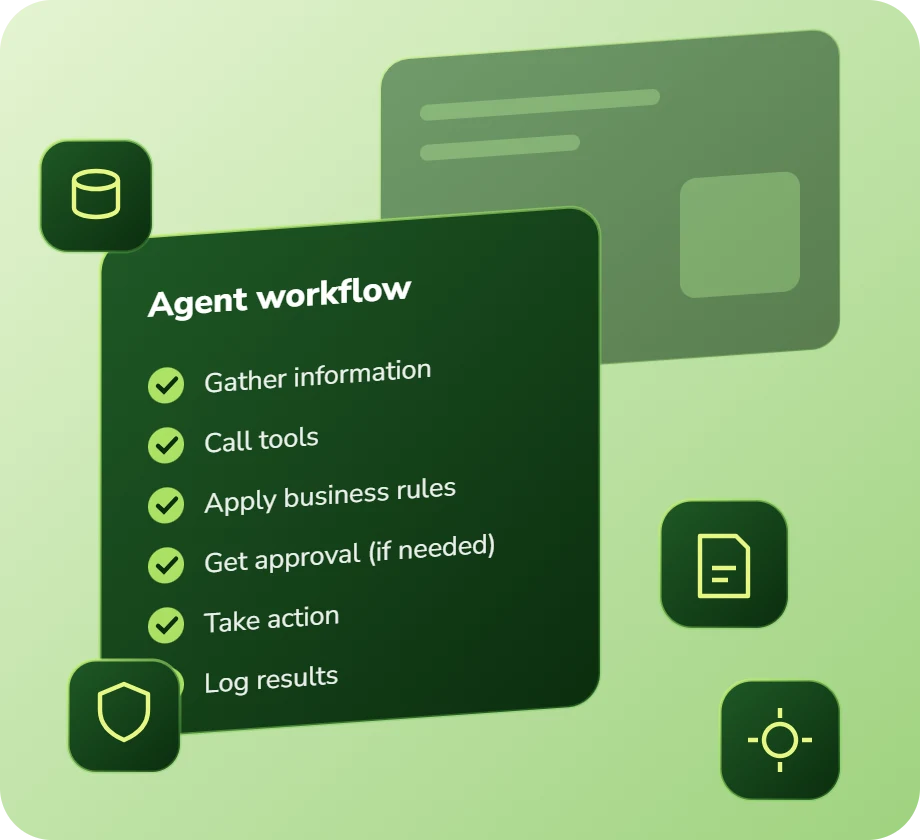
What every agent build includes
Every engagement for our AI agent development services includes everything below as standard. Nothing here is an upsell that surfaces halfway through the build.
Agent architecture design
Tool inventory, permission boundaries, escalation rules and failure paths designed and signed off before we write any code.
Tool and API integration
Scoped function definitions letting the agent query and update your systems, each with its own permission and rate limits.
Retrieval grounding
A retrieval layer over your policies and documentation so the agent works from your rules rather than general knowledge.
Guardrails and validation
Input filtering, output validation, prompt-injection defenses, spend caps and loop limits on every agent.
Human approval workflow
A review queue where gated actions surface with the agent’s plan and reasoning attached for a one-click decision.
Observability and tracing
Step-level traces, token and cost tracking, latency monitoring and alerting on abnormal behavior patterns.
Evaluation harness
A regression test suite of real cases with expected outcomes, so model or prompt changes can be validated rather than hoped about.
Deployment and handover
Deployed to your infrastructure with documentation, runbooks and training so your team can operate and extend it.
Which AI models and tools power your agent?
Our AI agent development services are vendor-neutral. Instead, we choose models and infrastructure on accuracy, cost per task, latency, and where your data is allowed to live.
How we deliver AI agent development, step by step
Every agent build follows the same five stages, from the first interview to ongoing tuning. That way, you always know what happens next.
Discovery
First, we interview your team and map which lookups, systems and decisions each task actually involves.
AI Strategy
Next, we score candidate tasks on cost, time to value and savings, and recommend plain automation where a flowchart works.
Pilot Build
Then a three to four week prototype runs on your real historical data and gives a go/no-go recommendation.
Implementation
After that, we connect scoped tools to your live systems and add approval gates, spend caps and step logging.
Optimization
Finally, we rerun the regression suite after every model or prompt change and report hours and dollars saved monthly.
AI agent, chatbot or copilot: which do you need?
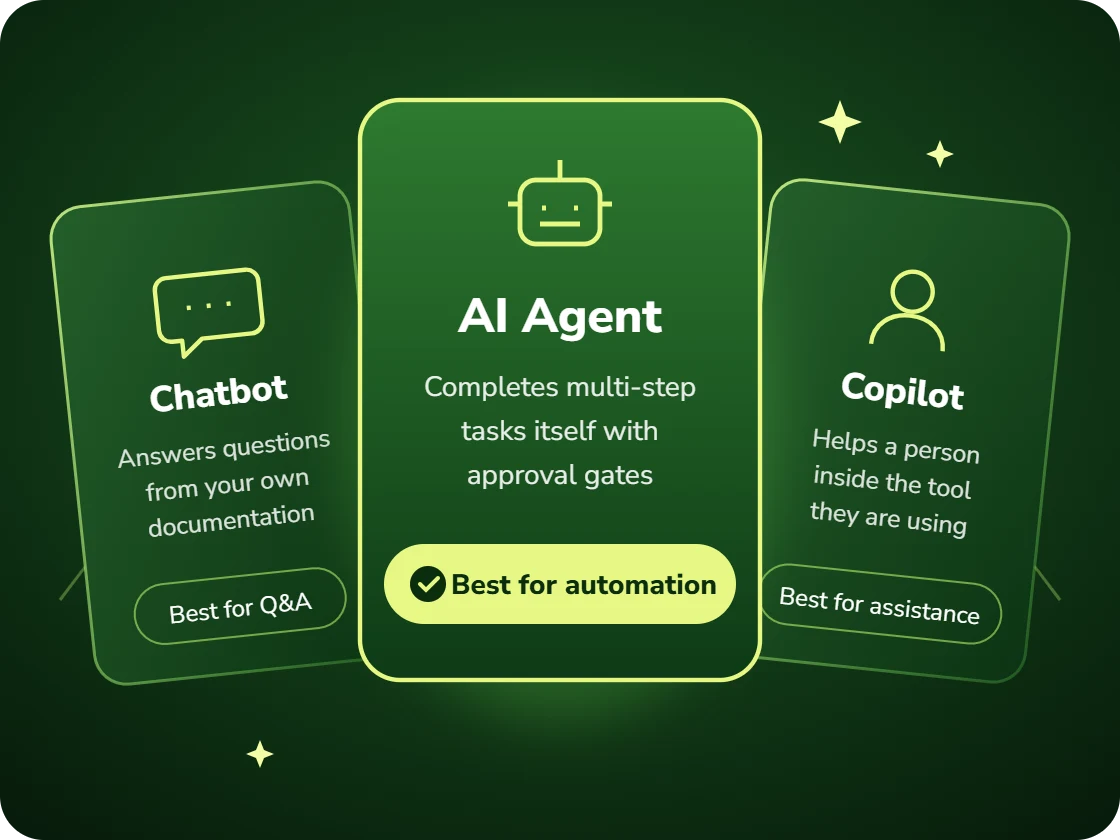
The three are often confused, but they do different jobs. Picking the right one first saves budget.
- Chatbots answer questions from your own documentation and hand anything else to a person.
- A copilot helps a person inside the tool they are using, while that person stays in control.
- An AI agent completes multi-step tasks itself, such as checking a policy and updating a record, within the permissions and approval gates you set.
If your need is answering questions, see AI chatbot development. If it is assisting your team in their own software, see AI copilot development.
How much does an AI agent development project cost?
The cost of AI agent development depends on how many systems your agent touches, how many decisions it makes on its own and how much human approval it needs. So instead of a rate card, you get a fixed written price for your own workflow before any work starts, with no surprises halfway through the build.
Start with a free 30-minute call. Bring one task that eats your team's time. You leave knowing what it costs you today, what an agent could save, and whether it is worth building at all.
- A written savings estimate before any paid work
- Fixed scope and fixed price, agreed up front
- Full ownership of everything we build for you
- An honest recommendation when the numbers do not work
Figures are internal measurements across recent engagements, reported to every client monthly in writing.
AI agent development FAQs
What is the difference between an AI agent and a chatbot?
A chatbot generates a response. An agent takes actions: it calls tools, queries systems, makes decisions based on what it finds, and completes a task. A chatbot can tell a customer their refund policy; an agent can check eligibility, process the refund, update the order and confirm it. The engineering difference is substantial, agents need tool integration, permission boundaries, state across steps, and failure recovery.
How do you stop an agent doing something harmful?
Several layers. Agents only have access to tools you explicitly grant, and each tool has its own permission scope. Actions that are irreversible, expensive or customer-facing sit behind a human approval gate. There are spend caps and loop limits on every run. And the default design principle is reversibility: agents get reversible actions where possible, so a mistake is correctable rather than final.
How much does an AI agent cost to build?
It depends on how many systems the agent connects to, how much it does on its own and the approval rules it must follow. We scope your workflow in a short discovery, then give you one fixed written price before any build starts. Running costs per task are usually small, and we estimate them for you up front. The quickest way to get your number is a free 30-minute consultation.
Which model do you use?
It depends on the task, and we deliberately build so it can change. Complex reasoning and tool use generally favor frontier models such as Claude or GPT; high-volume classification steps often run well on smaller, cheaper models. We frequently mix models inside a single agent, using an expensive one for planning and a cheap one for repetitive sub-steps. Because agent logic is separate from the model, you are not locked to today’s choice.
What happens when an agent fails halfway through a task?
That case is designed for explicitly. Steps that change data are made idempotent where possible, so a retry does not double-apply. Sequences that cannot be made idempotent get a compensating rollback path. We log every failure with its full state, alert an owner, and surface it in the review queue instead of silently retrying until something breaks.
Can we start small before committing to a full build?
That is the recommended path and how most of our agent engagements begin. A three to four week prototype runs against your real historical data and produces a measured accuracy figure plus a go/no-go recommendation. Roughly one in four prototypes leads us to advise against proceeding, usually because the data required is not reliably available.
Ready to scope your AI agent development project?
Book a free 30-minute consultation. Bring one workflow. You will leave with a realistic estimate of what it would cost to automate and what it would save.