
AI strategy consulting for leadership teams
Our AI strategy consulting gives leadership one sequenced plan in place of competing initiatives, with governance, budget and ownership attached. You can compare investments across the organization and agree up front how you will review progress at each quarterly gate.
We reply within 4 business hours.
What does AI strategy consulting deliver?
AI strategy consulting produces the decision framework above individual projects. It settles which capabilities to build in-house versus buy and how you fund and govern AI initiatives. In addition, it names who owns model risk and the order of investments over twelve to thirty-six months. It is the layer that stops a company running six disconnected pilots.
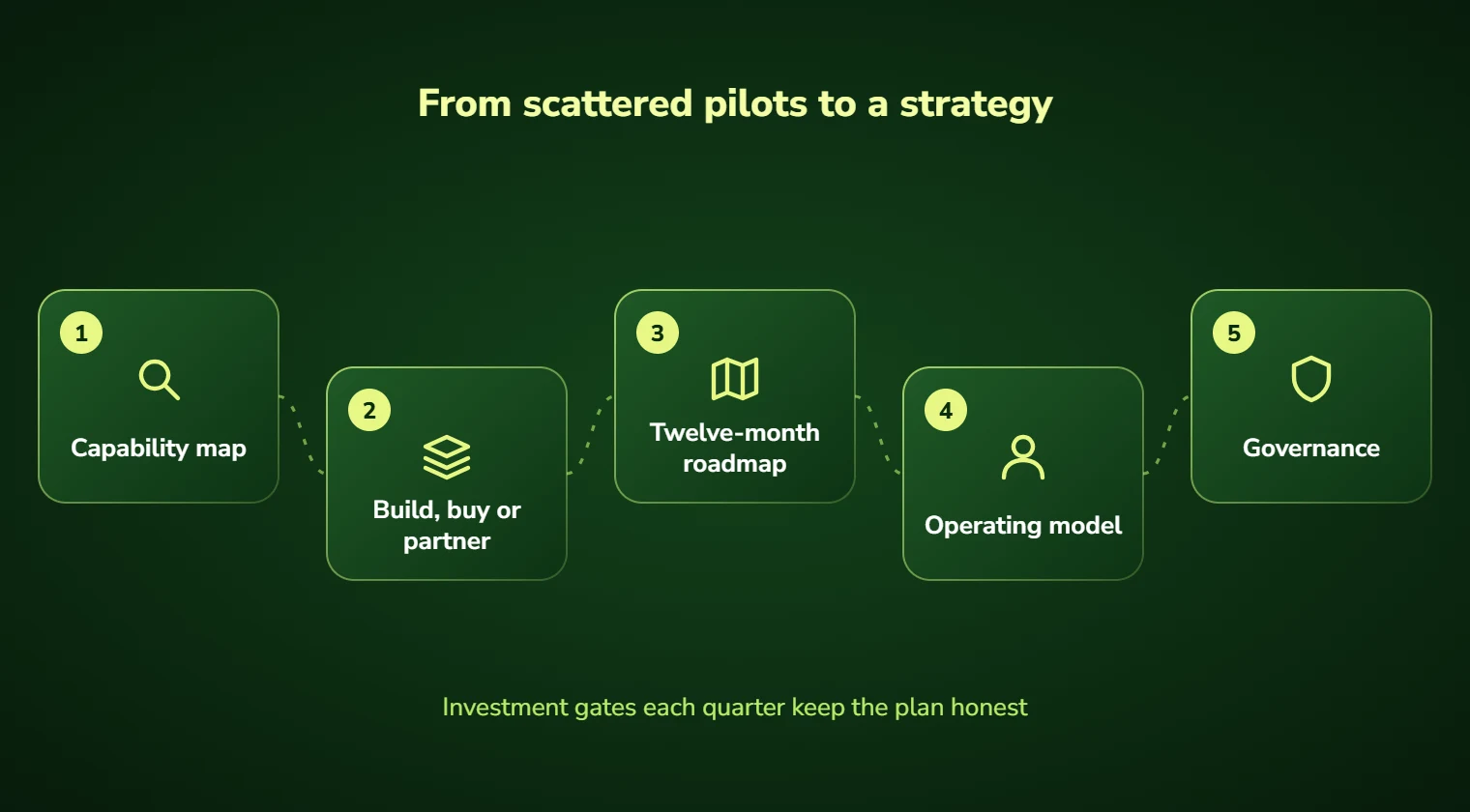
Pilots multiply, strategy does not follow
Most mid-market companies do not have an AI problem. Instead, they have an AI portfolio problem: four departments running four experiments on four platforms. None of them share data, infrastructure, or a definition of success.
Without a strategy layer, leaders judge each pilot on enthusiasm rather than economics. As a result, teams approve budgets because a competitor announced something, then quietly abandon them when the champion changes role.
One plan, sequenced, funded and governed
We build the decision framework that sits above individual projects: what you build versus buy and which capabilities are strategic. It also sets how you fund initiatives and who is accountable for model risk when something goes wrong.
The output is a twelve-month sequenced roadmap with quarterly gates and an operating model for who runs AI internally. In addition, you get a governance policy proportionate to your regulatory exposure, not a hundred-page framework nobody reads.
What our AI strategy consulting includes
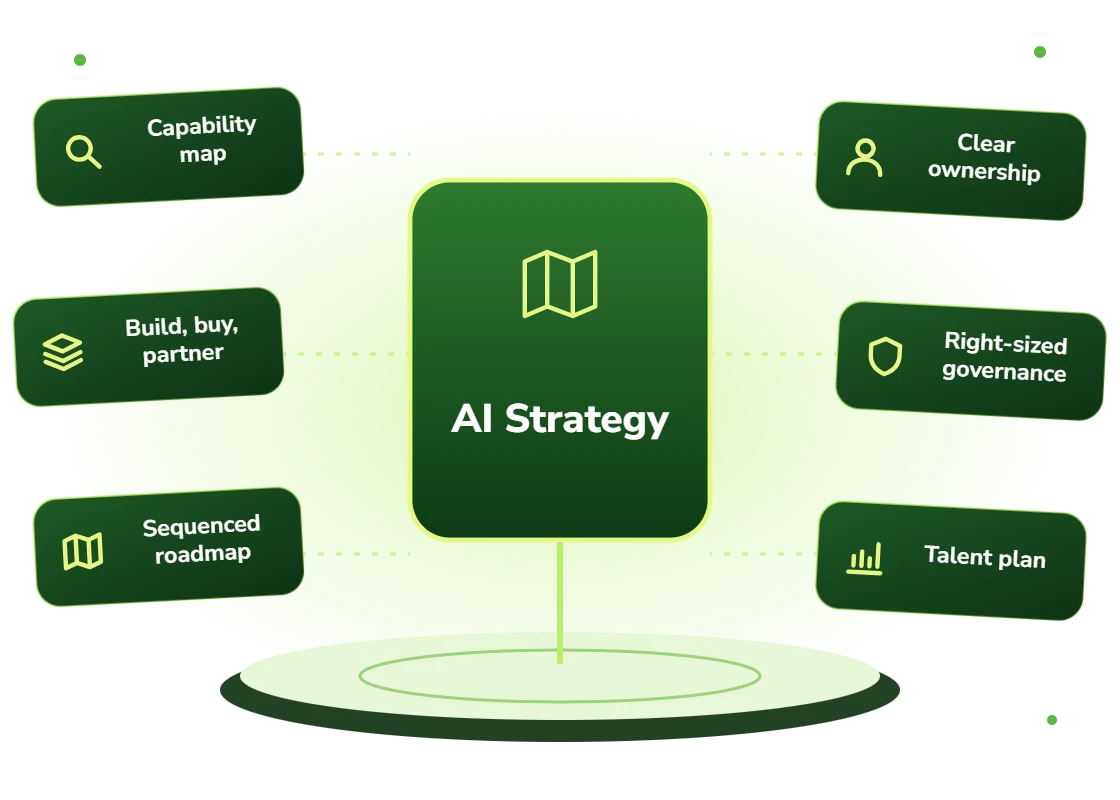
Strategy work answers the questions that individual project teams cannot: where AI creates durable advantage for your business specifically. It also shows where AI is simply table stakes you need to match without over-investing.
We separate the two deliberately. For example, buy table-stakes capabilities such as support deflection, document processing and meeting summarization cheaply and implement them fast. By contrast, differentiating capabilities, those tied to proprietary data or a genuine process advantage, justify custom builds and ongoing investment.
That distinction drives everything else: budget allocation, hiring plans, platform commitments, and which vendors you can afford to depend on.
Our AI strategy consulting services produce an enterprise AI strategy with an AI adoption roadmap, AI investment prioritization and AI ROI planning for each initiative.
- A capability map separating table-stakes AI from genuinely differentiating AI
- Build, buy or partner recommendation for each capability, with cost modeling
- A twelve-month sequenced roadmap with quarterly investment gates
- An operating model: who owns AI, how projects are proposed, funded and killed
- AI governance policy sized to your actual regulatory exposure
- A talent plan covering what to hire, what to contract, and what to outsource
Need to assess one workflow before a build? Start with AI consulting services. This strategy engagement addresses priorities, governance and ownership across multiple initiatives.
Is AI strategy consulting right for your business?
If you have one obvious process to automate, you do not need this service. Instead, you need an automation build, and we will tell you so. Strategy work earns its fee when multiple initiatives compete for the same budget and the same engineering attention.
It also matters when the downside of getting it wrong is structural. Think of a platform commitment you cannot reverse or a data architecture decision that constrains you for years. Similarly, it matters for a regulated deployment where governance failure is an existential risk.
An AI transformation strategy needs clear ownership as well as a plan. We include an AI governance strategy sized to your real regulatory exposure, so the roadmap can actually be run.
- Organizations running three or more AI initiatives with no shared roadmap
- Companies about to make a multi-year platform or infrastructure commitment
- Boards asking for an AI position and a defensible investment case
- Regulated businesses that need governance in place before scaling adoption
- PE-backed companies expected to show AI-driven margin improvement
- Firms whose competitors have launched AI features and need a measured response
What AI strategy consulting can do for your business
Stop funding duplicate work
A shared roadmap exposes the three departments quietly solving the same document problem with three different vendors.
Defensible investment case
Capability-level economics rather than project-level enthusiasm, in a form that survives a finance committee.
Governance sized to reality
Proportionate policy. A twelve-person firm does not need the model risk framework of a national bank. So we will not sell you one.
Platform decisions you can reverse
We design for portability so a model, vendor, or cloud change later is a migration, not a rebuild.
Clear internal ownership
An operating model naming who proposes, approves, funds and retires AI initiatives, the absence of which kills most programs.
A realistic hiring plan
We show which roles genuinely need to be in-house and which to contract. We also price each one in the current U.S. market.
Problems AI strategy consulting solves
Six pilots, no portfolio view
We consolidate initiatives into one register with shared success criteria, then recommend which to continue, merge or stop.
AI budget with no allocation logic
Capability-level cost modeling replaces first-come-first-served budgeting with a defensible allocation method.
Nobody owns model risk
We define accountability, escalation paths and review cadence before an incident forces the question.
Fear of betting on the wrong platform
We write portability requirements into the architecture standard, so no single vendor decision becomes irreversible.
Board pressure without board literacy
We produce briefing material that lets non-technical directors ask good questions and evaluate answers.
Talent strategy by job title
Hiring an “AI engineer” without knowing which capability they serve. We map roles to the roadmap instead.
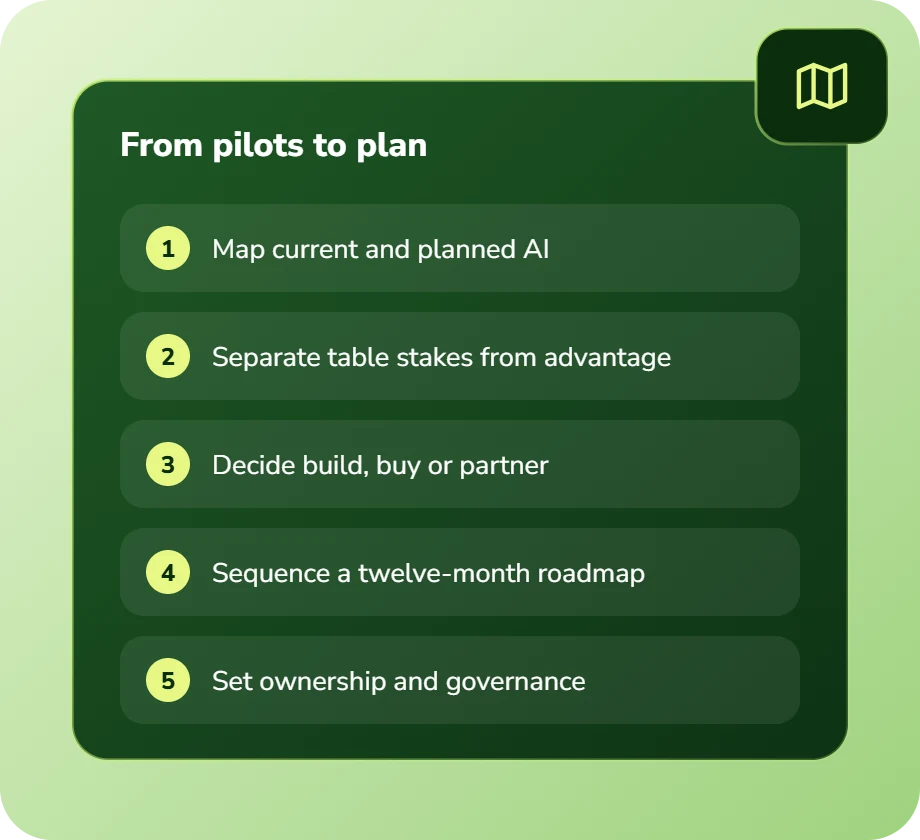
What every AI strategy consulting engagement includes
Everything below is in scope on a standard engagement. Nothing here is an upsell discovered halfway through the build.
Executive alignment workshop
A facilitated session establishing what leadership actually expects AI to change. Usually, it is the first time leaders state those expectations out loud together.
Capability mapping
Every candidate AI capability classified as table stakes, differentiating, or speculative, with the investment posture that implies.
Portfolio rationalization
A review of every in-flight initiative with a continue, merge, or stop recommendation and the reasoning behind it.
Build-buy-partner modeling
Three-year total cost of ownership for each route per capability, including the internal maintenance cost people forget to count.
AI governance framework
Acceptable-use policy, model approval process, human-review thresholds, incident response and audit requirements, sized to your exposure.
Operating model design
Centralized, federated or center-of-excellence, we recommend a structure that matches your size and culture, not a textbook ideal.
Sequenced twelve-month roadmap
Quarterly gates, budget per quarter, dependencies mapped, and defined criteria for proceeding or stopping at each gate.
Board briefing pack
A concise deck and written summary your leadership can present without translation, including the risks and what could go wrong.
Which AI models and tools do we use for AI strategy consulting?
We are not tied to one vendor. Instead, each platform recommendation weighs accuracy, cost per task, latency, and where your rules let your data live.
How we deliver AI strategy consulting, step by step
Every strategy engagement runs through the same five stages, from executive alignment to a funded roadmap. You always know what comes next.
Discovery
First, we interview leadership and initiative owners and inventory every AI pilot, platform and budget in flight.
AI Strategy
Next, we map each capability as table stakes, differentiating or speculative and model build, buy or partner costs.
Pilot Build
Then the top-ranked capability becomes a defined first quarter of work, so the roadmap starts with real delivery.
Implementation
After the board readout, your team owns the roadmap, governance policy and operating model, with clear internal accountability.
Optimization
Finally, quarterly gates let you re-score initiatives as costs and model capabilities change, using the scoring model you keep.
How is an AI strategy consulting project priced?
AI strategy consulting is priced on the size of your organization and how many business units the strategy has to cover. You get a fixed written price before we start, and a roadmap your leadership team can fund with confidence.
Book a free 30-minute call and tell us where your AI efforts stand today. We will show you what a clear strategy would settle first and what your board will want to see.
- A written savings estimate before any paid work
- Fixed scope and fixed price, agreed up front
- Full ownership of everything we build for you
- An honest recommendation when the numbers do not work
Figures are internal measurements across recent engagements, reported to every client monthly in writing.
AI strategy consulting FAQs
What is the difference between AI strategy consulting and AI consulting?
AI consulting typically answers “which processes should we automate and what will it cost”. AI strategy consulting sits a level above that. It decides which capabilities matter to your competitive position and how you fund and govern AI across the organization. It also sets who owns model risk and in what order investments happen over one to three years. If you have one clear process to automate, you want the former. If several initiatives compete for the same budget, you want the latter.
How long does an AI strategy engagement take?
Four weeks for a strategy sprint covering capability mapping and a sequenced roadmap. Six weeks when governance drafting and operating model design are included. We deliberately do not run longer engagements at this stage. After all, strategy documents that take a quarter to write are usually out of date by the time they land.
Do you write the AI governance policy for us?
Yes, in the Strategy and Governance engagement. We draft acceptable-use policy, the model approval process, human-review thresholds, incident response procedure and audit requirements. Then we work through them with your legal, risk or compliance function until it approves them. We size the policy to your actual regulatory exposure rather than copying it from an enterprise template.
Will you recommend stopping projects we have already invested in?
Frequently, yes. On a typical portfolio review we recommend stopping or merging around half of in-flight initiatives. Sunk cost is not a reason to continue. Instead, we will show you the forward-looking economics rather than relitigating the original decision.
Can you help present the strategy to our board?
Yes. The board briefing pack is a standard deliverable. We will also attend the board or leadership meeting to present it and answer technical questions directly. Directors generally ask better questions when they can challenge the person who did the analysis.
Do we need an AI strategy if we are only 40 people?
Usually not. At that size a single well-chosen automation project beats a strategy document. We would rather run a short consulting engagement and build you something useful. We will say this on the first call rather than selling you a strategy engagement you do not need.
How do you handle build-versus-buy recommendations?
We model three-year total cost of ownership for each route. That includes the internal maintenance and monitoring cost that build options carry and buyers routinely forget. For that reason, you should almost always buy capabilities classified as table stakes. Capabilities tied to proprietary data or a genuine process advantage are where custom builds earn their cost.
What if our strategy needs to change in six months?
It will, and the roadmap is designed for that. Quarterly gates exist specifically so you can re-score initiatives as costs, model capabilities and competitive conditions change. You keep the scoring model, so re-planning does not require another engagement. Even so, many clients keep us on a light advisory retainer for it.
Ready to scope your AI strategy consulting project?
Book a free 30-minute consultation. Bring one workflow. You will leave with a realistic estimate of what it would cost to automate and what it would save.