
AI chatbot development services for U.S. Businesses
Our AI chatbot development services give your customers instant, accurate answers from your own policies and documentation, day and night. We build the knowledge retrieval, system connections and one-step handoff to a person, so fewer questions reach your team and none go unanswered.
We reply within 4 business hours.
What is an AI chatbot?
An AI chatbot uses a language model to hold a natural conversation and answer questions, unlike older scripted bots that follow fixed decision trees. A well-built business chatbot is grounded in the company’s own documentation through retrieval, so its answers reflect actual policies, and it escalates to a human with full conversation context when it cannot help.
Why most business chatbots frustrate customers
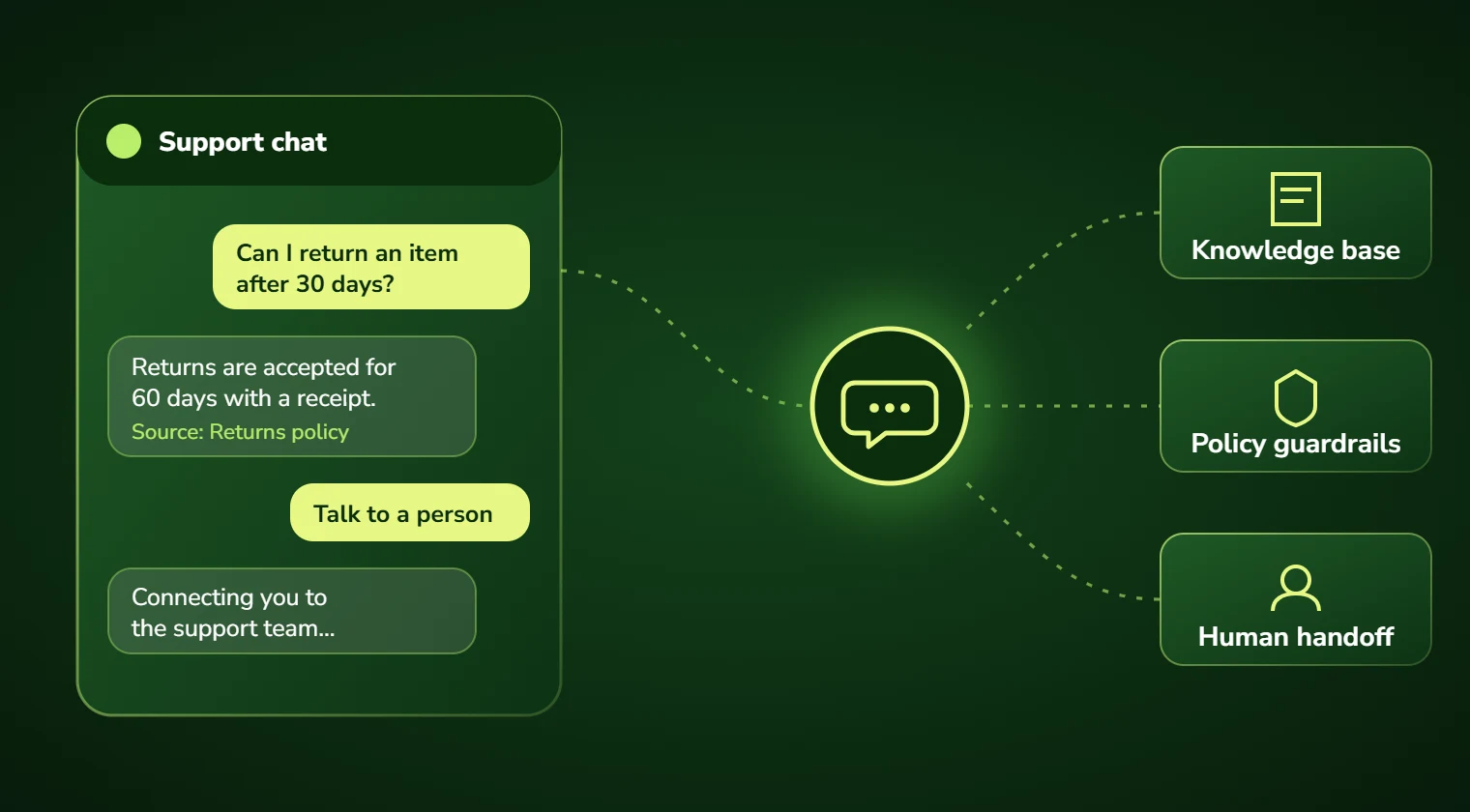
Two failures account for almost all of it. The bot confidently states something that is not your policy, because it is answering from general knowledge. Or the customer asks for a human and there is no way to get one.
Both are solvable, and both are usually left unsolved because the bot was bought as a product rather than built around the business. A generic bot cannot know your refund window or your escalation rules.
Grounded answers and a visible way out
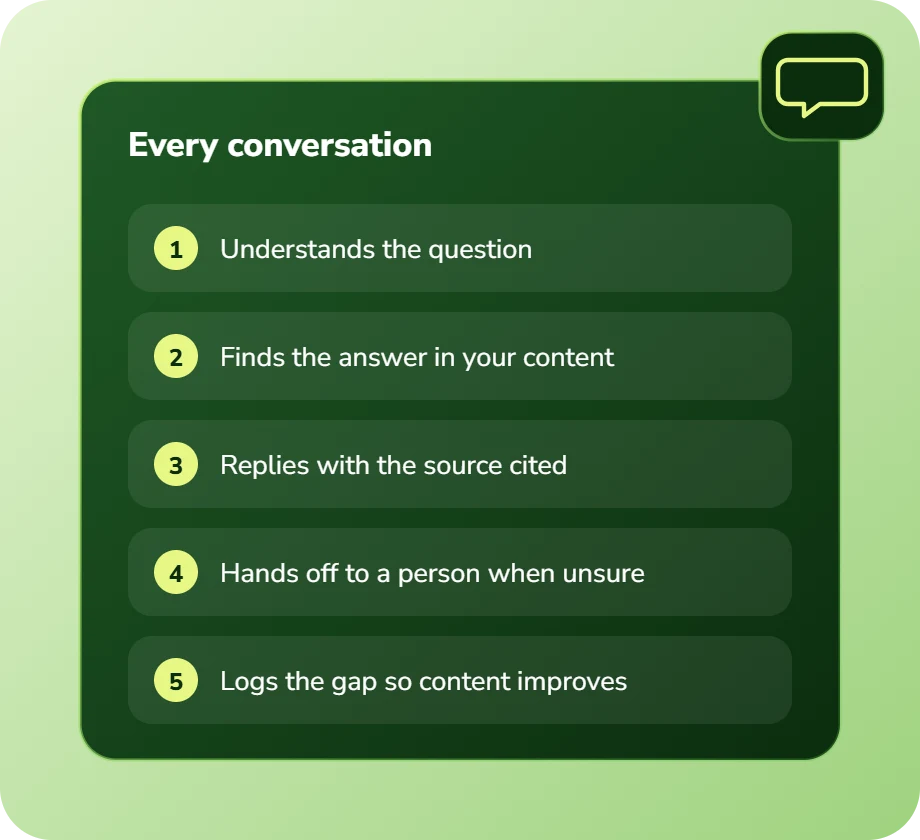
With our AI chatbot development services, every answer comes from your own content through retrieval, with a citation back to the source. If the answer is not in your documentation, the bot says it does not know rather than inventing something plausible.
We design escalation first, not later. A human is always reachable in one step. When the handoff happens, the agent receives the full conversation, the customer record, and what the bot already tried.
What our AI chatbot development services include
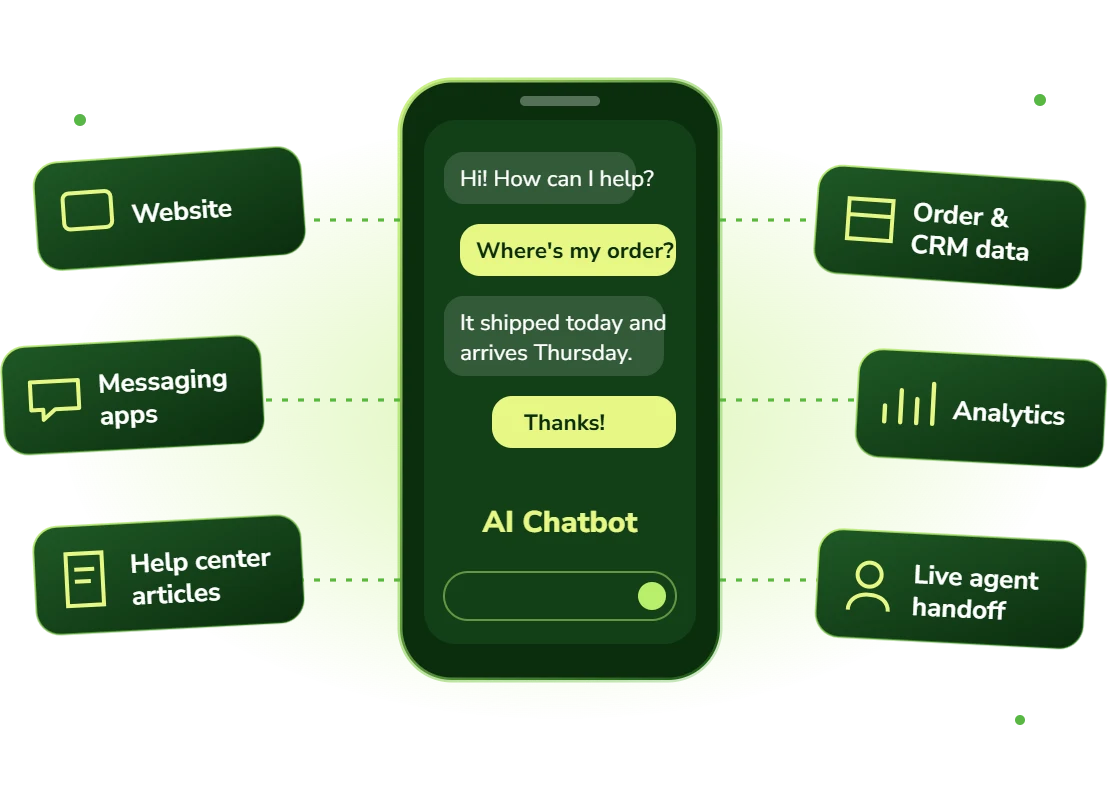
The chatbot itself is the easy part of our AI chatbot development services. The work is in retrieval quality, escalation design, and knowing what the bot must never attempt, which for most businesses includes anything about pricing exceptions, medical guidance, or legal obligations.
We also design for the moment the bot is wrong, because it will occasionally be. Confidence thresholds route uncertain questions to a person. Every conversation is reviewable. And there is a fast path to correct the underlying content when a bad answer is traced to a stale document.
Deflection is measured honestly. A conversation that ends because the customer gave up is not a deflection, and we report resolution rather than containment.
As an AI chatbot development company, we focus on custom AI chatbot development grounded in your own content. That usually means RAG chatbot development, so every answer is drawn from your policies and documentation, with CRM chatbot integration for order and account lookups.
- Retrieval grounding over your help center, policies, product data and past tickets
- Source citation on every answer so customers and agents can verify
- One-step human escalation with full context handed to the agent
- Live system lookups: order status, account details, appointment availability
- Multilingual support where your customer base needs it
- Analytics on resolution rate, escalation reasons and unanswered questions
When is an AI chatbot worth building?
The economics depend on repetition. If a large share of your inbound questions are variations of the same twenty, a chatbot will handle most of them. When every inquiry is genuinely unique, it will not, and we will say so.
The other strong case is coverage. Similarly, when customers need answers outside the hours your team works, the value lies in covering those hours. It is less about reducing daytime workload.
An AI chatbot for business pays off where the same questions repeat. Typical builds include an AI customer service chatbot for support queues and a website AI chatbot that answers visitors around the clock and hands complex cases to your team.
- Support teams answering the same questions repeatedly across channels
- Businesses whose customers expect answers outside working hours
- Companies with good documentation that customers never find
- E-commerce operations fielding order status and returns questions at volume
- Service businesses losing inquiries because nobody answered quickly enough
- Organizations serving customers in more than one language
What an AI chatbot can do for your support team
Answers from your policies
Retrieval grounding means the bot quotes your actual refund window, not a plausible-sounding invention.
Immediate first response
Every inquiry answered in seconds, at 2am and on holidays, which is where most missed inquiries currently occur.
Escalation that works
A human is one step away, and the agent inherits the full conversation and customer record rather than starting cold.
Volume without headcount
Inquiry spikes are absorbed without a queue forming, so seasonal peaks stop requiring temporary staff.
Content gaps made visible
Unanswered questions are logged and reported, which tells you exactly what your documentation is missing.
Cheap to run
Typical cost is a fraction of a cent per conversation, so unit economics improve as volume grows rather than degrading.
Customer service problems an AI chatbot solves
Repetitive questions eating the queue
The same twenty questions arriving hundreds of times. Deflecting them frees the team for cases that need judgment.
No coverage outside business hours
Inquiries arriving overnight and answered a day later. Instant response often matters more than perfect response.
Documentation nobody reads
A comprehensive help center customers never search. A chatbot turns it into something they will actually use.
Inconsistent answers between agents
Different staff giving different answers to the same question. A grounded bot is consistent by construction.
Language barriers
Customers underserved because support only operates in English. Multilingual handling costs almost nothing extra.
Previous chatbot that failed
A scripted bot customers learned to bypass. We diagnose why before rebuilding, because it is usually escalation design rather than the model.
What every chatbot build includes
Every engagement for our AI chatbot development services includes everything below as standard. Nothing here is an upsell that surfaces halfway through the build.
Knowledge base ingestion
Your help center, policy documents, product data and resolved tickets indexed, chunked and kept in sync as they change.
Retrieval-grounded responses
Answers generated only from retrieved content, with citations, and an explicit “I do not know” when nothing relevant is found.
Live system lookups
Authenticated queries for order status, account details, appointment slots or balances, so answers are current rather than generic.
Escalation and handoff
Routing to your existing helpdesk with full transcript, customer record and attempted resolution attached.
Guardrails and topic limits
Explicit boundaries on what the bot will discuss, plus prompt-injection defenses and PII handling rules.
Multi-channel deployment
Website widget, in-app, WhatsApp, SMS or Messenger from one backend, so the knowledge stays consistent across channels.
Conversation analytics
Resolution rate, escalation reasons, unanswered questions and satisfaction, reported so you can improve content rather than guess.
Review and correction loop
A workflow for flagging bad answers, tracing them to the source document, and fixing the content rather than patching prompts.
Which AI models and platforms power your chatbot?
Our AI chatbot development services are vendor-neutral. Instead, we choose models and infrastructure on accuracy, cost per task, latency, and where your data is allowed to live.
How we build your AI chatbot, step by step
Every chatbot project follows the same five stages. That way, you always know what happens next and what you get at the end.
Discovery
First, we read your support tickets and documentation to find the questions customers ask most often.
AI Strategy
Next, we rank those questions by volume and by how safely a bot can answer them, and agree what it must never attempt.
Pilot Build
Then we build a grounded chatbot on your real content and test it internally before any customer sees it.
Implementation
We connect it to your channels and helpdesk, train your team on the handoff, and launch with a rollback path.
Optimization
Finally, we review conversations every month, fix content gaps, tune answers and report resolution rates in writing.
Chatbot, live chat or AI agent: which do you need?
The three often get confused, but they solve different problems. Picking the right one first saves budget.
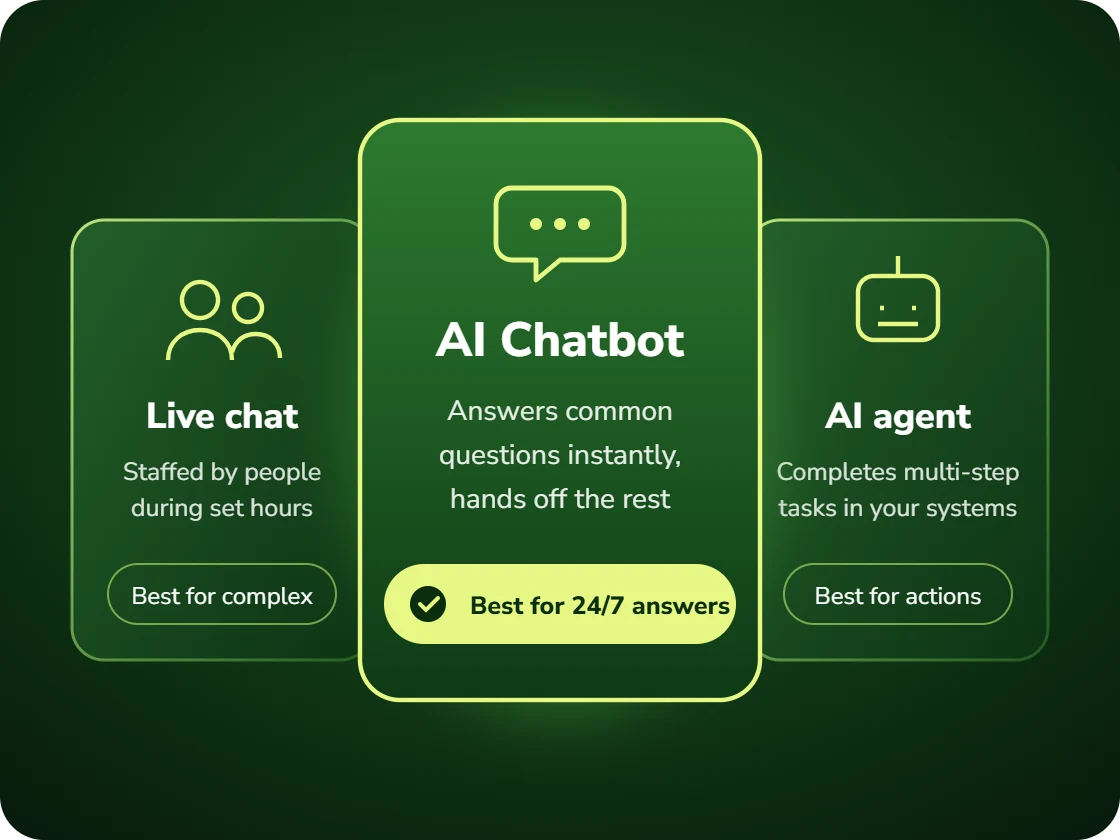
- Live chat puts a person on every conversation. It suits low volumes and complex sales questions, but it stops when your team logs off.
- An AI chatbot answers repeated questions instantly from your own documentation, around the clock, and hands everything else to a person with the conversation attached.
- An AI agent goes further and takes actions in your systems, such as processing a refund or updating an order, within the permissions you set.
Most support teams start with a chatbot and add agent actions once the common questions are handled. If you already know the work involves multi-step actions, see our AI agent development services.
How much does AI chatbot development cost?
AI chatbot development is priced on what your chatbot needs to do: how much content it answers from, which systems it looks up and how many channels and languages it covers. You get one fixed, written price for your support setup before we start, so the budget is settled before the build begins.
Book a free 30-minute call and bring your most common customer questions. We will show you how many a chatbot could answer, what that is worth to your team, and the simplest version worth launching first.
- A written savings estimate before any paid work
- Fixed scope and fixed price, agreed up front
- Full ownership of everything we build for you
- An honest recommendation when the numbers do not work
Figures are internal measurements across recent engagements, reported to every client monthly in writing.
AI chatbot development FAQs
How do you stop the chatbot making things up?
Retrieval grounding is the main defense: the model only answers from content retrieved out of your own documentation, and every answer carries a citation. When retrieval finds nothing relevant, the bot says so and offers escalation rather than generating a plausible guess. We also test against a set of adversarial questions before launch and monitor for hallucination patterns afterwards.
Will customers be able to reach a human?
Always, in one step, and visibly. Hiding the escalation path is the single most common reason customers hate chatbots. It also damages the metrics: a conversation someone abandons in frustration looks like deflection, but it is actually a lost customer. We measure resolution, not containment.
How much does an AI chatbot cost?
The price depends on how much content the chatbot answers from, whether it needs live system lookups, and how many channels and languages it covers. After a short discovery you get a fixed written price for your setup, agreed before any build. Running cost per conversation is low and falls as volume grows. Book a free 30-minute consultation to get a quote for your support team.
What if our documentation is out of date or incomplete?
That surfaces immediately, and it is one of the more useful side effects. The bot can only be as good as what it retrieves, so the content audit in week one usually finds significant gaps. Some clients spend two weeks improving documentation before launch, which improves both the chatbot and the human support team’s consistency.
Can the chatbot look up a customer's order or account?
Yes, with authentication. The bot can query your order system, CRM or booking platform to give a specific answer rather than a generic one, which is usually where most of the deflection value comes from. Access is scoped and read-only by default, and any action that changes data sits behind explicit confirmation.
Which channels can it run on?
Website widget, inside your product, WhatsApp, SMS, Facebook Messenger and email, from one backend. Running one knowledge layer across channels keeps answers consistent. In contrast, separate bots per channel are how organizations end up giving different answers depending on where a customer asks.
Ready to launch a chatbot customers actually use?
Book a free 30-minute consultation. Bring one workflow. You will leave with a realistic estimate of what it would cost to automate and what it would save.