Business Automation Consulting

Business automation consulting to prioritize your investment

Business automation consulting helps you decide which processes are worth changing before buying tools. We compare process redesign, rules-based automation and AI against costs, volumes and implementation constraints.

Free 30-minute consultation
Fixed-scope pilots
U.S.-based team
Custom, not off-the-shelf
SOC 2-aligned practices
ROI tracked in writing
What is business automation consulting?

Business automation consulting assesses an organization’s processes to identify which are worth automating, using what technology, in what order. A proper engagement produces cost, timeline and payback estimates per opportunity, and explicit recommendations against opportunities that do not justify their cost.

7+
Years building AI systems
240+
Projects delivered
4.8
Avg. months to payback
38
U.S. states served
The Problem

Automation programmes that automate whatever was easiest to sell

Automation opportunities are usually identified by whoever is selling the automation. Platform vendors find opportunities suited to their platform, and RPA firms find opportunities suited to RPA.

The result is a programme shaped by supplier capability rather than by where the cost actually is, and a set of automations that individually work and collectively did not move the number.

Our Approach

Score everything, recommend a third of it

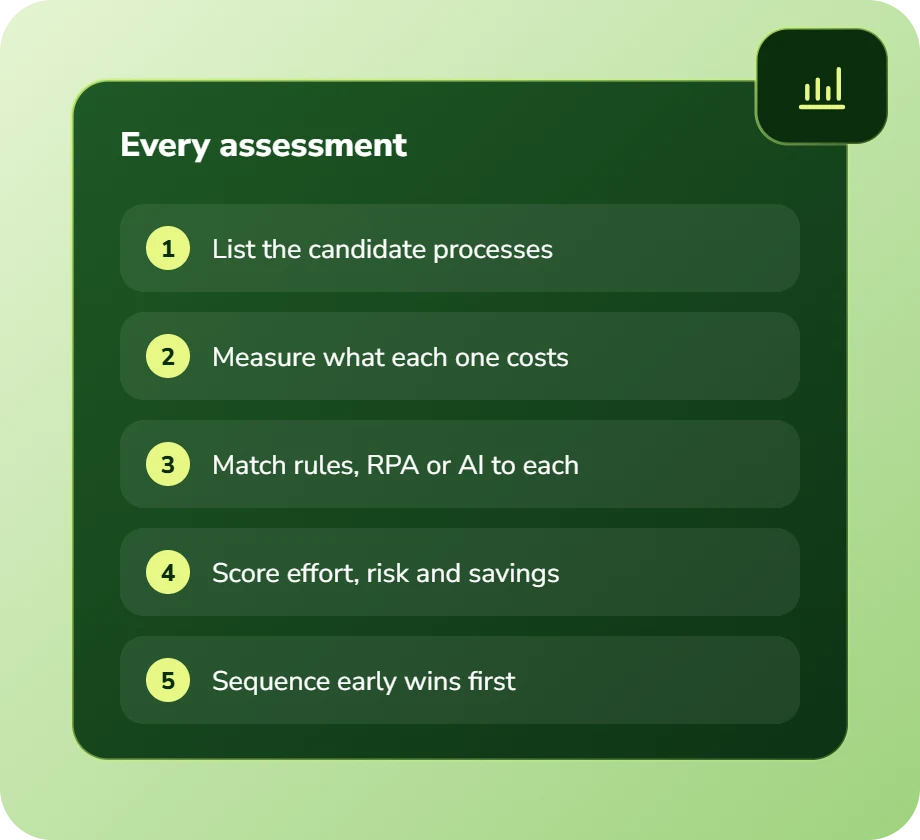
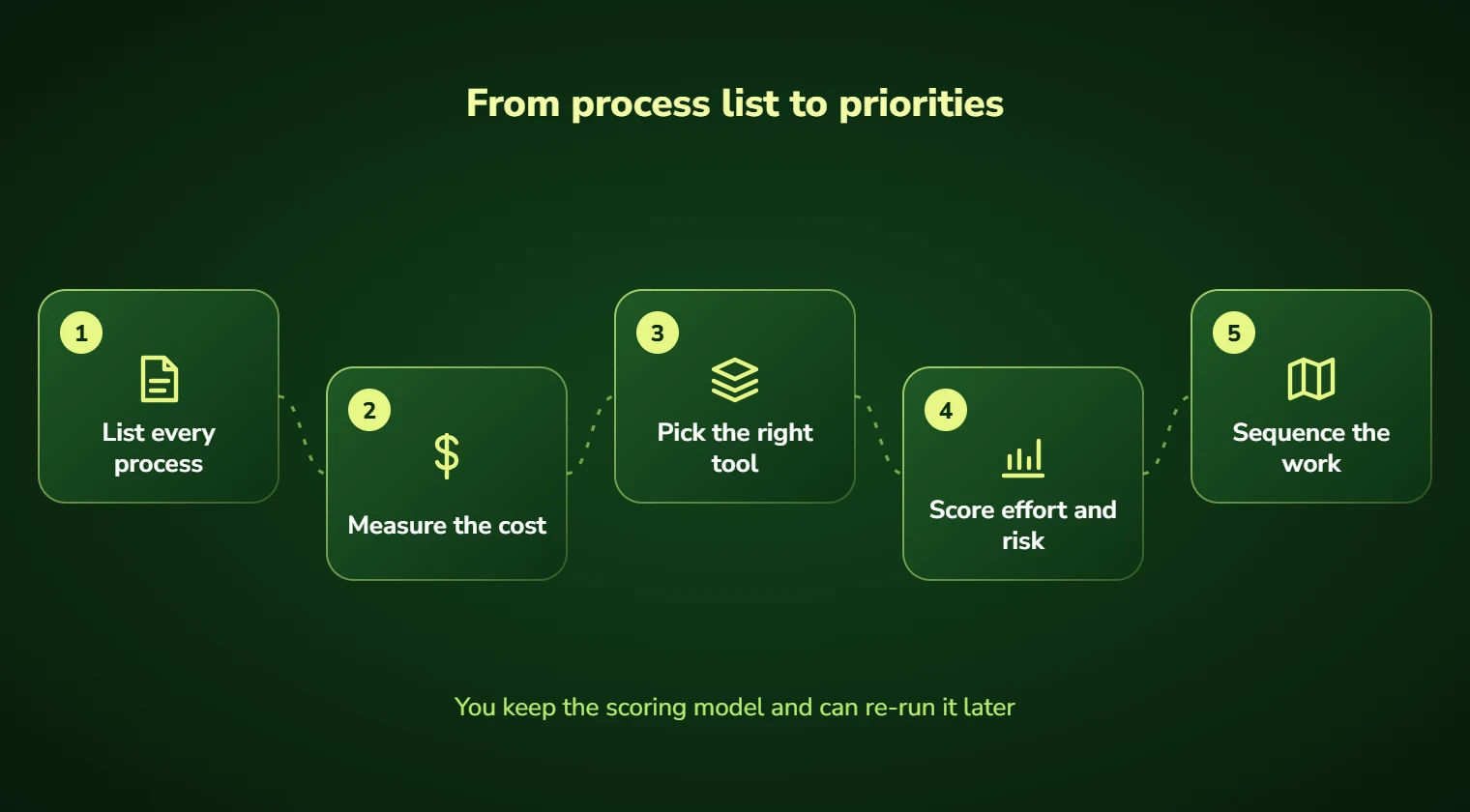
We inventory candidate processes, measure their actual cost, and score each on savings, effort and risk. The output is a ranked list with a payback estimate per item.

And an explicit list of what not to automate, with reasons. On a typical assessment we recommend proceeding with around a third of the opportunities scored.

Illustration of a roadmap with five numbered milestones
Service Overview

Business automation consulting: scope and deliverables

Process inventory and cost measurement first. What runs, how often, how long it takes, and what it costs annually in fully loaded terms.

Then technology fit per opportunity. Deterministic automation, RPA, AI, or a workflow change with no technology at all, each opportunity gets the cheapest approach that works, which is frequently not the one a vendor would propose.

Then sequencing, because order matters. Early wins that fund and de-risk later work beat starting with the largest and most complex.

And the exclusions, which are usually the most valuable part of the document.

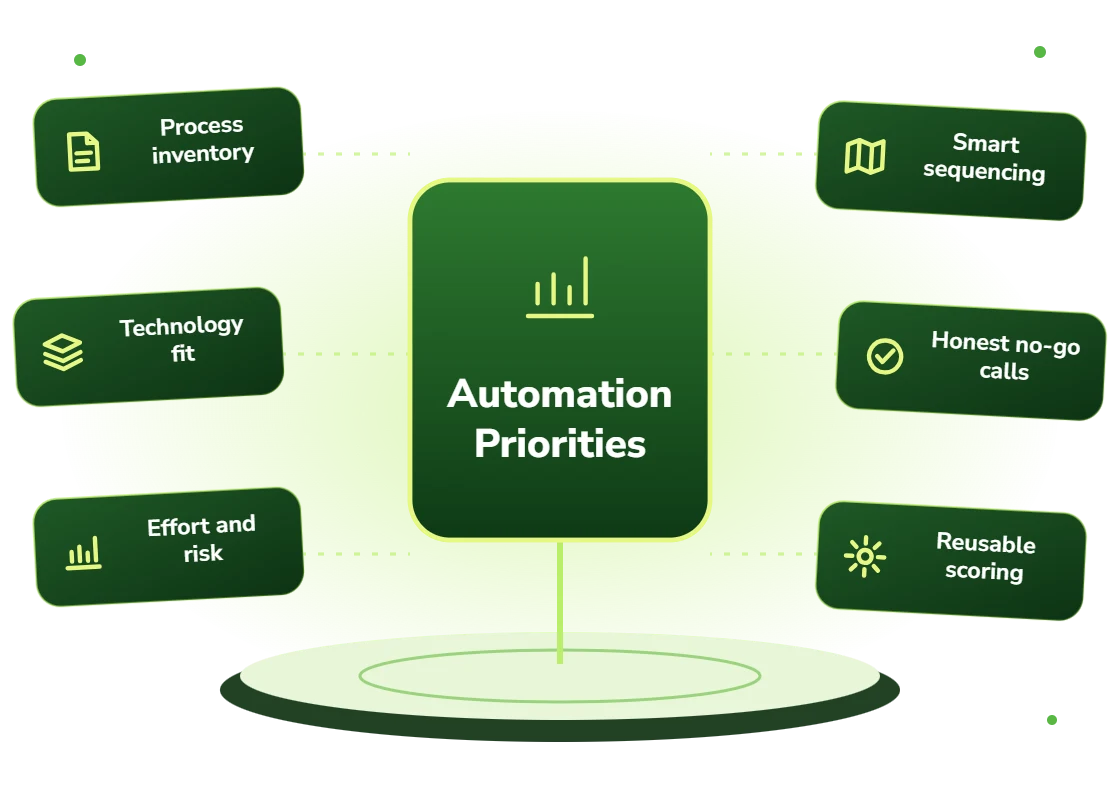
  • Process inventory with measured annual cost per candidate
  • Technology fit assessment: rules, RPA, AI, or no technology at all
  • Effort and risk scoring alongside savings, not just savings
  • Sequencing so early wins fund and de-risk later initiatives
  • Explicit recommendations against opportunities that do not justify cost
  • A scoring model you keep and can re-run as conditions change
Right Fit

When to get automation advice

Before committing to an automation platform or programme, when the decision is still cheap. This is the highest-value moment and the least common one at which people ask.

And after an automation programme has underdelivered, when an honest diagnosis of why is worth more than another vendor proposal.

  • Organizations planning an automation programme or platform commitment
  • Companies whose previous automation delivered less than expected
  • Leadership teams asked for an automation plan with real numbers
  • Businesses with competing automation proposals to evaluate
  • Operations knowing costs are high without knowing where
  • Companies wanting an independent view before committing budget
Benefits

Benefits of business automation consulting

The exclusions, in writing

An explicit list of what not to automate with reasons, which no automation vendor will produce.

Technology chosen on fit

Rules, RPA, AI or no technology at all, picked per opportunity rather than by supplier capability.

Payback per initiative

A defensible number per opportunity so budget decisions rest on arithmetic.

Sequencing that funds itself

Early wins chosen for fast visible payback, which is what keeps a programme funded.

Independent of any platform

No resale margin and no alliances, so recommending against a build costs us nothing.

A model you keep

The scoring framework itself, so you can re-rank opportunities later without another engagement.

Problems We Solve

Business challenges this solves

01

Vendor-shaped automation plans

Opportunities identified by whoever sells the tooling. Independent scoring resolves it.

02

Programmes that did not move the number

Individual automations working, aggregate impact absent. Cost-first scoring targets what matters.

03

No idea where cost actually is

Painful processes assumed to be expensive ones. Measurement frequently contradicts.

04

Competing proposals to evaluate

Multiple vendors, no basis for comparison. Independent assessment provides one.

05

Wrong sequencing

Starting with the largest and slowest. Early wins keep programmes funded.

06

Automation proposed where rules would do

AI recommended for deterministic work. Technology fit assessed per opportunity.

What's Included

Features and deliverables

Everything below is in scope on a standard engagement. Nothing here is an upsell discovered halfway through the build.

01

Process inventory

Candidate processes catalogued with volume, duration and fully loaded annual cost measured rather than estimated.

02

Opportunity scoring

Each candidate scored on annual savings, build effort and implementation risk in a transparent model.

03

Technology fit assessment

The cheapest adequate approach per opportunity, including recommending no technology where a process change suffices.

04

Build-versus-buy analysis

Named commercial alternatives with pricing where a product would serve better than a build.

05

Sequencing plan

Ordered roadmap with dependencies, budget phasing and early wins prioritized for programme momentum.

06

Exclusion list

Explicit documentation of opportunities we recommend against, with the reasoning for each.

07

Vendor proposal review

Independent assessment of competing automation proposals on scope, pricing, approach and lock-in.

08

Scoring model handover

The framework itself, so opportunities can be re-scored internally as costs and conditions change.

Technology Stack

Technologies we use for business automation consulting

We are not tied to one vendor. Model and infrastructure choices are made on accuracy, cost per task, latency, and where your data is allowed to live.

Language Models
C
Claude (Anthropic)
G
GPT (OpenAI)
G
Gemini (Google)
L
Llama
M
Mistral
A
Azure OpenAI Service
Agent & Orchestration
M
Model Context Protocol
L
LangGraph
L
LangChain
L
LlamaIndex
T
Temporal
C
Celery
Data & Backend
P
Python
T
TypeScript / Node.js
P
PostgreSQL
S
Snowflake
d
dbt
A
Apache Airflow
Business Systems
S
Salesforce
H
HubSpot
N
NetSuite
M
Microsoft 365
S
Slack
Z
Zapier / Make
How We Work

Our AI development process

The same five stages on every engagement, so you always know what happens next and what you get at the end of it.

01

Discovery

We interview the people doing the work, map the workflow end to end, and audit the systems and data behind it.

02

AI Strategy

Every opportunity gets scored on cost to build, time to value, and annual savings, then ranked.

03

Pilot Build

We ship the top-ranked automation as a fixed-scope pilot so you see real output before committing further budget.

04

Implementation

Integration with your live systems, staff training, human-in-the-loop review gates, and a documented rollback path.

05

Optimization

Monthly accuracy reviews, prompt and retrieval tuning, and a written report on hours and dollars saved.

Timeline

How long it takes

A typical first engagement, week by week. Complex integrations and regulated environments extend this, and we say so during discovery rather than after.

Weeks 1 to 2

Discovery and scoping

Process observation, systems audit, data review, and a written estimate of cost and expected saving before anything is built.

Week 3

Design sign-off

Architecture, data handling rules, review thresholds and success measures agreed in writing.

Weeks 4 to 7

Build and integration

Development against your real data, connected to your live systems, with weekly demos rather than a single reveal.

Week 8

Parallel run and testing

The system runs alongside the existing process so accuracy can be compared directly before anyone depends on it.

Weeks 9 to 10

Launch and handover

Cutover with a rollback path, staff training, full documentation, then 30 days of included tuning.

Who We Work With

Industries we deliver business automation consulting for

Professional Services

Proposal drafting, timesheet capture, research synthesis, and client reporting at scale.

Manufacturing

Quality inspection, maintenance prediction, supplier communication, and production scheduling.

Financial Services

Document extraction, reconciliation, KYC support, and audit-ready reporting with full traceability.

Logistics & Supply Chain

Document processing, carrier communication, exception handling, and inventory rebalancing.

Healthcare

Intake, prior authorization, clinical documentation, and revenue-cycle workflows built to respect HIPAA boundaries.

Insurance

First-notice-of-loss intake, claims triage, policy Q&A, and fraud signal detection.

Construction

Bid takeoffs, submittal review, RFI drafting, and field-report summarization.

Retail & E-commerce

Product data enrichment, demand forecasting, support deflection, and personalized merchandising.

Use Cases

Real-world use cases

01

Automation programme planning

A ranked roadmap with payback per initiative before committing budget.

02

Platform decision support

Independent assessment before committing to an automation platform.

03

Programme diagnosis

Understanding why a previous automation programme underdelivered.

04

Vendor proposal evaluation

Comparing competing proposals on a consistent basis with lock-in risk assessed.

05

Board and budget case

A defensible automation investment case for leadership or board approval.

06

Post-merger rationalization

Assessing overlapping automation investments across merged organizations.

Why DevSolutionsAI

Why choose DevSolutionsAI for business automation consulting

Business case before build

Every recommendation carries an estimated cost, timeline, and annual savings figure. If the math does not work, we say so before you spend.

Vendor-neutral by design

We resell nothing and take no platform commissions. Model and infrastructure choices are made on fit, cost, and your data-residency rules.

Fixed-scope pilots

The first engagement is a defined deliverable at a defined price, not an open-ended retainer that quietly grows each quarter.

Built for handover

You own the code, the prompts, the infrastructure, and the documentation. No lock-in to a proprietary wrapper you cannot leave.

Human-in-the-loop where it counts

Anything customer-facing, clinical, financial, or legal gets a review gate, a confidence threshold, and a logged audit trail.

Security reviewed early

Data flow diagrams, retention rules, and access boundaries are agreed in week one, not retrofitted after your security team objects.

Get Started

Find out what business automation consulting would cost you, before you commit to anything

Every engagement is quoted after a short discovery, so you get a fixed written price built around your actual volumes rather than a rate card that assumes someone else’s business.

The first call is thirty minutes and free. Bring one workflow. We will tell you what it is likely costing you each year, roughly what automating it would take, and whether we think it is worth doing at all.

  • A written savings estimate before any paid work
  • Fixed scope and fixed price, agreed up front
  • Full ownership of everything we build for you
  • An honest recommendation when the numbers do not work
What clients typically see
Across recent projects
Staff hours saved each week
31
Months to payback
4.8
Client retention
94%
Response to enquiries
4 hrs

Figures are internal measurements across recent engagements, reported to every client monthly in writing.

Illustrative project scenario

Illustrative project scenario

Distribution group · automation programme review

Recommending against seven of eleven proposed automations

Challenge. A distribution group had eleven automation opportunities identified by an RPA vendor, with a substantial combined implementation quote. Leadership wanted an independent view before committing, having been burned by a previous automation programme that delivered less than promised.

What we built. We measured the actual annual cost of each candidate process rather than accepting the estimates. Four opportunities justified their build cost. Three were addressable by a process change with no technology at all. Two were better served by a commercial product we named. Two had negative payback at their real volumes.

Outcome. The group proceeded with the four justified opportunities plus the three process changes. The programme cost roughly a third of the original quote and delivered more measured saving, because the excluded opportunities would have consumed budget without returning it.

4 of 11
Recommended to build
3
Solved by process change alone
~1/3
Of the original quote
2
With negative payback identified

Illustrative project scenario. The figures demonstrate how a project could be scoped and evaluated; they are not verified client results or an audited average.

Client Feedback

What clients say about working with us

31
Avg. staff hours saved weekly
4.8
Avg. months to payback
94%
Client retention
4
Hour response to enquiries
Common Questions

Business Automation Consulting FAQs

We will recommend against things. Platform vendors and implementation firms give genuine advice from a position that is not neutral, they find opportunities suited to what they sell. We take no resale margin and hold no alliances, so recommending a process change with no technology, or a competitor’s product, or nothing at all, costs us nothing. On a recent engagement we recommended against seven of eleven proposed automations.
By measuring the actual annual cost of each candidate process rather than accepting estimates, then scoring on savings, build effort and implementation risk. Opportunities that look attractive frequently have lower real volume than assumed, and opportunities nobody mentioned frequently turn out to be the expensive ones. The scoring model is transparent and we hand it over.

No, and it is often the wrong answer. Deterministic automation is cheaper to run and easier to audit where the logic can be specified. RPA suits stable screen-based tasks. Some opportunities need no technology at all, on a recent assessment three of eleven were solved by a process change. AI earns its cost where variation defeats rules, which is a narrower set than the marketing suggests.

It depends on how many processes you intend to automate and how much governance you need. A platform is worth its licence cost across dozens of processes with a standard approach. For three to five high-value processes, custom builds are usually cheaper over three years with no per-seat cost. We do this analysis explicitly rather than assuming either answer.

Yes, and it is a common reason for engagement. We assess scope, pricing, technical approach and lock-in risk, and produce a written opinion with specific questions to put back to the vendor. Having someone with no stake in the outcome read a proposal frequently surfaces assumptions worth challenging.

A three to four week assessment with process inventory, measured costs, scoring and a documented roadmap runs $12,000 to $30,000 depending on how many processes are in scope. A combined assessment and pilot build runs $48,000 to $95,000. Ongoing advisory is available monthly for organizations running continuous automation programmes.

Service Areas

Business Automation Consulting across the United States

We deliver business automation consulting remotely to clients nationwide, with on-site workshops available in major metros.

Ready to scope your business automation consulting project?

Book a free 30-minute consultation. Bring one workflow and leave with a realistic estimate of what it would cost to automate and what it would save.

Free 30-minute consultation
Fixed-scope pilots
U.S.-based team
Custom, not off-the-shelf
SOC 2-aligned practices
ROI tracked in writing
Free 30-minute AI consultation