AI security consulting for the attack surface your existing controls do not cover
Our AI security consulting assesses prompt injection, data exposure and excessive tool permissions alongside existing application controls. We map the system’s data flows and prioritize findings by impact and likelihood.
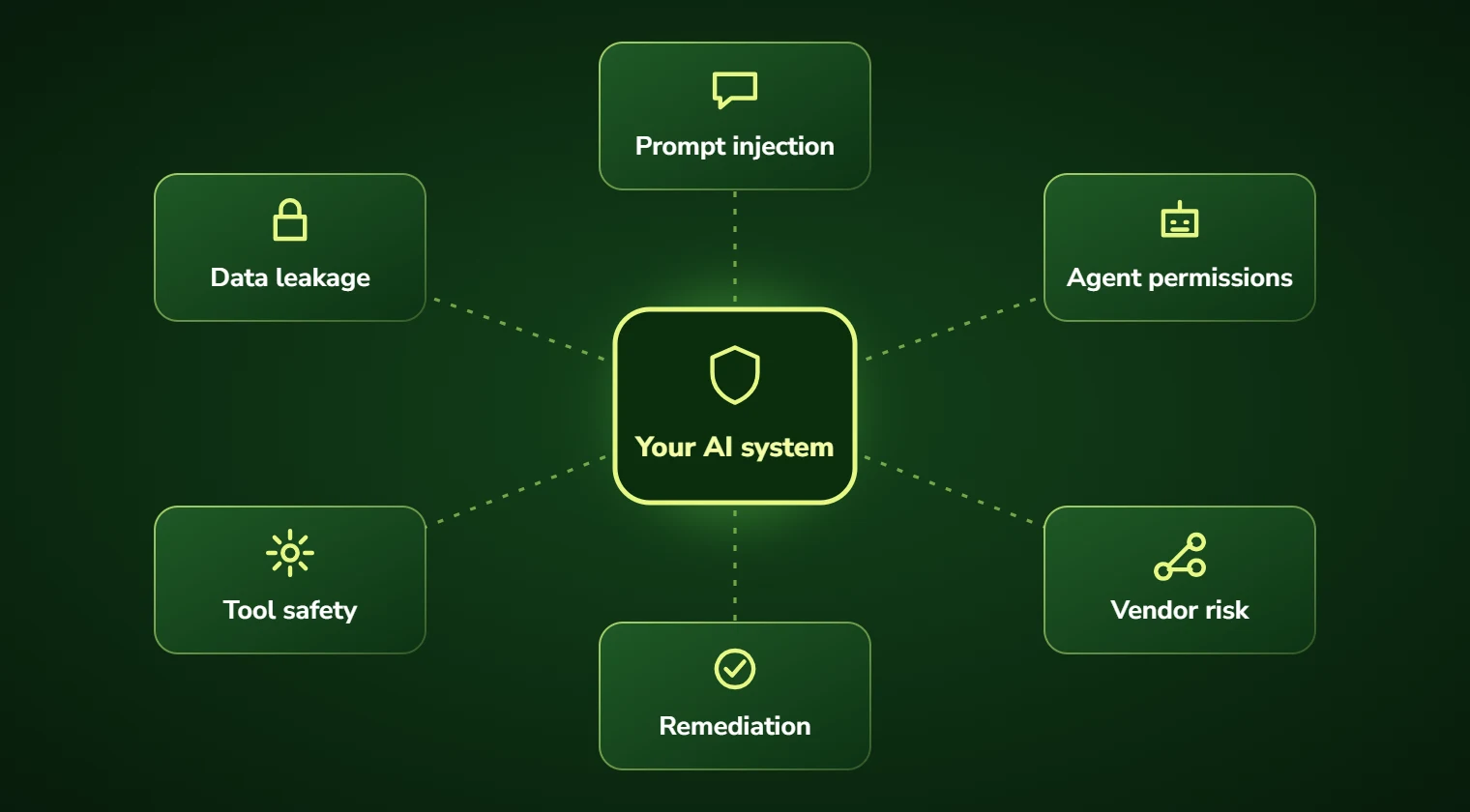
AI security consulting assesses and remediates risks specific to AI systems: prompt injection, data leakage through model outputs, over-permissioned agent access, insecure tool use, model supply chain risk and vendor data handling. These are distinct from traditional application security concerns and require specific testing.
Your penetration test did not cover this
Traditional application security testing looks for injection into interpreters, broken authentication and misconfiguration. It does not test whether a document uploaded by a customer can instruct your AI to exfiltrate other customers’ data.
Prompt injection has no complete technical fix, over-permissioned agents can take actions nobody authorized, and retrieval systems leak content across permission boundaries when filtering happens after retrieval rather than before.
Test the AI-specific attack surface explicitly
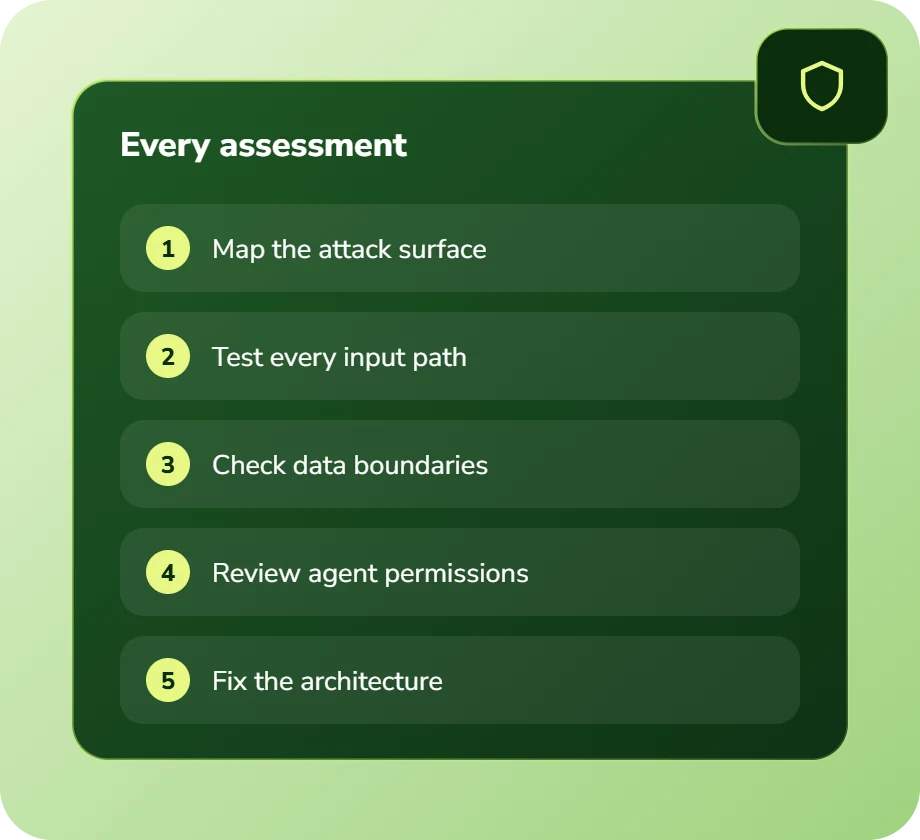
We assess the failure modes specific to AI systems: injection through every input path including retrieved documents, leakage through outputs, agent permission scope, tool use safety and vendor data handling.
Then we remediate: architectural controls that bound impact rather than relying on the model to refuse, because relying on a model to refuse is not a security control.
AI security consulting: scope and deliverables
Prompt injection is the defining problem. Instructions embedded in any content the model processes, a document, a web page, an email, a retrieved passage, can influence its behaviour. There is no complete fix, so the mitigation is architectural: bound what the model can do so injection cannot cause serious harm.
Data leakage is the second: models returning content from other tenants, other users, or documents the requester should not access. Retrieval systems that filter after retrieval rather than before are the common cause.
Agent permissions are the third and increasingly the most consequential. An agent with broad system access and a prompt injection vulnerability is a serious problem, and the two are frequently deployed together.
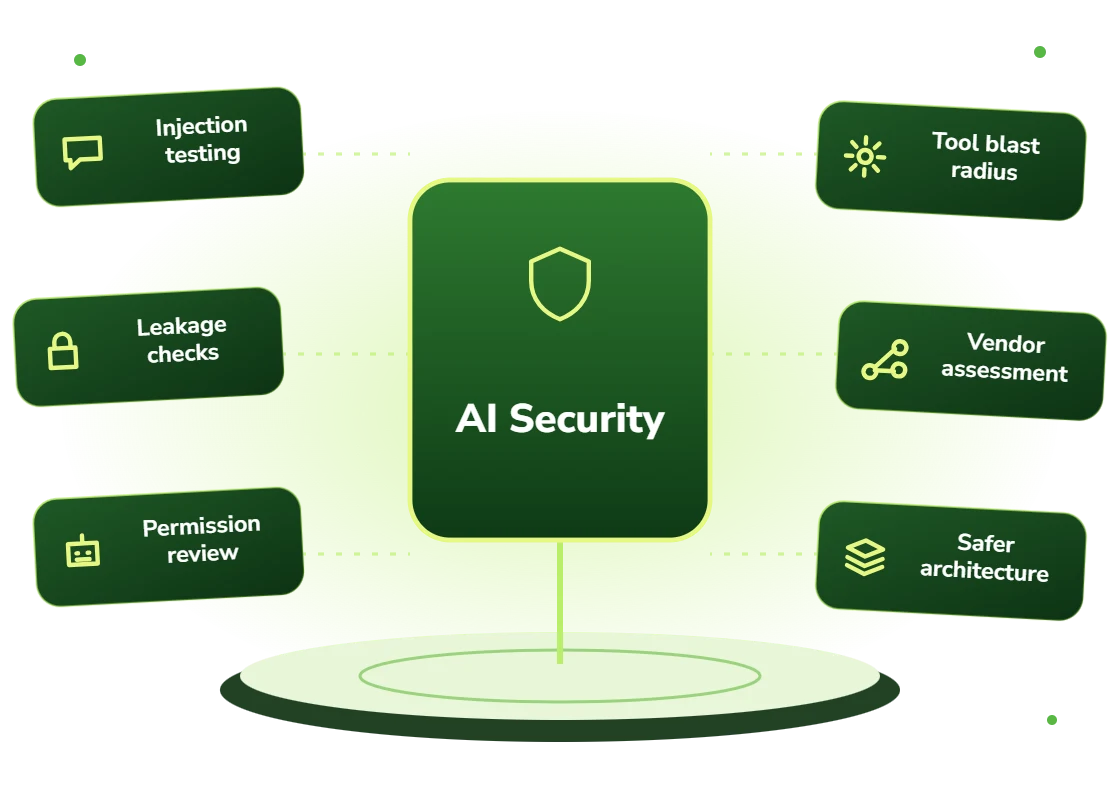
- Prompt injection testing across every input path including retrieved content
- Data leakage assessment: cross-tenant, cross-user and permission boundary
- Agent permission review: what can it actually do if compromised
- Tool use safety: blast radius of every function an agent may call
- Vendor and supply chain assessment: data handling, retention, subprocessors
- Architectural remediation that bounds impact rather than relying on refusal
Who needs an AI security assessment
Organizations with AI in production handling sensitive data, particularly where the AI has access to systems or serves multiple tenants.
And security teams asked to approve an AI deployment who do not have an established framework for assessing it, which is most security teams.
- Organizations with production AI handling sensitive or regulated data
- Multi-tenant AI products needing isolation assurance for customers
- Teams deploying agents with write access to business systems
- Security functions asked to approve AI deployments without a framework
- Companies whose customers are asking AI security questions in procurement
- Regulated firms needing documented AI risk assessment
Benefits of AI security consulting
The right threats tested
Injection, leakage and permission escalation assessed specifically, which standard penetration testing does not cover.
Architectural controls, not refusals
Impact bounded by design rather than relying on the model declining, which is not a security control.
Tenant isolation proven
Documented isolation assurance that survives a customer security questionnaire.
Agent blast radius understood
Explicit assessment of what an agent could do if compromised, before that becomes a live question.
Vendor risk documented
Data handling, retention and subprocessor arrangements assessed and recorded for compliance.
A framework your team keeps
An assessment approach your security function can apply to future AI deployments independently.
Business challenges this solves
Penetration tests missing AI risks
Standard testing not covering injection or leakage. AI-specific assessment closes the gap.
Retrieval leaking across permissions
Filtering after retrieval exposing content. Pre-retrieval filtering fixes it architecturally.
Over-permissioned agents
Broad system access with injection exposure. Least-privilege scoping bounds the risk.
Security asked to approve blind
No framework for assessing AI. We provide one your team retains.
Customer security questionnaires
Buyers asking AI-specific questions. Documented isolation and controls answer them.
Vendor data handling unclear
Uncertainty about retention and training use. Assessment documents the actual position.
Features and deliverables
Everything below is in scope on a standard engagement. Nothing here is an upsell discovered halfway through the build.
Threat modelling
AI-specific threat model covering injection paths, data flows, trust boundaries and agent capability.
Prompt injection testing
Adversarial testing across every input path including user input, uploaded documents, retrieved content and tool results.
Data leakage assessment
Testing for cross-tenant, cross-user and permission boundary leakage through model outputs and retrieval.
Agent permission review
Assessment of every tool an agent may call, its blast radius, and what a compromised agent could achieve.
Retrieval security
Verification that permission filtering happens before retrieval rather than after, which is the common leak path.
Vendor assessment
Model provider data handling, retention, training use and subprocessor arrangements documented against your requirements.
Architectural remediation
Controls that bound impact structurally rather than depending on model refusal behaviour.
Assessment framework handover
A repeatable framework your security team can apply to subsequent AI deployments.
Technologies we use for AI security consulting
We are not tied to one vendor. Model and infrastructure choices are made on accuracy, cost per task, latency, and where your data is allowed to live.
Our AI development process
The same five stages on every engagement, so you always know what happens next and what you get at the end of it.
Discovery
We interview the people doing the work, map the workflow end to end, and audit the systems and data behind it.
AI Strategy
Every opportunity gets scored on cost to build, time to value, and annual savings, then ranked.
Pilot Build
We ship the top-ranked automation as a fixed-scope pilot so you see real output before committing further budget.
Implementation
Integration with your live systems, staff training, human-in-the-loop review gates, and a documented rollback path.
Optimization
Monthly accuracy reviews, prompt and retrieval tuning, and a written report on hours and dollars saved.
How long it takes
A typical first engagement, week by week. Complex integrations and regulated environments extend this, and we say so during discovery rather than after.
Discovery and scoping
Process observation, systems audit, data review, and a written estimate of cost and expected saving before anything is built.
Design sign-off
Architecture, data handling rules, review thresholds and success measures agreed in writing.
Build and integration
Development against your real data, connected to your live systems, with weekly demos rather than a single reveal.
Parallel run and testing
The system runs alongside the existing process so accuracy can be compared directly before anyone depends on it.
Launch and handover
Cutover with a rollback path, staff training, full documentation, then 30 days of included tuning.
Industries we deliver AI security consulting for
Financial Services
Document extraction, reconciliation, KYC support, and audit-ready reporting with full traceability.
Healthcare
Intake, prior authorization, clinical documentation, and revenue-cycle workflows built to respect HIPAA boundaries.
Insurance
First-notice-of-loss intake, claims triage, policy Q&A, and fraud signal detection.
Legal
Contract review, discovery triage, and matter intake with citation-checked outputs and attorney sign-off gates.
Professional Services
Proposal drafting, timesheet capture, research synthesis, and client reporting at scale.
SaaS & Technology
AI features inside your product, support deflection, onboarding assistants, and usage analytics.
Manufacturing
Quality inspection, maintenance prediction, supplier communication, and production scheduling.
Education
Enrollment support, content generation, tutoring assistants, and administrative automation.
Real-world use cases
Pre-deployment security review
Assessment before an AI system reaches production, when remediation is still cheap.
Multi-tenant isolation verification
Testing and documenting tenant isolation for customer security questionnaires.
Agent deployment assessment
Reviewing agent permissions and blast radius before granting write access to business systems.
Vendor risk assessment
Documenting model provider data handling against your compliance requirements.
Existing system audit
Assessing AI already in production that was deployed without security review.
Security team enablement
Building an internal framework for assessing AI systems going forward.
Why choose DevSolutionsAI for AI security consulting
Business case before build
Every recommendation carries an estimated cost, timeline, and annual savings figure. If the math does not work, we say so before you spend.
Vendor-neutral by design
We resell nothing and take no platform commissions. Model and infrastructure choices are made on fit, cost, and your data-residency rules.
Fixed-scope pilots
The first engagement is a defined deliverable at a defined price, not an open-ended retainer that quietly grows each quarter.
Built for handover
You own the code, the prompts, the infrastructure, and the documentation. No lock-in to a proprietary wrapper you cannot leave.
Human-in-the-loop where it counts
Anything customer-facing, clinical, financial, or legal gets a review gate, a confidence threshold, and a logged audit trail.
Security reviewed early
Data flow diagrams, retention rules, and access boundaries are agreed in week one, not retrofitted after your security team objects.
Find out what AI security consulting would cost you, before you commit to anything
Every engagement is quoted after a short discovery, so you get a fixed written price built around your actual volumes rather than a rate card that assumes someone else’s business.
The first call is thirty minutes and free. Bring one workflow. We will tell you what it is likely costing you each year, roughly what automating it would take, and whether we think it is worth doing at all.
- A written savings estimate before any paid work
- Fixed scope and fixed price, agreed up front
- Full ownership of everything we build for you
- An honest recommendation when the numbers do not work
Figures are internal measurements across recent engagements, reported to every client monthly in writing.
Illustrative project scenario
Finding a cross-tenant leak path before a customer did
Challenge. A SaaS company was preparing to launch a multi-tenant AI feature. Their standard penetration test had passed. Enterprise customers were asking AI-specific questions in security questionnaires that the team could not answer confidently.
What we built. An AI-specific assessment covering injection across all input paths, tenant isolation, and agent permissions. Testing found that retrieval permission filtering was applied after documents were retrieved rather than before, meaning content from other tenants entered the model context even though it was filtered from the visible response.
Outcome. The leak path was remediated by moving filtering before retrieval, and verified by retest. The documented assessment subsequently satisfied enterprise security questionnaires that had been stalling deals. The client’s security team retained the assessment framework for future AI features.
Illustrative project scenario. The figures demonstrate how a project could be scoped and evaluated; they are not verified client results or an audited average.
What clients say about working with us
AI Security Consulting FAQs
Does our existing penetration test cover AI risks?
Almost certainly not. Standard application security testing looks for injection into interpreters, broken authentication and misconfiguration. It does not test whether a document a customer uploads can instruct your AI to retrieve other customers’ data, or what an agent with write access could do if manipulated. On a recent engagement a system that had passed a standard penetration test had a cross-tenant retrieval leak.
Can prompt injection be fully prevented?
No, and any vendor claiming otherwise is overselling. Instructions embedded in content the model processes can influence its behaviour, and no filter reliably catches all of them. The correct response is architectural: assume injection may succeed and bound what the model can do so success is not catastrophic. Least-privilege tool scoping, approval gates on consequential actions and output validation all limit impact regardless of whether injection works.
What is the most common serious finding?
Retrieval permission filtering applied after retrieval rather than before. It looks correct because the filtered content does not appear in the response, but the content has already entered the model context, which means it can be extracted through injection. It is a common implementation shortcut and a genuine data leak.
How do we assess model provider risk?
By reading the actual terms rather than the marketing, and documenting the position. Key questions are whether data is used for training, what retention applies, whether zero-retention is available for your use case, which subprocessors are involved, and where processing occurs. We document this against your compliance requirements, and terms change, so we verify current rather than remembered positions.
Can you help us answer customer security questionnaires?
Yes, and this is an increasingly common reason for engagement. Enterprise buyers are asking AI-specific questions that most vendors cannot answer confidently, and a documented assessment with evidence answers them properly. On a recent engagement the assessment documentation unblocked deals that had stalled in security review.
What does an AI security assessment cost?
An assessment covering threat modelling, injection and leakage testing and agent permission review runs $18,000 to $35,000 over three to four weeks. Adding remediation implementation, vendor documentation and retest typically brings it to $45,000 to $85,000. Ongoing assurance for organizations deploying AI continuously is available monthly.
Services that pair well with this one
Most clients combine two or three of these. We will tell you the right sequence during discovery.
Ready to scope your AI security consulting project?
Book a free 30-minute consultation. Bring one workflow and leave with a realistic estimate of what it would cost to automate and what it would save.