Customer Support AI

Customer support AI solutions for faster, clearer workflows

Our customer support AI solutions help teams triage requests, retrieve approved information and draft replies. We define escalation rules and measure resolution quality alongside handling time.

Free 30-minute consultation
Fixed-scope pilots
U.S.-based team
Custom, not off-the-shelf
SOC 2-aligned practices
ROI tracked in writing
How is AI used in customer support?

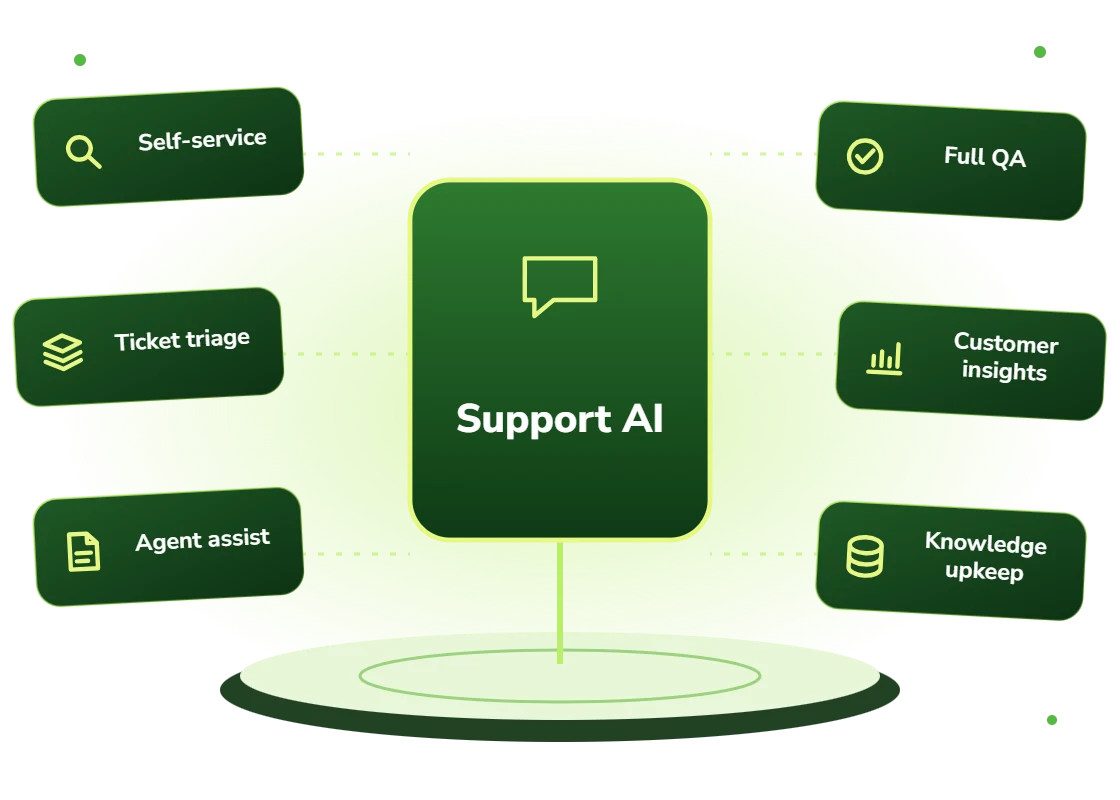
AI is used in customer support in four main ways: deflecting repetitive questions before they become tickets, triaging and routing inbound tickets automatically, drafting replies for agents to review and send, and surfacing relevant knowledge to agents while they work. The largest measured gains usually come from triage and agent assist rather than from full deflection.

7+
Years building AI systems
240+
Projects delivered
4.8
Avg. months to payback
38
U.S. states served
The Problem

Deflection metrics that hide a worse experience

It is trivial to raise a deflection rate: make it hard to reach a person. The number improves, and the customers who gave up show up later as churn, chargebacks or a bad review.

The second failure is subtler. Support AI is deployed on the wrong part of the job. Most agent time is not spent typing; it is spent finding context and deciding what applies. Automating the typing saves the smallest part.

Our Approach

Target the context gathering, measure the resolution

We instrument the queue first and find where the minutes actually go. In most teams it is context assembly: checking the account, the order, the history and the policy before writing anything.

So we automate that, then layer deflection only where it genuinely resolves. Success is measured on resolution rate and repeat-contact rate within 72 hours, which is the metric that catches customers who gave up.

Illustration of alternating messages in a chat conversation
Service Overview

Customer support AI solutions: scope and deliverables

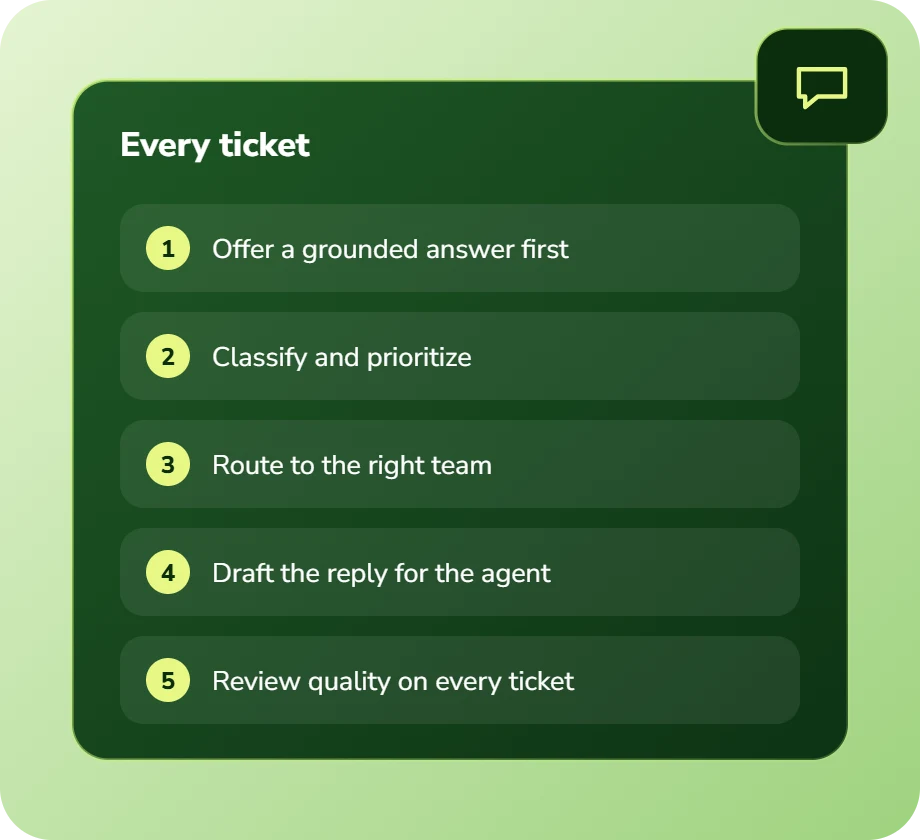
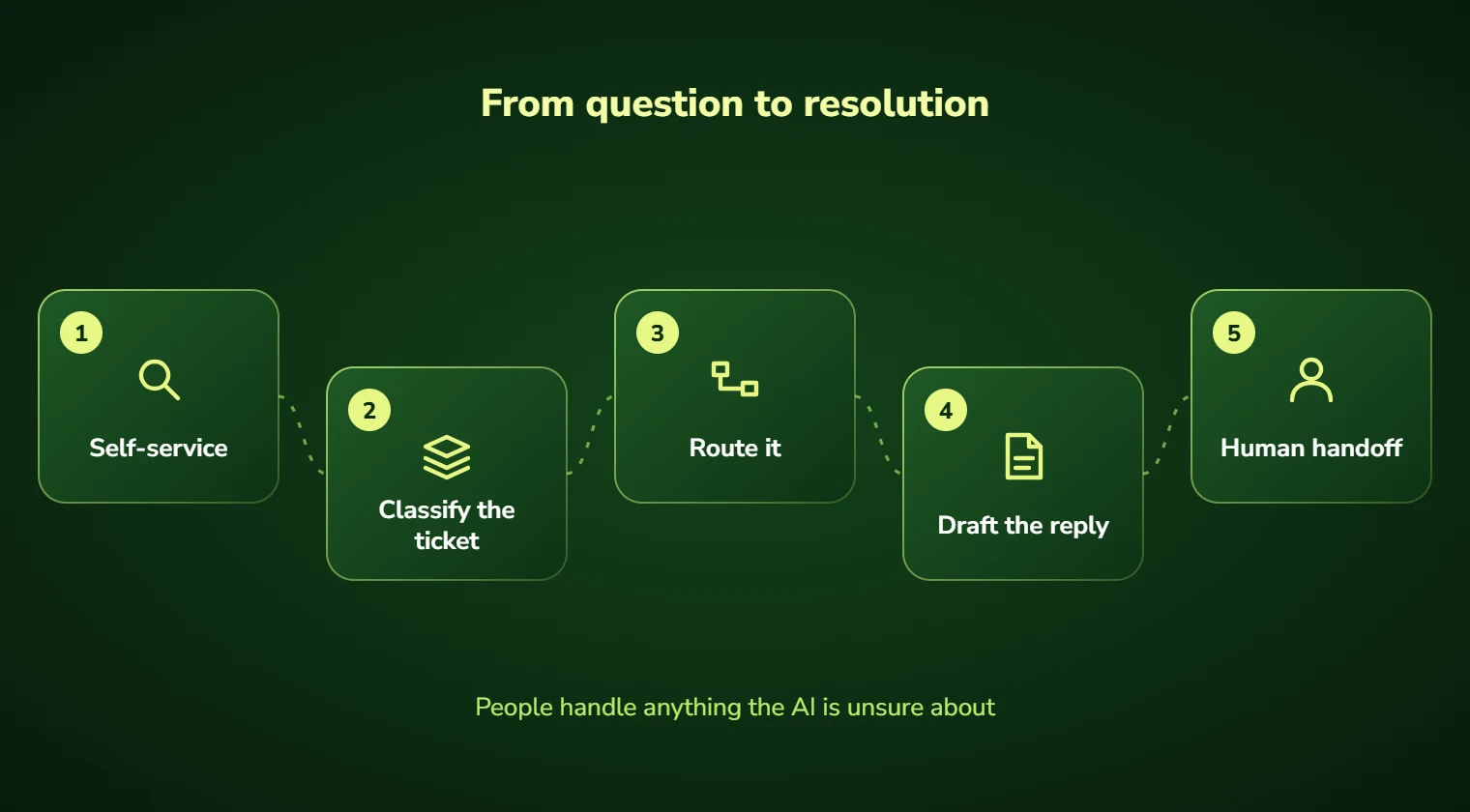
Deflection prevents a ticket from being created, and works best on high-volume repetitive questions where the answer is genuinely in your documentation.

Triage routes and prioritizes what does arrive, which is usually the highest-return intervention because misrouted tickets are the largest single cause of slow resolution.

Agent assist drafts replies and surfaces relevant knowledge and account context. Quality assurance reviews conversations at full coverage rather than the two percent sample a human QA team can manage.

We usually recommend starting with triage and agent assist, because they improve the experience for everyone rather than gating access to help.

  • Deflection: grounded self-service before a ticket is raised
  • Triage: classification, priority, routing and duplicate detection
  • Agent assist: drafted replies, surfaced knowledge, account context assembled
  • Quality assurance: every conversation reviewed rather than a small sample
  • Voice-of-customer analysis: themes, emerging issues and content gaps
  • Knowledge maintenance: gaps identified from real unanswered questions
Right Fit

Support teams that benefit most

Volume matters less than repetition. A team handling 300 varied tickets a week may gain more from agent assist than one handling 3,000 near-identical ones gains from deflection.

The strongest signal is agents spending more time gathering context than responding. If your average handle time is dominated by lookups, the return is immediate and large.

  • Teams where average handle time is dominated by context gathering
  • Support queues with a long tail of misrouted or reassigned tickets
  • Operations with seasonal spikes that currently require temporary agents
  • Companies growing customer count faster than they can hire support staff
  • Teams with high agent turnover where ramp time is a recurring cost
  • Organizations sampling only a fraction of conversations for quality review
Benefits

Benefits of customer support AI

Faster first response

Triage and drafting remove the delay between arrival and action, which is usually most of the elapsed time.

Shorter handle times

Context assembled before the agent opens the ticket, typically the largest single saving available in a support queue.

Fewer misroutes

Accurate classification at intake removes the reassignment loops that quietly double resolution time.

Faster agent ramp

New agents perform closer to experienced ones sooner, because the system surfaces what a veteran would already know.

Full QA coverage

Every conversation reviewed against your criteria rather than the small sample a human team can manage.

Honest measurement

Resolution and 72-hour repeat-contact rate, so improvements are real rather than artefacts of hiding the escalation button.

Problems We Solve

Business challenges this solves

01

Queue resets to a backlog daily

Overnight arrivals overwhelming the morning. Automated triage means the queue is already sorted and enriched at 9am.

02

Agents hunting for context

Minutes per ticket spent in other systems. Context assembly happens before the agent opens it.

03

Tickets bouncing between teams

Misrouting causing repeated reassignment. Classification at intake removes most of it.

04

Long ramp time for new agents

Months before a hire is productive. Agent assist compresses that materially.

05

QA covering 2% of contacts

Quality assessed on a tiny sample. Automated review covers everything against your rubric.

06

Emerging issues found too late

A product problem visible in tickets for a week before anyone notices. Theme detection surfaces it in hours.

What's Included

Features and deliverables

Everything below is in scope on a standard engagement. Nothing here is an upsell discovered halfway through the build.

01

Queue instrumentation

We measure where handle time actually goes before proposing anything, because the assumption is usually wrong.

02

Automatic classification and routing

Intent, product area, urgency and sentiment applied at intake, with routing rules and duplicate detection.

03

Context assembly

Account, order, subscription, prior tickets and relevant policy pulled together and attached before an agent opens the ticket.

04

Reply drafting

Grounded draft responses with cited sources, presented for agent review rather than sent automatically.

05

Self-service deflection

Grounded answers offered before ticket creation, with a visible path to a human at every step.

06

Automated quality review

Every conversation scored against your QA rubric, with outliers flagged for human review.

07

Theme and trend detection

Emerging issues, recurring complaints and documentation gaps surfaced from actual conversation content.

08

Helpdesk integration

Works inside Zendesk, Intercom, Freshdesk, Salesforce Service Cloud or your existing platform rather than replacing it.

Technology Stack

Technologies we use for customer support AI

We are not tied to one vendor. Model and infrastructure choices are made on accuracy, cost per task, latency, and where your data is allowed to live.

Language Models
C
Claude (Anthropic)
G
GPT (OpenAI)
G
Gemini (Google)
L
Llama
M
Mistral
A
Azure OpenAI Service
Vector & Retrieval
P
Pinecone
W
Weaviate
Q
Qdrant
p
pgvector
E
Elasticsearch
A
Amazon OpenSearch
Data & Backend
P
Python
T
TypeScript / Node.js
P
PostgreSQL
S
Snowflake
d
dbt
A
Apache Airflow
Business Systems
S
Salesforce
H
HubSpot
N
NetSuite
M
Microsoft 365
S
Slack
Z
Zapier / Make
How We Work

Our AI development process

The same five stages on every engagement, so you always know what happens next and what you get at the end of it.

01

Discovery

We interview the people doing the work, map the workflow end to end, and audit the systems and data behind it.

02

AI Strategy

Every opportunity gets scored on cost to build, time to value, and annual savings, then ranked.

03

Pilot Build

We ship the top-ranked automation as a fixed-scope pilot so you see real output before committing further budget.

04

Implementation

Integration with your live systems, staff training, human-in-the-loop review gates, and a documented rollback path.

05

Optimization

Monthly accuracy reviews, prompt and retrieval tuning, and a written report on hours and dollars saved.

Timeline

How long it takes

A typical first engagement, week by week. Complex integrations and regulated environments extend this, and we say so during discovery rather than after.

Weeks 1 to 2

Discovery and scoping

Process observation, systems audit, data review, and a written estimate of cost and expected saving before anything is built.

Week 3

Design sign-off

Architecture, data handling rules, review thresholds and success measures agreed in writing.

Weeks 4 to 7

Build and integration

Development against your real data, connected to your live systems, with weekly demos rather than a single reveal.

Week 8

Parallel run and testing

The system runs alongside the existing process so accuracy can be compared directly before anyone depends on it.

Weeks 9 to 10

Launch and handover

Cutover with a rollback path, staff training, full documentation, then 30 days of included tuning.

Who We Work With

Industries we deliver customer support AI for

Retail & E-commerce

Product data enrichment, demand forecasting, support deflection, and personalized merchandising.

SaaS & Technology

AI features inside your product, support deflection, onboarding assistants, and usage analytics.

Insurance

First-notice-of-loss intake, claims triage, policy Q&A, and fraud signal detection.

Financial Services

Document extraction, reconciliation, KYC support, and audit-ready reporting with full traceability.

Logistics & Supply Chain

Document processing, carrier communication, exception handling, and inventory rebalancing.

Healthcare

Intake, prior authorization, clinical documentation, and revenue-cycle workflows built to respect HIPAA boundaries.

Education

Enrollment support, content generation, tutoring assistants, and administrative automation.

Professional Services

Proposal drafting, timesheet capture, research synthesis, and client reporting at scale.

Use Cases

Real-world use cases

01

Order and shipping enquiries

Live status lookups answering the highest-volume, lowest-value question category before it becomes a ticket.

02

Technical troubleshooting assist

Error logs and account configuration assembled with likely causes ranked from prior resolved tickets.

03

Billing and subscription queries

Invoice history and plan details assembled, with drafted explanations for the agent to verify and send.

04

Escalation prediction

Conversations likely to escalate flagged early so a senior agent intervenes before the customer becomes frustrated.

05

Seasonal surge handling

Peak volume absorbed through triage and deflection without hiring and retraining temporary agents each year.

06

Multilingual support

Tickets in any language classified, drafted and answered without a separate language-specific team.

Why DevSolutionsAI

Why choose DevSolutionsAI for customer support AI

Business case before build

Every recommendation carries an estimated cost, timeline, and annual savings figure. If the math does not work, we say so before you spend.

Vendor-neutral by design

We resell nothing and take no platform commissions. Model and infrastructure choices are made on fit, cost, and your data-residency rules.

Fixed-scope pilots

The first engagement is a defined deliverable at a defined price, not an open-ended retainer that quietly grows each quarter.

Built for handover

You own the code, the prompts, the infrastructure, and the documentation. No lock-in to a proprietary wrapper you cannot leave.

Human-in-the-loop where it counts

Anything customer-facing, clinical, financial, or legal gets a review gate, a confidence threshold, and a logged audit trail.

Security reviewed early

Data flow diagrams, retention rules, and access boundaries are agreed in week one, not retrofitted after your security team objects.

Get Started

Find out what customer support AI would cost you, before you commit to anything

Every engagement is quoted after a short discovery, so you get a fixed written price built around your actual volumes rather than a rate card that assumes someone else’s business.

The first call is thirty minutes and free. Bring one workflow. We will tell you what it is likely costing you each year, roughly what automating it would take, and whether we think it is worth doing at all.

  • A written savings estimate before any paid work
  • Fixed scope and fixed price, agreed up front
  • Full ownership of everything we build for you
  • An honest recommendation when the numbers do not work
What clients typically see
Across recent projects
Staff hours saved each week
31
Months to payback
4.8
Client retention
94%
Response to enquiries
4 hrs

Figures are internal measurements across recent engagements, reported to every client monthly in writing.

Illustrative project scenario

Illustrative project scenario

Subscription e-commerce · 60 agents

Cutting handle time 44% without touching deflection

Challenge. A subscription retailer’s support team averaged 9.4 minutes per ticket. Instrumentation showed 5.1 of those minutes were spent gathering context across four systems before the agent wrote anything. Leadership had been quoted a deflection product; the data suggested that was the wrong first move.

What we built. Automatic classification and routing at intake, plus a context assembly layer pulling subscription status, order history, delivery tracking and prior tickets into the ticket before the agent opens it. Drafted replies were added in a second phase, always reviewed before sending.

Outcome. Average handle time fell from 9.4 to 5.3 minutes. Misroutes dropped by roughly two thirds. CSAT rose slightly, which is unusual for an efficiency project and is attributed to agents having full context on first reply. No deflection was deployed in phase one.

9.4 → 5.3 min
Average handle time
−66%
Ticket misroutes
+3 pts
CSAT change
0%
Deflection in phase one

Illustrative project scenario. The figures demonstrate how a project could be scoped and evaluated; they are not verified client results or an audited average.

Client Feedback

What clients say about working with us

31
Avg. staff hours saved weekly
4.8
Avg. months to payback
94%
Client retention
4
Hour response to enquiries
Common Questions

Customer Support AI FAQs

It can, if you deploy deflection badly, hiding the path to a human reliably raises deflection and lowers satisfaction at the same time. Triage, context assembly and agent assist carry almost no experience risk because the customer still reaches a person, just faster and better informed. We generally recommend starting there and adding deflection only once the knowledge layer is measurably accurate.

Resolution rate, not containment. We count a conversation as resolved only if it ends without escalation and without a repeat contact from the same customer within 72 hours. That single change catches the customers who gave up, which vanity deflection metrics quietly count as successes.

In our engagements it usually absorbs growth rather than reducing headcount. Teams handle materially more volume with the same people, and agents spend their time on cases that need judgement rather than on lookups. If reduction is your explicit goal we will tell you honestly what the numbers support rather than implying more than the data does.

Yes. We build into Zendesk, Intercom, Freshdesk, Salesforce Service Cloud, HubSpot and most other platforms rather than replacing them. Replacing a helpdesk is a separate and much larger project, and bundling it into an AI engagement is a common way for both to go badly.
Triage and context assembly start around $22,000 and take three to five weeks. A fuller programme with agent assist and deflection runs $45,000 to $90,000. Payback is usually four to seven months for teams above roughly fifteen agents, and we produce the estimate from your own queue data during discovery rather than from a benchmark.

Anything customer-facing is grounded in your own documentation with citations, and drafted replies are reviewed by an agent before sending in the first phase. We only move to autonomous sending on categories where measured accuracy over a sustained period justifies it, and each category is enabled separately rather than all at once.

Service Areas

Customer Support AI across the United States

We deliver customer support ai remotely to clients nationwide, with on-site workshops available in major metros.

Ready to scope your customer support AI project?

Book a free 30-minute consultation. Bring one workflow and leave with a realistic estimate of what it would cost to automate and what it would save.

Free 30-minute consultation
Fixed-scope pilots
U.S.-based team
Custom, not off-the-shelf
SOC 2-aligned practices
ROI tracked in writing
Free 30-minute AI consultation