Finance automation services that keep the controls your auditors expect
Our finance automation services cut the manual matching, reconciliation and commentary work out of accounts payable, close and reporting. Because we set permissions, segregation of duties, review gates and audit trails first, the controls your auditors expect stay intact.
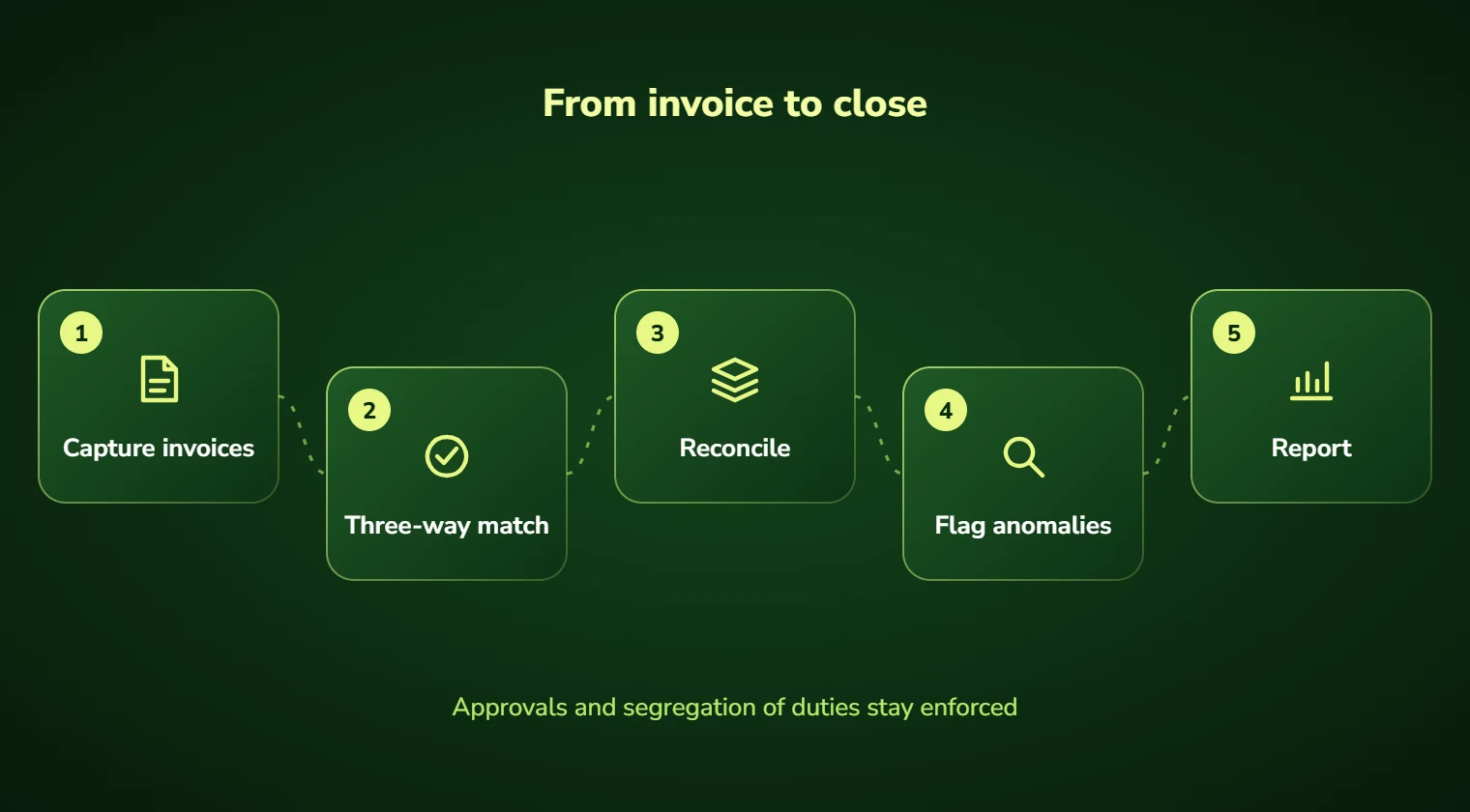
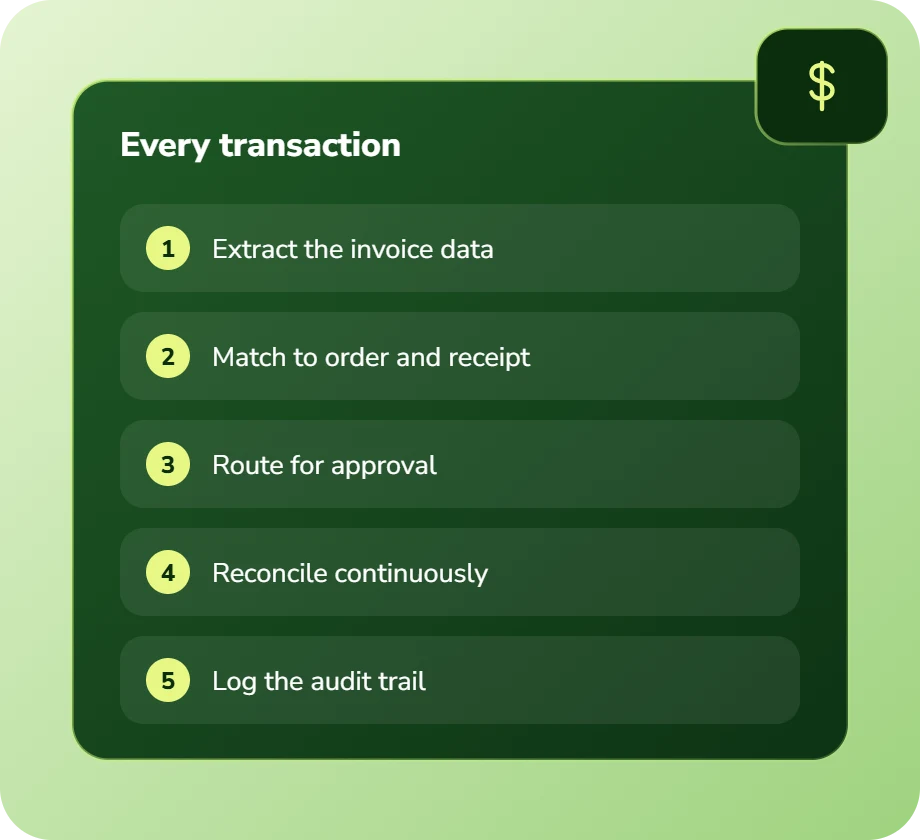
AI finance automation applies language and vision models to finance operations. In practice, it means extracting data from invoices and statements, three-way matching, reconciling accounts, flagging anomalies and generating reporting commentary. Because we design controls first, our finance automation services preserve segregation of duties, approval thresholds and audit trails.
Diagram showing information extracted from a document into structured fields
Diagram showing information extracted from a document into structured fields
The Problem
Close takes two weeks and nobody knows why until it does not finish
Month-end close is a sequence of manual reconciliations, chased approvals and spreadsheet assembly. Each individual step is small; however, the queue time between them is what makes close take two weeks.
Similarly, accounts payable has the same shape. Staff match invoices by hand against purchase orders and receipts, and discrepancies get caught late or not at all.
Our Approach
Automate the matching, keep the approvals
Extraction, matching and reconciliation are mechanical and automate well. Our finance automation services then surface anomalies and exceptions with supporting evidence attached, so a person reviews rather than searches.
However, approvals, journal postings above threshold and anything requiring judgment stay human. The system, not convention, enforces the segregation of duties your control environment requires.
Service Overview
What our finance automation services include
Accounts payable is usually the first and clearest win: invoice extraction regardless of supplier format, three-way matching against purchase orders and receipts, and automatic posting of clean invoices with exceptions routed for review.
Reconciliation is the second: bank, intercompany and subledger reconciliation performed continuously rather than in a month-end crush, with unmatched items surfaced as they arise.
Finally, reporting and commentary is the third: variance analysis and narrative explanation drafted from the underlying data, reviewed by the controller rather than written from scratch.
Throughout, our finance automation services design the control environment first. This matters because automation that removes segregation of duties creates an audit finding regardless of how much time it saves.
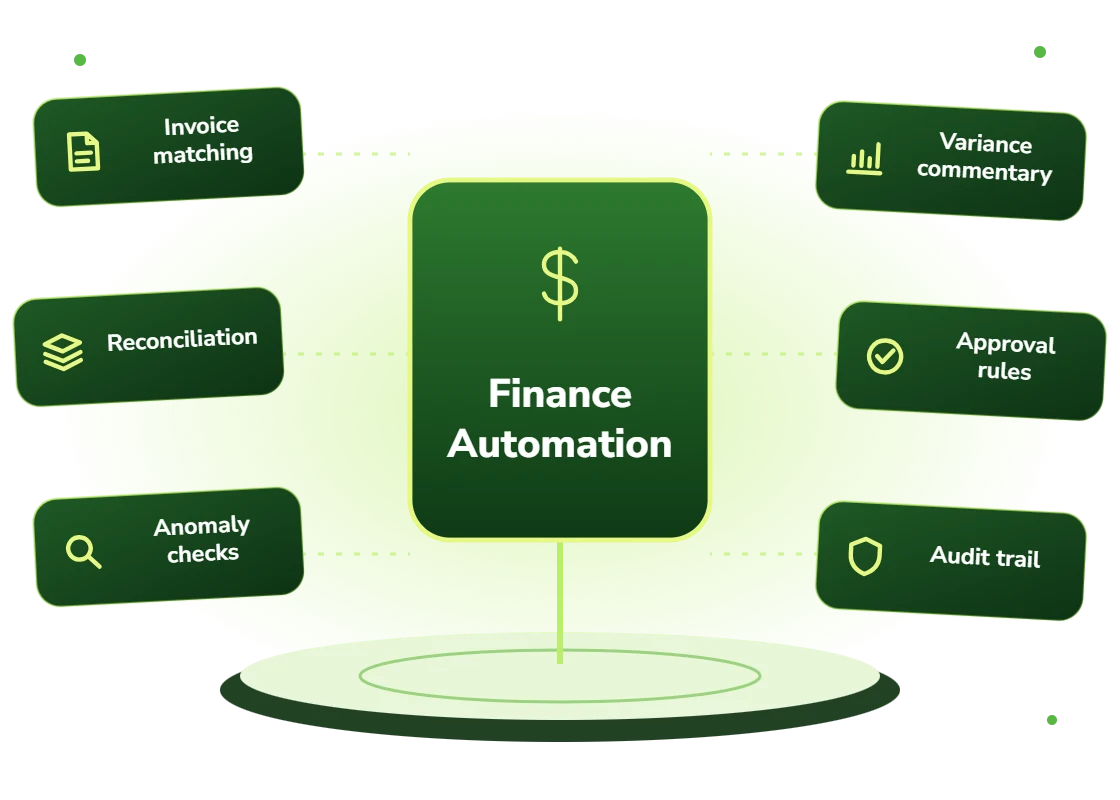
Our AI finance automation covers accounts payable automation, invoice approval workflows and financial reconciliation automation, with automated financial reporting drafted from your actual data.
Invoice extraction and three-way matching across varied supplier formats
Continuous reconciliation with exceptions surfaced as they arise
Anomaly detection on transactions, coding and vendor behavior
Variance analysis and reporting commentary drafted from actual data
Approval workflows with thresholds and segregation of duties enforced
Complete audit trail on every automated action and its inputs
Right Fit
Is finance automation right for your business?
Teams where close consistently takes longer than target and the cause is queue time and manual reconciliation rather than genuine complexity.
Also, accounts payable functions processing significant invoice volume across many suppliers, where template-based capture has never covered the long tail.
Financial process automation and finance workflow automation suit teams whose close takes too long because matching and reconciliation are still done by hand.
Finance teams whose close takes longer than target consistently
AP functions processing over 300 invoices monthly across many suppliers
Organizations reconciling multiple bank accounts or entities manually
Companies where discrepancies are found late in the cycle or not at all
Finance teams assembling reporting commentary manually each period
Businesses that have received audit findings on manual control weaknesses
Benefits
What finance automation can do for your business
Faster close
Continuous reconciliation removes the month-end crush, and most of the gain is queue time rather than task time.
Discrepancies found early
Matching exceptions surfaced at receipt rather than during reconciliation, when correction is cheap.
Controls preserved
Segregation of duties and approval thresholds enforced by the system, which is stronger than by convention.
Audit trail as a by-product
Every automated action logged with its inputs, so audit evidence is continuous rather than assembled under deadline.
AP coverage across the long tail
Suppliers no template ever covered handled from their first invoice.
Commentary drafted, not written
Variance narratives produced from actual data for the controller to review rather than compose.
Problems We Solve
Problems finance automation solves
01
Close taking too long
Sequential manual reconciliation. Continuous processing removes the month-end concentration.
02
Invoice matching by hand
AP staff comparing documents manually. Automated three-way matching handles the routine majority.
03
Discrepancies found at reconciliation
Errors surfacing weeks after the transaction. Validation at receipt catches them immediately.
04
Audit findings on manual controls
Weaknesses in manual processes. System-enforced controls with logging address them directly.
05
Commentary written from scratch
Controllers composing variance narratives monthly. Drafting from data leaves review rather than writing.
06
Supplier long tail still manual
Template capture covering only major suppliers. Template-free extraction covers everyone.
What's Included
What every finance automation engagement includes
Everything below is in scope on a standard engagement. In short, nothing here is an upsell you find halfway through the build.
01
Invoice extraction
Template-free capture of header and line-item data across any supplier format, including scans and email attachments.
02
Three-way matching
Automated matching against purchase orders and goods receipts with configurable tolerance thresholds.
03
Continuous reconciliation
Bank, intercompany and subledger reconciliation performed as transactions arrive rather than at period end.
04
Anomaly detection
Unusual amounts, duplicate payments, coding inconsistencies and vendor behavior changes flagged for review.
05
Approval workflow
Threshold-based routing with delegation, escalation and enforced segregation of duties.
06
Reporting commentary
Variance analysis and narrative explanation drafted from underlying data for controller review.
07
Audit trail
Complete logging of every automated action, its inputs, confidence and outcome, exportable for audit.
08
ERP integration
Direct posting into NetSuite, SAP, Microsoft Dynamics, Sage, QuickBooks or your existing finance system.
Technology Stack
Which AI models and tools do we use for finance automation?
We do not tie our finance automation services to one vendor. Instead, we choose models and infrastructure on accuracy, cost per task, latency, and where your data is allowed to live.
Language Models
C
Claude (Anthropic)
G
GPT (OpenAI)
G
Gemini (Google)
L
Llama
M
Mistral
A
Azure OpenAI Service
Agent & Orchestration
M
Model Context Protocol
L
LangGraph
L
LangChain
L
LlamaIndex
T
Temporal
C
Celery
Data & Backend
P
Python
T
TypeScript / Node.js
P
PostgreSQL
S
Snowflake
d
dbt
A
Apache Airflow
Business Systems
S
Salesforce
H
HubSpot
N
NetSuite
M
Microsoft 365
S
Slack
Z
Zapier / Make
How We Work
How we deliver finance automation, step by step
Every finance automation engagement follows the same five stages. We design the control environment before we automate a single step.
01
Discovery
First, we observe your close, AP and reconciliation work and audit the systems and data behind it.
02
AI Strategy
Next, we score candidates like AP matching or bank reconciliation on cost, time to value and annual savings.
03
Pilot Build
Then we pilot the top workflow, usually accounts payable, as a fixed-scope build with controls designed first.
04
Implementation
After sign-off, we connect to your ERP, enforce approval thresholds and segregation of duties, and train your staff.
05
Optimization
Finally, we review matching accuracy and exception rates monthly and report the hours and dollars saved in writing.
Get Started
How much does a finance automation project cost?
Finance automation services are priced on your transaction volume, the systems involved and the controls each step must keep. You get a fixed written price before we start, and an estimate of the days it takes off your close.
Book a free 30-minute call and tell us where your close slows down. We will show you what can be automated while keeping every control your auditors expect.
A written savings estimate before any paid work
Fixed scope and fixed price, agreed up front
Full ownership of everything we build for you
An honest recommendation when the numbers do not work
It will if it removes segregation of duties, which is the most common way finance automation fails audit. We design the control environment before automating and recommend involving your auditors early. For example, auditors on a recent engagement reviewed the approach before build. Afterward, they noted the audit trail was stronger than the manual process it replaced. Automation that logs every action with its inputs is generally an improvement in evidence, not a weakening.
Only within thresholds you set, and never for anything requiring judgment. Clean invoices matching within tolerance can post automatically; anything outside tolerance, unusual, or above a value threshold routes for human approval. In both cases, the system enforces approval authority and segregation of duties, which is stronger than relying on process discipline.
Correctly, on the first one. Template-free extraction reads documents by understanding their content rather than matching coordinates. As a result, a new supplier needs no setup, and an existing supplier redesigning their invoice does not break anything. This is usually where the majority of remaining manual AP effort sits.
Yes, NetSuite, SAP, Microsoft Dynamics, Sage Intacct, QuickBooks and most others through their APIs, or through file-based interfaces for older systems. We post into your existing finance system rather than requiring migration.
Detection runs across suppliers, formats and reference variations, which catches duplicates that exact matching misses. For example, it flags one invoice submitted twice under a slightly different reference, or sent by both email and post. For most clients this is one of the more immediately quantifiable returns.
It depends on transaction volume, your finance systems and the controls involved. You get a fixed written price before we start, and every automated step keeps an audit trail. Book a free 30-minute consultation to scope it.
Ready to scope your finance automation project?
Book a free 30-minute consultation. Bring one workflow. You will leave with a realistic estimate of what it would cost to automate and what it would save.