
RAG development services grounded in your documents
Our RAG development services give you answers from your own documents, each with a citation you can check in seconds. We build the retrieval, source citations and evaluation, and we are upfront that grounding reduces errors rather than eliminating them.
We reply within 4 business hours.
What is RAG (retrieval augmented generation)?
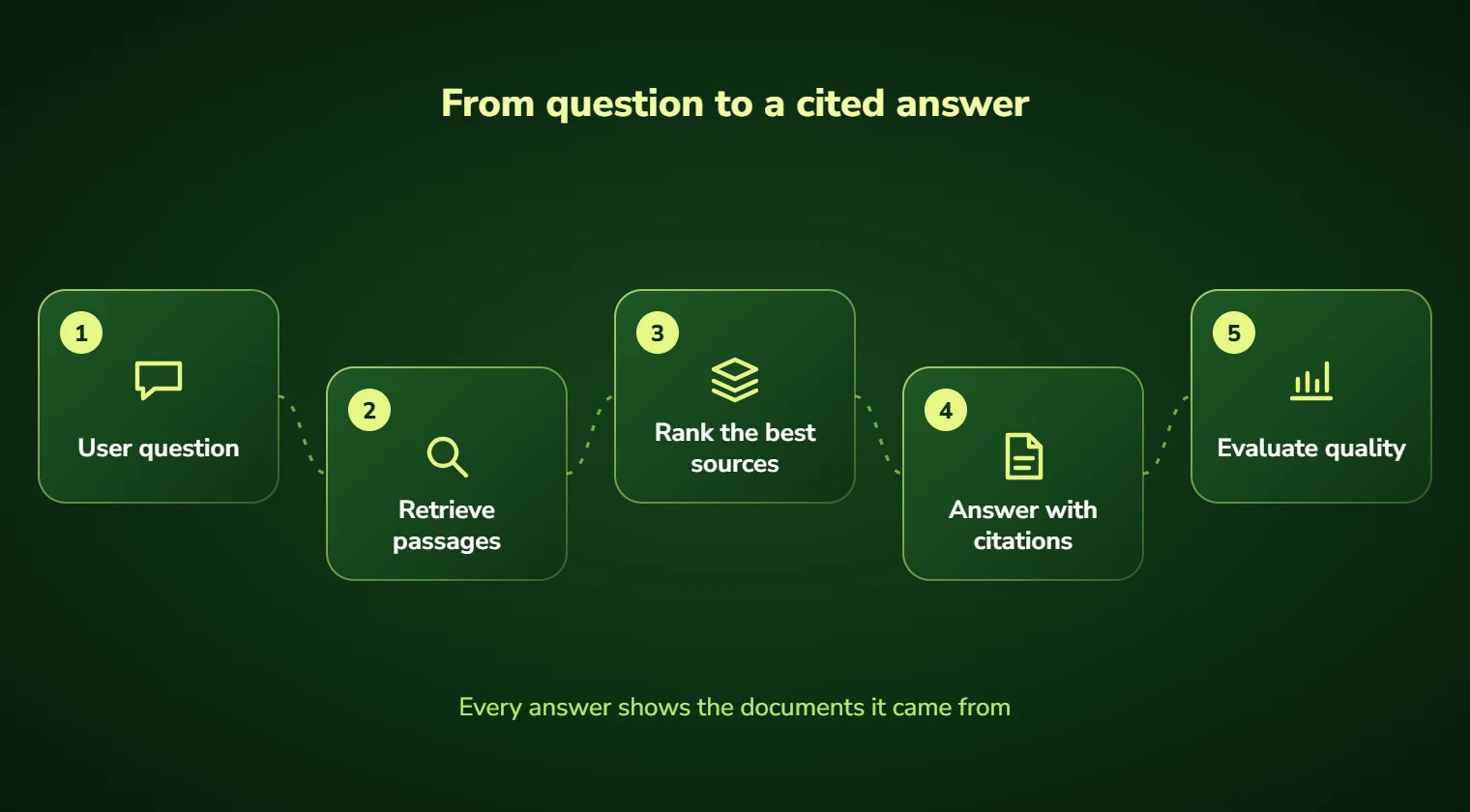
Retrieval-augmented generation is an architecture in which a language model retrieves relevant passages from a specific document collection before answering. It then generates its response from those passages, with citations. As a result, answers rest on verifiable source material rather than model training data. That substantially reduces fabrication and lets anyone check the answer.
Confident answers that are quietly wrong
A language model without retrieval answers from what it absorbed during training. Ask it about your return policy and it will produce something that sounds exactly like a return policy. After all, it has read thousands. It just will not be yours.
This is worse than a refusal, because it is undetectable to the person asking. The failure mode is not obvious nonsense; it is plausible, well-formatted and wrong.
Retrieve first, then answer, and cite the source
RAG inverts the order. First, the system finds the relevant passages in your own document collection. Then it generates an answer constrained to what it retrieved, with a citation back to the source paragraph.
The engineering that matters is retrieval quality, not the model. If retrieval misses the right passage, no model can produce a correct answer. That is why our RAG development services evaluate retrieval separately from generation and report both.
What our RAG development services include
Building a demo RAG system takes an afternoon. However, building one that holds up on a real corpus of a hundred thousand heterogeneous documents is a different problem. It is where most implementations quietly fail.
The usual causes are unglamorous. Chunking splits a clause from its qualifier, and embeddings miss domain vocabulary. Nothing handles document versions, so the system cites a superseded policy. Meanwhile, there is no evaluation, so nobody notices any of it.
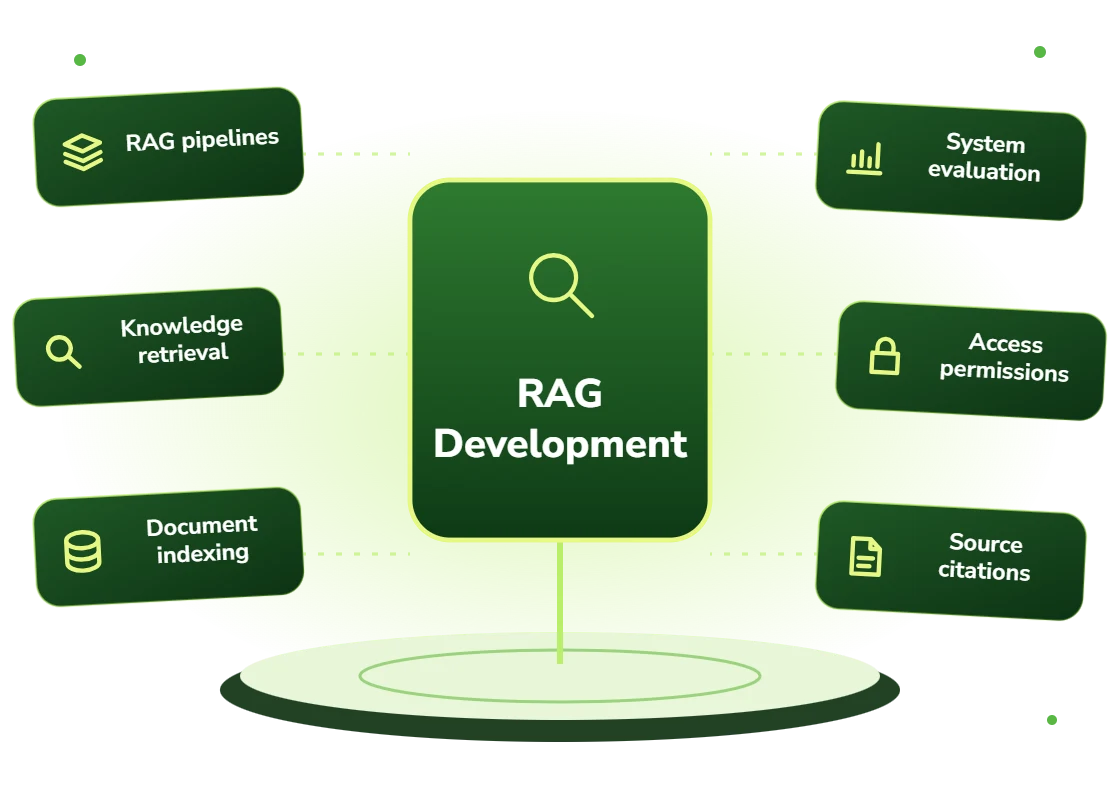
Our RAG development services treat retrieval as the primary engineering problem. That means hybrid search combining semantic and keyword matching, reranking, metadata filtering and version awareness. It also means an evaluation set built from your real questions with known correct answers.
Our retrieval augmented generation services cover custom RAG development and RAG application development: RAG pipeline development, enterprise knowledge retrieval, document retrieval for LLMs and RAG system evaluation on real questions.
- Document ingestion handling PDFs, scans, spreadsheets, email and web content
- Structure-aware chunking that respects sections, clauses and tables
- Hybrid retrieval: semantic embeddings plus keyword search, then reranking
- Metadata filtering by date, department, document type and access permission
- Version and supersession handling so the system never cites a retired policy as current
- Evaluation harness with real questions and known answers, scored continuously
Is RAG development right for your business?
RAG suits any situation where answers must come from a specific, authoritative body of content and be verifiable afterwards. Regulated industries are the obvious case. However, so is any technical business whose documentation is too large for anyone to hold in their head.
It is the wrong choice when the knowledge is small and static. If everything fits comfortably in a prompt, that is simpler and cheaper. RAG development services are also the wrong fit when the task needs reasoning over data rather than retrieval of text. In that case, a database query beats semantic search.
- Organizations whose answers must be traceable to an authoritative document
- Businesses with documentation too large for staff to know completely
- Regulated firms where citing the wrong policy version has consequences
- Support and technical teams answering from a large product knowledge base
- Companies with decades of accumulated institutional documents
- Any AI deployment where fabricated answers would be materially damaging
What RAG development can do for your business
Answers you can verify
Every response cites the source passage, so a reader can check it in seconds rather than trusting the system.
Fabrication substantially reduced
Constraining generation to retrieved passages removes the largest category of AI error in business use.
Current, not frozen
Update the document and the answer updates. No retraining, no model fine-tuning cycle, no waiting.
Permission-aware
Retrieval respects existing access rights, so people only get answers from documents they are entitled to see.
Measured, not assumed
An evaluation harness scores retrieval and answer accuracy continuously, so quality drift is visible.
Cheaper than fine-tuning
For factual knowledge, retrieval beats fine-tuning on cost, speed of update and auditability.
Problems RAG development solves
AI that invents your policies
Plausible answers that are not yours. Grounding with citation makes fabrication both rarer and detectable.
Documentation nobody can navigate
Answers exist but are unfindable across thousands of files. Semantic retrieval finds them by meaning.
Superseded documents cited as current
Old policy versions surfacing as answers. Version awareness and supersession rules prevent it.
Permissions ignored by search
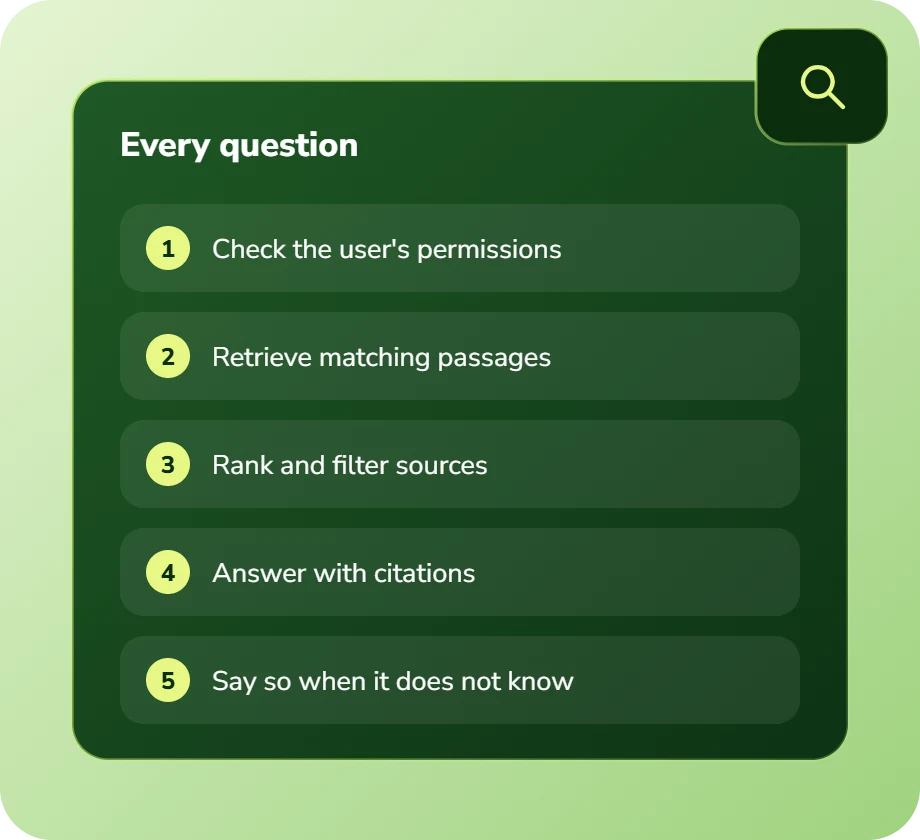
AI surfacing content a user should not see. Retrieval filters by existing access rights before generating.
No way to tell if it is accurate
Systems deployed on vibes. Evaluation sets with known answers give an actual accuracy number.
Fine-tuning that costs more and updates slower
Retraining to teach facts. For factual knowledge, retrieval is cheaper, faster to update and auditable.
What every RAG development engagement includes
Everything below is in scope on a standard engagement for our RAG development services. Nothing here is an upsell you discover halfway through the build.
Document ingestion pipeline
Handling PDFs, scanned images, Office files, spreadsheets, email archives, wikis and web content, with incremental sync as sources change.
Structure-aware chunking
Splitting that respects headings, clauses, tables and list structure, because naive fixed-size chunking separates rules from their exceptions.
Hybrid retrieval
Dense semantic search combined with sparse keyword matching, so search finds exact identifiers and part numbers alongside conceptual matches.
Reranking
A second-stage model reordering candidates by actual relevance, typically the single highest-return improvement to a mediocre RAG system.
Metadata and permission filtering
Filtering by document type, date, department, jurisdiction and user access rights before retrieval, not after.
Citation and source linking
Every answer linked to the specific passage and document version it came from, with a direct link to the source.
Evaluation harness
A test set of real questions with known correct answers, scoring retrieval recall and answer accuracy on every change.
Freshness and version control
Detecting superseded documents, handling effective dates, and stopping the system from presenting retired content as current.
Which AI models and tools do we use for RAG development?
We are not tied to one vendor. Instead, we choose models and infrastructure on accuracy, cost per task, latency, and where your data is allowed to live.
How we deliver RAG development, step by step
Every RAG project follows the same five stages. You always know what happens next and what you get at the end.
Discovery
First, we audit your documents for volume, format, quality and version chaos, and collect the questions your team asks.
AI Strategy
Next, we score each retrieval use case on cost to build, time to value and annual savings, then rank them.
Pilot Build
Then we build a fixed-scope pilot on your real corpus and score it against an evaluation set of known answers.
Implementation
After that, we connect retrieval to your live systems with permission filtering, citations, review gates and a documented rollback path.
Optimization
Finally, we review accuracy monthly, tune retrieval and prompts, and report the hours and dollars saved in writing.
How is a RAG development project priced?
RAG development services are priced on the document sources, the access rules and the evaluation you need. You get a fixed written price before we start, with answer quality measured on real questions from your team.
Book a free 30-minute call and bring a few questions your team asks every week. We will show you how a RAG system would answer them and cite its sources.
- A written savings estimate before any paid work
- Fixed scope and fixed price, agreed up front
- Full ownership of everything we build for you
- An honest recommendation when the numbers do not work
Figures are internal measurements across recent engagements, reported to every client monthly in writing.
RAG development FAQs
What is RAG and why does it matter?
Retrieval-augmented generation makes the AI find relevant passages in your own documents before answering, then generate its response from those passages with a citation. It matters because a model without retrieval answers from training data. As a result, it produces confident, well-written, wrong answers about your specific business. RAG makes answers both more accurate and checkable.
Is RAG better than fine-tuning?
For factual knowledge, almost always yes. Retrieval updates instantly when you edit a document, supports citations, respects access permissions and costs nothing to change. Fine-tuning requires a retraining run for every knowledge update and cannot cite sources. However, fine-tuning is the better tool for teaching output format, tone or a narrow specialized task. Teams frequently combine the two.
Why do so many RAG projects disappoint?
Almost always retrieval quality rather than the model. Common causes are naive fixed-size chunking that separates a rule from its exception and embeddings that miss domain vocabulary. Others include no reranking stage, no version handling so the system cites superseded policies, and no evaluation, so nobody notices. That is why our RAG development services treat retrieval as the main engineering problem. We measure it separately from answer quality.
How do you measure whether it is accurate?
We build an evaluation set of real questions from your team with verified correct answers. Then we score two things separately. Retrieval recall asks whether the system found the right passage. Answer accuracy asks whether the response was correct given what it retrieved. Separating them matters because a bad answer from good retrieval is a different fix from a good answer the system could never have produced.
Can it handle scanned documents and handwriting?
Yes, through a vision-model parsing stage, though accuracy depends on scan quality. We test on your actual documents in week one and give you a measured figure rather than an assurance. For very poor source material, we will sometimes recommend improving the scans first. After all, retrieval cannot recover text that the scan never captured.
Does it respect who is allowed to see what?
Yes, and we design this in rather than adding it later. Permission filtering happens before retrieval, so a user’s query only searches documents they are entitled to access. By contrast, filtering after retrieval is a common implementation shortcut. It is also a genuine data-leak risk, because the model has already seen the content.
Ready to scope your RAG development project?
Book a free 30-minute consultation. Bring one workflow. You will leave with a realistic estimate of what it would cost to automate and what it would save.