Business Process Automation

Business process automation services that fixes the process first

Our business process automation services address work that spans departments and systems. We map the process, remove unnecessary steps and define controls before automating the handoffs that remain.

Free 30-minute consultation
Fixed-scope pilots
U.S.-based team
Custom, not off-the-shelf
SOC 2-aligned practices
ROI tracked in writing
What is business process automation?

Business process automation (BPA) uses technology to run an entire business process end to end rather than individual tasks within it. A BPA engagement typically maps the current process, eliminates redundant steps, then automates handoffs, approvals, data movement and notifications across the systems and departments involved.

7+
Years building AI systems
240+
Projects delivered
4.8
Avg. months to payback
38
U.S. states served
The Problem

Most processes were never designed, they accumulated

Ask why a step exists and the honest answer is usually that someone added it after a problem in 2019, the problem is long gone, and the step remains. Multiply that across a decade and you get processes with approval gates nobody reads and forms nobody uses.

Automating that as-is is the most common and expensive mistake in this field. You spend six figures making a process that should have twelve steps run its twenty-six steps very efficiently.

Our Approach

Redesign first, automate second

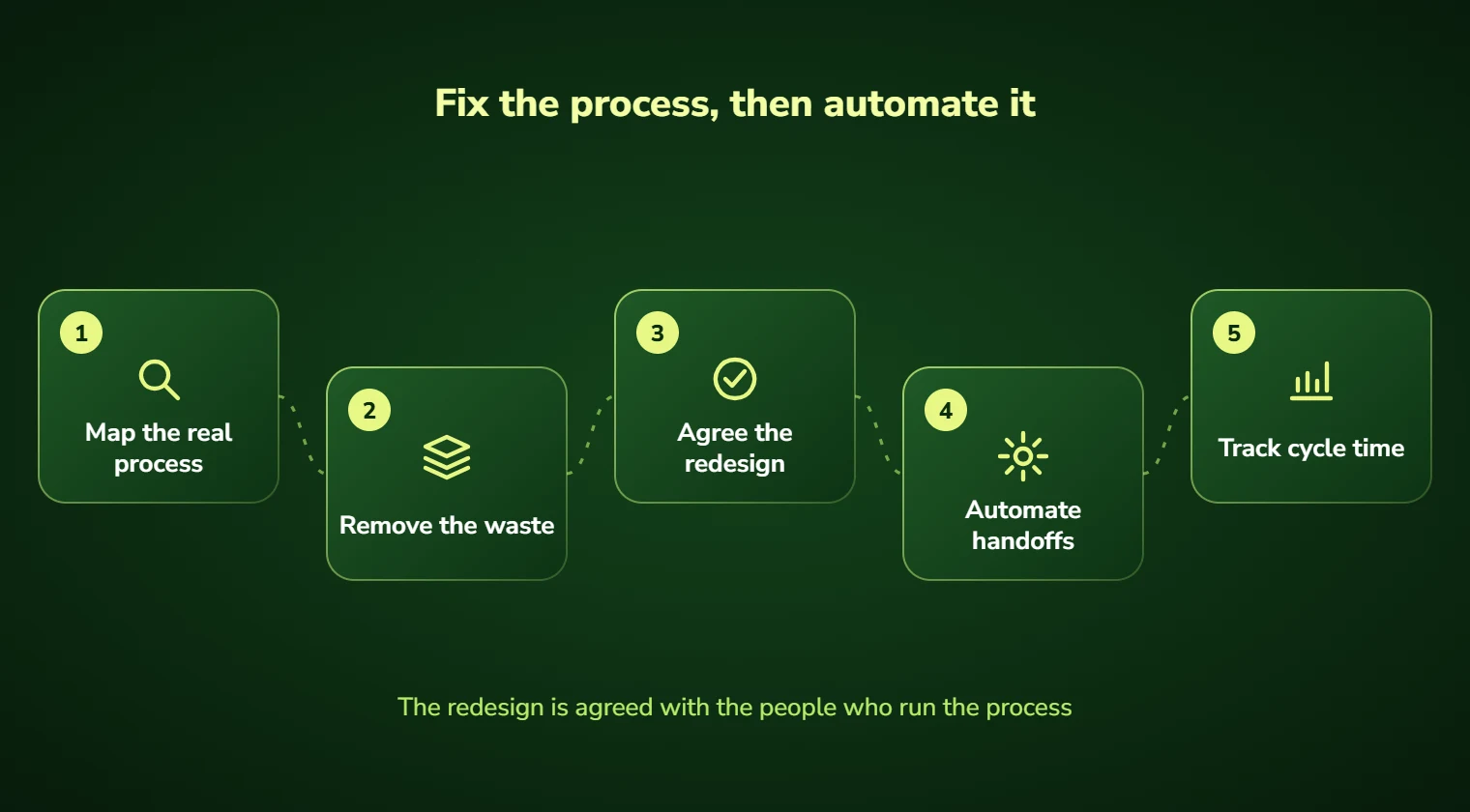
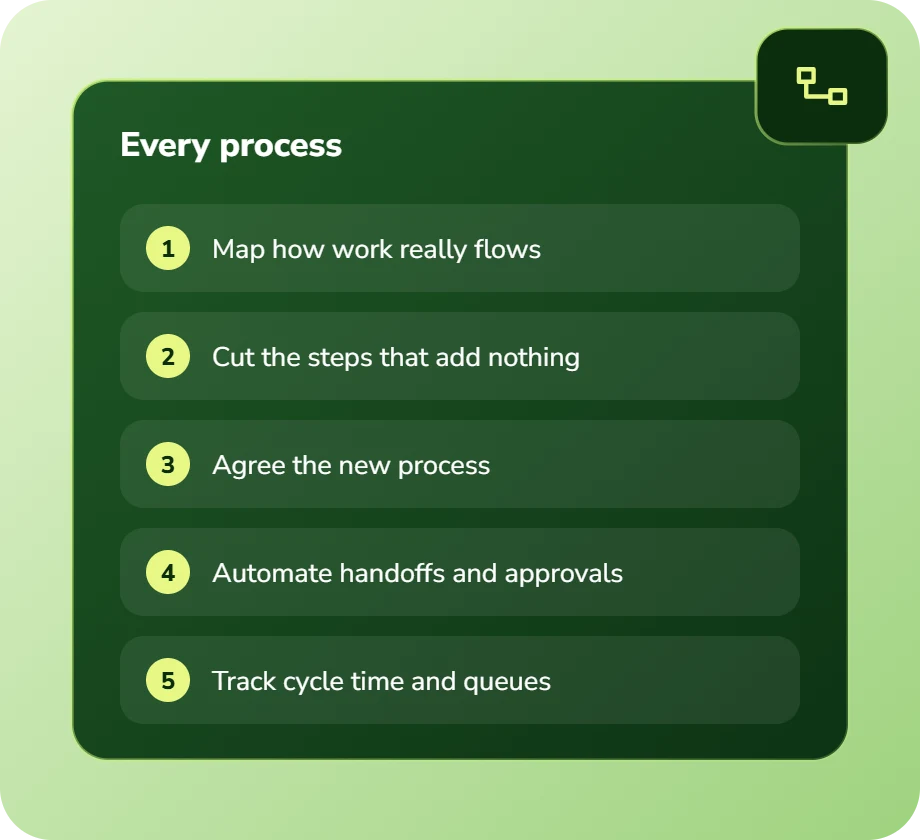
We map the process as it actually runs, including the workarounds people invented because the official route was too slow. Then we ask of every step whether it changes an outcome. The ones that do not, we remove.

What remains is usually a much smaller automation problem. Clients are routinely surprised that the redesign alone recovers a meaningful share of the time, before any technology is built.

Diagram of five connected workflow steps
Service Overview

Business process automation services: scope and deliverables

A process is not a task. Order-to-cash, hire-to-retire, procure-to-pay and claim-to-settlement all cross several departments and several systems, and the waste usually sits in the handoffs between them rather than inside any one step.

That is why we scope BPA engagements by process rather than by department. Automating accounts payable in isolation optimizes one link; automating procure-to-pay end to end removes the reconciliation work that exists because purchasing and finance never share a system.

The deliverable is both the automation and the documented process itself, which for many clients is the first accurate written record of how the work actually gets done.

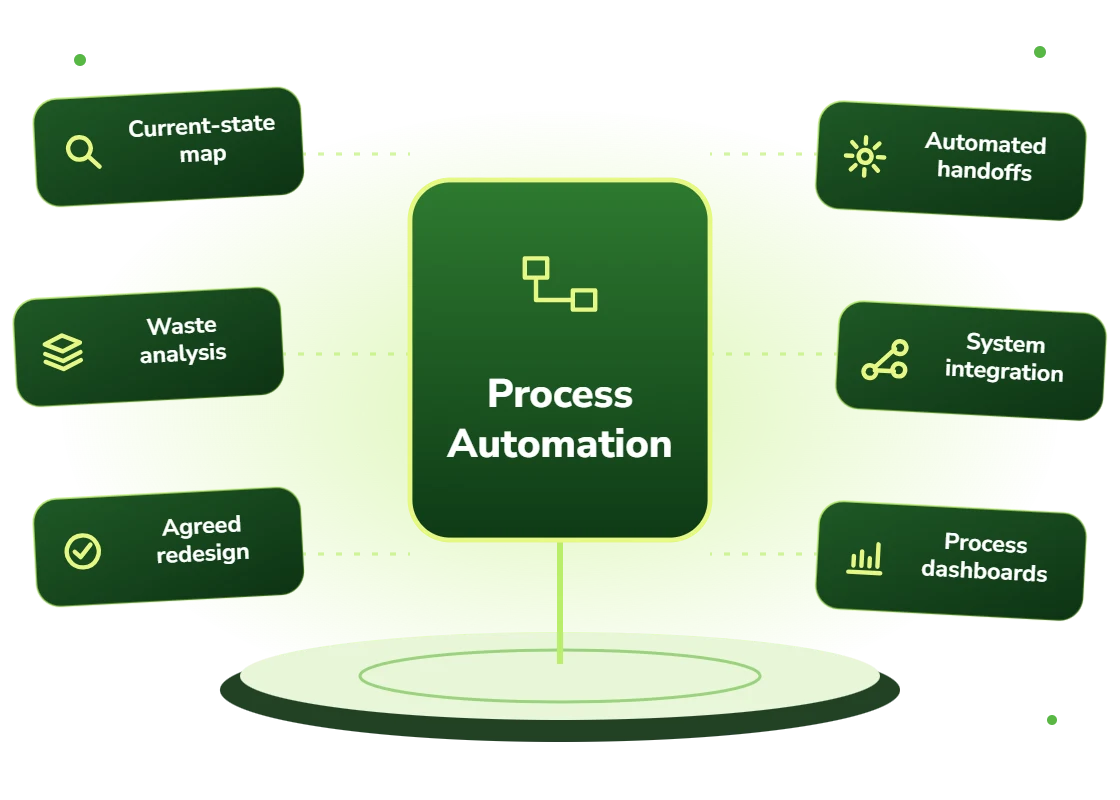
  • Current-state process mapping including undocumented workarounds
  • Waste analysis: which steps change an outcome and which are habit
  • Redesigned target-state process agreed with the people who run it
  • Automated handoffs, approvals, notifications and status tracking
  • Integration across the systems the process touches
  • Process performance dashboards showing cycle time and bottlenecks
Right Fit

When to automate a process rather than a task

If the pain is one repetitive task, a targeted automation is cheaper and faster. Process-level work earns its cost when the problem is coordination: things sitting in queues, nobody knowing what stage something is at, and rework caused by information arriving incomplete.

A reliable signal is that nobody can tell you the end-to-end cycle time. If the answer is “it depends who you ask”, the process is the problem rather than any step within it.

  • Processes crossing three or more departments or systems
  • Cycle times nobody can state accurately
  • Work that regularly stalls waiting for an approval or a document
  • Frequent rework because information arrives incomplete
  • Compliance processes where the audit trail is assembled manually
  • Post-merger operations running two versions of the same process
Benefits

Benefits of business process automation

Shorter cycle times

Removing queue time between steps usually cuts more elapsed time than speeding up the steps themselves ever could.

Visibility for the first time

Status tracking across the whole process, so “where is it?” stops being a question that requires three phone calls.

Fewer handoff errors

Most process defects are created at handoffs. Automating them removes the re-keying that causes the errors.

Capacity released, not cut

Coordination work disappears, so the same team handles materially more volume without working differently.

Audit trails built in

Compliance evidence is produced as a by-product of running the process rather than assembled afterwards under deadline.

A documented process you keep

The map itself is a deliverable. For many clients it is the first accurate written record of how the work is really done.

Problems We Solve

Business challenges this solves

01

Nobody owns the whole process

Each department owns its slice. We map end to end and name a process owner, which is often the highest-value output.

02

Work stalls invisibly in queues

Items waiting days for an approval nobody knew was outstanding. Automated routing and escalation removes the dead time.

03

Two systems, one truth, no agreement

Finance and operations reporting different numbers. We reconcile at the source rather than in a spreadsheet each month.

04

Compliance evidence assembled by hand

Audit preparation consuming weeks. Automated processes produce the trail continuously instead.

05

Post-merger process duplication

Two ways of doing everything after an acquisition. We design the target state and automate the merged version.

06

Improvement projects that never stick

Process changes that decay within months because nothing enforces them. Automation makes the new way the path of least resistance.

What's Included

Features and deliverables

Everything below is in scope on a standard engagement. Nothing here is an upsell discovered halfway through the build.

01

End-to-end process mapping

The real process including workarounds, captured from the people doing the work rather than from the procedure manual.

02

Cycle-time and bottleneck analysis

Where elapsed time actually goes, which is almost always queue time between steps rather than the steps themselves.

03

Waste elimination workshop

A facilitated session removing steps that do not change an outcome, run with the people who own them.

04

Target-state process design

The redesigned process documented and agreed before any technology decision is made.

05

Workflow orchestration build

Automated routing, approvals, notifications, SLA timers and escalation across every system the process touches.

06

Cross-system integration

Connecting the systems involved, including legacy applications where we work through the interface if there is no API.

07

Exception and escalation design

Explicit handling for the cases that do not follow the happy path, which is where unmanaged processes lose most of their time.

08

Process performance dashboard

Live cycle time, volume, bottleneck and SLA breach reporting, so process management becomes continuous rather than annual.

Technology Stack

Technologies we use for business process automation

We are not tied to one vendor. Model and infrastructure choices are made on accuracy, cost per task, latency, and where your data is allowed to live.

Language Models
C
Claude (Anthropic)
G
GPT (OpenAI)
G
Gemini (Google)
L
Llama
M
Mistral
A
Azure OpenAI Service
Agent & Orchestration
M
Model Context Protocol
L
LangGraph
L
LangChain
L
LlamaIndex
T
Temporal
C
Celery
Data & Backend
P
Python
T
TypeScript / Node.js
P
PostgreSQL
S
Snowflake
d
dbt
A
Apache Airflow
Business Systems
S
Salesforce
H
HubSpot
N
NetSuite
M
Microsoft 365
S
Slack
Z
Zapier / Make
How We Work

Our AI development process

The same five stages on every engagement, so you always know what happens next and what you get at the end of it.

01

Discovery

We interview the people doing the work, map the workflow end to end, and audit the systems and data behind it.

02

AI Strategy

Every opportunity gets scored on cost to build, time to value, and annual savings, then ranked.

03

Pilot Build

We ship the top-ranked automation as a fixed-scope pilot so you see real output before committing further budget.

04

Implementation

Integration with your live systems, staff training, human-in-the-loop review gates, and a documented rollback path.

05

Optimization

Monthly accuracy reviews, prompt and retrieval tuning, and a written report on hours and dollars saved.

Timeline

How long it takes

A typical first engagement, week by week. Complex integrations and regulated environments extend this, and we say so during discovery rather than after.

Weeks 1 to 2

Current-state mapping

Interviews, observation and data pulls to document the process as it actually runs today.

Week 3

Analysis and redesign

Bottleneck analysis, waste elimination workshop, and agreement on the target-state process.

Weeks 4 to 8

Build and integrate

Orchestration, system connections and exception handling built, with fortnightly demos.

Weeks 9 to 10

Pilot with one team

A single team or region runs the new process live while the old route stays available as a fallback.

Weeks 11 to 12

Rollout and handover

Phased rollout, training, documentation, dashboard handover and 30 days of included tuning.

Who We Work With

Industries we deliver business process automation for

Financial Services

Document extraction, reconciliation, KYC support, and audit-ready reporting with full traceability.

Insurance

First-notice-of-loss intake, claims triage, policy Q&A, and fraud signal detection.

Healthcare

Intake, prior authorization, clinical documentation, and revenue-cycle workflows built to respect HIPAA boundaries.

Manufacturing

Quality inspection, maintenance prediction, supplier communication, and production scheduling.

Professional Services

Proposal drafting, timesheet capture, research synthesis, and client reporting at scale.

Logistics & Supply Chain

Document processing, carrier communication, exception handling, and inventory rebalancing.

Construction

Bid takeoffs, submittal review, RFI drafting, and field-report summarization.

Education

Enrollment support, content generation, tutoring assistants, and administrative automation.

Use Cases

Real-world use cases

01

Procure-to-pay

Requisition, approval, purchase order, receipt, invoice matching and payment as one tracked flow rather than four disconnected ones.

02

Order-to-cash

Order capture through fulfilment, invoicing and collections, with automated exception handling at each transition.

03

Employee onboarding

Offer through equipment, accounts, training and first-day readiness, coordinated across HR, IT and facilities.

04

Claims handling

First notice of loss through triage, assessment, approval and settlement with SLA tracking at every stage.

05

Client onboarding and KYC

Document collection, verification, risk scoring and approval with a complete compliance trail generated automatically.

06

Change and RFI management

Construction and engineering change requests routed, priced, approved and recorded without spreadsheet tracking.

Why DevSolutionsAI

Why choose DevSolutionsAI for business process automation

Business case before build

Every recommendation carries an estimated cost, timeline, and annual savings figure. If the math does not work, we say so before you spend.

Vendor-neutral by design

We resell nothing and take no platform commissions. Model and infrastructure choices are made on fit, cost, and your data-residency rules.

Fixed-scope pilots

The first engagement is a defined deliverable at a defined price, not an open-ended retainer that quietly grows each quarter.

Built for handover

You own the code, the prompts, the infrastructure, and the documentation. No lock-in to a proprietary wrapper you cannot leave.

Human-in-the-loop where it counts

Anything customer-facing, clinical, financial, or legal gets a review gate, a confidence threshold, and a logged audit trail.

Security reviewed early

Data flow diagrams, retention rules, and access boundaries are agreed in week one, not retrofitted after your security team objects.

Get Started

Find out what business process automation would cost you, before you commit to anything

Every engagement is quoted after a short discovery, so you get a fixed written price built around your actual volumes rather than a rate card that assumes someone else’s business.

The first call is thirty minutes and free. Bring one workflow. We will tell you what it is likely costing you each year, roughly what automating it would take, and whether we think it is worth doing at all.

  • A written savings estimate before any paid work
  • Fixed scope and fixed price, agreed up front
  • Full ownership of everything we build for you
  • An honest recommendation when the numbers do not work
What clients typically see
Across recent projects
Staff hours saved each week
31
Months to payback
4.8
Client retention
94%
Response to enquiries
4 hrs

Figures are internal measurements across recent engagements, reported to every client monthly in writing.

Illustrative project scenario

Illustrative project scenario

Specialty insurer · 620 staff

Cutting claim cycle time from 19 days to 6

Challenge. A specialty insurer had a claims process spanning four departments and three systems. Nobody could state the end-to-end cycle time. Claims routinely sat waiting for an approval that no one knew was outstanding, and audit preparation consumed two weeks each quarter.

What we built. Twelve-week engagement: full current-state mapping, a waste workshop that eliminated seven of twenty-three steps, then an orchestration layer routing claims across all three systems with SLA timers, automated escalation and continuous audit-trail capture.

Outcome. Average cycle time fell from 19 days to 6. Around 40% of the improvement came from the redesign alone, before automation. Quarterly audit preparation dropped from two weeks to under a day because the evidence was already assembled.

19 → 6 days
Claim cycle time
7 of 23
Steps eliminated
2 wks → 1 day
Audit preparation
5.6 mo
To payback

Illustrative project scenario. The figures demonstrate how a project could be scoped and evaluated; they are not verified client results or an audited average.

Client Feedback

What clients say about working with us

31
Avg. staff hours saved weekly
4.8
Avg. months to payback
94%
Client retention
4
Hour response to enquiries
Common Questions

Business Process Automation FAQs

Task automation makes one activity faster, extracting data from invoices, for example. Business process automation covers an entire flow across departments and systems, such as procure-to-pay from requisition through payment. If your problem is one repetitive task, task automation is cheaper and quicker. If the problem is coordination, queue time and handoffs, you need the process-level engagement.

Because most processes contain steps that no longer change any outcome, and automating them means paying to run unnecessary work efficiently. On a typical engagement we eliminate around a quarter to a third of steps before writing any code, and clients frequently recover meaningful time from the redesign alone. It also makes the automation substantially cheaper to build.

Less than most leaders expect, provided they are involved in the mapping. The people doing the work usually know exactly which steps are pointless and have wanted them gone for years. Resistance appears when a process is redesigned by people who have never performed it, which is why our mapping is done by observation and interview rather than from the procedure manual.

Ten to twelve weeks for a single end-to-end process, from mapping through rollout. Multi-process programmes run sequentially rather than in parallel, because the first process teaches us things about your systems that make the second one faster and cheaper.

Almost never, and we would push back if a vendor told you otherwise. The orchestration layer sits above your existing systems and coordinates them. Where a system has no usable API we can work through its interface. Replacing core systems is a much larger and riskier project that should be justified on its own merits, not smuggled in as part of an automation programme.

We baseline cycle time, touch time, rework rate and exception volume before anything changes, then report the same measures afterwards. The dashboard we hand over tracks them continuously, so the answer does not depend on our claims or on a one-off study six months later.

Service Areas

Business Process Automation across the United States

We deliver business process automation remotely to clients nationwide, with on-site workshops available in major metros.

Ready to scope your business process automation project?

Book a free 30-minute consultation. Bring one workflow and leave with a realistic estimate of what it would cost to automate and what it would save.

Free 30-minute consultation
Fixed-scope pilots
U.S.-based team
Custom, not off-the-shelf
SOC 2-aligned practices
ROI tracked in writing
Free 30-minute AI consultation