
ChatGPT integration services into the systems your team actually uses
Our ChatGPT integration services put AI assistance inside the tools your team already uses, grounded in your knowledge and data. We set the workflow, data access and review rules first, then pick the integration approach that fits.
We reply within 4 business hours.
What is ChatGPT integration?
ChatGPT integration means connecting OpenAI’s models to your business systems through the API, so AI capability runs inside your CRM, helpdesk, website or internal tools rather than in a separate chat window. Done properly, ChatGPT integration services also ground responses in your own data and apply access controls and usage governance. They abstract the provider too, so you can change models later.
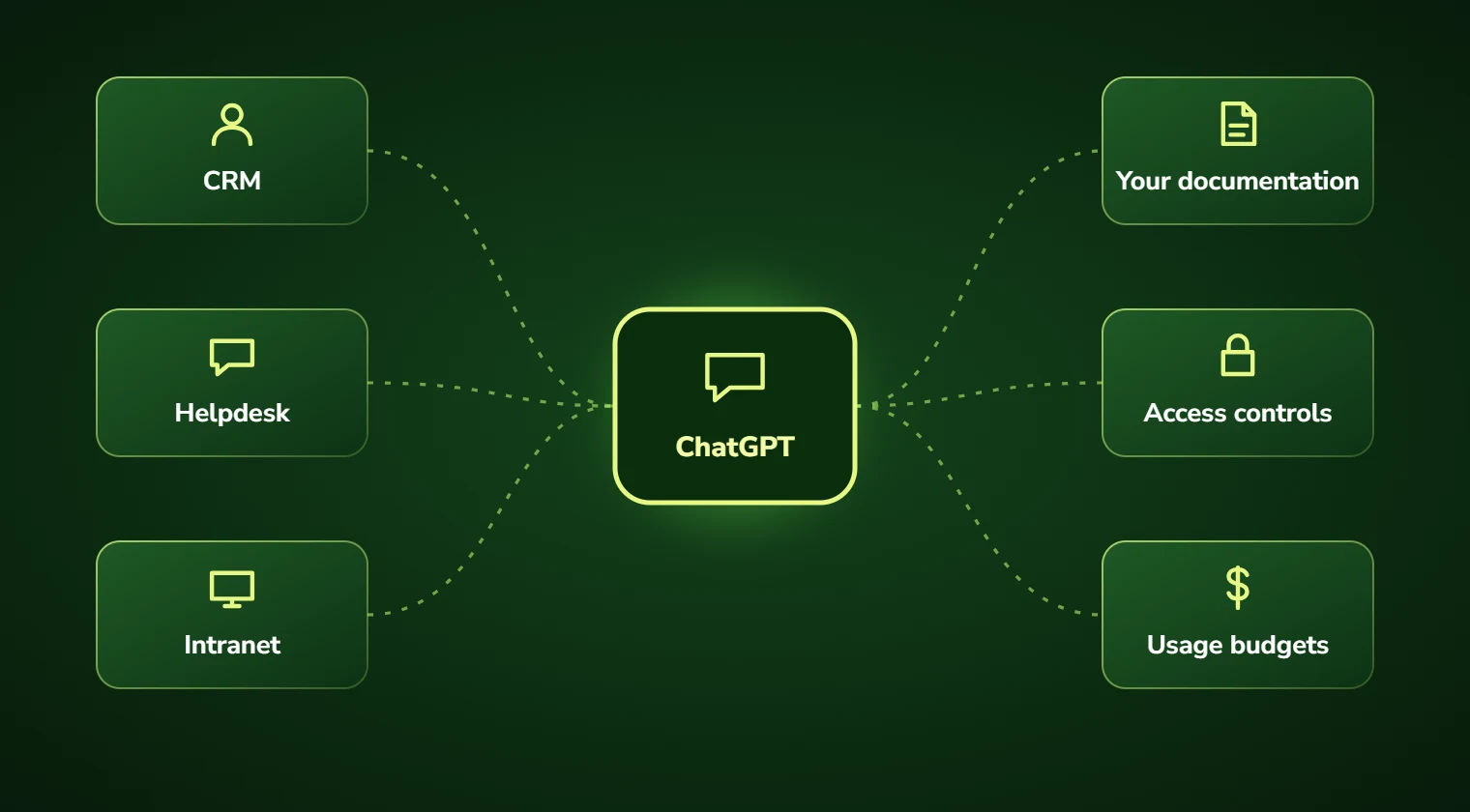
Copy-pasting into a chat window is not integration
Most organizations start by giving staff a ChatGPT subscription. It helps, but it also means staff paste company data into a browser tab. There is no logging, no grounding in your actual policies, and no way to know what is happening.
Staff then copy the output back by hand, which caps the value. Worse, the model knows nothing about your business. So staff spend their time correcting confident answers about policies you do not have.
Connected, grounded and governed
Our ChatGPT integration services put the capability inside the tool where the work happens. For example, it drafts in the helpdesk with the ticket and account already in context. It also summarizes in the CRM and answers from your own documentation.
It also makes governance possible. We log every request and enforce PII handling. Retrieval grounds answers in your content, and we attribute usage and cost instead of leaving them invisible.
What our ChatGPT integration services include
OpenAI’s models are strong general-purpose performers with a broad ecosystem, wide language coverage and mature tooling, which is why they are frequently the default choice. Their function-calling and structured-output support is also mature, which matters for integration work specifically.
Most of the effort in ChatGPT integration services is not model work. Instead, it is connecting to your systems and deciding what context each request should carry. It also covers authentication, permissions and the review workflow where output has consequence.
We always build behind an abstraction layer. Today ChatGPT may be the right model for your task; in a year a different one may be cheaper or better, and that should be a configuration change rather than a rebuild.
Our ChatGPT API integration brings ChatGPT into the systems your team uses, with custom ChatGPT integration for each workflow. ChatGPT CRM integration and ChatGPT knowledge base integration ground answers in your own data.
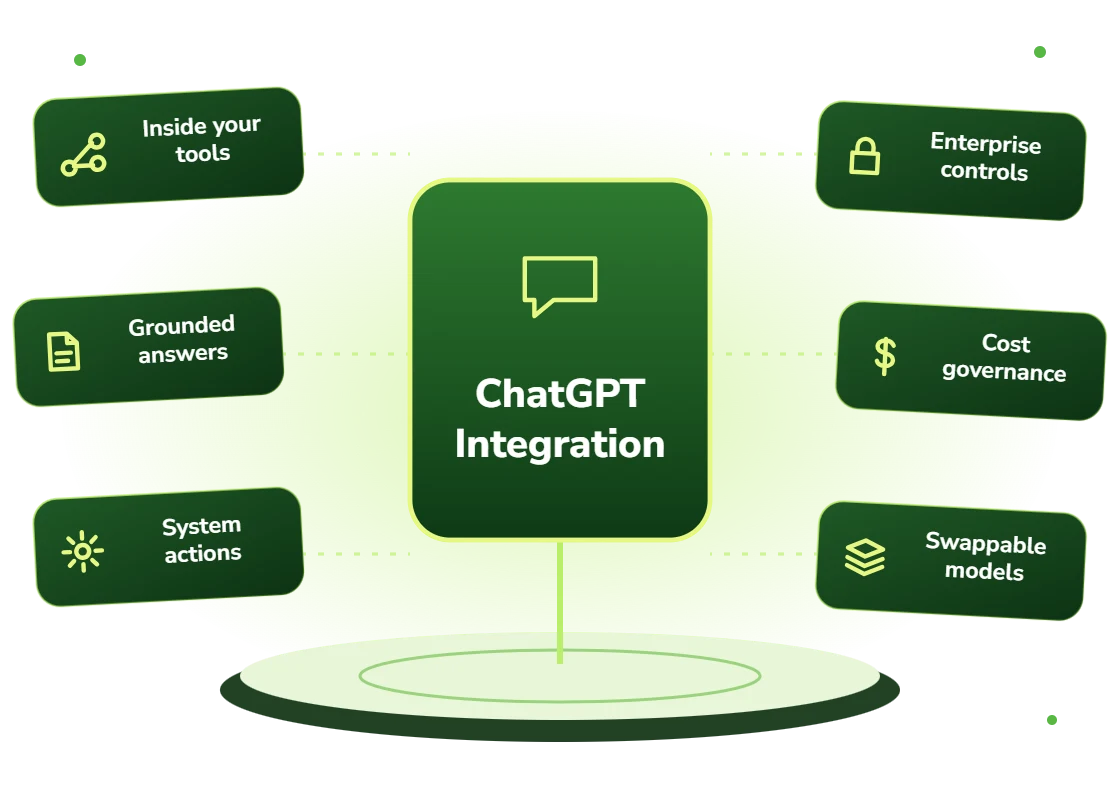
- API integration into CRM, helpdesk, intranet, website or internal tools
- Retrieval grounding so answers come from your documentation, not general knowledge
- Function calling so the model can query and update your systems within permissions
- Enterprise controls: logging, PII handling, retention rules, access scoping
- Cost governance: caching, model routing, per-team budgets and attribution
- Provider abstraction so models can be switched or mixed later
For a broader model API implementation, compare OpenAI integration services. Discuss whether you need a ChatGPT-based assistant or an API-powered feature in your own application.
Is ChatGPT integration right for your business?
Teams already getting value from ChatGPT informally, where the constraint is that it does not know anything about the business and the output has to be moved by hand.
ChatGPT integration services also suit organizations that need the governance, such as regulated businesses. There, staff pasting client data into a consumer tool is a compliance problem. It needs a sanctioned alternative rather than a policy nobody follows.
ChatGPT integration for business suits teams already pasting data into a browser. ChatGPT API development and ChatGPT workflow automation bring that work inside your own controls.
- Companies where staff already use ChatGPT informally with company data
- Teams wanting AI inside their helpdesk, CRM or internal tools rather than a separate tab
- Organizations needing logging and governance over AI usage
- Businesses whose AI answers need grounding in their own policies
- Regulated firms needing a sanctioned alternative to consumer AI tools
- Companies wanting AI capability without per-seat consumer licenses
What ChatGPT integration can do for your business
AI where the work happens
Inside the helpdesk or CRM with context already loaded, rather than in a tab requiring copy-paste both ways.
Answers from your content
Retrieval grounding means responses reflect your actual policies rather than plausible general knowledge.
Governed and logged
Every request logged, PII handling enforced, retention controlled, none of which a browser tab provides.
Cheaper than per-seat licenses
API pricing is usage-based, which for occasional users is typically far below a per-seat consumer subscription.
Function calling into your systems
The model can look things up and take scoped actions. It does more than produce text for someone else to act on.
Not locked to one provider
Built behind an abstraction, so switching or mixing models later is configuration rather than a rebuild.
Problems ChatGPT integration solves
Staff pasting data into a browser
Ungoverned use of consumer tools. A sanctioned integrated alternative is more effective than a policy.
Answers that are not your policy
Confident general-knowledge responses. Retrieval grounding fixes this at the source.
Copy-paste capping the value
Output moved by hand between tools. Integration removes the manual transfer entirely.
No visibility into usage
No idea who uses AI or for what. API integration makes usage and cost measurable.
Per-seat costs for light users
Paying full subscriptions for occasional use. Usage-based API pricing is usually far cheaper.
Worry about provider lock-in
Concern about depending on one vendor. An abstraction layer keeps the exit open.
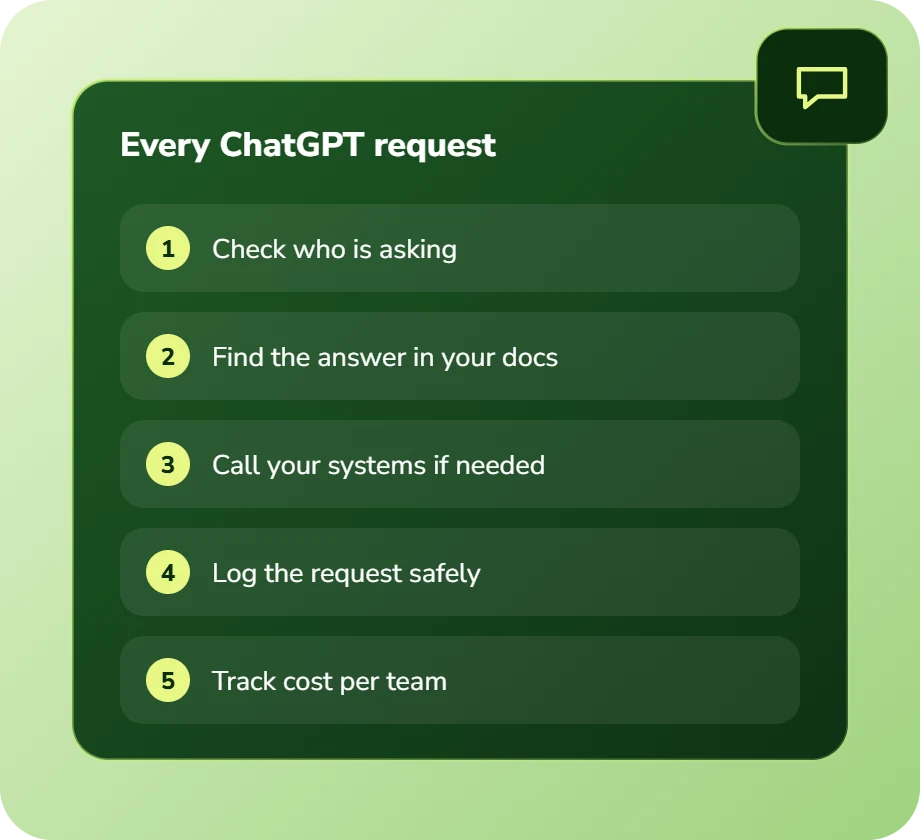
What every ChatGPT integration engagement includes
Everything below is in scope on a standard engagement. No part of our ChatGPT integration services is an upsell you discover halfway through the build.
Systems integration
Connection into Salesforce, HubSpot, Zendesk, Intercom, Microsoft 365, Slack or your internal applications.
Retrieval grounding
A retrieval layer over your documentation so the model answers from your content with citations.
Function and tool calling
Scoped functions letting the model query records and take approved actions in your systems.
Structured output handling
Schema-validated responses so downstream systems receive reliable data rather than prose to parse.
Governance controls
Request logging, PII detection and redaction, zero-retention endpoints where required, and per-team access scoping.
Cost management
Semantic caching, routing simple tasks to smaller models, per-team budgets and usage dashboards.
Provider abstraction
An integration layer so OpenAI models can be swapped or mixed with others without touching consuming code.
Prompt and evaluation management
Version-controlled prompts with a regression suite, so every change passes validation rather than shipping on hope.
Which AI models and tools do we use for ChatGPT integration?
We are not tied to one vendor. We make model and infrastructure choices on accuracy, cost per task, latency, and where your data is allowed to live.
How we deliver ChatGPT integration, step by step
ChatGPT projects follow five stages in sequence. At each one, you know what we are doing and what you will receive.
Discovery
First, we see where staff already use ChatGPT, which systems need it, and what data each request can touch.
AI Strategy
Next, we score each use case on cost to build, time to value and annual savings, then pick models.
Pilot Build
Then we build the top-ranked integration as a fixed-scope pilot, grounded in your documents with logging on.
Implementation
After that, we connect your CRM or helpdesk, add PII handling and review gates, and train your staff.
Optimization
Finally, we review accuracy monthly, tune prompts, retrieval and model routing, and report hours and dollars saved.
How much does a ChatGPT integration project cost?
ChatGPT integration is priced on the systems it connects to, the documents it answers from and the controls your company needs. You get a fixed written price before we start, and API costs are estimated up front so there are no surprises.
Book a free 30-minute call and tell us where your team already pastes data into ChatGPT. We will show you how to bring that into your own systems safely, and what it would save.
- A written savings estimate before any paid work
- Fixed scope and fixed price, agreed up front
- Full ownership of everything we build for you
- An honest recommendation when the numbers do not work
Figures are internal measurements across recent engagements, reported to every client monthly in writing.
ChatGPT integration FAQs
What is the difference between ChatGPT Enterprise and API integration?
ChatGPT Enterprise is a chat interface with admin controls, excellent for general staff productivity, but it remains a separate place people go. By contrast, API integration puts the capability inside your existing systems, grounded in your data, with output written back automatically. Many organizations run both. Enterprise covers general use, and API integration covers specific workflows where AI must sit inside a business system.
Is our data used to train OpenAI's models?
Under OpenAI’s API data usage policy, OpenAI does not use data submitted through the API for training by default. That differs from the consumer product. Zero data retention is available for eligible use cases. For clients with stricter requirements, we deploy via Azure OpenAI Service, which keeps data within your Azure tenancy. Alternatively, we use open-weight models on your own infrastructure. We confirm the current terms during design rather than relying on what was true last year.
How much does ChatGPT integration cost?
It depends on how many systems it connects to, whether answers must come from your documentation, and the governance controls you need. Every integration gets a fixed written price first, and ongoing API costs are estimated before you commit. Book a free 30-minute consultation to scope it.
Will we be locked into OpenAI?
Not if we build it properly. We put provider calls behind an abstraction layer. As a result, switching to a different model or mixing several is a configuration change rather than a rebuild. We routinely build systems that use OpenAI models for some tasks and other providers for others, chosen on cost and capability per task.
Can it answer from our own documents?
Yes, and this is usually the largest single improvement over informal use. We build a retrieval layer over your documentation. The model then generates responses from your actual content, with citations back to source. Without that, the model answers from general knowledge, which produces confident and specific answers about policies you do not have.
Which OpenAI model should we use?
It depends on the task and we generally mix them. Complex reasoning and tool use justify the larger models. However, high-volume classification and extraction usually run well on smaller, much cheaper ones. Routing by task complexity is one of the more effective cost levers available. We build it in rather than defaulting every request to the most capable model.
Ready to scope your ChatGPT integration project?
Book a free 30-minute consultation. Bring one workflow, and you will leave with a realistic estimate of its automation cost and savings.