AI data engineering services for reliable pipelines
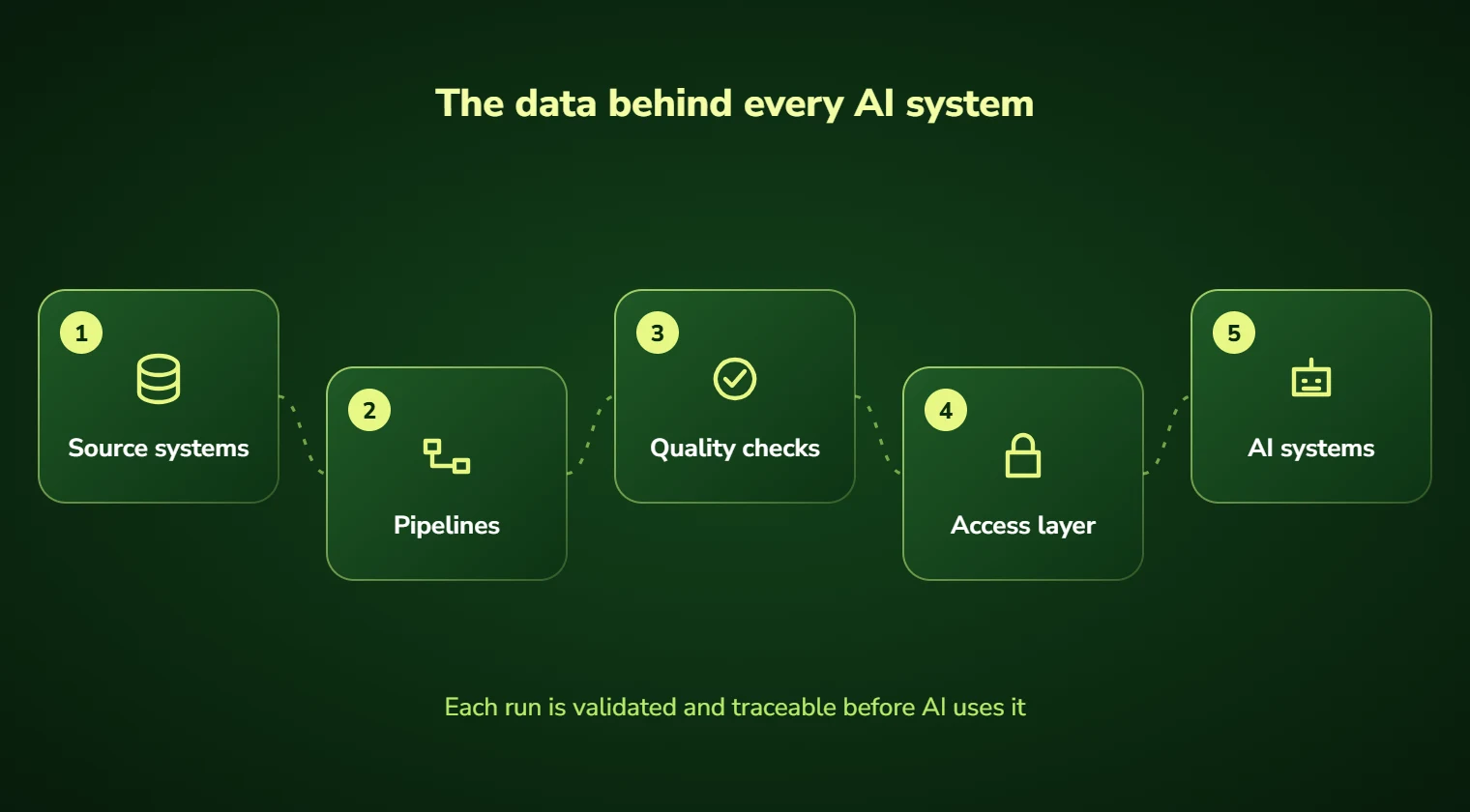
Our AI data engineering services address data access, quality and reliability before model development. We assess the datasets your workflow needs, then build pipelines and checks to support them.
AI data engineering builds the data infrastructure that AI systems depend on: pipelines that move and transform data reliably, quality validation, lineage tracking, and storage designed for both analytical and AI workloads. It is typically the largest and least visible portion of work in an AI programme.
The AI project that discovered its data does not exist
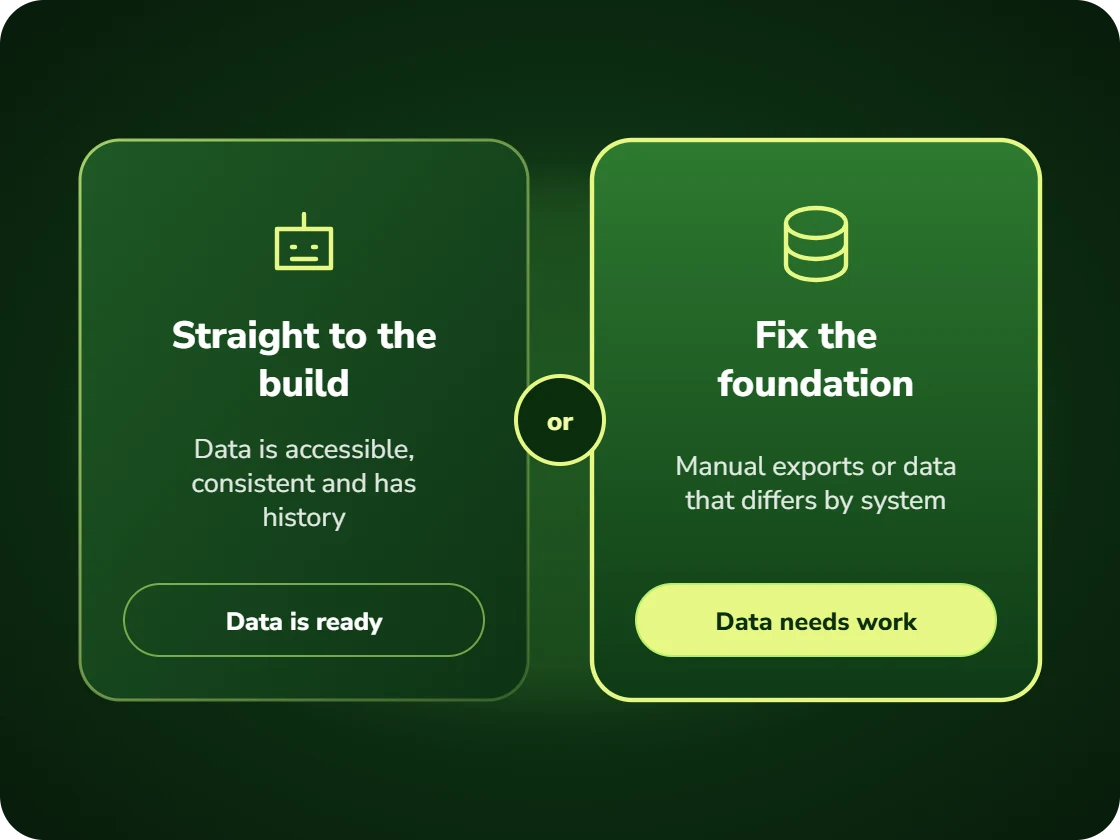
Discovery routinely finds that the data an AI project assumed is incomplete, inconsistent between systems, missing history, or accessible only through an export someone runs manually each month.
That is not a failure of the AI plan; it is a data engineering gap that was never assessed. Finding it in month four rather than week two is the expensive version.
Fix the foundation, then build on it
We assess data readiness before any AI project and build the pipelines, quality checks and access layers the AI depends on.
This work is unglamorous and it determines whether everything downstream succeeds. It is also reusable: pipelines built for one AI project serve the next three.
AI data engineering services: scope and deliverables
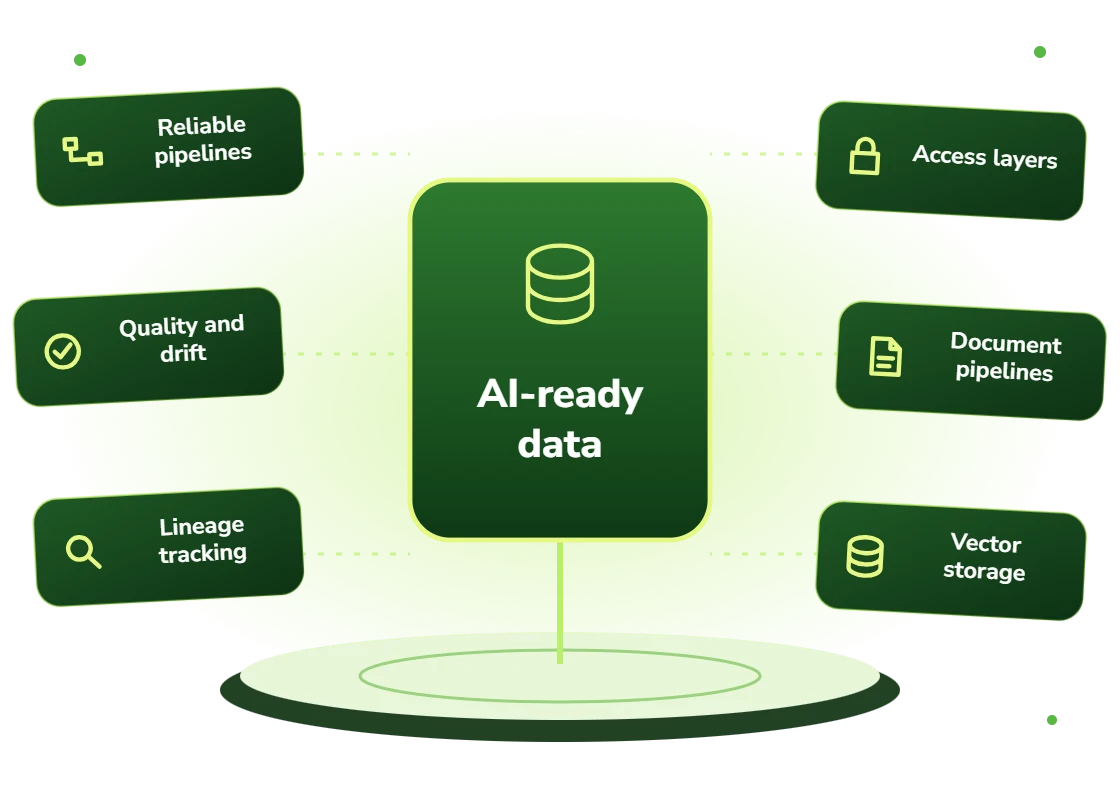
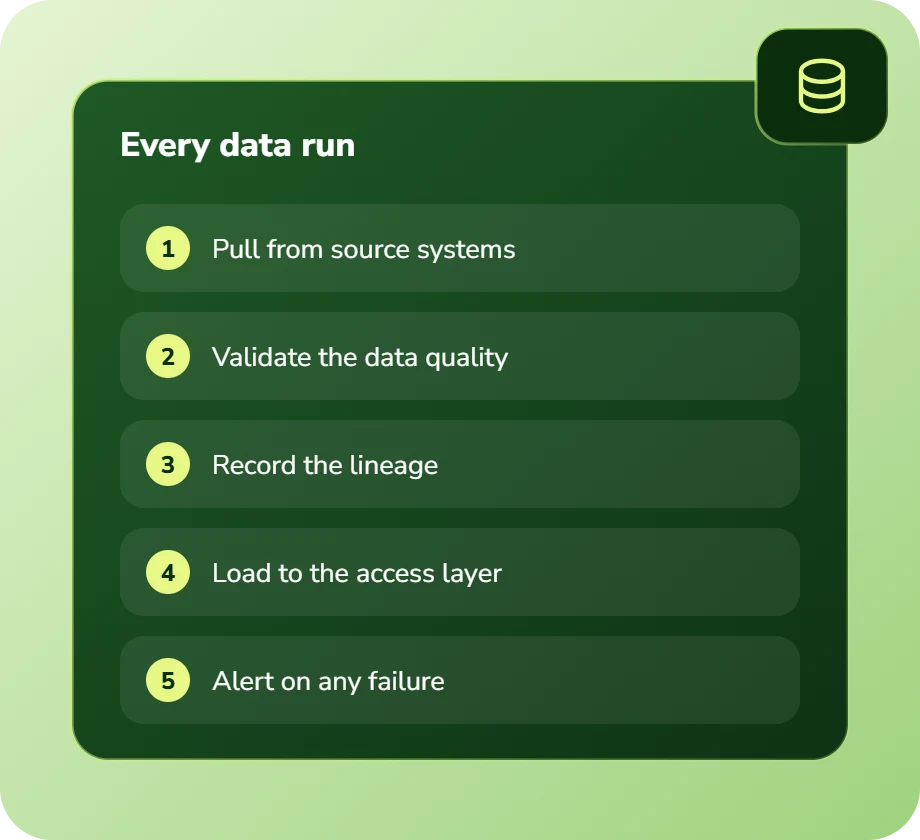
Pipelines that move data reliably from source systems into a form AI can use, with failure handling, retry and alerting rather than a script that fails silently.
Quality validation, because AI amplifies data problems rather than tolerating them. Checks on completeness, range, referential integrity and distribution drift, applied continuously.
Lineage, so when a model produces something unexpected you can trace what fed it. And access layers so AI systems query data without hammering production databases.
For AI specifically there is also embedding and vector infrastructure, and the document processing pipelines that turn unstructured sources into usable content.
- Reliable pipelines with failure handling, retry and alerting
- Continuous data quality validation and drift detection
- Lineage tracking so model inputs can be traced
- Access layers isolating AI workloads from production systems
- Document and unstructured data pipelines feeding retrieval systems
- Embedding generation and vector storage infrastructure
When data engineering is the actual project
Teams whose AI project stalled on data access or quality, which is the most common stall point.
And organizations planning multiple AI initiatives, where building the data foundation once serves all of them rather than each project solving it badly in isolation.
- AI projects stalled on data access, quality or availability
- Organizations planning several AI initiatives needing a shared foundation
- Teams whose data pipelines fail silently and are discovered late
- Companies where the same data differs between systems
- Businesses needing document and unstructured sources made AI-usable
- Teams whose AI workloads are affecting production database performance
Benefits of AI data engineering
AI projects that do not stall
The most common failure point addressed before it blocks a build rather than after.
Foundation reused across projects
Pipelines built once serve every subsequent AI initiative rather than each solving it separately.
Quality problems caught early
Continuous validation surfacing data issues before they corrupt model output or reporting.
Failures that are visible
Pipelines that alert when they break rather than failing silently for three weeks.
Production systems protected
Access layers so AI workloads do not degrade the databases running your business.
Traceable model inputs
Lineage so unexpected output can be traced back to what fed it rather than guessed about.
Business challenges this solves
AI blocked on data access
Required data unavailable or manual. Pipelines make it reliably accessible.
Silent pipeline failures
Data stopped flowing weeks ago unnoticed. Monitoring and alerting makes failures visible.
The same data differing by system
Reconciliation consuming time. Canonical definitions and validation resolve it.
AI queries slowing production
Analytical load on operational databases. Access layers isolate the workloads.
Unstructured sources unusable
Documents and text not in any pipeline. Processing pipelines make them available.
No lineage when output is wrong
Unable to trace what fed a model. Lineage tracking makes diagnosis possible.
Features and deliverables
Everything below is in scope on a standard engagement. Nothing here is an upsell discovered halfway through the build.
Data readiness assessment
What data exists, its quality, accessibility and history depth, evaluated before an AI project depends on it.
Pipeline development
Batch and streaming pipelines with failure handling, retry, backfill capability and alerting.
Quality validation
Continuous checks on completeness, ranges, referential integrity and distribution drift with alerting.
Lineage and cataloguing
Tracking of where data came from and what transformations it passed through, for diagnosis and governance.
Access layer design
Serving layers isolating AI and analytical workloads from operational database performance.
Document pipelines
Unstructured sources ingested, parsed, chunked and indexed for retrieval systems, with incremental sync.
Vector infrastructure
Embedding generation, storage and re-embedding pipelines for retrieval and similarity workloads.
Governance and access control
Permission enforcement, PII handling, retention rules and audit logging within the data layer.
Technologies we use for AI data engineering
We are not tied to one vendor. Model and infrastructure choices are made on accuracy, cost per task, latency, and where your data is allowed to live.
Our AI development process
The same five stages on every engagement, so you always know what happens next and what you get at the end of it.
Discovery
We interview the people doing the work, map the workflow end to end, and audit the systems and data behind it.
AI Strategy
Every opportunity gets scored on cost to build, time to value, and annual savings, then ranked.
Pilot Build
We ship the top-ranked automation as a fixed-scope pilot so you see real output before committing further budget.
Implementation
Integration with your live systems, staff training, human-in-the-loop review gates, and a documented rollback path.
Optimization
Monthly accuracy reviews, prompt and retrieval tuning, and a written report on hours and dollars saved.
How long it takes
A typical first engagement, week by week. Complex integrations and regulated environments extend this, and we say so during discovery rather than after.
Discovery and scoping
Process observation, systems audit, data review, and a written estimate of cost and expected saving before anything is built.
Design sign-off
Architecture, data handling rules, review thresholds and success measures agreed in writing.
Build and integration
Development against your real data, connected to your live systems, with weekly demos rather than a single reveal.
Parallel run and testing
The system runs alongside the existing process so accuracy can be compared directly before anyone depends on it.
Launch and handover
Cutover with a rollback path, staff training, full documentation, then 30 days of included tuning.
Industries we deliver AI data engineering for
Financial Services
Document extraction, reconciliation, KYC support, and audit-ready reporting with full traceability.
Healthcare
Intake, prior authorization, clinical documentation, and revenue-cycle workflows built to respect HIPAA boundaries.
Retail & E-commerce
Product data enrichment, demand forecasting, support deflection, and personalized merchandising.
Manufacturing
Quality inspection, maintenance prediction, supplier communication, and production scheduling.
Logistics & Supply Chain
Document processing, carrier communication, exception handling, and inventory rebalancing.
Insurance
First-notice-of-loss intake, claims triage, policy Q&A, and fraud signal detection.
SaaS & Technology
AI features inside your product, support deflection, onboarding assistants, and usage analytics.
Professional Services
Proposal drafting, timesheet capture, research synthesis, and client reporting at scale.
Real-world use cases
Pre-AI data foundation
Building the pipelines and quality layer before an AI programme depends on data nobody assessed.
Retrieval content pipelines
Document sources ingested, parsed and kept in sync for RAG and knowledge systems.
Feature pipelines for ML
Reliable feature computation and serving for machine learning models in production.
Cross-system reconciliation
Canonical definitions resolving the same data differing across operational systems.
Data quality monitoring
Continuous validation catching upstream problems before they reach models or reports.
Warehouse modernization
Migrating and restructuring analytical data infrastructure to support AI workloads.
Why choose DevSolutionsAI for AI data engineering
Business case before build
Every recommendation carries an estimated cost, timeline, and annual savings figure. If the math does not work, we say so before you spend.
Vendor-neutral by design
We resell nothing and take no platform commissions. Model and infrastructure choices are made on fit, cost, and your data-residency rules.
Fixed-scope pilots
The first engagement is a defined deliverable at a defined price, not an open-ended retainer that quietly grows each quarter.
Built for handover
You own the code, the prompts, the infrastructure, and the documentation. No lock-in to a proprietary wrapper you cannot leave.
Human-in-the-loop where it counts
Anything customer-facing, clinical, financial, or legal gets a review gate, a confidence threshold, and a logged audit trail.
Security reviewed early
Data flow diagrams, retention rules, and access boundaries are agreed in week one, not retrofitted after your security team objects.
Find out what AI data engineering would cost you, before you commit to anything
Every engagement is quoted after a short discovery, so you get a fixed written price built around your actual volumes rather than a rate card that assumes someone else’s business.
The first call is thirty minutes and free. Bring one workflow. We will tell you what it is likely costing you each year, roughly what automating it would take, and whether we think it is worth doing at all.
- A written savings estimate before any paid work
- Fixed scope and fixed price, agreed up front
- Full ownership of everything we build for you
- An honest recommendation when the numbers do not work
Figures are internal measurements across recent engagements, reported to every client monthly in writing.
Illustrative project scenario
Diagnosing four stalled AI projects as one data problem
Challenge. An insurance group had four AI initiatives in various stages of stall. Each team had independently concluded the problem was technical and was pursuing a different fix. Leadership wanted an independent assessment before writing off the programme.
What we built. Assessment found all four had the same root cause: claims data was accessible only through a monthly manual export, quality varied because three systems held overlapping records with no canonical definition, and no team had lineage to diagnose discrepancies. We built the shared pipeline, quality validation and canonical definitions once rather than four times.
Outcome. Three of the four projects resumed and reached production within six months of the data foundation being in place. The fourth was cancelled on its own merits rather than on data grounds. Subsequent AI initiatives started from the existing foundation rather than rebuilding it.
Illustrative project scenario. The figures demonstrate how a project could be scoped and evaluated; they are not verified client results or an audited average.
What clients say about working with us
AI Data Engineering FAQs
Why do AI projects fail on data rather than models?
Because model selection gets the planning attention and data availability gets assumed. In the stalled projects we are asked to diagnose, the causes are overwhelmingly that required data is not reliably accessible, is worse quality than assumed, or lacks sufficient history. All three are cheaply assessed in two to three weeks before a project commits, and finding them in month four instead is the expensive version.
Should we fix our data before starting AI projects?
Partially, and in the right order. Fixing everything first is a multi-year programme that delivers nothing visible, which loses organizational support. We recommend assessing readiness for the specific AI initiatives you plan, fixing what those need, and building the shared foundation as you go. That produces working systems while the foundation accumulates.
What if we do not have enough historical data?
Then some projects are not viable yet, and we will say so. Forecasting and predictive models need years of history that cannot be manufactured. The useful response is usually to implement the data capture that makes those projects viable in a year, while proceeding with the AI applications that work on data you already have, document processing and retrieval, typically.
Will AI workloads affect our production systems?
They will if they query production databases directly, which is a common early mistake. We build access layers, replicas, warehouses or serving layers, so analytical and AI workloads are isolated from the databases running your business. This is standard practice and it is frequently skipped in the rush to demonstrate an AI capability.
Is this work reusable across projects?
Substantially, which is one of the strongest arguments for doing it deliberately. Pipelines, quality validation and canonical definitions built for one AI initiative serve every subsequent one. On a recent engagement, four stalled projects turned out to share one root data problem, and fixing it once unblocked three of them.
What does data engineering cost?
A two to three week readiness assessment runs $10,000 to $18,000 and frequently changes the plan for an entire AI programme. A foundation build covering pipelines, quality and access layers typically runs $55,000 to $130,000 depending on source system count and complexity. Ongoing operations run monthly if you want us to keep running it rather than your team.
Services that pair well with this one
Most clients combine two or three of these. We will tell you the right sequence during discovery.
Ready to scope your AI data engineering project?
Book a free 30-minute consultation. Bring one workflow and leave with a realistic estimate of what it would cost to automate and what it would save.