AI ERP Integration

AI ERP integration with controls and audit trails

AI ERP integration connects model outputs to the system of record. We design document posting, exception handling and querying around the access controls, segregation of duties and audit trails your workflow requires.

Free 30-minute consultation
Fixed-scope pilots
U.S.-based team
Custom, not off-the-shelf
SOC 2-aligned practices
ROI tracked in writing
What is AI ERP integration?

AI ERP integration connects artificial intelligence to enterprise resource planning systems such as SAP, NetSuite, Oracle or Microsoft Dynamics. Common applications include posting extracted document data, handling exceptions, enriching master data and enabling natural language querying, all within the ERP’s existing control and approval framework.

7+
Years building AI systems
240+
Projects delivered
4.8
Avg. months to payback
38
U.S. states served
The Problem

The system of record has rules for a reason

The ERP is where the numbers your auditors examine live. Anything that writes to it inherits the segregation of duties, approval thresholds and audit requirements that exist because of past failures.

AI integrations that bypass those controls to move faster create an audit finding, and the efficiency gain is worth considerably less than the qualification it produces.

Our Approach

Integrate inside the control framework

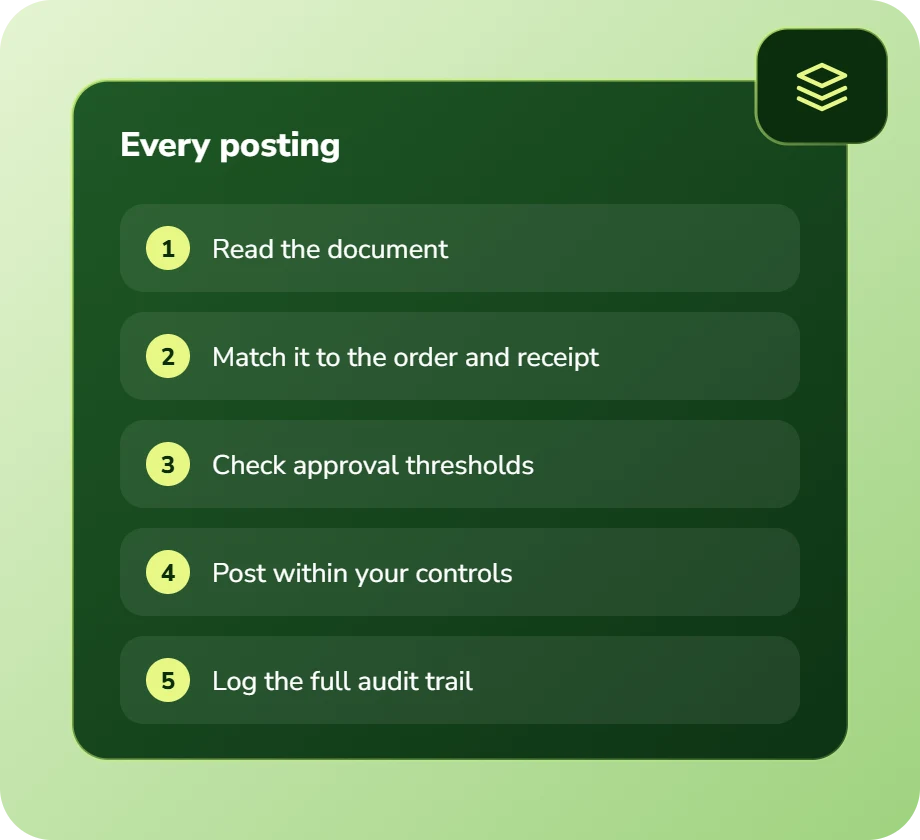
We map the control environment first: who may approve what, at which thresholds, and what evidence must exist. Then AI operates within it rather than around it.

Practically that means AI posts within defined tolerances, anything outside them routes to a human with the appropriate authority, and every automated action is logged with its inputs and reasoning.

Diagram of AI services integrating a CRM, helpdesk and finance tools
Conceptual integration illustration
Service Overview

AI ERP integration: scope and deliverables

Document posting is the largest application: extracting data from invoices, receipts and orders and posting it, with matching and validation before anything reaches the ledger.

Exception handling is the second: when a posting fails validation or a match does not reconcile, gathering the context needed to resolve it rather than leaving it in a queue.

Master data quality is underrated. ERPs accumulate duplicate vendors, inconsistent item records and stale customer data, all of which degrade everything built on them.

And natural language querying, which lets people get answers from the ERP without knowing its reporting module.

  • Document extraction and posting within approval thresholds
  • Matching and validation before anything reaches the ledger
  • Exception context gathering and resolution within defined limits
  • Master data deduplication and quality improvement
  • Natural language querying over ERP data with permission enforcement
  • Complete audit trail on every automated action
Right Fit

Who needs AI ERP integration

Organizations with high transaction volume where manual ERP data entry is a significant cost, particularly in accounts payable and order processing.

And companies whose ERP master data has degraded to the point where reporting and downstream systems are affected.

  • Operations with high-volume manual ERP data entry
  • Companies whose ERP master data has accumulated duplicates and errors
  • Businesses where posting exceptions sit in queues for days
  • Organizations needing ERP data accessible without report-building skills
  • Teams that have received audit findings on manual control weaknesses
  • Companies with legacy ERPs that vendors decline to integrate with
Benefits

Benefits of AI ERP integration

Controls preserved

Segregation of duties and approval thresholds enforced by the integration rather than bypassed for speed.

Audit trail strengthened

Every automated action logged with inputs and reasoning, which is frequently better evidence than the manual process it replaced.

Posting volume absorbed

High-volume document posting handled automatically within tolerance, with exceptions routed properly.

Master data cleaned

Duplicate vendors and inconsistent item records identified and merged with full traceability.

ERP data accessible

Natural language querying so people get answers without knowing the reporting module.

Legacy ERPs reachable

Integration routes for older systems where vendors offer no modern API.

Problems We Solve

Business challenges this solves

01

Manual posting at volume

Staff keying documents into the ERP. Automated posting within tolerance absorbs the routine share.

02

Exceptions sitting in queues

Failed postings waiting for investigation. Context gathered automatically speeds resolution.

03

Master data degraded

Duplicate vendors and stale records affecting reporting. Deduplication with audit trail resolves it.

04

ERP reporting inaccessible

Answers requiring a report builder. Natural language querying opens access.

05

Audit findings on manual controls

Weaknesses in manual processes. Automated actions with logging strengthen the evidence.

06

Legacy ERP with no API

Vendors declining integration. Alternative routes assessed and used where safe.

What's Included

Features and deliverables

Everything below is in scope on a standard engagement. Nothing here is an upsell discovered halfway through the build.

01

Control environment mapping

Approval authorities, thresholds and evidence requirements documented before any integration is designed.

02

Document posting

Extracted data validated and posted within defined tolerances, with everything outside routed for approval.

03

Matching and validation

Three-way matching and business rule validation applied before anything reaches the ledger.

04

Exception handling

Context assembled automatically for failed postings and unmatched items, with resolution within defined limits.

05

Master data management

Duplicate detection, standardization and enrichment for vendor, customer and item master records.

06

Natural language querying

Plain-language questions over ERP data with the generated query shown and permissions enforced.

07

Audit logging

Complete records of every automated action with inputs, confidence and outcome, exportable for audit.

08

Legacy connectivity

Integration routes for older ERPs where no modern API exists, assessed for safety first.

Technology Stack

Technologies we use for AI ERP integration

We are not tied to one vendor. Model and infrastructure choices are made on accuracy, cost per task, latency, and where your data is allowed to live.

Language Models
C
Claude (Anthropic)
G
GPT (OpenAI)
G
Gemini (Google)
L
Llama
M
Mistral
A
Azure OpenAI Service
Agent & Orchestration
M
Model Context Protocol
L
LangGraph
L
LangChain
L
LlamaIndex
T
Temporal
C
Celery
Data & Backend
P
Python
T
TypeScript / Node.js
P
PostgreSQL
S
Snowflake
d
dbt
A
Apache Airflow
Business Systems
S
Salesforce
H
HubSpot
N
NetSuite
M
Microsoft 365
S
Slack
Z
Zapier / Make
How We Work

Our AI development process

The same five stages on every engagement, so you always know what happens next and what you get at the end of it.

01

Discovery

We interview the people doing the work, map the workflow end to end, and audit the systems and data behind it.

02

AI Strategy

Every opportunity gets scored on cost to build, time to value, and annual savings, then ranked.

03

Pilot Build

We ship the top-ranked automation as a fixed-scope pilot so you see real output before committing further budget.

04

Implementation

Integration with your live systems, staff training, human-in-the-loop review gates, and a documented rollback path.

05

Optimization

Monthly accuracy reviews, prompt and retrieval tuning, and a written report on hours and dollars saved.

Timeline

How long it takes

A typical first engagement, week by week. Complex integrations and regulated environments extend this, and we say so during discovery rather than after.

Weeks 1 to 2

Discovery and scoping

Process observation, systems audit, data review, and a written estimate of cost and expected saving before anything is built.

Week 3

Design sign-off

Architecture, data handling rules, review thresholds and success measures agreed in writing.

Weeks 4 to 7

Build and integration

Development against your real data, connected to your live systems, with weekly demos rather than a single reveal.

Week 8

Parallel run and testing

The system runs alongside the existing process so accuracy can be compared directly before anyone depends on it.

Weeks 9 to 10

Launch and handover

Cutover with a rollback path, staff training, full documentation, then 30 days of included tuning.

Who We Work With

Industries we deliver AI ERP integration for

Manufacturing

Quality inspection, maintenance prediction, supplier communication, and production scheduling.

Logistics & Supply Chain

Document processing, carrier communication, exception handling, and inventory rebalancing.

Retail & E-commerce

Product data enrichment, demand forecasting, support deflection, and personalized merchandising.

Financial Services

Document extraction, reconciliation, KYC support, and audit-ready reporting with full traceability.

Construction

Bid takeoffs, submittal review, RFI drafting, and field-report summarization.

Healthcare

Intake, prior authorization, clinical documentation, and revenue-cycle workflows built to respect HIPAA boundaries.

Professional Services

Proposal drafting, timesheet capture, research synthesis, and client reporting at scale.

Insurance

First-notice-of-loss intake, claims triage, policy Q&A, and fraud signal detection.

Use Cases

Real-world use cases

01

Invoice posting

Supplier invoices extracted, matched and posted within tolerance with exceptions routed for approval.

02

Sales order entry

Orders arriving by email and PDF extracted and entered without manual keying.

03

Vendor master deduplication

Duplicate vendor records identified and merged with full audit trail.

04

Goods receipt matching

Receipts matched against orders and invoices with discrepancies surfaced immediately.

05

ERP question answering

Staff querying inventory, order and financial data in plain language with permissions respected.

06

Exception queue clearance

Failed postings investigated automatically with resolution proposed for approval.

Why DevSolutionsAI

Why choose DevSolutionsAI for AI ERP integration

Business case before build

Every recommendation carries an estimated cost, timeline, and annual savings figure. If the math does not work, we say so before you spend.

Vendor-neutral by design

We resell nothing and take no platform commissions. Model and infrastructure choices are made on fit, cost, and your data-residency rules.

Fixed-scope pilots

The first engagement is a defined deliverable at a defined price, not an open-ended retainer that quietly grows each quarter.

Built for handover

You own the code, the prompts, the infrastructure, and the documentation. No lock-in to a proprietary wrapper you cannot leave.

Human-in-the-loop where it counts

Anything customer-facing, clinical, financial, or legal gets a review gate, a confidence threshold, and a logged audit trail.

Security reviewed early

Data flow diagrams, retention rules, and access boundaries are agreed in week one, not retrofitted after your security team objects.

Get Started

Find out what AI ERP integration would cost you, before you commit to anything

Every engagement is quoted after a short discovery, so you get a fixed written price built around your actual volumes rather than a rate card that assumes someone else’s business.

The first call is thirty minutes and free. Bring one workflow. We will tell you what it is likely costing you each year, roughly what automating it would take, and whether we think it is worth doing at all.

  • A written savings estimate before any paid work
  • Fixed scope and fixed price, agreed up front
  • Full ownership of everything we build for you
  • An honest recommendation when the numbers do not work
What clients typically see
Across recent projects
Staff hours saved each week
31
Months to payback
4.8
Client retention
94%
Response to enquiries
4 hrs

Figures are internal measurements across recent engagements, reported to every client monthly in writing.

Illustrative project scenario

Illustrative project scenario

Distribution group · NetSuite, 4 entities

Automating 78% of order entry with the controls unchanged

Challenge. A distribution group received roughly 1,400 sales orders monthly by email and PDF across four entities, all keyed into NetSuite by hand. A previous automation attempt had been rejected by their auditors because it bypassed the approval workflow for orders above the credit threshold.

What we built. Extraction and posting operating strictly within the existing approval framework: orders within credit limits and pricing tolerance post automatically, anything outside routes to the appropriate approver with the discrepancy highlighted. Every automated posting is logged with the source document, extracted values and confidence.

Outcome. 78% of orders now post without manual entry. The external auditors reviewed the control design before deployment and accepted it, noting the audit trail was more complete than the manual process. Order entry turnaround fell from an average of four hours to under ten minutes.

78%
Orders auto-posted
4h → 10m
Order entry turnaround
0
Control exceptions
Approved
By auditors pre-deployment

Illustrative project scenario. The figures demonstrate how a project could be scoped and evaluated; they are not verified client results or an audited average.

Client Feedback

What clients say about working with us

31
Avg. staff hours saved weekly
4.8
Avg. months to payback
94%
Client retention
4
Hour response to enquiries
Common Questions

AI ERP Integration FAQs

It will if it bypasses your approval workflow, which is how most rejected implementations fail. We map the control environment first and design AI to operate within it: posting only within defined tolerances, routing everything else to the appropriate approver, and logging every action with its inputs. On a recent engagement the auditors reviewed the design before deployment and noted the audit trail was more complete than the manual process it replaced.

Evaluate it first if you are on a current version. Native modules integrate cleanly and carry no custom maintenance burden. They frequently do not exist for older ERP versions, do not cover the specific document types you receive, or cost more across your transaction volume than a build. Our assessment includes that comparison explicitly.

SAP, Oracle, NetSuite, Microsoft Dynamics 365, Sage Intacct, Infor and others, plus older ERP versions where vendors no longer offer integration support. For legacy systems without APIs we assess alternative routes, supported import interfaces, scheduled file exchange, or read-only database access with vendor consent.
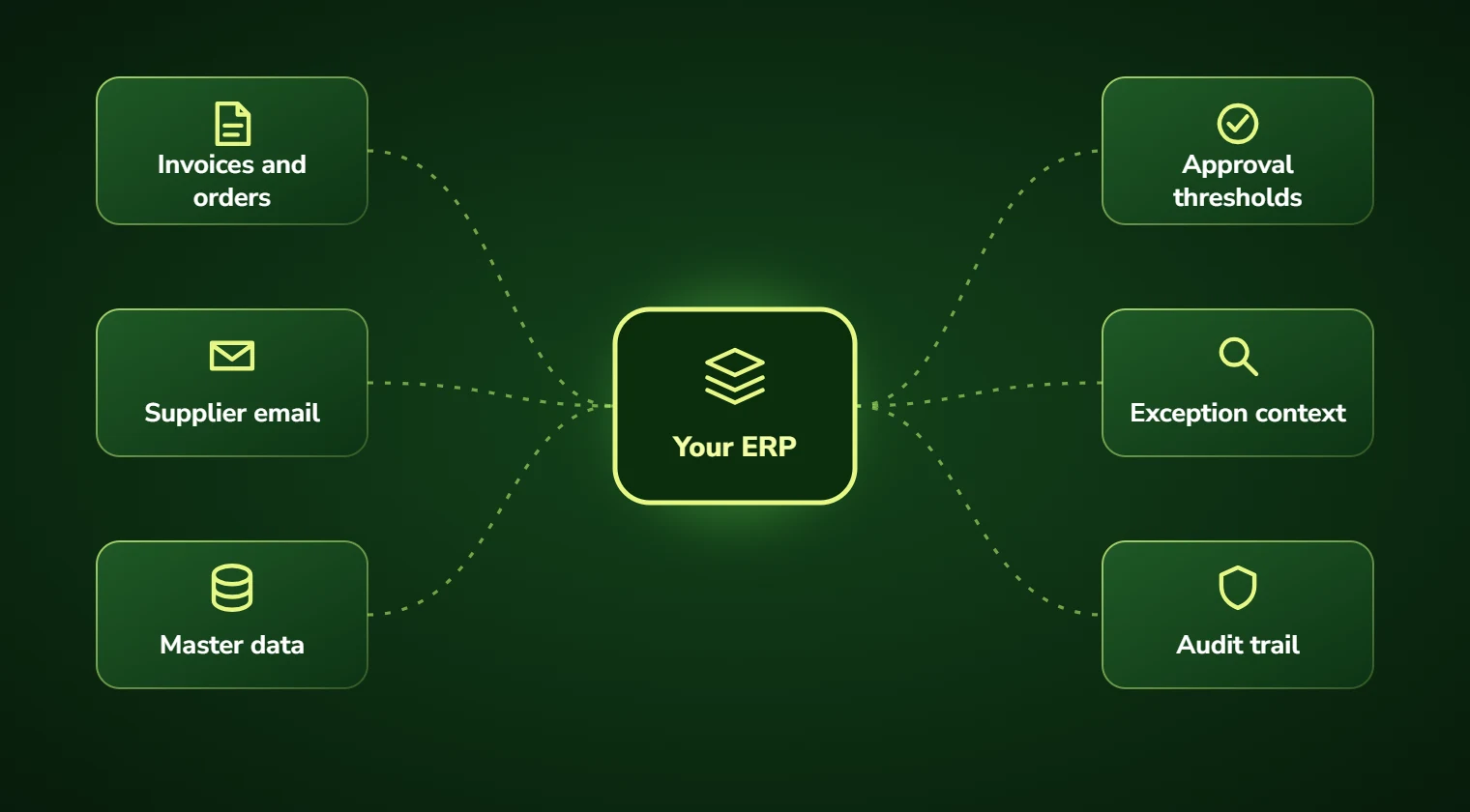
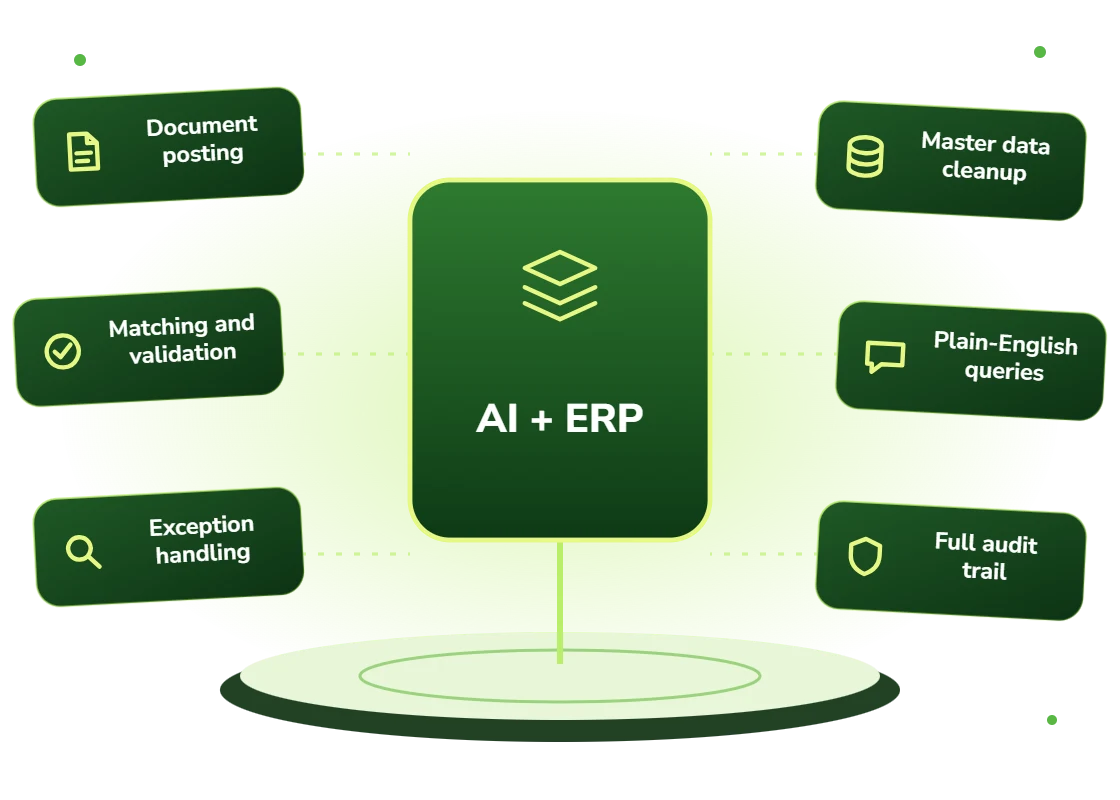
Within defined tolerances and through supported interfaces, yes. We do not write directly to ERP database tables, because that bypasses the application’s own validation and business logic and typically invalidates your support agreement. Postings go through the ERP’s supported import or API interfaces so its own rules still apply.

It is frequently the more valuable half of the engagement. ERPs accumulate duplicate vendors, inconsistent item records and stale customer data, all of which degrade reporting and every downstream system. Deduplication and standardization run with full audit trail and human review on ambiguous merges.

A two-week assessment covering control mapping and integration route evaluation runs $9,000 to $16,000. A build typically runs $42,000 to $95,000 depending on document types, entity count and whether legacy connectivity is required. For operations above roughly 500 documents monthly, payback is commonly five to nine months.

Service Areas

AI ERP Integration across the United States

We deliver AI erp integration remotely to clients nationwide, with on-site workshops available in major metros.

Ready to scope your AI ERP integration project?

Book a free 30-minute consultation. Bring one workflow and leave with a realistic estimate of what it would cost to automate and what it would save.

Free 30-minute consultation
Fixed-scope pilots
U.S.-based team
Custom, not off-the-shelf
SOC 2-aligned practices
ROI tracked in writing
Free 30-minute AI consultation