AI infrastructure consulting for your workload
Our AI infrastructure consulting evaluates architecture, deployment costs and scaling requirements. We compare managed and self-hosted options against your workload, data constraints and capacity to operate the system.
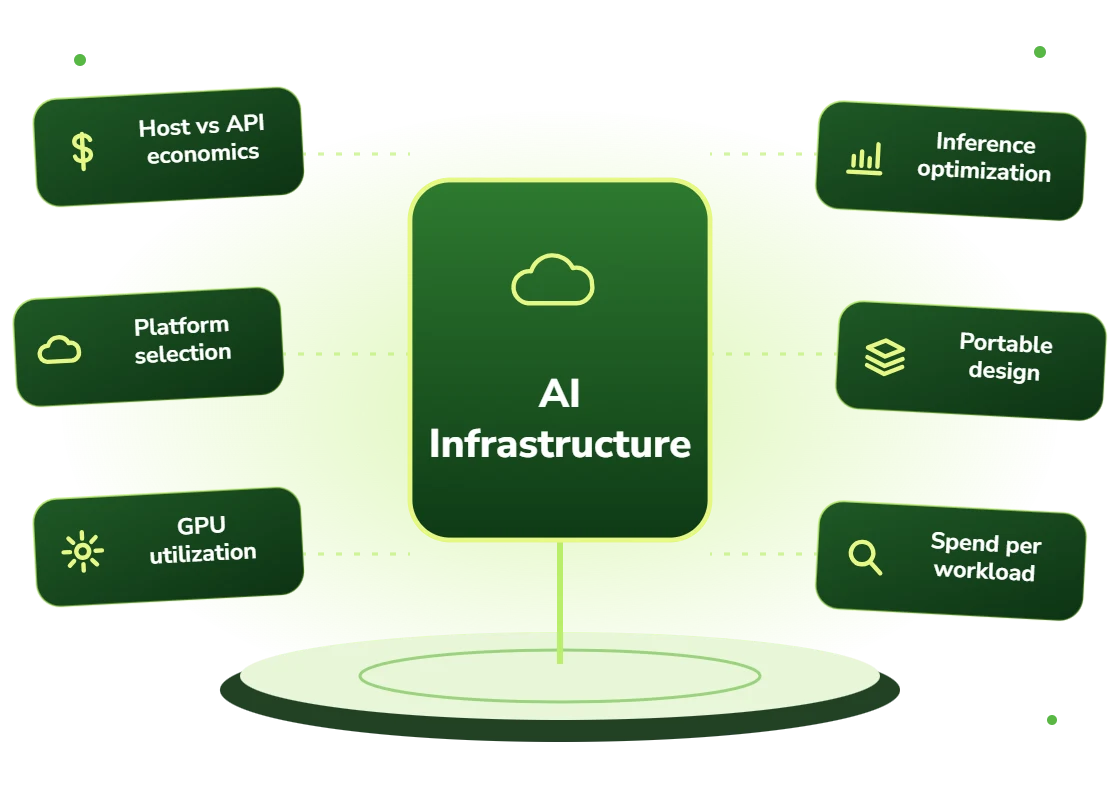
AI infrastructure consulting advises on the architecture, platform and cost decisions underlying AI systems: whether to use hosted APIs or self-host, which cloud platform fits, how to size GPU capacity, how to model cost at scale, and how to design for portability so decisions remain reversible.
Infrastructure decisions made at prototype scale
AI infrastructure is typically chosen when the workload is small and everything is cheap. The decision then hardens, and the cost curve becomes apparent at production scale when migration is expensive.
The advice available is also structurally conflicted: cloud vendors recommend their platform, model providers recommend their API, and hardware vendors recommend buying GPUs. All are giving genuine advice from a position that is not neutral.
Model the cost, then decide
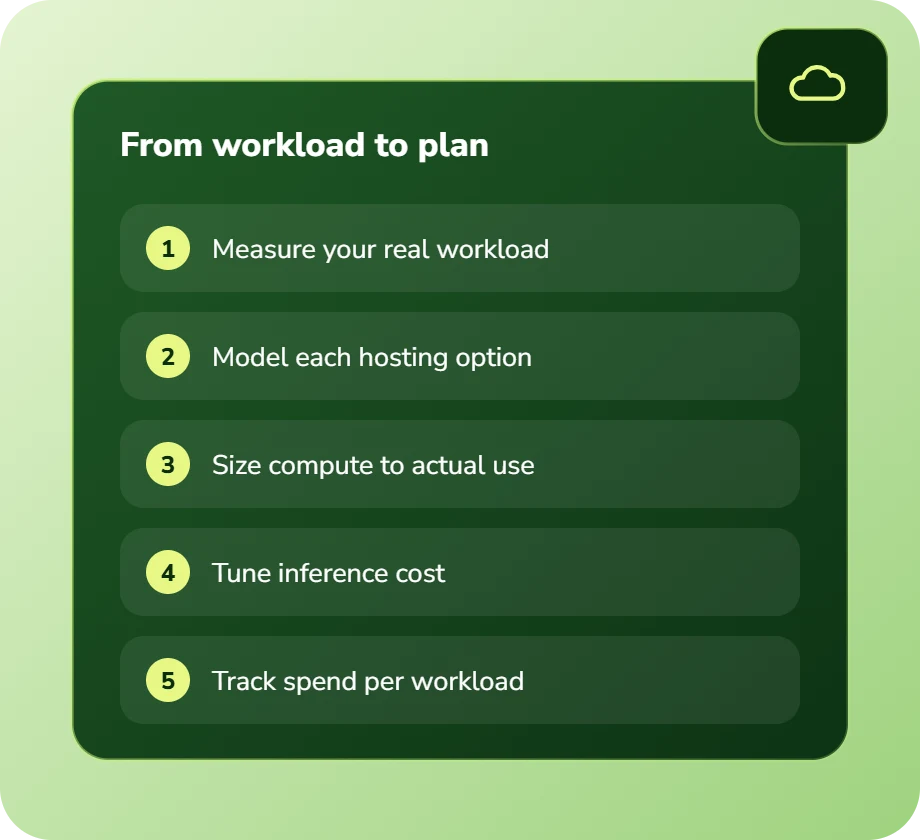
We model cost across deployment options at your projected scale, including the parts vendors omit: engineering time to operate self-hosted infrastructure, idle GPU capacity, and the cost of migrating later.
And we design for portability, so whichever decision you make remains reversible rather than becoming a permanent constraint.
AI infrastructure consulting: scope and deliverables
Hosted API versus self-hosting is the largest, and it has a genuine crossover point that depends on your volume, latency requirements and data residency constraints. Below that point APIs are cheaper and far less work; above it, self-hosting wins clearly.
Cloud platform choice matters mostly for adjacency: where your data already lives, what commitments you hold, and which compliance boundaries are already approved.
GPU sizing is where self-hosting costs go wrong, usually through over-provisioning for peak and paying for idle capacity.
And portability, which is the decision that keeps all the others reversible.
- Hosted API versus self-hosting economics modelled at your scale
- Cloud platform selection based on adjacency and existing commitments
- GPU sizing and utilization design to avoid paying for idle capacity
- Inference optimization: quantization, batching, caching, serving choices
- Portability architecture so infrastructure decisions stay reversible
- Cost monitoring and attribution so spend is visible per workload
When to get infrastructure advice
Before a significant infrastructure commitment, when the decision is still cheap to change. This is the highest-value point and the least common one at which people ask.
And when AI costs are growing faster than usage, which usually indicates an architectural rather than a usage problem.
- Teams facing a significant AI infrastructure or platform commitment
- Organizations whose AI costs are growing faster than usage
- Companies evaluating whether to self-host models
- Teams with data residency requirements constraining deployment options
- Businesses wanting an independent second opinion on a vendor proposal
- Organizations with GPU infrastructure running at low utilization
Benefits of AI infrastructure consulting
Advice with no margin attached
No platform alliances and no resale, so recommending the cheaper option costs us nothing.
Cost modelled honestly
Including engineering time, idle capacity and migration cost, which vendor models routinely omit.
The crossover point identified
Where self-hosting genuinely becomes cheaper than APIs for your specific workload and volume.
Decisions that stay reversible
Portability designed in, so a platform or model change later is migration rather than rebuild.
GPU capacity right-sized
Utilization modelled so you are not paying for idle hardware provisioned for a peak that rarely occurs.
Spend attributed
Cost visibility per workload and team, so growth can be diagnosed rather than absorbed.
Business challenges this solves
Costs growing faster than usage
An architectural problem presenting as a usage one. Cost modelling identifies the cause.
Self-hosting proposed without economics
GPU purchases justified on intuition. Honest crossover modelling settles it.
GPUs running at low utilization
Capacity provisioned for peak, idle most of the time. Utilization design cuts waste.
Locked to one platform
Decisions that hardened into constraints. Portability architecture keeps options open.
Conflicted vendor advice
Every recommendation coming from an interested party. Independent assessment resolves it.
Data residency blocking options
Compliance constraining deployment. Options assessed against actual requirements.
Features and deliverables
Everything below is in scope on a standard engagement. Nothing here is an upsell discovered halfway through the build.
Workload characterization
Request volume, patterns, latency requirements and growth projection quantified as the basis for every recommendation.
Cost modelling
Total cost across deployment options at projected scale, including engineering time, idle capacity and migration cost.
Build-versus-buy analysis
Hosted API against self-hosted economics with the crossover point identified for your specific workload.
Platform selection
Cloud and platform recommendation based on data adjacency, existing commitments and compliance boundaries.
GPU sizing
Capacity modelling against real utilization patterns to avoid provisioning for a peak that rarely occurs.
Inference optimization
Quantization, batching, caching and serving configuration to reduce cost and latency on self-hosted deployments.
Portability architecture
Abstraction design so model, platform and infrastructure decisions remain reversible.
Cost monitoring design
Attribution and alerting so spend is visible per workload, team and feature rather than as one bill.
Technologies we use for AI infrastructure consulting
We are not tied to one vendor. Model and infrastructure choices are made on accuracy, cost per task, latency, and where your data is allowed to live.
Our AI development process
The same five stages on every engagement, so you always know what happens next and what you get at the end of it.
Discovery
We interview the people doing the work, map the workflow end to end, and audit the systems and data behind it.
AI Strategy
Every opportunity gets scored on cost to build, time to value, and annual savings, then ranked.
Pilot Build
We ship the top-ranked automation as a fixed-scope pilot so you see real output before committing further budget.
Implementation
Integration with your live systems, staff training, human-in-the-loop review gates, and a documented rollback path.
Optimization
Monthly accuracy reviews, prompt and retrieval tuning, and a written report on hours and dollars saved.
How long it takes
A typical first engagement, week by week. Complex integrations and regulated environments extend this, and we say so during discovery rather than after.
Discovery and scoping
Process observation, systems audit, data review, and a written estimate of cost and expected saving before anything is built.
Design sign-off
Architecture, data handling rules, review thresholds and success measures agreed in writing.
Build and integration
Development against your real data, connected to your live systems, with weekly demos rather than a single reveal.
Parallel run and testing
The system runs alongside the existing process so accuracy can be compared directly before anyone depends on it.
Launch and handover
Cutover with a rollback path, staff training, full documentation, then 30 days of included tuning.
Industries we deliver AI infrastructure consulting for
SaaS & Technology
AI features inside your product, support deflection, onboarding assistants, and usage analytics.
Financial Services
Document extraction, reconciliation, KYC support, and audit-ready reporting with full traceability.
Healthcare
Intake, prior authorization, clinical documentation, and revenue-cycle workflows built to respect HIPAA boundaries.
Manufacturing
Quality inspection, maintenance prediction, supplier communication, and production scheduling.
Logistics & Supply Chain
Document processing, carrier communication, exception handling, and inventory rebalancing.
Insurance
First-notice-of-loss intake, claims triage, policy Q&A, and fraud signal detection.
Education
Enrollment support, content generation, tutoring assistants, and administrative automation.
Professional Services
Proposal drafting, timesheet capture, research synthesis, and client reporting at scale.
Real-world use cases
Self-hosting decision
Modelling whether owning inference infrastructure is genuinely cheaper at your volume.
Cost reduction
Diagnosing why AI spend is growing faster than usage and addressing the architectural cause.
Platform selection
Choosing a cloud and model platform based on adjacency and commitments rather than marketing.
Vendor proposal review
Independent assessment of an infrastructure proposal before committing.
GPU capacity planning
Sizing infrastructure against real utilization rather than peak provisioning.
Portability remediation
Refactoring so a hardened platform decision becomes reversible again.
Why choose DevSolutionsAI for AI infrastructure consulting
Business case before build
Every recommendation carries an estimated cost, timeline, and annual savings figure. If the math does not work, we say so before you spend.
Vendor-neutral by design
We resell nothing and take no platform commissions. Model and infrastructure choices are made on fit, cost, and your data-residency rules.
Fixed-scope pilots
The first engagement is a defined deliverable at a defined price, not an open-ended retainer that quietly grows each quarter.
Built for handover
You own the code, the prompts, the infrastructure, and the documentation. No lock-in to a proprietary wrapper you cannot leave.
Human-in-the-loop where it counts
Anything customer-facing, clinical, financial, or legal gets a review gate, a confidence threshold, and a logged audit trail.
Security reviewed early
Data flow diagrams, retention rules, and access boundaries are agreed in week one, not retrofitted after your security team objects.
Find out what AI infrastructure consulting would cost you, before you commit to anything
Every engagement is quoted after a short discovery, so you get a fixed written price built around your actual volumes rather than a rate card that assumes someone else’s business.
The first call is thirty minutes and free. Bring one workflow. We will tell you what it is likely costing you each year, roughly what automating it would take, and whether we think it is worth doing at all.
- A written savings estimate before any paid work
- Fixed scope and fixed price, agreed up front
- Full ownership of everything we build for you
- An honest recommendation when the numbers do not work
Figures are internal measurements across recent engagements, reported to every client monthly in writing.
Illustrative project scenario
Recommending against a GPU purchase that had already been budgeted
Challenge. A company had budgeted a substantial GPU cluster purchase, on advice that self-hosting would cut their inference costs. Their workload was growing and API costs were the largest line in their infrastructure budget.
What we built. Workload characterization found request volume was highly variable, with peaks roughly twelve times median. Cost modelling showed a cluster sized for peak would sit largely idle, and once engineering time to operate it was included, self-hosting was more expensive than their current API spend at realistic utilization. We modelled a hybrid instead.
Outcome. The GPU purchase was cancelled. A hybrid architecture routed high-volume routine classification to a small self-hosted model on modest cloud GPU capacity, with complex requests continuing to hosted APIs. Total inference cost fell by roughly half at a fraction of the capital commitment.
Illustrative project scenario. The figures demonstrate how a project could be scoped and evaluated; they are not verified client results or an audited average.
What clients say about working with us
AI Infrastructure Consulting FAQs
When does self-hosting become cheaper than APIs?
There is a genuine crossover point and it depends on your volume, request variability and latency requirements. Self-hosting carries fixed costs, GPU capacity, serving infrastructure, engineering time to operate it, that only amortize at sustained high utilization. Highly variable workloads frequently do not reach it, because capacity sized for peak sits idle. We model it with your actual numbers rather than generalizing.
Why is your advice more independent than a cloud vendor's?
We hold no platform alliances, take no resale margin and receive no commissions, so recommending the cheaper option costs us nothing. Cloud vendors give genuine advice from a position that is structurally not neutral, and so do model providers and hardware vendors. That does not make them wrong, but it is worth having one assessment from someone with no stake in the answer.
What do vendor cost models usually omit?
Engineering time to operate self-hosted infrastructure, which is substantial and recurring. Idle capacity when workloads are variable. And the cost of migrating away later, which is the one that turns a reversible decision into a permanent constraint. We include all three, which frequently changes the conclusion.
What is hybrid routing and why do you recommend it?
Routing high-volume routine requests to small self-hosted models while complex requests go to hosted APIs. It captures most of the self-hosting cost benefit without provisioning for peak, and it is rarely proposed by vendors on either side because it does not maximize anyone’s revenue. On a recent engagement it cut inference cost by roughly half with no capital commitment.
How do we keep infrastructure decisions reversible?
Through abstraction: model and platform calls behind an interface so switching is configuration rather than refactoring. This costs a small amount of engineering effort upfront and preserves optionality that is worth considerably more, particularly in a field where the cost and capability landscape changes every few months.
What does infrastructure consulting cost?
A two to three week assessment with workload characterization and cost modelling across options runs $11,000 to $20,000, and frequently identifies savings that exceed it substantially. Architecture and migration work runs $40,000 to $90,000. An advisory retainer is available for organizations making infrastructure decisions continuously.
Services that pair well with this one
Most clients combine two or three of these. We will tell you the right sequence during discovery.
Ready to scope your AI infrastructure consulting project?
Book a free 30-minute consultation. Bring one workflow and leave with a realistic estimate of what it would cost to automate and what it would save.