AI Integration Services

AI integration services for the systems you are not going to replace

Our AI integration services connect models to the systems your business already uses. We assess APIs, data access and operational constraints, including options for legacy platforms that cannot be replaced or taken offline.

Free 30-minute consultation
Fixed-scope pilots
U.S.-based team
Custom, not off-the-shelf
SOC 2-aligned practices
ROI tracked in writing
What are AI integration services?

AI integration services connect AI capabilities to an organization’s existing software: CRM, ERP, helpdesk, document stores and custom internal systems. The work covers authentication, data mapping, error handling and synchronization, and frequently includes connecting to legacy platforms that provide no modern API.

7+
Years building AI systems
240+
Projects delivered
4.8
Avg. months to payback
38
U.S. states served
The Problem

The AI works and it cannot reach your data

AI pilots typically run against exported data. Then production requires live access to the ERP, the practice management system, or the custom application someone built in 2003 that runs the business.

That system has no API, no documentation, and a vendor who quotes six figures for an integration module. The project stops there far more often than it stops on model quality.

Our Approach

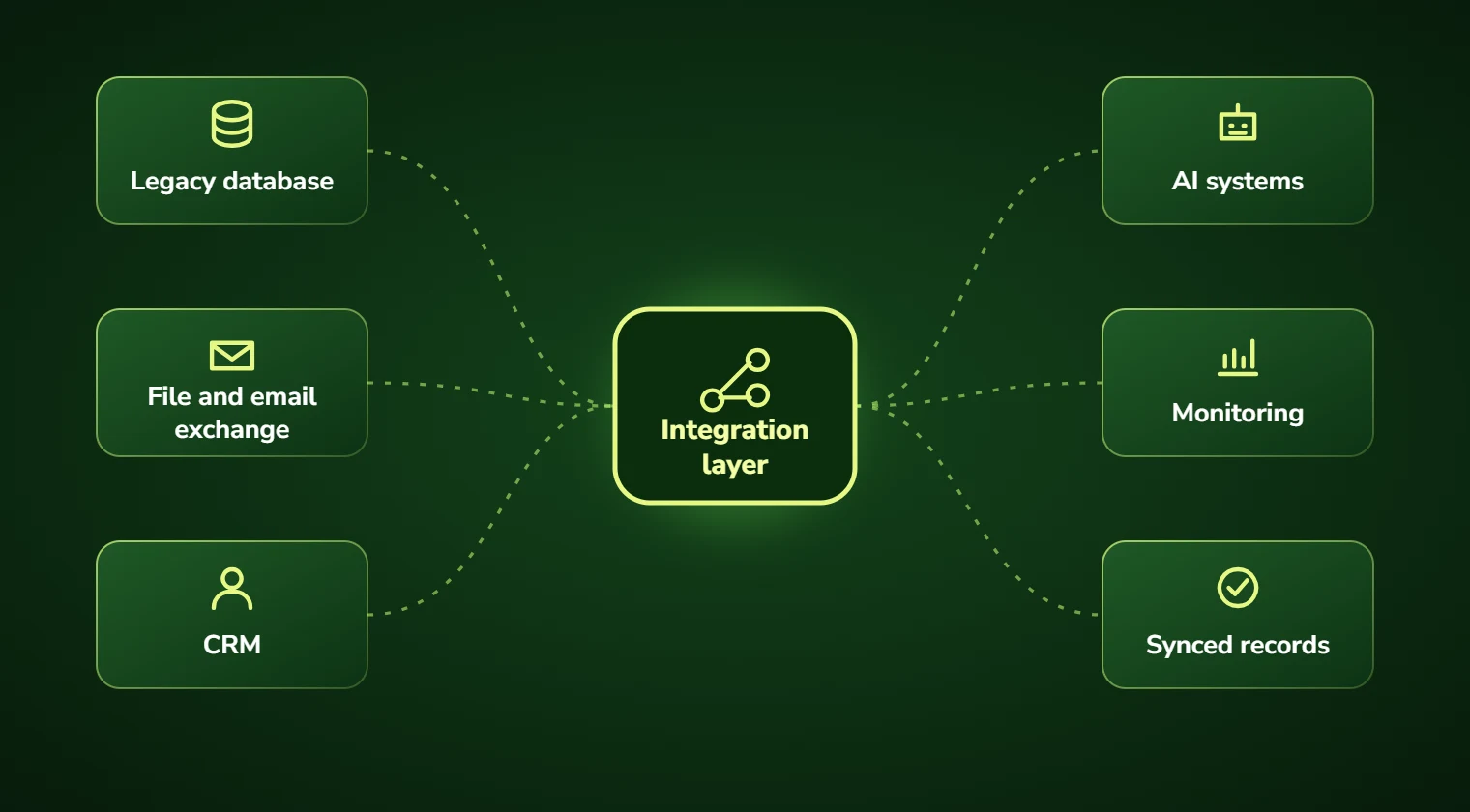
Integrate with what exists, however it exists

Where APIs exist we use them properly, with authentication, rate limiting, retry and error handling built in rather than assumed.

Where they do not, there are other routes: direct database access where it is safe, interface automation, scheduled file exchange, or email-based integration. Each has trade-offs, and we tell you which applies before quoting rather than discovering it mid-build.

Diagram of AI services integrating a CRM, helpdesk and finance tools
Conceptual integration illustration
Service Overview

AI integration services: scope and deliverables

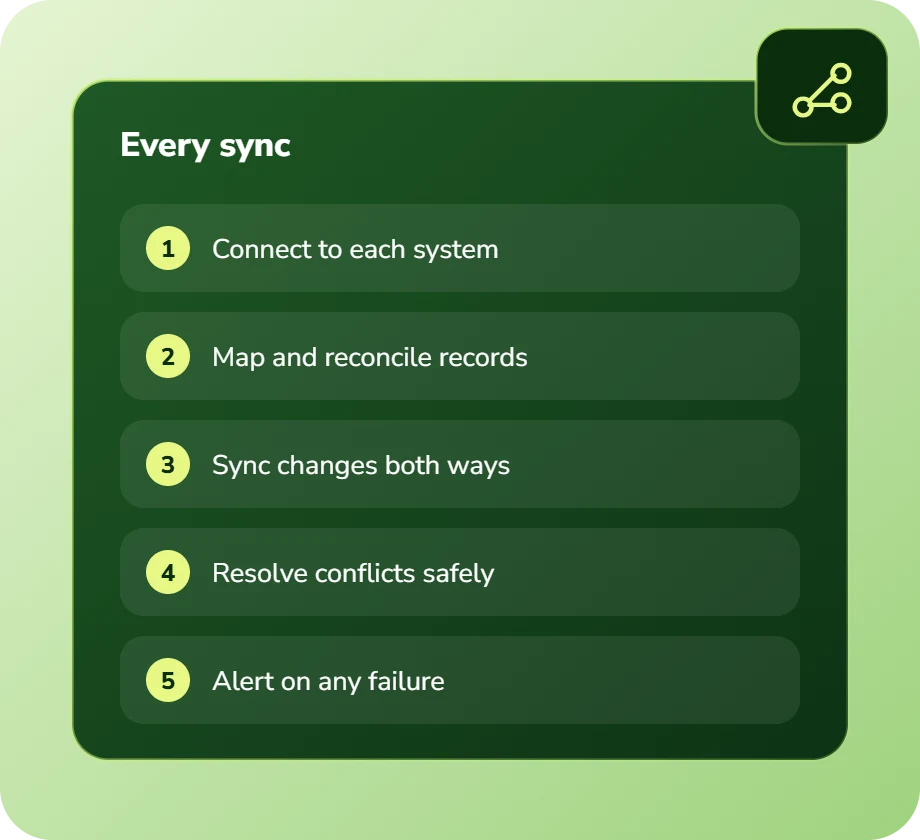
Data mapping is usually the largest hidden cost. Your CRM calls it an account, the ERP calls it a customer, and the practice system has three records for the same entity. Reconciling that is real work and it is where estimates go wrong.

Then the mechanics: authentication that survives credential rotation, rate limiting that respects the target system, retry with backoff, and synchronization that handles conflicts rather than last-write-wins.

And monitoring, because integrations fail silently by default. An integration that stopped working three weeks ago and nobody noticed is worse than no integration.

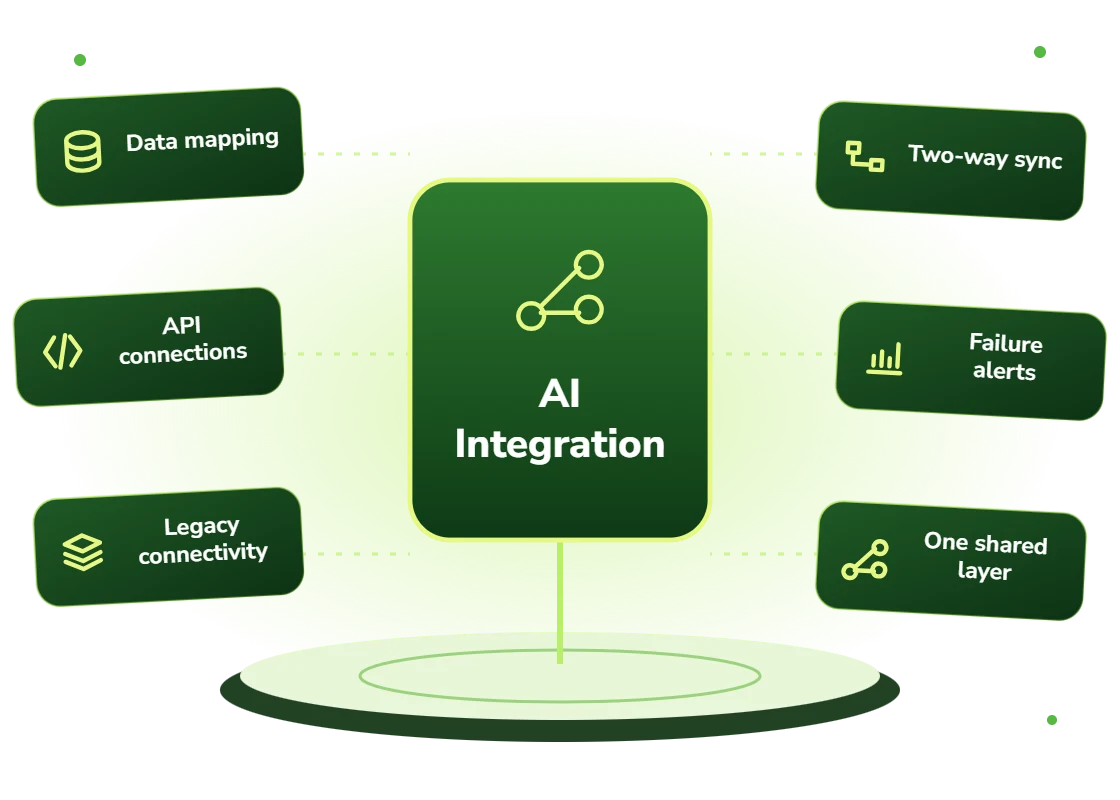
  • Data mapping and entity reconciliation across systems
  • API integration with authentication, rate limiting and retry
  • Legacy connectivity: database, interface automation, file or email exchange
  • Bi-directional synchronization with conflict handling
  • Monitoring and alerting so failures are visible immediately
  • A single integration layer rather than point-to-point connections per project
Right Fit

When integration is the project

Teams whose AI pilot proved value on exported data and now needs live system access, which is the most common point at which projects stall.

And organizations building several AI initiatives, where a shared integration layer avoids each project solving the same connectivity problem separately and inconsistently.

  • AI pilots that worked on exports and now need live system access
  • Organizations with legacy systems that vendors decline to integrate with
  • Teams building multiple AI initiatives needing shared connectivity
  • Companies whose existing integrations fail silently
  • Businesses where the same entity exists differently across systems
  • Operations that cannot take core systems offline for integration work
Benefits

Benefits of AI integration services

Legacy systems reachable

Connectivity to platforms with no API through database, interface or file-based routes, assessed honestly first.

One layer, many projects

Shared integration infrastructure so the second and third AI projects do not rebuild the same connections.

Failures that are visible

Monitoring and alerting rather than an integration that stopped three weeks ago unnoticed.

Entity reconciliation solved

The mapping work between systems done properly rather than approximated and discovered later.

No system replacement required

AI connected to what you run rather than bundled with a migration project you did not want.

Honest feasibility upfront

We assess your actual systems before quoting rather than discovering the constraint mid-build.
Problems We Solve

Business challenges this solves

01

Pilots that cannot reach production data

Working on exports, blocked on live access. Integration is the actual project.

02

Legacy systems with no API

Vendors quoting heavily or declining. Alternative connectivity routes exist and we assess them.

03

Integrations failing silently

Data stopped syncing unnoticed. Monitoring and alerting makes failures visible.

04

Same entity, different records

Reconciliation work underestimated in every estimate. We scope it explicitly.

05

Point-to-point sprawl

Every project building its own connections. A shared layer stops the proliferation.

06

Systems that cannot go offline

Integration work constrained by uptime requirements. Designed around it rather than requiring downtime.

What's Included

Features and deliverables

Everything below is in scope on a standard engagement. Nothing here is an upsell discovered halfway through the build.

01

Systems assessment

Inventory of every system in scope, its API surface or lack of one, data quality and realistic integration route.

02

Data mapping

Entity reconciliation across systems with canonical definitions and matching rules, which is usually the largest hidden cost.

03

API integration

Connections with authentication, credential rotation handling, rate limiting, retry with backoff and structured error handling.

04

Legacy connectivity

Database access, interface automation, scheduled file exchange or email integration where no API exists.

05

Synchronization design

Bi-directional sync with explicit conflict resolution rather than last-write-wins data loss.

06

Integration monitoring

Health checks, throughput monitoring and alerting on failure with the payload retained for replay.

07

Shared integration layer

A single connectivity layer serving multiple AI initiatives rather than point-to-point per project.

08

Documentation

Every integration documented with its data flow, failure modes and runbook for your team.

Technology Stack

Technologies we use for AI integration services

We are not tied to one vendor. Model and infrastructure choices are made on accuracy, cost per task, latency, and where your data is allowed to live.

Language Models
C
Claude (Anthropic)
G
GPT (OpenAI)
G
Gemini (Google)
L
Llama
M
Mistral
A
Azure OpenAI Service
Agent & Orchestration
M
Model Context Protocol
L
LangGraph
L
LangChain
L
LlamaIndex
T
Temporal
C
Celery
Data & Backend
P
Python
T
TypeScript / Node.js
P
PostgreSQL
S
Snowflake
d
dbt
A
Apache Airflow
Cloud & Infrastructure
A
AWS Bedrock
G
Google Vertex AI
M
Microsoft Azure
D
Docker
K
Kubernetes
T
Terraform
Business Systems
S
Salesforce
H
HubSpot
N
NetSuite
M
Microsoft 365
S
Slack
Z
Zapier / Make
How We Work

Our AI development process

The same five stages on every engagement, so you always know what happens next and what you get at the end of it.

01

Discovery

We interview the people doing the work, map the workflow end to end, and audit the systems and data behind it.

02

AI Strategy

Every opportunity gets scored on cost to build, time to value, and annual savings, then ranked.

03

Pilot Build

We ship the top-ranked automation as a fixed-scope pilot so you see real output before committing further budget.

04

Implementation

Integration with your live systems, staff training, human-in-the-loop review gates, and a documented rollback path.

05

Optimization

Monthly accuracy reviews, prompt and retrieval tuning, and a written report on hours and dollars saved.

Timeline

How long it takes

A typical first engagement, week by week. Complex integrations and regulated environments extend this, and we say so during discovery rather than after.

Weeks 1 to 2

Discovery and scoping

Process observation, systems audit, data review, and a written estimate of cost and expected saving before anything is built.

Week 3

Design sign-off

Architecture, data handling rules, review thresholds and success measures agreed in writing.

Weeks 4 to 7

Build and integration

Development against your real data, connected to your live systems, with weekly demos rather than a single reveal.

Week 8

Parallel run and testing

The system runs alongside the existing process so accuracy can be compared directly before anyone depends on it.

Weeks 9 to 10

Launch and handover

Cutover with a rollback path, staff training, full documentation, then 30 days of included tuning.

Who We Work With

Industries we deliver AI integration services for

Manufacturing

Quality inspection, maintenance prediction, supplier communication, and production scheduling.

Financial Services

Document extraction, reconciliation, KYC support, and audit-ready reporting with full traceability.

Healthcare

Intake, prior authorization, clinical documentation, and revenue-cycle workflows built to respect HIPAA boundaries.

Logistics & Supply Chain

Document processing, carrier communication, exception handling, and inventory rebalancing.

Insurance

First-notice-of-loss intake, claims triage, policy Q&A, and fraud signal detection.

Professional Services

Proposal drafting, timesheet capture, research synthesis, and client reporting at scale.

Construction

Bid takeoffs, submittal review, RFI drafting, and field-report summarization.

Education

Enrollment support, content generation, tutoring assistants, and administrative automation.

Use Cases

Real-world use cases

01

CRM and AI connectivity

AI reading and writing CRM records with proper authentication and conflict handling.

02

Legacy ERP integration

Connecting AI to an ERP with no modern API through database or interface routes.

03

Helpdesk integration

AI operating inside Zendesk, Intercom or Salesforce Service Cloud rather than alongside them.

04

Document store connectivity

SharePoint, Drive and file shares connected to retrieval systems with permission enforcement.

05

Multi-system orchestration

AI workflows spanning several systems with consistent error handling and state management.

06

Shared integration platform

One connectivity layer serving every AI initiative rather than each building its own.

Why DevSolutionsAI

Why choose DevSolutionsAI for AI integration services

Business case before build

Every recommendation carries an estimated cost, timeline, and annual savings figure. If the math does not work, we say so before you spend.

Vendor-neutral by design

We resell nothing and take no platform commissions. Model and infrastructure choices are made on fit, cost, and your data-residency rules.

Fixed-scope pilots

The first engagement is a defined deliverable at a defined price, not an open-ended retainer that quietly grows each quarter.

Built for handover

You own the code, the prompts, the infrastructure, and the documentation. No lock-in to a proprietary wrapper you cannot leave.

Human-in-the-loop where it counts

Anything customer-facing, clinical, financial, or legal gets a review gate, a confidence threshold, and a logged audit trail.

Security reviewed early

Data flow diagrams, retention rules, and access boundaries are agreed in week one, not retrofitted after your security team objects.

Get Started

Find out what AI integration services would cost you, before you commit to anything

Every engagement is quoted after a short discovery, so you get a fixed written price built around your actual volumes rather than a rate card that assumes someone else’s business.

The first call is thirty minutes and free. Bring one workflow. We will tell you what it is likely costing you each year, roughly what automating it would take, and whether we think it is worth doing at all.

  • A written savings estimate before any paid work
  • Fixed scope and fixed price, agreed up front
  • Full ownership of everything we build for you
  • An honest recommendation when the numbers do not work
What clients typically see
Across recent projects
Staff hours saved each week
31
Months to payback
4.8
Client retention
94%
Response to enquiries
4 hrs

Figures are internal measurements across recent engagements, reported to every client monthly in writing.

Illustrative project scenario

Illustrative project scenario

Building products manufacturer · 1998 ERP

Reaching an ERP the vendor said could not be integrated

Challenge. A manufacturer’s AI project for quote automation stalled because the required data lived in an ERP implemented in 1998. The vendor offered no API and quoted a substantial sum for a custom integration module with a nine-month timeline.

What we built. Assessment identified a viable route: read-only database access for retrieval, agreed with the vendor in writing, combined with the ERP’s existing scheduled export capability for bulk data and its email notification system for change events. Writes go through the ERP’s supported import interface rather than direct database writes.

Outcome. Integration completed in seven weeks at a fraction of the vendor quote. The quote automation project resumed and reached production. The integration layer was subsequently reused by two further AI initiatives without additional connectivity work.

7 weeks
Versus 9 months quoted
3
Projects using the layer
1998
ERP vintage integrated
0
Direct database writes

Illustrative project scenario. The figures demonstrate how a project could be scoped and evaluated; they are not verified client results or an audited average.

Client Feedback

What clients say about working with us

31
Avg. staff hours saved weekly
4.8
Avg. months to payback
94%
Client retention
4
Hour response to enquiries
Common Questions

AI Integration Services FAQs

Usually, and this is a large share of our integration work. Options include read-only database access where the vendor supports it, automating the user interface, scheduled file exchange, and email-based integration. Each has different reliability and risk characteristics, and we assess which applies to your specific system before quoting rather than discovering the constraint mid-build.
Only with the vendor’s explicit written support, which is rare. Writing directly bypasses the application’s own validation and business logic, which can corrupt data in ways that are difficult to detect, and it typically invalidates your support agreement. We use supported import interfaces instead, even when they are slower.

Almost always entity mapping. Your CRM calls it an account, the ERP calls it a customer, and there are three records for the same entity with slightly different names. Reconciling that is real work and it is routinely omitted from estimates. We scope it explicitly during assessment, which makes our estimates less attractive upfront and considerably more accurate.

Health checks, throughput monitoring against expected volumes, and alerting to a named owner when either goes outside normal range. Failed messages go to a dead-letter queue with the full payload retained so they can be replayed after a fix. An integration that stopped working three weeks ago unnoticed is worse than no integration at all.

If you are planning more than one or two AI initiatives, yes. Point-to-point integration per project means the same connectivity is built repeatedly, inconsistently, and maintained by whoever built it. A shared layer costs more for the first project and less for every subsequent one, on a recent engagement the layer built for one project served two more with no additional connectivity work.

A one to two week assessment runs $7,000 to $14,000 and produces realistic route recommendations and effort estimates per system. A build typically runs $30,000 to $75,000 depending on system count, whether legacy connectivity is required, and how much entity reconciliation is involved. The assessment is worth doing separately because it frequently changes the plan.

Service Areas

AI Integration Services across the United States

We deliver AI integration services remotely to clients nationwide, with on-site workshops available in major metros.

Ready to scope your AI integration services project?

Book a free 30-minute consultation. Bring one workflow and leave with a realistic estimate of what it would cost to automate and what it would save.

Free 30-minute consultation
Fixed-scope pilots
U.S.-based team
Custom, not off-the-shelf
SOC 2-aligned practices
ROI tracked in writing
Free 30-minute AI consultation