AI Maintenance & Support

AI maintenance and support for production systems

AI maintenance and support help you manage model changes, content drift and evolving usage. We review accuracy, costs and incidents so your production system can be maintained against agreed requirements.

Free 30-minute consultation
Fixed-scope pilots
U.S.-based team
Custom, not off-the-shelf
SOC 2-aligned practices
ROI tracked in writing
Why does AI need ongoing maintenance?

AI systems degrade without code changes because their inputs and dependencies shift. Model providers deprecate and update models, source content becomes stale, user behaviour changes, and accuracy drifts. Ongoing maintenance covers accuracy monitoring, model migration, content freshness, cost optimization and incident response.

7+
Years building AI systems
240+
Projects delivered
4.8
Avg. months to payback
38
U.S. states served
The Problem

The system that was working and quietly stopped

AI systems degrade in ways conventional software does not. A model gets deprecated. Source documentation goes stale so retrieval starts citing superseded content. Usage shifts toward cases the system was never tested on.

None of this triggers an error. The system keeps responding, the responses get worse, and nobody notices until a customer complains or someone spots a pattern months later.

Our Approach

Monitor the things that actually drift

Accuracy is measured continuously against an evaluation set, so quality degradation is visible as a trend rather than discovered through complaints.

Model deprecations are tracked and migrations planned before the forced cutover date. Content freshness is monitored. Cost is tracked against usage so growth can be diagnosed.

Cloud illustration
Conceptual cloud illustration
Service Overview

AI maintenance and support: scope and deliverables

Accuracy monitoring against a maintained evaluation set is the foundation. Without it, quality is assessed by whoever last complained, which is not a monitoring strategy.

Model lifecycle management is the most concrete recurring need. Providers deprecate models with notice periods, and a forced migration under deadline is considerably worse than a planned one with regression testing.

Cost optimization matters because model pricing and capability change frequently. A workload that needed a frontier model last year may run equivalently on something far cheaper now, and nobody checks unless someone is responsible for checking.

And incident response, because production AI systems occasionally fail in ways that need someone who understands them.

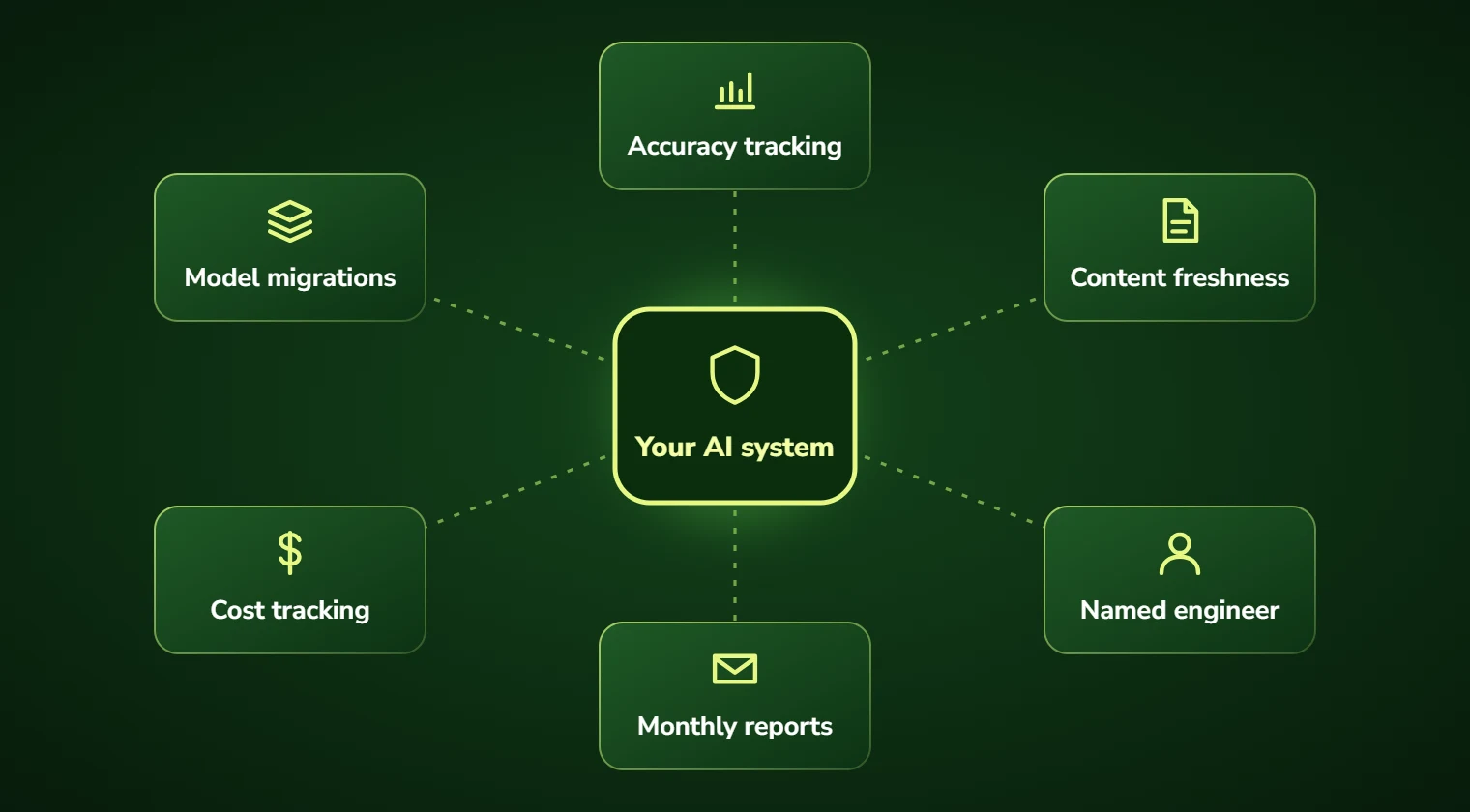
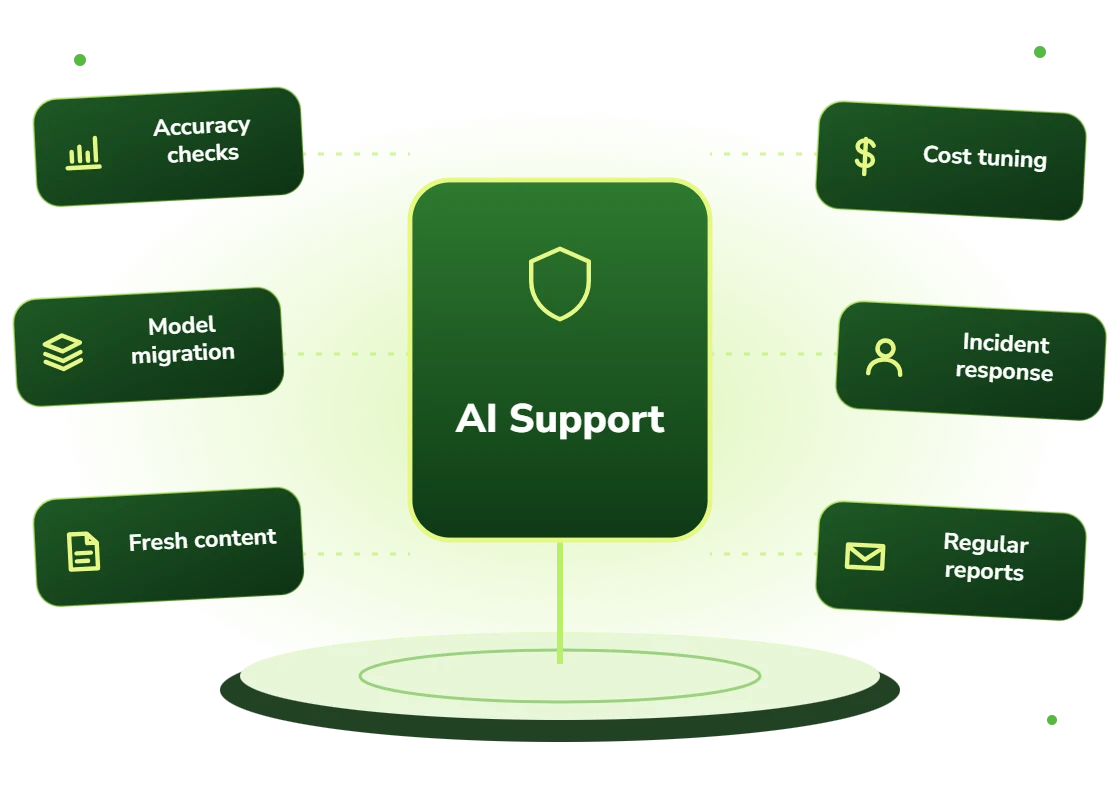
  • Continuous accuracy measurement against a maintained evaluation set
  • Model deprecation tracking and planned migration with regression testing
  • Content freshness monitoring for retrieval systems
  • Cost tracking with optimization when cheaper options become adequate
  • Incident response with a named engineer rather than a ticket queue
  • Regular reporting on accuracy, cost and usage trends
Right Fit

Who needs ongoing AI support

Organizations with AI in production that matters, particularly where degradation would affect customers or where the system informs consequential decisions.

And teams without in-house AI expertise to maintain what was built, which is common when the build was outsourced or the person who built it has moved on.

  • Organizations with production AI that customers or operations depend on
  • Teams without in-house expertise to maintain AI systems
  • Companies whose AI was built by someone who has since left
  • Businesses with AI costs growing without a diagnosis
  • Organizations with no accuracy monitoring on production AI
  • Teams facing model deprecation notices without a migration plan
Benefits

Benefits of AI maintenance & support

Degradation caught early

Accuracy trends monitored so quality problems surface before customers report them.

Migrations that are planned

Model deprecations handled with regression testing on your timeline rather than under a forced deadline.

Costs that come down

Proactive review when cheaper models become adequate, including when that reduces our own revenue.

Content that stays current

Freshness monitoring on retrieval systems so answers do not quietly start citing superseded documents.

A named engineer

Incidents handled by someone who understands your system rather than by a ticket queue.

Written reporting

Regular reports on accuracy, cost and usage so the system’s health is visible rather than assumed.

Problems We Solve

Business challenges this solves

01

Quality degrading unnoticed

No monitoring, so problems surface via complaints. Continuous measurement makes trends visible.

02

Forced model migrations

Deprecation deadlines arriving unplanned. Tracking and planned migration removes the crisis.

03

Retrieval citing stale content

Source documents superseded without re-indexing. Freshness monitoring catches it.

04

Costs growing without diagnosis

Spend rising with no attribution. Tracking and periodic optimization addresses it.

05

Nobody left who understands it

The builder has moved on. Ongoing support provides continuity.

06

Incidents with no expert response

AI failures handled by generalists. A named engineer who knows the system responds.

What's Included

Features and deliverables

Everything below is in scope on a standard engagement. Nothing here is an upsell discovered halfway through the build.

01

Accuracy monitoring

Continuous scoring against a maintained evaluation set with alerting when quality moves outside expected range.

02

Model lifecycle management

Deprecation tracking, migration planning, regression testing and cutover with rollback capability.

03

Content freshness

Monitoring of source content currency and re-indexing for retrieval systems as documents change.

04

Cost monitoring and optimization

Spend tracked against usage, with periodic review of whether cheaper models now meet the accuracy bar.

05

Incident response

A named engineer familiar with your system, with defined response commitments including out of hours for production incidents.

06

Guardrail maintenance

Injection defences and output validation updated as new attack patterns emerge.

07

Usage analysis

Reporting on how the system is actually used, including queries it handles poorly, feeding an improvement backlog.

08

Periodic reporting

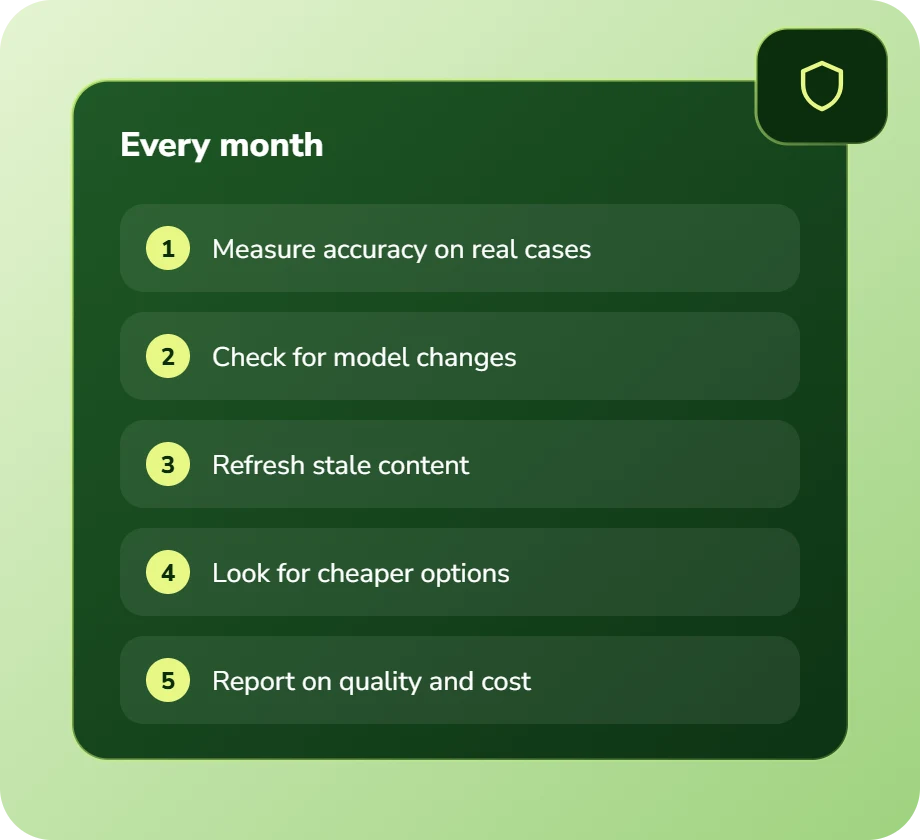
Written monthly reporting on accuracy, cost, usage and any recommended changes.

Technology Stack

Technologies we use for AI maintenance & support

We are not tied to one vendor. Model and infrastructure choices are made on accuracy, cost per task, latency, and where your data is allowed to live.

Language Models
C
Claude (Anthropic)
G
GPT (OpenAI)
G
Gemini (Google)
L
Llama
M
Mistral
A
Azure OpenAI Service
Vector & Retrieval
P
Pinecone
W
Weaviate
Q
Qdrant
p
pgvector
E
Elasticsearch
A
Amazon OpenSearch
Data & Backend
P
Python
T
TypeScript / Node.js
P
PostgreSQL
S
Snowflake
d
dbt
A
Apache Airflow
Cloud & Infrastructure
A
AWS Bedrock
G
Google Vertex AI
M
Microsoft Azure
D
Docker
K
Kubernetes
T
Terraform
How We Work

Our AI development process

The same five stages on every engagement, so you always know what happens next and what you get at the end of it.

01

Discovery

We interview the people doing the work, map the workflow end to end, and audit the systems and data behind it.

02

AI Strategy

Every opportunity gets scored on cost to build, time to value, and annual savings, then ranked.

03

Pilot Build

We ship the top-ranked automation as a fixed-scope pilot so you see real output before committing further budget.

04

Implementation

Integration with your live systems, staff training, human-in-the-loop review gates, and a documented rollback path.

05

Optimization

Monthly accuracy reviews, prompt and retrieval tuning, and a written report on hours and dollars saved.

Timeline

How long it takes

A typical first engagement, week by week. Complex integrations and regulated environments extend this, and we say so during discovery rather than after.

Weeks 1 to 2

Discovery and scoping

Process observation, systems audit, data review, and a written estimate of cost and expected saving before anything is built.

Week 3

Design sign-off

Architecture, data handling rules, review thresholds and success measures agreed in writing.

Weeks 4 to 7

Build and integration

Development against your real data, connected to your live systems, with weekly demos rather than a single reveal.

Week 8

Parallel run and testing

The system runs alongside the existing process so accuracy can be compared directly before anyone depends on it.

Weeks 9 to 10

Launch and handover

Cutover with a rollback path, staff training, full documentation, then 30 days of included tuning.

Who We Work With

Industries we deliver AI maintenance & support for

SaaS & Technology

AI features inside your product, support deflection, onboarding assistants, and usage analytics.

Financial Services

Document extraction, reconciliation, KYC support, and audit-ready reporting with full traceability.

Healthcare

Intake, prior authorization, clinical documentation, and revenue-cycle workflows built to respect HIPAA boundaries.

Logistics & Supply Chain

Document processing, carrier communication, exception handling, and inventory rebalancing.

Insurance

First-notice-of-loss intake, claims triage, policy Q&A, and fraud signal detection.

Retail & E-commerce

Product data enrichment, demand forecasting, support deflection, and personalized merchandising.

Manufacturing

Quality inspection, maintenance prediction, supplier communication, and production scheduling.

Professional Services

Proposal drafting, timesheet capture, research synthesis, and client reporting at scale.

Use Cases

Real-world use cases

01

Post-launch support

Ongoing care for a system after the build engagement concludes.

02

Inherited system support

Taking over maintenance of AI built by another firm or a departed employee.

03

Model migration

Planned migration off a deprecated model with regression testing and rollback.

04

Cost reduction programme

Periodic review and optimization as model pricing and capability change.

05

Accuracy monitoring implementation

Adding evaluation and monitoring to a production system that has none.

06

Incident support

Expert response when a production AI system fails or degrades unexpectedly.

Why DevSolutionsAI

Why choose DevSolutionsAI for AI maintenance & support

Business case before build

Every recommendation carries an estimated cost, timeline, and annual savings figure. If the math does not work, we say so before you spend.

Vendor-neutral by design

We resell nothing and take no platform commissions. Model and infrastructure choices are made on fit, cost, and your data-residency rules.

Fixed-scope pilots

The first engagement is a defined deliverable at a defined price, not an open-ended retainer that quietly grows each quarter.

Built for handover

You own the code, the prompts, the infrastructure, and the documentation. No lock-in to a proprietary wrapper you cannot leave.

Human-in-the-loop where it counts

Anything customer-facing, clinical, financial, or legal gets a review gate, a confidence threshold, and a logged audit trail.

Security reviewed early

Data flow diagrams, retention rules, and access boundaries are agreed in week one, not retrofitted after your security team objects.

Get Started

Find out what AI maintenance & support would cost you, before you commit to anything

Every engagement is quoted after a short discovery, so you get a fixed written price built around your actual volumes rather than a rate card that assumes someone else’s business.

The first call is thirty minutes and free. Bring one workflow. We will tell you what it is likely costing you each year, roughly what automating it would take, and whether we think it is worth doing at all.

  • A written savings estimate before any paid work
  • Fixed scope and fixed price, agreed up front
  • Full ownership of everything we build for you
  • An honest recommendation when the numbers do not work
What clients typically see
Across recent projects
Staff hours saved each week
31
Months to payback
4.8
Client retention
94%
Response to enquiries
4 hrs

Figures are internal measurements across recent engagements, reported to every client monthly in writing.

Illustrative project scenario

Illustrative project scenario

Logistics platform · inherited AI system

Finding a system that had been degrading for five months

Challenge. A logistics company inherited an AI document classification system when the contractor who built it ended their engagement. There was no monitoring. Operations staff had begun mentioning that classification seemed less reliable, but nobody could quantify it or knew where to look.

What we built. We built an evaluation set from historical documents with verified correct classifications and measured current accuracy against it. The result was 79%, against 94% documented at handover. Investigation found the provider had silently updated the underlying model version five months earlier, and the prompts had not been revalidated against it.

Outcome. Prompt adjustment and revalidation restored accuracy to 93%. Continuous monitoring was implemented so the next model update would be detected within days rather than discovered through operational complaints. Cost review also identified that a cheaper model now met the accuracy bar.

94% → 79%
Undetected degradation
5 months
Before anyone measured
93%
Restored accuracy
Days
Detection time now

Illustrative project scenario. The figures demonstrate how a project could be scoped and evaluated; they are not verified client results or an audited average.

Client Feedback

What clients say about working with us

31
Avg. staff hours saved weekly
4.8
Avg. months to payback
94%
Client retention
4
Hour response to enquiries
Common Questions

AI Maintenance & Support FAQs

Because its dependencies and inputs change even when your code does not. Providers update and deprecate models, sometimes with minimal notice. Source documentation goes stale so retrieval starts citing superseded content. Usage shifts toward cases the system was never tested on. On a recent engagement, accuracy had fallen from 94% to 79% over five months because the provider silently updated a model version and nobody revalidated.

No. Standard monitoring watches uptime, latency and error rates. An AI system can be up, fast and error-free while producing materially worse output, and none of those metrics will show it. Detecting quality degradation requires evaluating actual output against known-correct answers, which is a different kind of monitoring entirely.

With monitoring, you get notice and a planned migration: regression testing against your evaluation set, validation that quality is maintained, and a cutover with rollback capability. Without it, you get a forced migration under a deadline with no way to verify the replacement performs equivalently, which is considerably worse.

Yes, and it is a standard part of the review. Model pricing and capability change frequently, and a workload that genuinely needed a frontier model last year may run equivalently on something far cheaper now. We check and report it. A support arrangement where the provider benefits from your inefficiency is not one worth having.

Yes, and inherited systems are a common engagement. We start with an assessment: building an evaluation set, measuring current accuracy, reviewing the architecture and documenting what exists. That frequently surfaces problems nobody had quantified, which is uncomfortable and useful.

Monitoring setup, including building the evaluation set, runs $12,000 to $22,000 as a one-off. Ongoing managed support starts at $4,500 monthly for a single system, covering monitoring, model migration, cost reviews and incident response with a named engineer. Enterprise arrangements covering multiple systems with faster incident response start at $14,000 monthly.

Service Areas

AI Maintenance & Support across the United States

We deliver AI maintenance & support remotely to clients nationwide, with on-site workshops available in major metros.

Ready to scope your AI maintenance & support project?

Book a free 30-minute consultation. Bring one workflow and leave with a realistic estimate of what it would cost to automate and what it would save.

Free 30-minute consultation
Fixed-scope pilots
U.S.-based team
Custom, not off-the-shelf
SOC 2-aligned practices
ROI tracked in writing
Free 30-minute AI consultation