AI MVP Development

AI MVP development that gets you to real users in weeks

Our AI MVP development work focuses on the smallest product that can test a useful assumption with real users. We define the core workflow, evaluation criteria and architecture before expanding the feature list.

Free 30-minute consultation
Fixed-scope pilots
U.S.-based team
Custom, not off-the-shelf
SOC 2-aligned practices
ROI tracked in writing
What is an AI MVP?

An AI MVP is the smallest working version of an AI product that real users can try, built to test whether the core value proposition holds. It deliberately omits secondary features, but should not omit the architectural decisions, data model, model portability and evaluation, that would otherwise force a full rewrite once the product finds traction.

7+
Years building AI systems
240+
Projects delivered
4.8
Avg. months to payback
38
U.S. states served
The Problem

Two ways AI MVPs go wrong

The first is building too much. Six months of development, a full feature set, and the first real user feedback arrives after the runway has been spent on assumptions.

The second is building too carelessly. A fast MVP with the data model wrong, the model hard-wired throughout, and no evaluation, so the moment it gets traction the only path forward is a rewrite.

Our Approach

Narrow scope, sound foundations

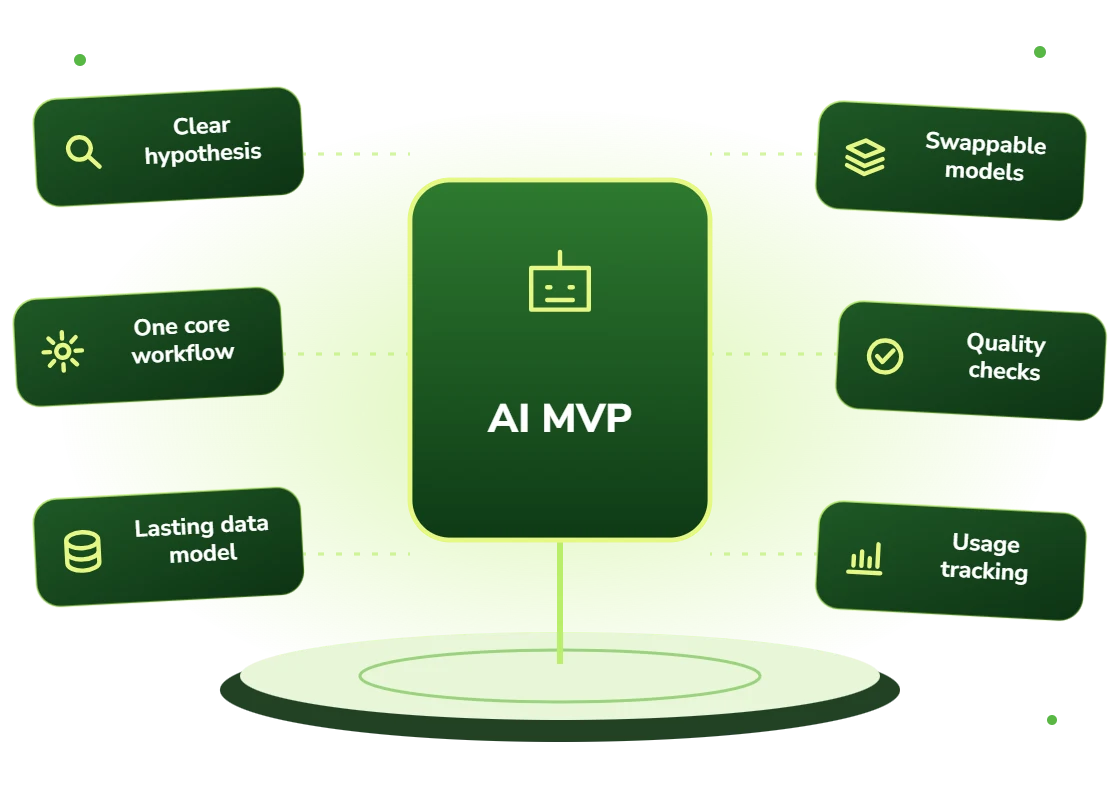
We cut scope hard on features and refuse to cut it on three things: a data model that will still make sense at scale, model portability, and a way to measure whether output quality is actually good.

Those three cost days to get right at the start and months to retrofit later. Everything else is genuinely negotiable and usually should be cut.

Illustration of a roadmap with five numbered milestones
Service Overview

AI MVP development: scope and deliverables

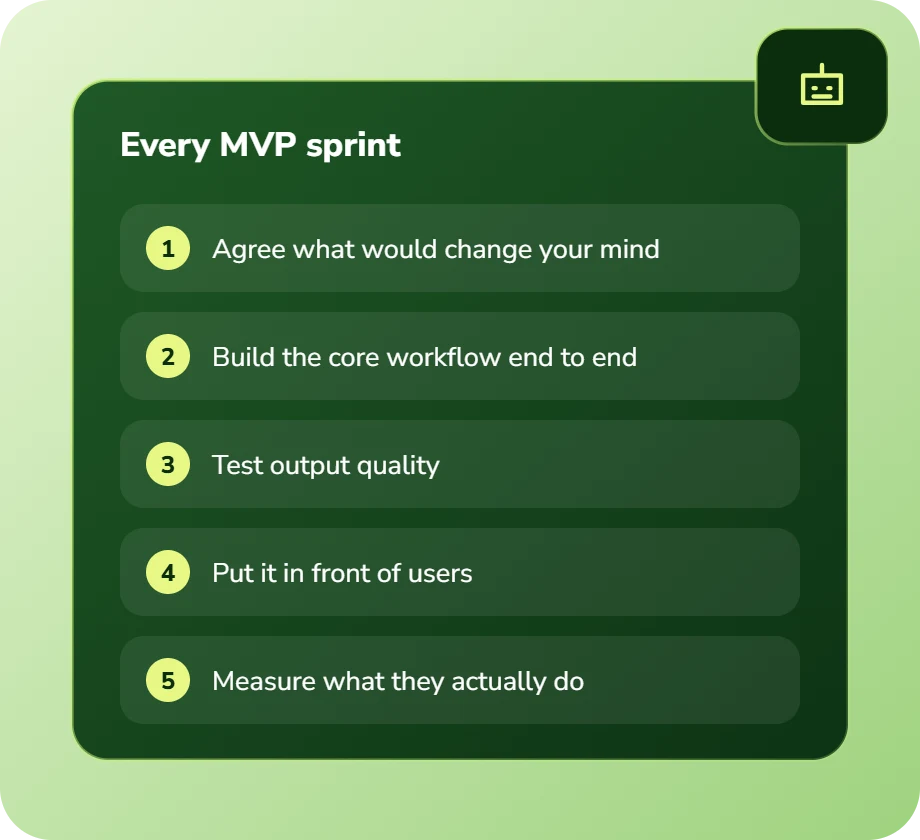
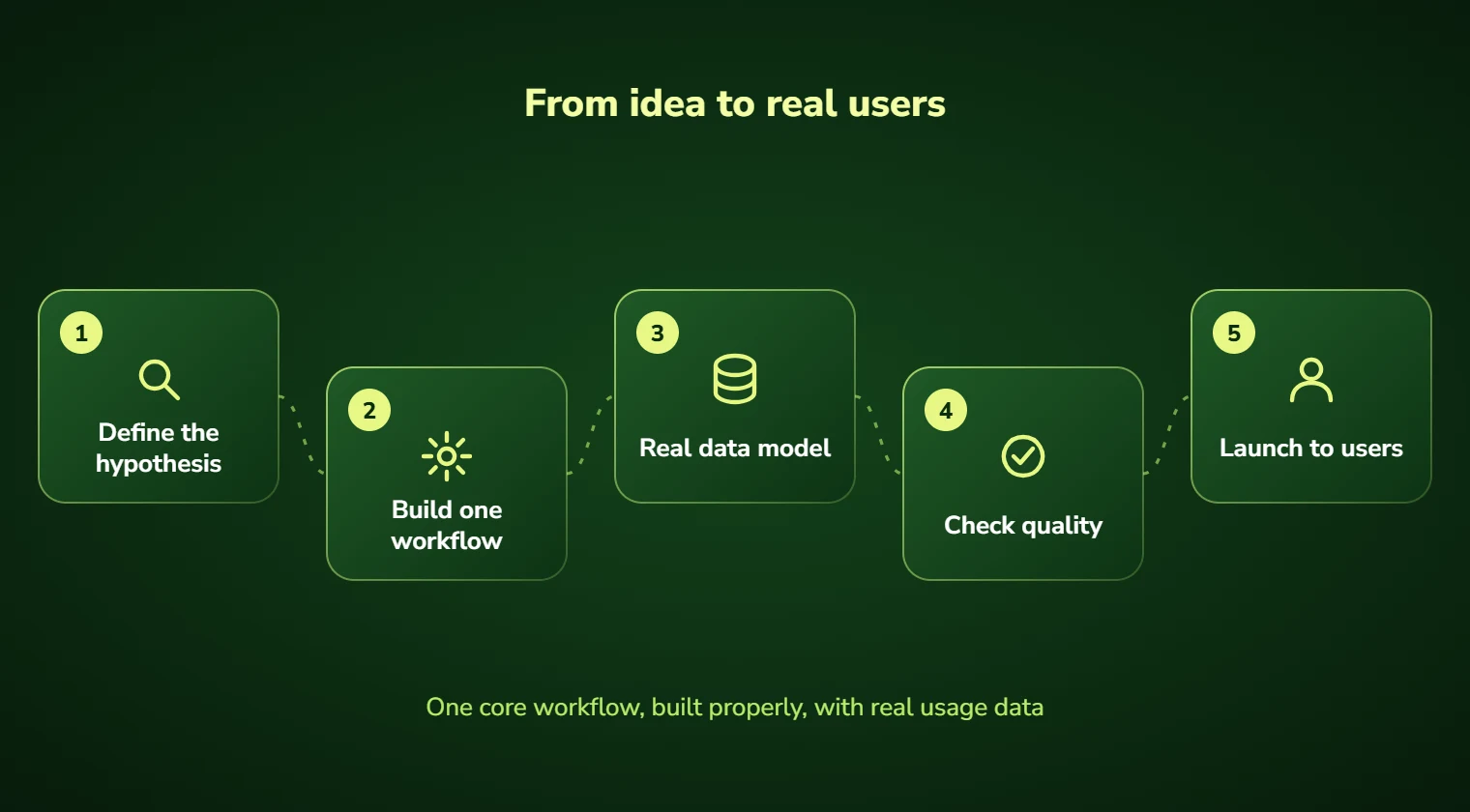
The first conversation is about what you are trying to learn. An MVP that cannot change your mind is not a test, it is a launch, and it should be scoped differently.

From there we identify the single workflow that carries the core hypothesis and build only that, end to end, well enough that a real user can complete it without a demo script.

We are deliberate about what gets deferred and what does not. Admin panels, billing, integrations and secondary features are usually deferred. Data model, evaluation and model abstraction are not, because they are cheap now and expensive later.

  • Hypothesis definition: what would change your mind about this product
  • One core workflow built end to end, properly, rather than five built partially
  • Data model designed for the product you intend, not just the demo
  • Model abstraction so switching providers later is configuration
  • Basic evaluation so you can tell whether output quality is acceptable
  • Usage instrumentation so user behaviour produces real signal
Right Fit

Who this is for

Founders with a specific hypothesis about an AI product and a need to test it before raising or committing further. Speed genuinely matters here and we scope for it.

Also product teams inside larger companies validating a new line before requesting significant budget, where an internal build would take two quarters to staff.

  • Founders validating an AI product concept before or between raises
  • Teams needing a working demo for investors or design partners
  • Product groups testing a new line before committing engineering headcount
  • Companies wanting to know if an idea is technically feasible at all
  • Founders without a technical co-founder who need a credible first build
  • Teams whose internal roadmap cannot accommodate an experiment for six months
Benefits

Benefits of AI MVP development

Real signal in weeks

Six to ten weeks to something users can actually try, rather than six months of building against assumptions.

No rewrite at traction

The three decisions that force a rebuild are made properly at the start, when they are nearly free.

Fixed price and scope

You know the cost before starting, which matters more when the money is finite and unraised.

Investor-credible

A working product with usage data is a materially different conversation from a deck and a prototype.

Honest feasibility answers

If the core idea is not achievable at acceptable cost or accuracy, you find out in week two rather than month five.

Yours entirely

Full code ownership, so an in-house team or another firm can pick it up without negotiation.

Problems We Solve

Business challenges AI MVP development solves

01

Runway spent before user contact

Months building on assumptions. A narrow MVP produces feedback while there is still time to act on it.

02

Version two is a rewrite

MVP shortcuts becoming structural. We protect the decisions that are expensive to reverse.

03

No technical co-founder

A strong idea with no way to build it. We deliver a credible first version and hand it over cleanly.

04

Unclear technical feasibility

Not knowing whether the core capability is even possible. Feasibility is tested first, cheaply.

05

Unpredictable unit economics

No idea what a user costs to serve. We measure per-user AI cost during the MVP.

06

Investors want more than a deck

Needing a working product for diligence. An MVP with usage data changes the conversation.

What's Included

Features and deliverables

Everything below is in scope on a standard engagement. Nothing here is an upsell discovered halfway through the build.

01

Hypothesis and scope workshop

Defining what you are testing and what result would change your mind, then cutting everything that does not serve it.

02

Feasibility spike

Where the core capability is uncertain, a short technical spike testing it before committing to the full build.

03

Core workflow build

One user journey built end to end, properly, so real users can complete it unassisted.

04

Durable data model

Schema designed for the product you intend rather than the demo, because migrating data later is the expensive part.

05

Model abstraction layer

Provider calls behind an interface, so switching or mixing models later is configuration rather than refactoring.

06

Basic evaluation

A small test set with known-good outputs so quality can be measured rather than eyeballed.

07

Usage instrumentation

Analytics on the actions that matter to your hypothesis, so the MVP produces evidence rather than opinions.

08

Deployment and handover

Live on your own infrastructure, with documentation and a walkthrough so any engineer can continue.

Technology Stack

Technologies we use for AI MVP development

We are not tied to one vendor. Model and infrastructure choices are made on accuracy, cost per task, latency, and where your data is allowed to live.

Language Models
C
Claude (Anthropic)
G
GPT (OpenAI)
G
Gemini (Google)
L
Llama
M
Mistral
A
Azure OpenAI Service
Vector & Retrieval
P
Pinecone
W
Weaviate
Q
Qdrant
p
pgvector
E
Elasticsearch
A
Amazon OpenSearch
Data & Backend
P
Python
T
TypeScript / Node.js
P
PostgreSQL
S
Snowflake
d
dbt
A
Apache Airflow
Cloud & Infrastructure
A
AWS Bedrock
G
Google Vertex AI
M
Microsoft Azure
D
Docker
K
Kubernetes
T
Terraform
How We Work

Our AI development process

The same five stages on every engagement, so you always know what happens next and what you get at the end of it.

01

Discovery

We interview the people doing the work, map the workflow end to end, and audit the systems and data behind it.

02

AI Strategy

Every opportunity gets scored on cost to build, time to value, and annual savings, then ranked.

03

Pilot Build

We ship the top-ranked automation as a fixed-scope pilot so you see real output before committing further budget.

04

Implementation

Integration with your live systems, staff training, human-in-the-loop review gates, and a documented rollback path.

05

Optimization

Monthly accuracy reviews, prompt and retrieval tuning, and a written report on hours and dollars saved.

Timeline

How long it takes

A typical first engagement, week by week. Complex integrations and regulated environments extend this, and we say so during discovery rather than after.

Week 1

Scope and hypothesis

What we are testing, what gets built, what explicitly does not, and a fixed price.

Week 2

Feasibility and foundations

Technical spike on the risky part, plus data model and model abstraction.

Weeks 3 to 6

Core build

The main workflow built end to end, with weekly demos you can react to.

Weeks 7 to 8

Polish and instrument

Enough interface quality for real users, plus analytics and basic evaluation.

Weeks 9 to 10

Launch and handover

Deployed live, documentation, walkthrough, and support through the first user cohort.

Who We Work With

Industries we deliver AI MVP development for

SaaS & Technology

AI features inside your product, support deflection, onboarding assistants, and usage analytics.

Healthcare

Intake, prior authorization, clinical documentation, and revenue-cycle workflows built to respect HIPAA boundaries.

Financial Services

Document extraction, reconciliation, KYC support, and audit-ready reporting with full traceability.

Professional Services

Proposal drafting, timesheet capture, research synthesis, and client reporting at scale.

Retail & E-commerce

Product data enrichment, demand forecasting, support deflection, and personalized merchandising.

Real Estate

Lead qualification, listing content, transaction coordination, and 24/7 inquiry response.

Education

Enrollment support, content generation, tutoring assistants, and administrative automation.

Legal

Contract review, discovery triage, and matter intake with citation-checked outputs and attorney sign-off gates.

Use Cases

Real-world AI MVP development use cases

01

Vertical AI SaaS validation

Testing whether an industry-specific AI tool solves a problem people will pay for.

02

AI feature for an existing product

Validating an AI addition with a subset of customers before committing roadmap capacity.

03

Investor demo build

A working product with real usage data ahead of a raise, rather than a clickable prototype.

04

Internal tool proof of value

Demonstrating value on one team before requesting budget for organization-wide rollout.

05

Marketplace or platform concept

Testing whether AI-driven matching produces outcomes users prefer to the manual alternative.

06

Technical feasibility test

Establishing whether the core capability is achievable at acceptable accuracy and cost at all.

Why DevSolutionsAI

Why choose DevSolutionsAI for AI MVP development

Business case before build

Every recommendation carries an estimated cost, timeline, and annual savings figure. If the math does not work, we say so before you spend.

Vendor-neutral by design

We resell nothing and take no platform commissions. Model and infrastructure choices are made on fit, cost, and your data-residency rules.

Fixed-scope pilots

The first engagement is a defined deliverable at a defined price, not an open-ended retainer that quietly grows each quarter.

Built for handover

You own the code, the prompts, the infrastructure, and the documentation. No lock-in to a proprietary wrapper you cannot leave.

Human-in-the-loop where it counts

Anything customer-facing, clinical, financial, or legal gets a review gate, a confidence threshold, and a logged audit trail.

Security reviewed early

Data flow diagrams, retention rules, and access boundaries are agreed in week one, not retrofitted after your security team objects.

Get Started

Find out what AI MVP development would cost you, before you commit to anything

Every engagement is quoted after a short discovery, so you get a fixed written price built around your actual volumes rather than a rate card that assumes someone else’s business.

The first call is thirty minutes and free. Bring one workflow. We will tell you what it is likely costing you each year, roughly what automating it would take, and whether we think it is worth doing at all.

  • A written savings estimate before any paid work
  • Fixed scope and fixed price, agreed up front
  • Full ownership of everything we build for you
  • An honest recommendation when the numbers do not work
What clients typically see
Across recent projects
Staff hours saved each week
31
Months to payback
4.8
Client retention
94%
Response to enquiries
4 hrs

Figures are internal measurements across recent engagements, reported to every client monthly in writing.

Illustrative project scenario

Illustrative project scenario

Seed-stage legal tech · pre-raise

From concept to 40 design partners in nine weeks

Challenge. Two non-technical founders had a hypothesis about contract review for small law firms and a seed round contingent on demonstrating real usage. They needed a working product fast, but had been warned by advisers that a rushed build would need rewriting.

What we built. A week-one feasibility spike established achievable accuracy on their specific document types before committing to the build. The MVP covered one workflow, upload, clause extraction, risk flagging, end to end. The data model, model abstraction and evaluation set were built properly; billing, admin tooling and integrations were explicitly deferred.

Outcome. Live in nine weeks with 40 design partners in the first month. Usage data from those partners materially reshaped the roadmap, killing two planned features and surfacing one nobody had considered. The round closed, and version two extended the MVP rather than replacing it.

9 weeks
Concept to live
40
Design partners month one
0
Rewrite required for v2
2
Planned features killed by data

Illustrative project scenario. The figures demonstrate how a project could be scoped and evaluated; they are not verified client results or an audited average.

Client Feedback

What clients say about working with us

31
Avg. staff hours saved weekly
4.8
Avg. months to payback
94%
Client retention
4
Hour response to enquiries
Common Questions

AI MVP Development FAQs

Six to ten weeks for a working product real users can try, depending on scope and how much technical uncertainty sits in the core capability. Where the central question is feasibility, we usually run a one to two week spike first, it is far cheaper to discover the accuracy is unachievable in week one than in month three.

MVP builds typically run $48,000 to $85,000 at a fixed price agreed before we start. A feasibility spike alone is $9,000 to $18,000. If your hypothesis is really about demand rather than product experience, we will tell you that a no-code build or a landing page test would answer it for a fraction of that.

Almost everything that is not the core hypothesis: admin panels, billing, integrations, secondary features, edge-case handling, and interface polish beyond what a real user needs to complete the workflow. What we never leave out is the data model, model abstraction and basic evaluation, because those are cheap now and cost months to retrofit.
That is precisely what the architecture discipline is designed to prevent, and in our engagements version two has generally extended the MVP rather than replacing it. We cannot promise it never happens, a product that pivots substantially may genuinely need different foundations, but the decisions that most commonly force a rewrite are made properly from the start.

Entirely. Source, prompts, infrastructure definitions and documentation are yours, and we hand over with a walkthrough so an in-house engineer or another firm can continue without negotiating with us. A number of clients take development in-house after the MVP, which is a reasonable outcome and one we plan for.

Yes, through a monthly iteration engagement, though it is optional and many clients bring development in-house at that point. What we would push back on is treating the MVP as finished at launch: the whole value is in what the first cohort of users teaches you, and acting on that quickly is usually more important than any feature on the original list.

Service Areas

AI MVP Development across the United States

We deliver AI mvp development remotely to clients nationwide, with on-site workshops available in major metros.

Ready to scope your AI MVP development project?

Book a free 30-minute consultation. Bring one workflow and leave with a realistic estimate of what it would cost to automate and what it would save.

Free 30-minute consultation
Fixed-scope pilots
U.S.-based team
Custom, not off-the-shelf
SOC 2-aligned practices
ROI tracked in writing
Free 30-minute AI consultation