AI search solutions for relevant answers
Our AI search solutions combine semantic retrieval with exact-match techniques where appropriate. We test real user queries against your content so relevance, latency and cost guide the implementation.
AI search, or semantic search, matches queries to content by meaning rather than exact keyword overlap. It uses embeddings to represent both the query and the content numerically, so a search for “waterproof jacket” matches a product described as “rainproof shell”. Hybrid search combines this with traditional keyword matching so exact identifiers still work.
Zero results for things you definitely sell
Search analytics in most organizations tell the same story: a meaningful share of queries return nothing useful, and a large share of those are for content that exists under different wording.
On an e-commerce site that is lost revenue you can measure. Internally it is lost time you cannot, which is why internal search stays broken far longer.
Hybrid search, tuned against real queries
Semantic search matches meaning, so a query and a document that share no words can still match. On its own it has a weakness: it is poor at exact identifiers like part numbers and SKUs.
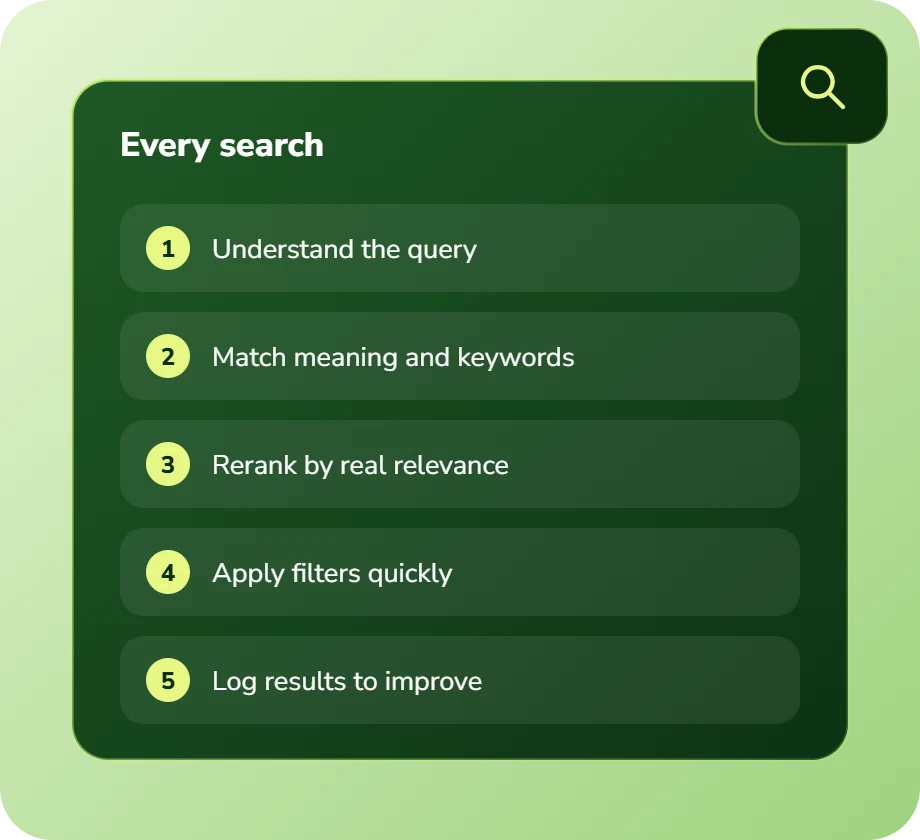
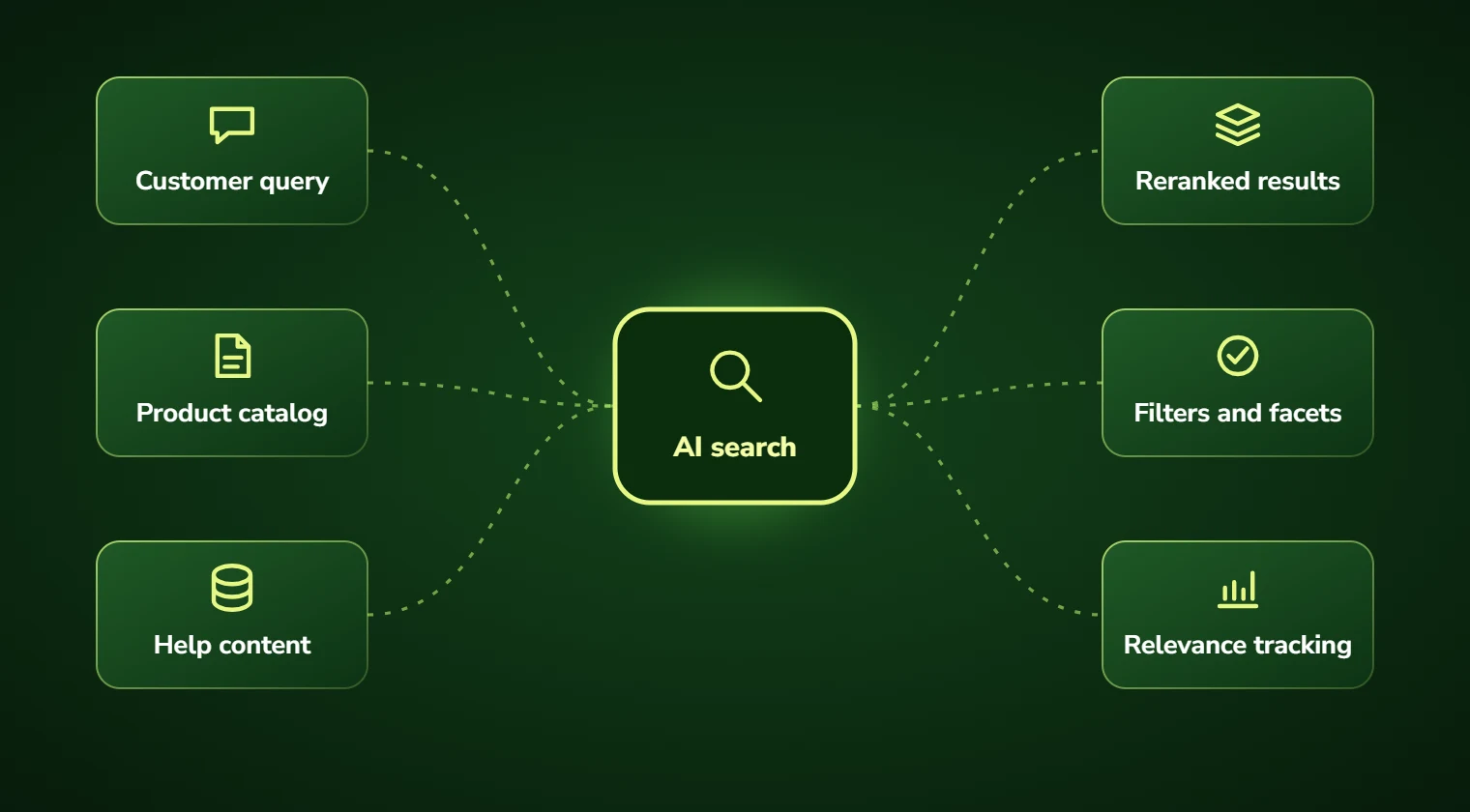
So we build hybrid: semantic and keyword search run together with the results fused and reranked. And we tune it against your real query logs with measured relevance, rather than against intuition.
AI search solutions: scope and deliverables
The first thing we do is measure what you have. Most teams have never quantified their search relevance, which means they cannot tell whether a change helped.
We build a relevance evaluation set from your actual query logs, with human-judged correct results. That gives a baseline number. Every subsequent change is measured against it, so tuning becomes engineering rather than guesswork.
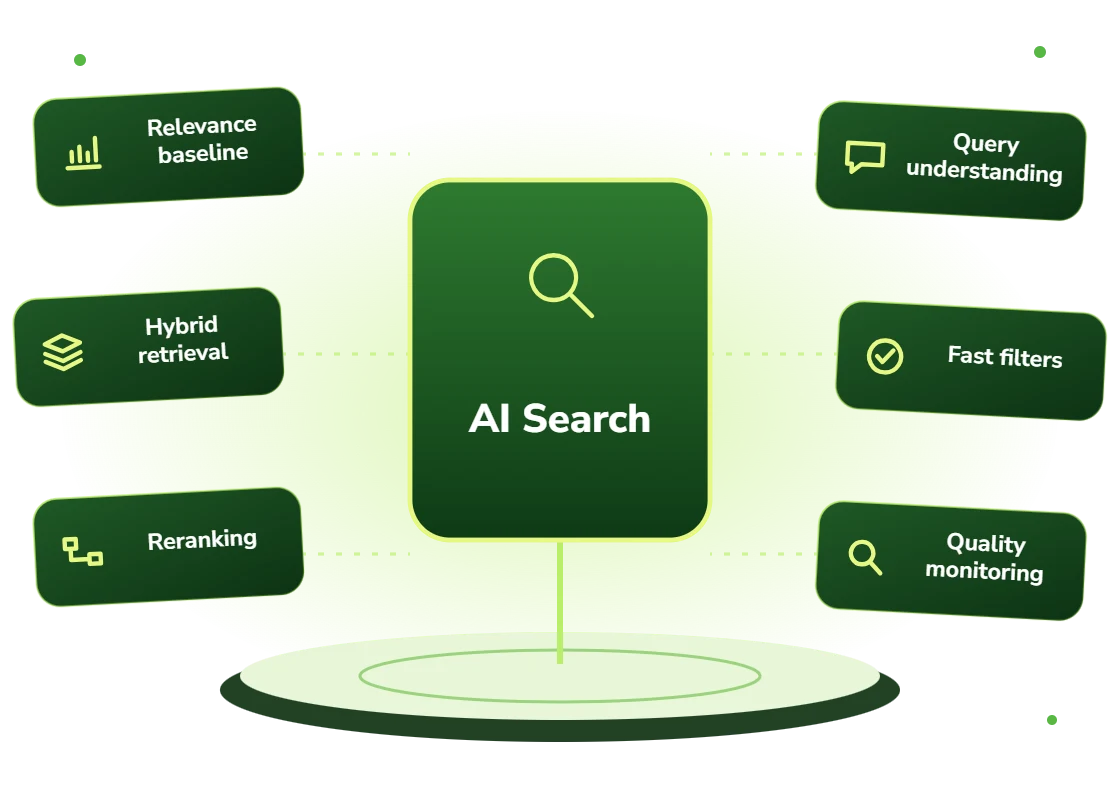
Then the usual improvements: hybrid retrieval, reranking, synonym and vocabulary handling, faceting that stays fast, and query understanding for things like typos, plurals and intent classification.
- Relevance baseline measured from real query logs with human judgements
- Hybrid retrieval: semantic embeddings fused with keyword matching
- Reranking to reorder candidates by genuine relevance
- Query understanding: typo tolerance, intent detection, entity extraction
- Fast filtering and faceting that does not degrade with catalogue size
- Continuous relevance monitoring so quality drift is detected
When to invest in search
For e-commerce the case is direct: search users convert at a much higher rate than browsers, so search relevance is a revenue lever rather than a usability nicety.
For internal and documentation search, the case is time. If people routinely give up on search and ask a colleague, the search box is costing two people’s attention per query rather than none.
- E-commerce sites with measurable zero-result or no-click search rates
- Product catalogues where customers and copy use different vocabulary
- Documentation sites where users cannot find existing answers
- Internal search that staff have learned to bypass entirely
- Marketplaces where relevance directly drives conversion
- Any search where nobody can say whether relevance is good or bad
Benefits of AI search solutions
Fewer dead-end searches
Semantic matching finds content described differently from how the user asked, which is the largest single cause of zero results.
Exact lookups still work
Hybrid search preserves precise SKU, part number and identifier matching that pure semantic search degrades.
Relevance you can measure
A scored evaluation set means tuning is measured rather than argued about in meetings.
Conversion impact
For commerce, search users convert substantially better than browsers, so relevance gains show up in revenue.
Search that stays fast
Filtering and faceting designed to hold latency as the catalogue or corpus grows.
Drift detected early
Continuous relevance monitoring catches degradation from content changes before users complain.
Business challenges this solves
High zero-result rate
Queries returning nothing for content that exists. Semantic matching resolves most vocabulary mismatches.
Customers use different words
Product copy written in industry terms, customers searching in plain language. Embeddings bridge the gap.
Part numbers stopped matching
A semantic-only migration breaking exact lookups. Hybrid retrieval restores precision without losing recall.
Filtered search too slow
Facets causing timeouts at scale. Index and pre-filter design fixes what more hardware will not.
No relevance measurement
Changes shipped on intuition. An evaluation set makes improvement provable.
Staff bypassing internal search
People asking colleagues instead of searching. Better relevance changes the habit.
Features and deliverables
Everything below is in scope on a standard engagement. Nothing here is an upsell discovered halfway through the build.
Query log analysis
Zero-result, no-click and refinement rates analysed to identify where search is actually failing and how often.
Relevance evaluation set
Real queries with human-judged correct results, giving a baseline score every change is measured against.
Hybrid retrieval
Dense semantic and sparse keyword search fused with reciprocal rank fusion, tuned for your query mix.
Reranking
Cross-encoder reranking of top candidates, typically the largest single relevance improvement available.
Query understanding
Typo tolerance, plural and stemming handling, entity extraction, and intent classification to route queries appropriately.
Faceting and filtering
Fast pre-filtered search across attributes, designed to hold latency as the corpus grows.
Personalization hooks
Optional ranking signals from user history, segment or context, applied transparently and switchable.
Relevance monitoring
Ongoing scoring against the evaluation set plus live click and conversion signals, with alerting on regression.
Technologies we use for AI search solutions
We are not tied to one vendor. Model and infrastructure choices are made on accuracy, cost per task, latency, and where your data is allowed to live.
Our AI development process
The same five stages on every engagement, so you always know what happens next and what you get at the end of it.
Discovery
We interview the people doing the work, map the workflow end to end, and audit the systems and data behind it.
AI Strategy
Every opportunity gets scored on cost to build, time to value, and annual savings, then ranked.
Pilot Build
We ship the top-ranked automation as a fixed-scope pilot so you see real output before committing further budget.
Implementation
Integration with your live systems, staff training, human-in-the-loop review gates, and a documented rollback path.
Optimization
Monthly accuracy reviews, prompt and retrieval tuning, and a written report on hours and dollars saved.
How long it takes
A typical first engagement, week by week. Complex integrations and regulated environments extend this, and we say so during discovery rather than after.
Discovery and scoping
Process observation, systems audit, data review, and a written estimate of cost and expected saving before anything is built.
Design sign-off
Architecture, data handling rules, review thresholds and success measures agreed in writing.
Build and integration
Development against your real data, connected to your live systems, with weekly demos rather than a single reveal.
Parallel run and testing
The system runs alongside the existing process so accuracy can be compared directly before anyone depends on it.
Launch and handover
Cutover with a rollback path, staff training, full documentation, then 30 days of included tuning.
Industries we deliver AI search solutions for
Retail & E-commerce
Product data enrichment, demand forecasting, support deflection, and personalized merchandising.
SaaS & Technology
AI features inside your product, support deflection, onboarding assistants, and usage analytics.
Manufacturing
Quality inspection, maintenance prediction, supplier communication, and production scheduling.
Professional Services
Proposal drafting, timesheet capture, research synthesis, and client reporting at scale.
Legal
Contract review, discovery triage, and matter intake with citation-checked outputs and attorney sign-off gates.
Healthcare
Intake, prior authorization, clinical documentation, and revenue-cycle workflows built to respect HIPAA boundaries.
Education
Enrollment support, content generation, tutoring assistants, and administrative automation.
Logistics & Supply Chain
Document processing, carrier communication, exception handling, and inventory rebalancing.
Real-world use cases
E-commerce product search
Catalogue search matching customer language to product copy, with fast faceting and exact SKU support.
Documentation and help search
Users finding the right article despite using entirely different terminology from the technical writers.
Marketplace listing search
Matching buyer intent to seller-written listings, where vocabulary varies enormously between sellers.
Legal and case search
Finding relevant matters and precedents by concept rather than by remembering the exact citation.
Parts and specification lookup
Technical catalogue search combining exact part-number matching with descriptive semantic search.
Internal enterprise search
Federated search across file shares, wikis and systems with permission-aware results.
Why choose DevSolutionsAI for AI search solutions
Business case before build
Every recommendation carries an estimated cost, timeline, and annual savings figure. If the math does not work, we say so before you spend.
Vendor-neutral by design
We resell nothing and take no platform commissions. Model and infrastructure choices are made on fit, cost, and your data-residency rules.
Fixed-scope pilots
The first engagement is a defined deliverable at a defined price, not an open-ended retainer that quietly grows each quarter.
Built for handover
You own the code, the prompts, the infrastructure, and the documentation. No lock-in to a proprietary wrapper you cannot leave.
Human-in-the-loop where it counts
Anything customer-facing, clinical, financial, or legal gets a review gate, a confidence threshold, and a logged audit trail.
Security reviewed early
Data flow diagrams, retention rules, and access boundaries are agreed in week one, not retrofitted after your security team objects.
Find out what AI search solutions would cost you, before you commit to anything
Every engagement is quoted after a short discovery, so you get a fixed written price built around your actual volumes rather than a rate card that assumes someone else’s business.
The first call is thirty minutes and free. Bring one workflow. We will tell you what it is likely costing you each year, roughly what automating it would take, and whether we think it is worth doing at all.
- A written savings estimate before any paid work
- Fixed scope and fixed price, agreed up front
- Full ownership of everything we build for you
- An honest recommendation when the numbers do not work
Figures are internal measurements across recent engagements, reported to every client monthly in writing.
Illustrative project scenario
Cutting zero-result searches from 23% to 4%
Challenge. A distributor’s catalogue search returned no results for 23% of queries. Analysis showed customers searched in descriptive language (“stainless hex bolt 10mm”) while product titles used manufacturer part descriptions. A prior attempt at semantic search had been reverted after exact part-number lookups broke.
What we built. Hybrid retrieval fusing semantic embeddings with keyword matching, so descriptive queries match by meaning while exact part numbers route to precise matching. A relevance evaluation set of 1,200 real queries with human-judged results established a baseline, and cross-encoder reranking was added and measured against it.
Outcome. Zero-result rate fell from 23% to 4%. Measured relevance on the evaluation set improved 41% against baseline. Exact part-number lookup precision was unchanged from the original keyword system, which was the requirement that had killed the previous attempt.
Illustrative project scenario. The figures demonstrate how a project could be scoped and evaluated; they are not verified client results or an audited average.
What clients say about working with us
AI Search Solutions FAQs
What is the difference between semantic and keyword search?
Keyword search matches literal words, so a query only finds documents containing those exact terms. Semantic search converts both query and content into numerical representations of meaning, so “waterproof jacket” can match “rainproof shell” despite sharing no words. Semantic search is better at vocabulary mismatch and worse at exact identifiers, which is why hybrid search combining both is usually the right answer.
Will semantic search break our part-number lookups?
On its own, frequently yes, and this is the most common reason semantic search migrations get reverted. Embeddings represent meaning, and a part number has no meaning to embed, so exact matching degrades. Hybrid retrieval avoids the problem by running keyword matching alongside semantic search and fusing the results, keeping precision on identifiers while gaining recall on descriptive queries.
How do you know whether search actually improved?
We build a relevance evaluation set from your real query logs with human-judged correct results, establishing a baseline score before any change. Every subsequent change is scored against it. Without this, search tuning is people arguing about anecdotes, and it is remarkable how many organizations ship search changes with no way to tell whether they helped.
How much can we expect search relevance to improve?
It depends heavily on your starting point, and we will not quote a number before measuring. Sites with high zero-result rates and vocabulary mismatch between customers and content typically see large gains; sites with already-good keyword search and tightly controlled vocabulary see modest ones. The two-week audit gives you a baseline and a realistic projection before committing to a rebuild.
Do we need to replace our existing search platform?
Usually not. Elasticsearch and OpenSearch both support vector search natively, so hybrid retrieval can often be added to what you already run. Where a replacement is warranted we will say so, but adding a semantic layer to an existing search cluster is the more common and much cheaper path.
How long does a search rebuild take?
A two-week audit produces the baseline and plan. A full hybrid rebuild with reranking, query understanding and monitoring typically takes six to eight weeks. We usually recommend A/B testing the new search against the old on live traffic rather than a hard cutover, so the improvement is proven on your actual users.
Services that pair well with this one
Most clients combine two or three of these. We will tell you the right sequence during discovery.
Ready to scope your AI search solutions project?
Book a free 30-minute consultation. Bring one workflow and leave with a realistic estimate of what it would cost to automate and what it would save.