Computer Vision Solutions

Computer vision solutions with accuracy measured on your images, not a benchmark

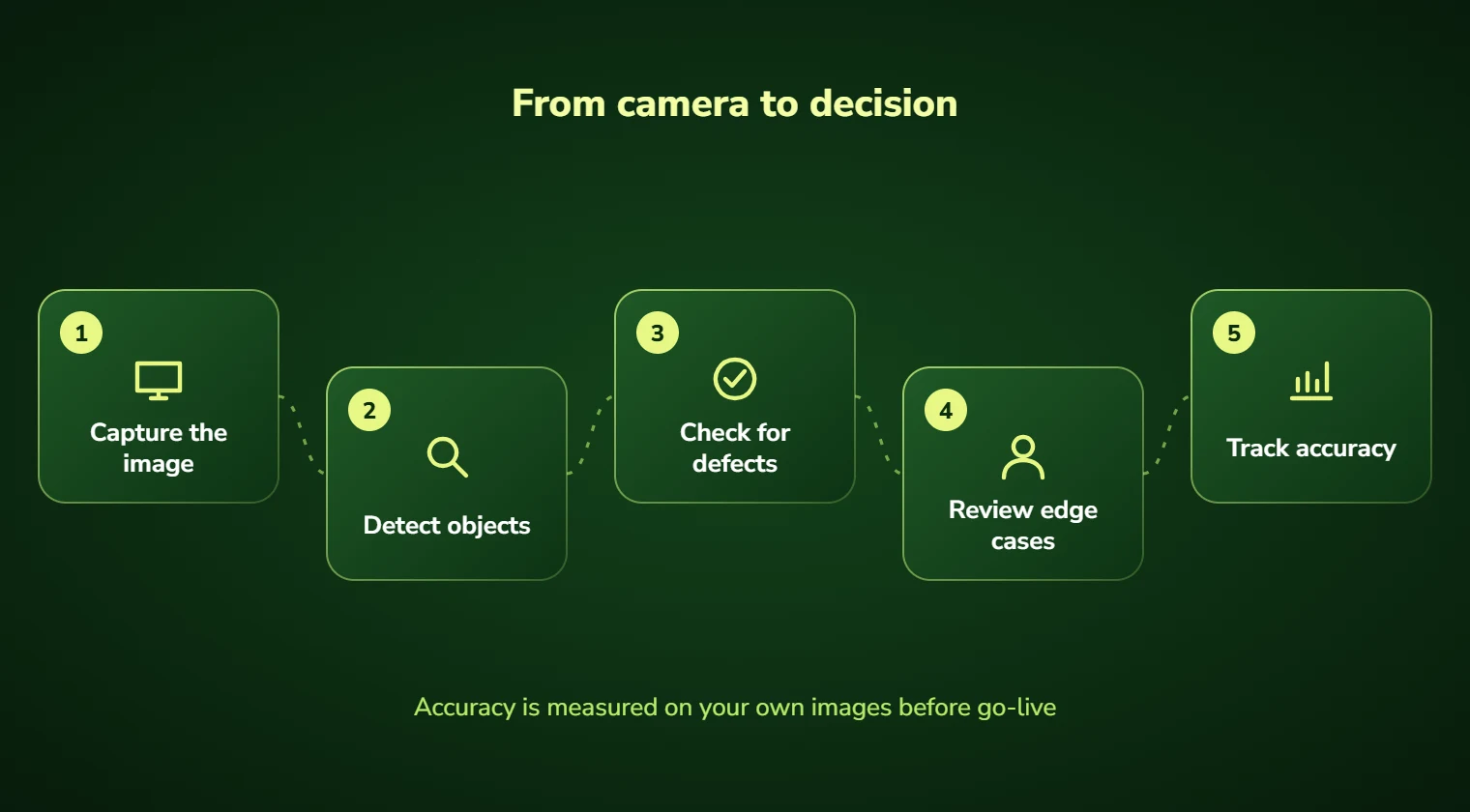
Our computer vision solutions start with your images and operating conditions. We assess lighting, camera angles, image quality and error costs before developing an inspection, document or counting workflow.

Free 30-minute consultation
Fixed-scope pilots
U.S.-based team
Custom, not off-the-shelf
SOC 2-aligned practices
ROI tracked in writing
What are computer vision solutions?

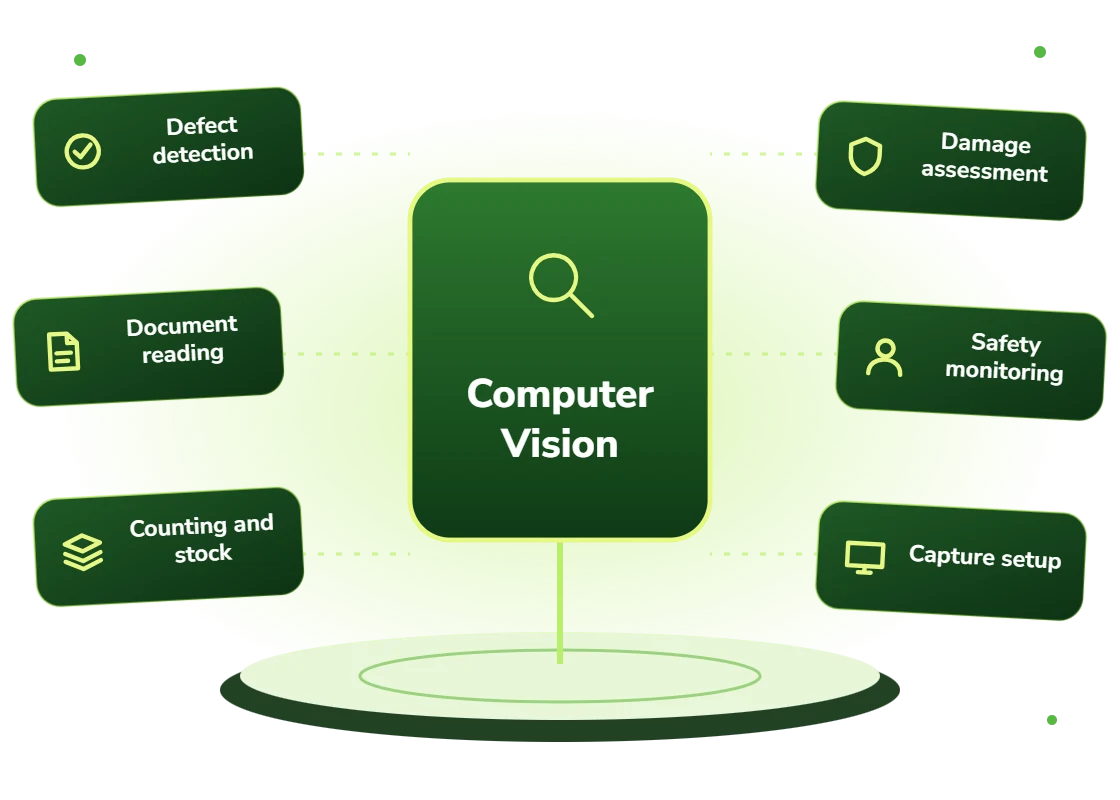
Computer vision solutions use AI models to interpret images and video: detecting objects, identifying defects, reading documents, counting items, and monitoring for specified conditions. Business accuracy depends heavily on image capture conditions, which is why measurement on real production images matters more than benchmark performance.

7+
Years building AI systems
240+
Projects delivered
4.8
Avg. months to payback
38
U.S. states served
The Problem

Vision demos work because the demo controlled the lighting

Vision models perform impressively on clean, well-lit, consistently framed images. Production environments have variable lighting, parts at different angles, dust on the lens and defects that look different depending on the shift.

So a system that scored 98% in evaluation delivers considerably less in the plant, and confidence in the whole approach collapses.

Our Approach

Measure on real images, fix the capture conditions

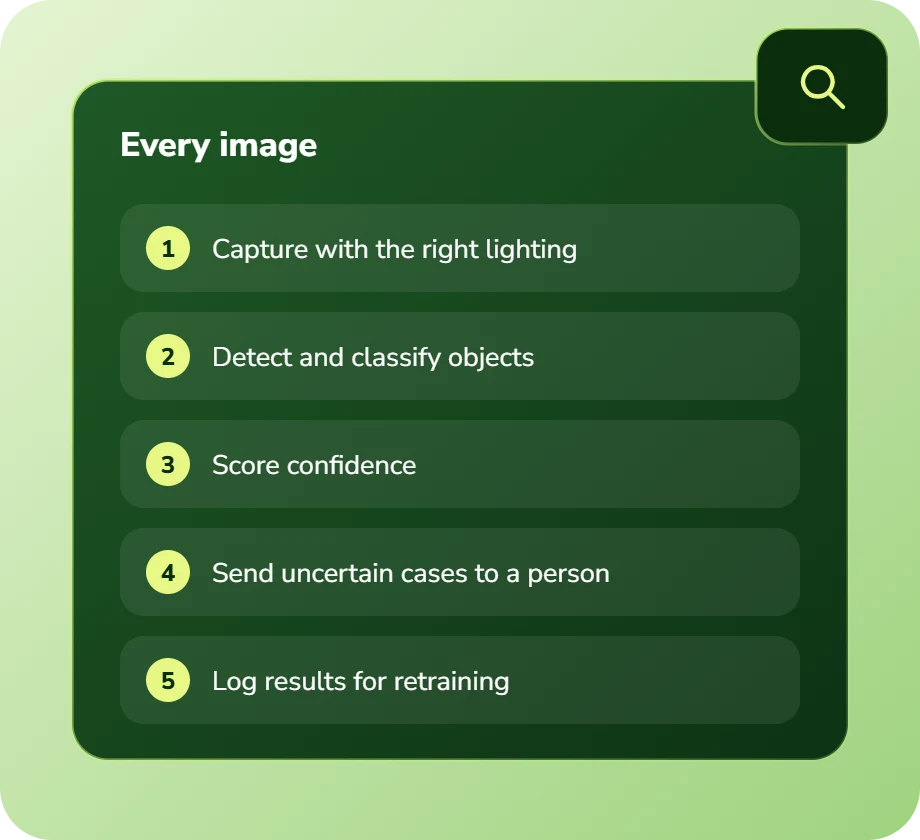
We start by collecting images under actual operating conditions and measuring accuracy on them. That produces a real number rather than a hopeful one.

Frequently the largest available improvement is not a better model but better capture: consistent lighting, a fixed mount, a different angle. Getting that right costs little and improves everything downstream.

Vision illustration
Conceptual vision illustration
Service Overview

Computer vision solutions: scope and deliverables

Defect detection on production lines is the most established application, particularly for surface, dimensional and assembly defects that are visually distinctive.

Document understanding is now largely a vision problem: modern vision-language models read documents including handwriting far better than traditional OCR, which changes what is digitizable.

Counting, presence and condition checking, inventory counts, safety compliance, damage assessment, are high-volume applications where full coverage replaces sampling.

What all of these share is that accuracy depends on capture conditions at least as much as on the model.

  • Defect detection: surface, dimensional and assembly on production lines
  • Document understanding including handwriting and poor-quality scans
  • Counting and inventory verification from images
  • Condition and damage assessment for insurance and logistics
  • Safety compliance monitoring: PPE, exclusion zones, procedure adherence
  • Capture optimization: lighting, mounting and framing, often the largest gain
Right Fit

Who benefits from computer vision

Operations with a visual quality or verification task currently done by sampling, where full coverage would materially change outcomes.

And organizations processing images at volume, damage claims, inspection photos, document scans, where manual review is the bottleneck.

  • Manufacturers inspecting visually with sampling rather than full coverage
  • Operations processing damage or condition photographs at volume
  • Businesses digitizing documents including handwriting and poor scans
  • Facilities monitoring safety compliance manually or not at all
  • Companies counting or verifying inventory visually
  • Teams whose previous vision project underperformed in production
Benefits

Benefits of computer vision solutions

Real accuracy before you commit

Measured on your own production images under actual conditions rather than quoted from a benchmark.

Full coverage instead of sampling

Every part, every image, every shift, which changes what quality outcomes are achievable.

Capture fixed first

Lighting and mounting improvements frequently deliver more than a better model, and cost far less.

Handwriting and poor scans handled

Vision-language models read documents traditional OCR could not, expanding what is digitizable.

Consistent at 3am

Detection quality does not vary with shift, fatigue or how busy the line was.

Honest about hard cases

Defect classes that are genuinely difficult are flagged for human review rather than automated badly.

Problems We Solve

Business challenges this solves

01

Demos that fail in production

Controlled-condition accuracy not surviving the plant. Measurement on real images first.

02

Sampling missing defects

Escapes reaching customers between samples. Full-coverage inspection changes the rate.

03

Inconsistent lighting and framing

Capture conditions degrading everything downstream. Fixing capture is often the biggest gain.

04

Handwritten documents still manual

Forms traditional OCR could not read. Vision models make them viable.

05

Safety monitoring by walkthrough

Compliance checked occasionally by a person. Continuous monitoring changes coverage.

06

Previous vision project disappointed

A system that underperformed. Diagnosis usually finds capture conditions rather than the model.

What's Included

Features and deliverables

Everything below is in scope on a standard engagement. Nothing here is an upsell discovered halfway through the build.

01

Image collection and assessment

Images gathered under real operating conditions and accuracy measured on them before any commitment.

02

Capture optimization

Lighting, mounting, angle and framing recommendations, frequently the highest-return improvement available.

03

Defect detection models

Detection and classification trained on your specific defect types, with confidence thresholds per class.

04

Document vision

Vision-language processing of documents including handwriting, tables, diagrams and poor-quality scans.

05

Counting and verification

Object counting, presence checking and condition assessment from images at volume.

06

Edge deployment

On-device inference where latency, connectivity or data residency requires processing locally.

07

Operator interfaces

Review interfaces designed for the environment: glove-friendly, high contrast, minimal interaction.

08

Continuous accuracy monitoring

Ongoing measurement against operator decisions so drift from changing conditions is detected.

Technology Stack

Technologies we use for computer vision solutions

We are not tied to one vendor. Model and infrastructure choices are made on accuracy, cost per task, latency, and where your data is allowed to live.

Language Models
C
Claude (Anthropic)
G
GPT (OpenAI)
G
Gemini (Google)
L
Llama
M
Mistral
A
Azure OpenAI Service
Data & Backend
P
Python
T
TypeScript / Node.js
P
PostgreSQL
S
Snowflake
d
dbt
A
Apache Airflow
Cloud & Infrastructure
A
AWS Bedrock
G
Google Vertex AI
M
Microsoft Azure
D
Docker
K
Kubernetes
T
Terraform
Business Systems
S
Salesforce
H
HubSpot
N
NetSuite
M
Microsoft 365
S
Slack
Z
Zapier / Make
How We Work

Our AI development process

The same five stages on every engagement, so you always know what happens next and what you get at the end of it.

01

Discovery

We interview the people doing the work, map the workflow end to end, and audit the systems and data behind it.

02

AI Strategy

Every opportunity gets scored on cost to build, time to value, and annual savings, then ranked.

03

Pilot Build

We ship the top-ranked automation as a fixed-scope pilot so you see real output before committing further budget.

04

Implementation

Integration with your live systems, staff training, human-in-the-loop review gates, and a documented rollback path.

05

Optimization

Monthly accuracy reviews, prompt and retrieval tuning, and a written report on hours and dollars saved.

Timeline

How long it takes

A typical first engagement, week by week. Complex integrations and regulated environments extend this, and we say so during discovery rather than after.

Weeks 1 to 2

Discovery and scoping

Process observation, systems audit, data review, and a written estimate of cost and expected saving before anything is built.

Week 3

Design sign-off

Architecture, data handling rules, review thresholds and success measures agreed in writing.

Weeks 4 to 7

Build and integration

Development against your real data, connected to your live systems, with weekly demos rather than a single reveal.

Week 8

Parallel run and testing

The system runs alongside the existing process so accuracy can be compared directly before anyone depends on it.

Weeks 9 to 10

Launch and handover

Cutover with a rollback path, staff training, full documentation, then 30 days of included tuning.

Who We Work With

Industries we deliver computer vision solutions for

Manufacturing

Quality inspection, maintenance prediction, supplier communication, and production scheduling.

Logistics & Supply Chain

Document processing, carrier communication, exception handling, and inventory rebalancing.

Construction

Bid takeoffs, submittal review, RFI drafting, and field-report summarization.

Retail & E-commerce

Product data enrichment, demand forecasting, support deflection, and personalized merchandising.

Healthcare

Intake, prior authorization, clinical documentation, and revenue-cycle workflows built to respect HIPAA boundaries.

Insurance

First-notice-of-loss intake, claims triage, policy Q&A, and fraud signal detection.

Professional Services

Proposal drafting, timesheet capture, research synthesis, and client reporting at scale.

Financial Services

Document extraction, reconciliation, KYC support, and audit-ready reporting with full traceability.

Use Cases

Real-world use cases

01

Production defect detection

Surface, dimensional and assembly defects identified on every part rather than on a sample.

02

Document and form reading

Scanned and photographed documents including handwriting extracted into structured data.

03

Damage assessment

Insurance and logistics damage photographs assessed and categorized consistently at volume.

04

Inventory counting

Stock levels verified from images rather than by manual count.

05

Safety compliance monitoring

PPE use, exclusion zone adherence and procedure compliance monitored continuously.

06

Product image quality control

Catalogue images checked for compliance with listing standards before publication.

Why DevSolutionsAI

Why choose DevSolutionsAI for computer vision solutions

Business case before build

Every recommendation carries an estimated cost, timeline, and annual savings figure. If the math does not work, we say so before you spend.

Vendor-neutral by design

We resell nothing and take no platform commissions. Model and infrastructure choices are made on fit, cost, and your data-residency rules.

Fixed-scope pilots

The first engagement is a defined deliverable at a defined price, not an open-ended retainer that quietly grows each quarter.

Built for handover

You own the code, the prompts, the infrastructure, and the documentation. No lock-in to a proprietary wrapper you cannot leave.

Human-in-the-loop where it counts

Anything customer-facing, clinical, financial, or legal gets a review gate, a confidence threshold, and a logged audit trail.

Security reviewed early

Data flow diagrams, retention rules, and access boundaries are agreed in week one, not retrofitted after your security team objects.

Get Started

Find out what computer vision solutions would cost you, before you commit to anything

Every engagement is quoted after a short discovery, so you get a fixed written price built around your actual volumes rather than a rate card that assumes someone else’s business.

The first call is thirty minutes and free. Bring one workflow. We will tell you what it is likely costing you each year, roughly what automating it would take, and whether we think it is worth doing at all.

  • A written savings estimate before any paid work
  • Fixed scope and fixed price, agreed up front
  • Full ownership of everything we build for you
  • An honest recommendation when the numbers do not work
What clients typically see
Across recent projects
Staff hours saved each week
31
Months to payback
4.8
Client retention
94%
Response to enquiries
4 hrs

Figures are internal measurements across recent engagements, reported to every client monthly in writing.

Illustrative project scenario

Illustrative project scenario

Metal components manufacturer

Better lighting delivered more than a better model would have

Challenge. A manufacturer had trialled a vision inspection system that achieved 71% defect detection in production, well below the vendor’s claimed performance. They assumed the model was inadequate and were considering a more expensive alternative.

What we built. A feasibility assessment collecting images under actual line conditions found the problem was capture rather than the model: variable overhead lighting created shadows that obscured exactly the surface defects being sought, and the camera mount vibrated at line speed. We specified fixed diffuse lighting and a rigid mount, then retrained on images captured under the corrected conditions.

Outcome. Detection rose from 71% to 94% on the same model architecture. The lighting and mounting cost a small fraction of the proposed alternative system. Two defect classes remained genuinely difficult and were configured to flag for operator review rather than automated rejection.

71% → 94%
Defect detection
Same
Model architecture
2
Classes flagged, not automated
Lighting
Root cause identified

Illustrative project scenario. The figures demonstrate how a project could be scoped and evaluated; they are not verified client results or an audited average.

Client Feedback

What clients say about working with us

31
Avg. staff hours saved weekly
4.8
Avg. months to payback
94%
Client retention
4
Hour response to enquiries
Common Questions

Computer Vision Solutions FAQs

It depends far more on your images than on the model, which is why we will not quote a figure before seeing them. Distinctive defects under consistent lighting can be detected extremely reliably; subtle defects under variable lighting are genuinely hard. We collect images under your real operating conditions and give you measured accuracy per defect class before you commit to anything.

In our experience, most often capture conditions rather than the model. On a recent engagement a system detecting 71% of defects improved to 94% on the same model architecture, purely by fixing variable lighting and a vibrating camera mount. Lighting and mounting have the largest effect on accuracy and are the cheapest things to fix, yet teams routinely try a bigger model first.

Frequently not. Industrial cameras you already have are often adequate, and the improvement comes from lighting and mounting rather than sensor quality. We assess your existing setup during feasibility and recommend the minimum change that achieves the accuracy you need, which is usually less than vendors propose.

Yes, through edge deployment where the model runs on local hardware. This matters for plants with unreliable connectivity, for latency-critical line-speed inspection, and for facilities whose security policy prohibits sending images off-site. Edge deployment constrains model size, which we account for during feasibility.
They get configured to flag for operator review rather than automated decision. Being honest about which defect classes are genuinely hard is more useful than automating all of them badly, and it preserves confidence in the classes the system does handle well. Confidence thresholds are set per defect class rather than globally.

A feasibility assessment with real image collection and measured accuracy runs $12,000 to $22,000 over two to three weeks. A production system including capture setup, models, operator interface and deployment typically runs $48,000 to $110,000. Hardware and installation are additional and depend on your line configuration.

Service Areas

Computer Vision Solutions across the United States

We deliver computer vision solutions remotely to clients nationwide, with on-site workshops available in major metros.

Ready to scope your computer vision solutions project?

Book a free 30-minute consultation. Bring one workflow and leave with a realistic estimate of what it would cost to automate and what it would save.

Free 30-minute consultation
Fixed-scope pilots
U.S.-based team
Custom, not off-the-shelf
SOC 2-aligned practices
ROI tracked in writing
Free 30-minute AI consultation