Conversational AI development that gives the same answer on every channel
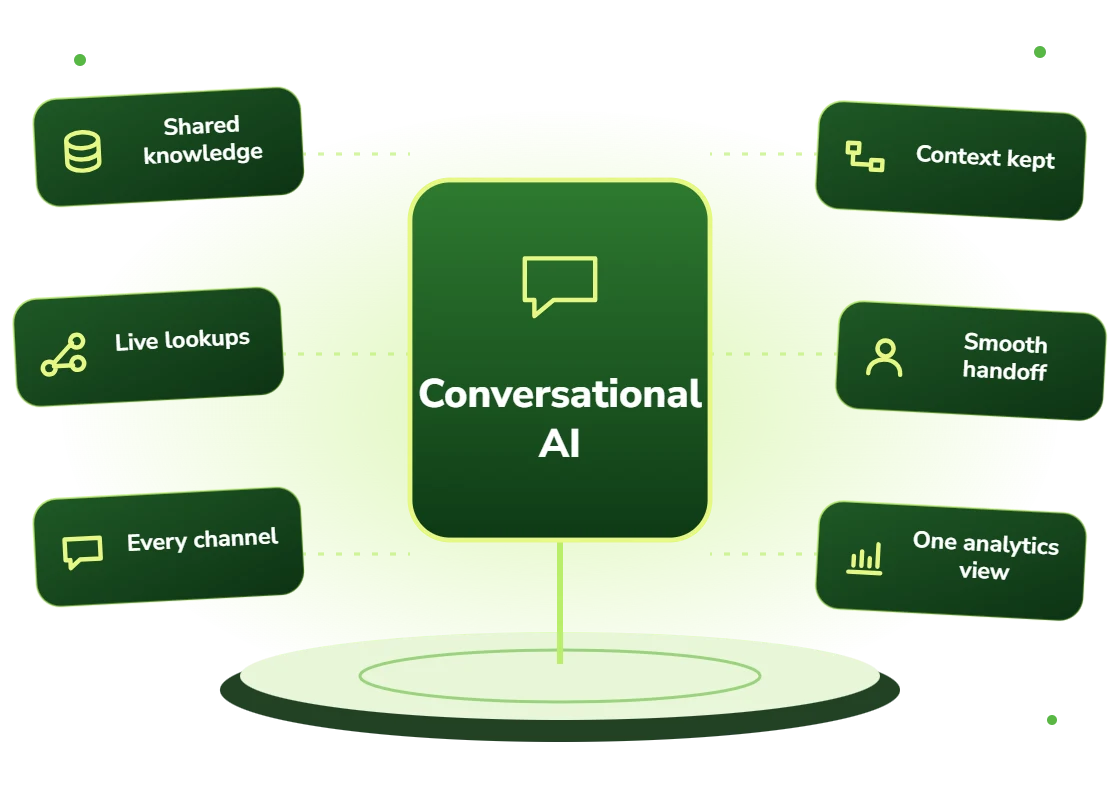
Our conversational AI development work connects chat, voice, SMS and email to a shared knowledge layer. We design consistent answers, scoped system access and human escalation across the channels you need.
Conversational AI is technology that enables natural, multi-turn dialogue between people and software across channels such as chat, voice, SMS and email. Unlike single-channel chatbots, a conversational AI platform shares one knowledge and logic layer across every channel, so answers stay consistent and a conversation can move between channels without losing context.
Every channel became its own silo
Companies bought a website chatbot, then a phone system, then a WhatsApp tool. Each has its own content, its own rules and its own idea of your refund policy. Customers notice.
Worse, context does not travel. A customer explains a problem in chat, gets told to call, and starts from nothing. The organization has the information and still makes the customer repeat it.
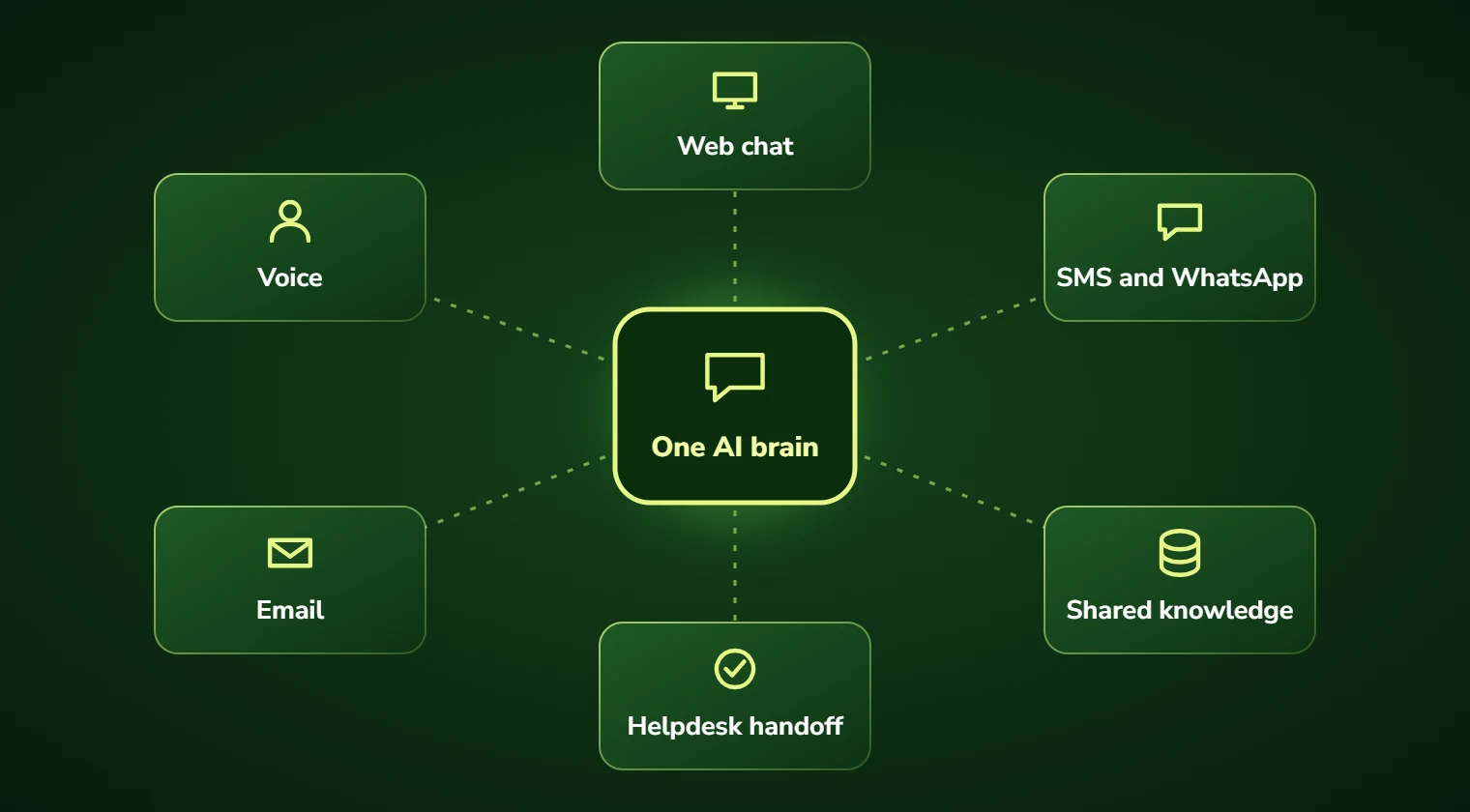
One brain, many channels
We build the knowledge, retrieval, business rules and system integrations once, then expose them through whichever channels you need. Updating a policy updates it everywhere at once.
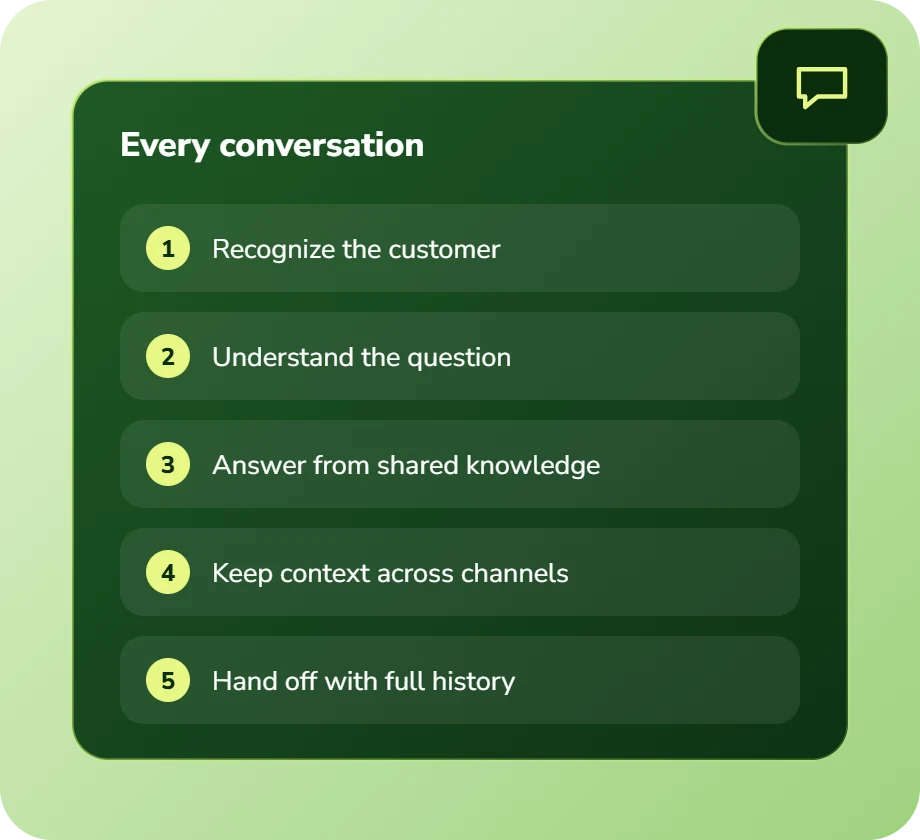
Conversation state is shared. A customer who starts in chat and moves to voice is recognized, and the agent or the voice system picks up with what has already been established.
Conversational AI development: scope and deliverables
The channel is the thin part. Underneath sits the layer that actually matters: a retrieval index over your content, a set of tools for querying live systems, the rules about what may be said, and the escalation logic.
Building it once has a compounding effect. Adding a fourth channel later costs a fraction of the first, because only the channel adapter is new. Most clients start with one or two channels and add more as the value proves out.
It also makes measurement coherent. Resolution rate, escalation reasons and content gaps are reported across channels rather than in three dashboards that count things differently.
- A shared retrieval layer over your documentation, policies and product data
- Shared tool definitions for live lookups into orders, accounts and calendars
- Channel adapters for web chat, voice, SMS, WhatsApp, email and in-app
- Cross-channel conversation state so context survives a channel switch
- Unified escalation into your existing helpdesk with full history
- One analytics view: resolution, escalation, sentiment and content gaps
When you need a platform rather than a chatbot
One channel and simple questions means you want a chatbot, not a platform, and we will scope it that way. The platform approach earns its cost once you are running two or more channels, or you know you will be within a year.
It is also the right choice when consistency is a compliance matter. Regulated businesses cannot afford three channels giving three answers about the same policy.
- Businesses running customer contact across three or more channels
- Companies whose channel tools currently hold separate, drifting content
- Regulated organizations needing provable answer consistency
- Teams planning to add voice or messaging to an existing chat deployment
- Operations where customers routinely switch channel mid-issue
- Multi-brand or multi-region businesses needing shared logic with local variation
Benefits of conversational AI
One source of truth
Change a policy once and every channel reflects it immediately. No more auditing four tools for stale content.
Context that travels
Customers moving from chat to phone are recognized and do not start over, which is the most-complained-about failure in multichannel support.
Cheaper channel expansion
The second and third channels cost a fraction of the first because only the adapter is new work.
Coherent measurement
Resolution and escalation reported the same way across channels, so you can compare rather than guess.
Consistent compliance posture
Boundaries and disclosures are defined once and enforced everywhere, which matters when an examiner asks.
Single integration surface
Your order and account systems are connected once, not separately for every channel tool.
Business challenges this solves
Contradictory answers by channel
Chat says 30 days, phone says 14. One knowledge layer removes the divergence at the source.
Customers repeating themselves
Context lost at every channel switch. Shared conversation state carries it across.
Content maintained four times
The same policy updated in four tools, badly. Update once, propagate everywhere.
Channel tools that will not integrate
Each vendor connecting to your CRM separately. A single integration layer replaces four fragile ones.
No comparable metrics
Three dashboards counting deflection differently. Unified analytics makes channel comparison meaningful.
Slow to add a new channel
Months to launch messaging because everything starts from zero. Adapters take weeks.
Features and deliverables
Everything below is in scope on a standard engagement. Nothing here is an upsell discovered halfway through the build.
Unified knowledge layer
One retrieval index over documentation, policies and product data, kept in sync with your sources automatically.
Shared tool and action library
System lookups and actions defined once and available to every channel, with consistent permissions.
Channel adapters
Web, in-app, voice, SMS, WhatsApp, Messenger and email, each tuned for its own interaction constraints.
Cross-channel identity and state
Customer recognition and conversation continuity across channels, subject to your authentication rules.
Unified escalation
One path into your helpdesk regardless of origin channel, carrying full transcript and context.
Governance and boundaries
Topic limits, disclosure rules, PII handling and prompt-injection defences applied globally.
Cross-channel analytics
Resolution, escalation reason, sentiment, content gaps and cost per conversation, comparable across channels.
Content operations workflow
A review process for flagged answers that fixes the source document rather than patching prompts.
Technologies we use for conversational AI
We are not tied to one vendor. Model and infrastructure choices are made on accuracy, cost per task, latency, and where your data is allowed to live.
Our AI development process
The same five stages on every engagement, so you always know what happens next and what you get at the end of it.
Discovery
We interview the people doing the work, map the workflow end to end, and audit the systems and data behind it.
AI Strategy
Every opportunity gets scored on cost to build, time to value, and annual savings, then ranked.
Pilot Build
We ship the top-ranked automation as a fixed-scope pilot so you see real output before committing further budget.
Implementation
Integration with your live systems, staff training, human-in-the-loop review gates, and a documented rollback path.
Optimization
Monthly accuracy reviews, prompt and retrieval tuning, and a written report on hours and dollars saved.
How long it takes
A typical first engagement, week by week. Complex integrations and regulated environments extend this, and we say so during discovery rather than after.
Discovery and scoping
Process observation, systems audit, data review, and a written estimate of cost and expected saving before anything is built.
Design sign-off
Architecture, data handling rules, review thresholds and success measures agreed in writing.
Build and integration
Development against your real data, connected to your live systems, with weekly demos rather than a single reveal.
Parallel run and testing
The system runs alongside the existing process so accuracy can be compared directly before anyone depends on it.
Launch and handover
Cutover with a rollback path, staff training, full documentation, then 30 days of included tuning.
Industries we deliver conversational AI for
Retail & E-commerce
Product data enrichment, demand forecasting, support deflection, and personalized merchandising.
Financial Services
Document extraction, reconciliation, KYC support, and audit-ready reporting with full traceability.
Healthcare
Intake, prior authorization, clinical documentation, and revenue-cycle workflows built to respect HIPAA boundaries.
Insurance
First-notice-of-loss intake, claims triage, policy Q&A, and fraud signal detection.
SaaS & Technology
AI features inside your product, support deflection, onboarding assistants, and usage analytics.
Logistics & Supply Chain
Document processing, carrier communication, exception handling, and inventory rebalancing.
Real Estate
Lead qualification, listing content, transaction coordination, and 24/7 inquiry response.
Education
Enrollment support, content generation, tutoring assistants, and administrative automation.
Real-world use cases
Retail customer service
Order, returns and product questions handled identically on web chat, WhatsApp and the phone line.
Bank and credit union support
Consistent, compliant answers across channels with authenticated account lookups and strict advice boundaries.
Healthcare patient communication
Scheduling, preparation and administrative questions across phone and text, bounded firmly away from clinical guidance.
Insurance policy servicing
Coverage questions, document requests and claim status consistent across every contact route.
SaaS onboarding and support
In-app assistance and email support sharing the same knowledge and account context.
Multi-brand contact centre
Shared logic with brand-specific tone and policy overlays, so each brand sounds distinct but stays correct.
Why choose DevSolutionsAI for conversational AI
Business case before build
Every recommendation carries an estimated cost, timeline, and annual savings figure. If the math does not work, we say so before you spend.
Vendor-neutral by design
We resell nothing and take no platform commissions. Model and infrastructure choices are made on fit, cost, and your data-residency rules.
Fixed-scope pilots
The first engagement is a defined deliverable at a defined price, not an open-ended retainer that quietly grows each quarter.
Built for handover
You own the code, the prompts, the infrastructure, and the documentation. No lock-in to a proprietary wrapper you cannot leave.
Human-in-the-loop where it counts
Anything customer-facing, clinical, financial, or legal gets a review gate, a confidence threshold, and a logged audit trail.
Security reviewed early
Data flow diagrams, retention rules, and access boundaries are agreed in week one, not retrofitted after your security team objects.
Find out what conversational AI would cost you, before you commit to anything
Every engagement is quoted after a short discovery, so you get a fixed written price built around your actual volumes rather than a rate card that assumes someone else’s business.
The first call is thirty minutes and free. Bring one workflow. We will tell you what it is likely costing you each year, roughly what automating it would take, and whether we think it is worth doing at all.
- A written savings estimate before any paid work
- Fixed scope and fixed price, agreed up front
- Full ownership of everything we build for you
- An honest recommendation when the numbers do not work
Figures are internal measurements across recent engagements, reported to every client monthly in writing.
Illustrative project scenario
Ending contradictory answers across four channels
Challenge. A credit union ran a website chatbot, an IVR, an SMS tool and email templates, each maintained by a different team. An internal audit found nineteen policies where at least two channels gave materially different answers, which had become a compliance concern.
What we built. A unified conversational layer with one retrieval index over policy documents, shared authenticated lookups into the core banking system, and channel adapters for web, voice, SMS and email. Advice boundaries and disclosures were defined once and enforced globally.
Outcome. Policy inconsistencies fell to zero on the next audit. Content maintenance moved from four teams to one. Adding a WhatsApp channel afterwards took three weeks rather than the four months the previous approach required.
Illustrative project scenario. The figures demonstrate how a project could be scoped and evaluated; they are not verified client results or an audited average.
What clients say about working with us
Conversational AI FAQs
What is the difference between conversational AI and a chatbot?
A chatbot is usually one channel with its own content and rules. Conversational AI is the shared layer beneath multiple channels: one knowledge index, one set of business rules, one integration surface, exposed through chat, voice, SMS and email. If you only need web chat, a chatbot is the cheaper and more sensible build. The platform approach earns its cost from the second channel onward.
Can it move a conversation between channels?
Yes, subject to your authentication rules. A customer who starts in chat and calls afterwards can be recognized, and the voice agent or human picks up with the established context. This is the most common source of customer frustration in multichannel support and one of the clearest wins from a shared layer.
How do you keep answers consistent?
By construction rather than by process. There is one retrieval index and one set of business rules; channels are presentation adapters over the same logic. Updating a policy document updates every channel simultaneously. This is structurally different from maintaining four tools and auditing them for drift.
Which channels can you support?
Web chat, in-app messaging, voice, SMS, WhatsApp, Facebook Messenger and email. Most clients start with two and add more once the value is proven. Each adapter is tuned to its channel constraints, voice needs different pacing and confirmation behaviour than chat, for example, even though the underlying knowledge is identical.
How long does a conversational AI platform take to build?
Ten to fourteen weeks for the platform plus two channels, depending on how much content preparation and system integration is required. Additional channels typically take two to four weeks each afterwards, which is where the architecture pays for itself.
Do we own the platform?
Yes. Code, configuration, retrieval index and integrations run in your infrastructure and are yours. There is no per-conversation pricing and no per-seat licence, which is usually the main cost difference against commercial platforms once volume grows.
Services that pair well with this one
Most clients combine two or three of these. We will tell you the right sequence during discovery.
Ready to scope your conversational AI project?
Book a free 30-minute consultation. Bring one workflow and leave with a realistic estimate of what it would cost to automate and what it would save.