Custom AI Software Development

Custom AI software development for complete applications

Our custom AI software development covers the application around the model: interfaces, permissions, integrations, testing and handover. It fits teams that need a complete product rather than an isolated AI component.

Free 30-minute consultation
Fixed-scope pilots
U.S.-based team
Custom, not off-the-shelf
SOC 2-aligned practices
ROI tracked in writing
What is custom AI software development?

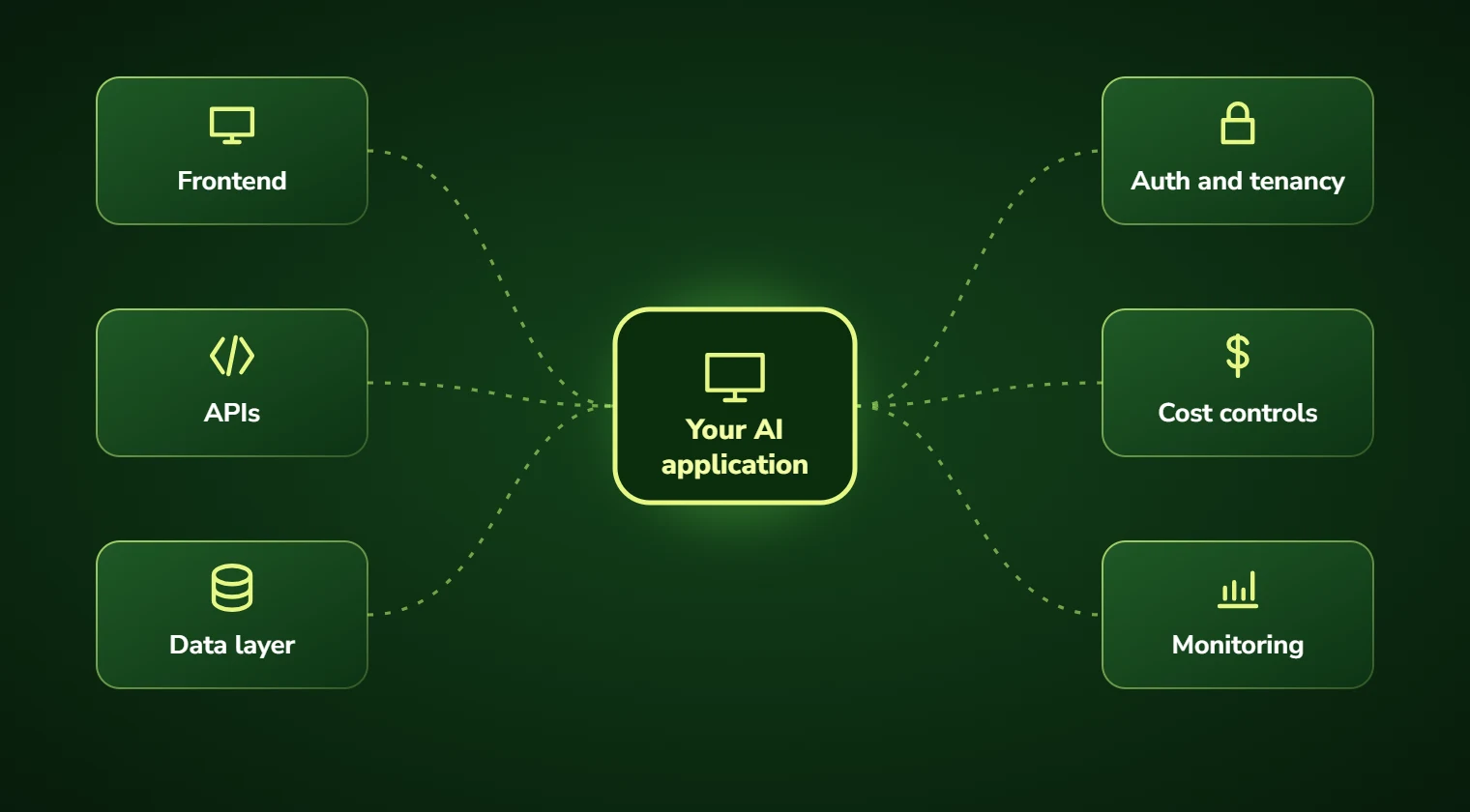
Custom AI software development is the building of complete, production-grade applications in which AI is a core component, including the user interfaces, APIs, authentication, data layer, testing, deployment pipeline and monitoring. It differs from AI prototyping in that the output is maintainable software fit for production use rather than a demonstration.

7+
Years building AI systems
240+
Projects delivered
4.8
Avg. months to payback
38
U.S. states served
The Problem

The gap between a working demo and working software

AI prototypes are easy and genuinely impressive. Then someone asks about authentication, concurrent users, what happens when the API rate-limits, how errors are surfaced, and who gets paged at 3am. The demo has no answers.

A large share of AI projects stall precisely here. The intelligence works; the software around it was never built, and building it turns out to be most of the actual work.

Our Approach

Software engineering, with AI as a component

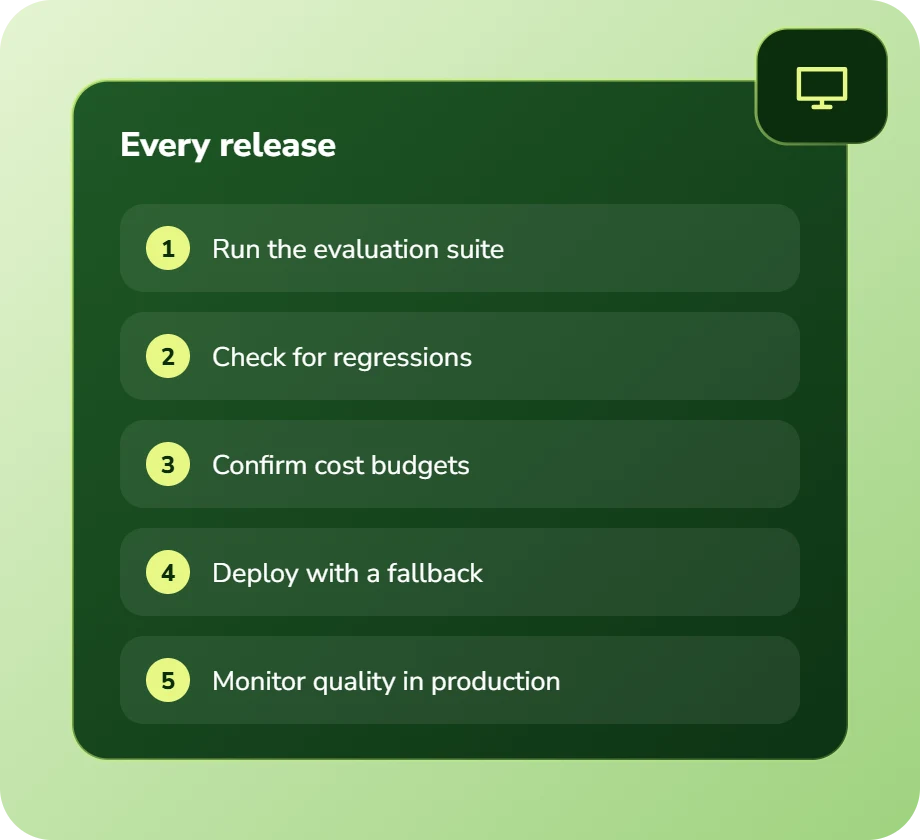
We treat AI features the way any other critical dependency is treated: with tests, error handling, timeouts, fallbacks, observability, cost controls and a deployment pipeline.

That is less exciting than the model work and it is the reason the system is still running in two years. The AI is a component inside a well-engineered application, not the application itself.

Cloud illustration
Conceptual cloud illustration
Service Overview

Custom AI software development: scope and deliverables

The visible part is the application: the interfaces people use, the workflows they follow, the reports they read. Underneath sits the ordinary but essential machinery of production software.

AI adds specific engineering concerns that conventional applications do not have: non-deterministic outputs that break naive tests, per-request costs that need tracking and capping, latency that varies with provider load, and quality that can degrade without any code changing.

We design for each of those explicitly, evaluation suites instead of exact-match assertions, cost budgets per request, graceful degradation when a provider is slow, and continuous quality monitoring.

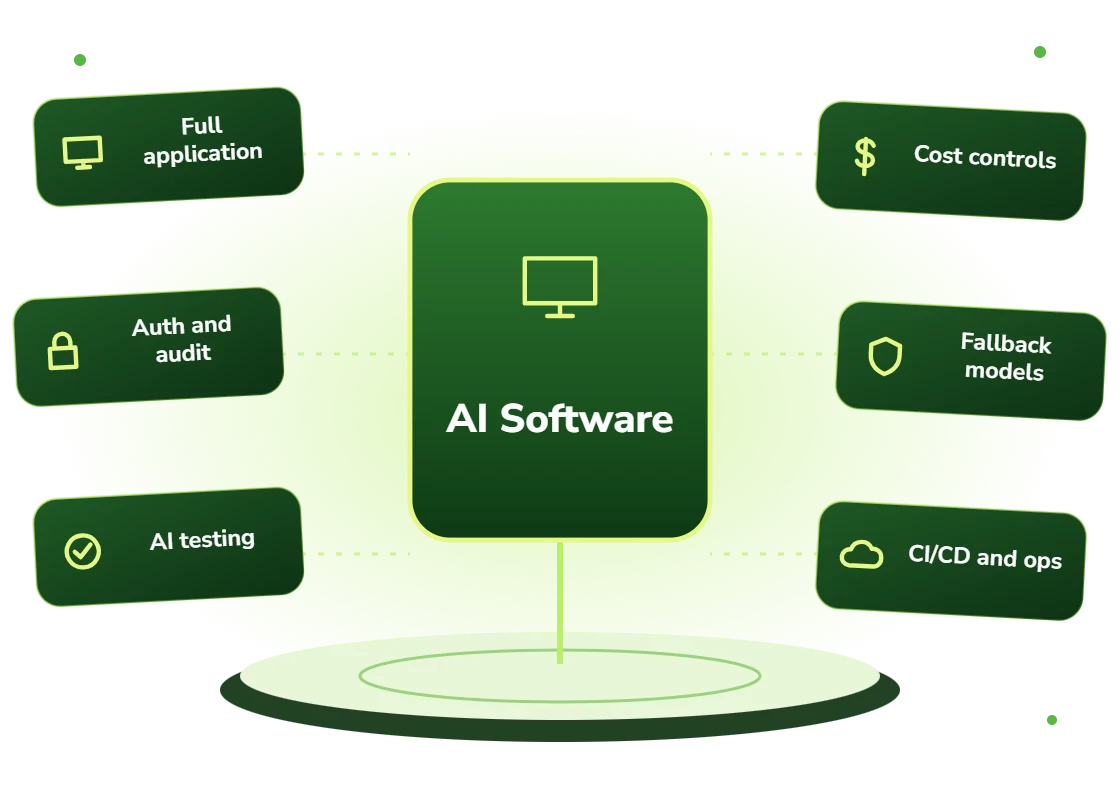
  • Full application development: frontend, backend, APIs, data layer
  • Authentication, authorization, multi-tenancy and audit logging
  • AI-specific testing: evaluation suites, regression detection, adversarial cases
  • Cost controls: per-request budgets, caching, model routing by task complexity
  • Resilience: timeouts, retries, fallback models, graceful degradation
  • CI/CD, infrastructure as code, monitoring, alerting and on-call runbooks

For a focused AI component in an existing system, see custom AI development. This page covers the complete application around that capability.

Right Fit

Who needs production AI software engineering

Companies whose AI prototype demonstrated value and now needs to become something real people depend on. This is the most common starting point and the transition is consistently underestimated.

Also product companies embedding AI into software they sell, where the reliability bar is set by customer expectations rather than internal tolerance.

  • Teams with a working prototype that cannot be trusted in production
  • Product companies embedding AI features into software they sell
  • Organizations where an AI failure would affect customers directly
  • Companies needing multi-tenant AI applications with per-customer isolation
  • Teams whose AI costs are unpredictable and uncontrolled
  • Businesses replacing a stalled internal AI effort with engineered delivery
Benefits

Benefits of custom AI software development

Survives real usage

Concurrency, rate limits, provider outages and malformed input are handled rather than discovered in production.

Costs that are controlled

Per-request budgets, caching and model routing keep spend predictable instead of arriving as a surprise invoice.

Quality that is monitored

Evaluation suites and drift detection catch degradation that no code change caused and no test would find.

Maintainable by your team

Conventional, well-documented engineering rather than a clever prototype only its author understands.

Secure by construction

Auth, tenancy isolation, prompt-injection defences, PII handling and audit logging designed in from the start.

Deployable and reversible

CI/CD, infrastructure as code and rollback paths, so shipping changes is routine rather than an event.

Problems We Solve

Business challenges this solves

01

Prototype that cannot go live

A working notebook with no path to production. We build the software around the intelligence.

02

Unpredictable AI costs

Bills that spike without warning. Budgets, caching and model routing make spend controllable.

03

Tests that cannot handle non-determinism

Exact-match assertions failing on valid output. Evaluation-based testing solves what unit tests cannot.

04

Silent quality degradation

Output getting worse with no deployment. Continuous evaluation catches drift.

05

Provider outages taking you down

A single model dependency as a single point of failure. Fallback routing keeps the service up.

06

Multi-tenant isolation concerns

Customer data bleeding across contexts. Tenancy isolation designed into the data and prompt layers.

What's Included

Features and deliverables

Everything below is in scope on a standard engagement. Nothing here is an upsell discovered halfway through the build.

01

Application architecture

Frontend, backend, API and data design based on your scale, team skills and operating constraints rather than fashion.

02

AI integration layer

An abstraction over model providers so routing, fallback, caching and cost control are centralized rather than scattered.

03

Evaluation-based testing

Test suites built for non-deterministic output, scoring against rubrics and regression sets instead of exact matches.

04

Cost governance

Per-request and per-tenant budgets, semantic caching, and routing cheap tasks to cheap models automatically.

05

Security engineering

Authentication, RBAC, tenancy isolation, prompt-injection defences, output validation and PII handling.

06

Observability

Structured tracing across AI calls, token and cost attribution, latency percentiles and quality metrics in one place.

07

Deployment pipeline

Infrastructure as code, automated testing, staged rollout, feature flags and documented rollback paths.

08

Documentation and handover

Architecture decision records, runbooks, API documentation and enablement sessions for your engineers.

Technology Stack

Technologies we use for custom AI software development

We are not tied to one vendor. Model and infrastructure choices are made on accuracy, cost per task, latency, and where your data is allowed to live.

Language Models
C
Claude (Anthropic)
G
GPT (OpenAI)
G
Gemini (Google)
L
Llama
M
Mistral
A
Azure OpenAI Service
Agent & Orchestration
M
Model Context Protocol
L
LangGraph
L
LangChain
L
LlamaIndex
T
Temporal
C
Celery
Vector & Retrieval
P
Pinecone
W
Weaviate
Q
Qdrant
p
pgvector
E
Elasticsearch
A
Amazon OpenSearch
Data & Backend
P
Python
T
TypeScript / Node.js
P
PostgreSQL
S
Snowflake
d
dbt
A
Apache Airflow
Cloud & Infrastructure
A
AWS Bedrock
G
Google Vertex AI
M
Microsoft Azure
D
Docker
K
Kubernetes
T
Terraform
How We Work

Our AI development process

The same five stages on every engagement, so you always know what happens next and what you get at the end of it.

01

Discovery

We interview the people doing the work, map the workflow end to end, and audit the systems and data behind it.

02

AI Strategy

Every opportunity gets scored on cost to build, time to value, and annual savings, then ranked.

03

Pilot Build

We ship the top-ranked automation as a fixed-scope pilot so you see real output before committing further budget.

04

Implementation

Integration with your live systems, staff training, human-in-the-loop review gates, and a documented rollback path.

05

Optimization

Monthly accuracy reviews, prompt and retrieval tuning, and a written report on hours and dollars saved.

Timeline

How long it takes

A typical first engagement, week by week. Complex integrations and regulated environments extend this, and we say so during discovery rather than after.

Weeks 1 to 2

Architecture and planning

Technical design, stack decisions, security model and a fixed-price delivery plan.

Weeks 3 to 6

Core platform

Data layer, authentication, AI integration layer and the deployment pipeline built first.

Weeks 7 to 12

Feature development

Application features built in demonstrable increments with fortnightly review.

Weeks 13 to 15

Hardening

Load testing, security review, evaluation suites, cost tuning and failure-mode testing.

Weeks 16 to 18

Launch and enablement

Staged production rollout, runbooks, engineer training and 30 days of included support.

Who We Work With

Industries we deliver custom AI software development for

SaaS & Technology

AI features inside your product, support deflection, onboarding assistants, and usage analytics.

Financial Services

Document extraction, reconciliation, KYC support, and audit-ready reporting with full traceability.

Healthcare

Intake, prior authorization, clinical documentation, and revenue-cycle workflows built to respect HIPAA boundaries.

Manufacturing

Quality inspection, maintenance prediction, supplier communication, and production scheduling.

Logistics & Supply Chain

Document processing, carrier communication, exception handling, and inventory rebalancing.

Retail & E-commerce

Product data enrichment, demand forecasting, support deflection, and personalized merchandising.

Insurance

First-notice-of-loss intake, claims triage, policy Q&A, and fraud signal detection.

Education

Enrollment support, content generation, tutoring assistants, and administrative automation.

Use Cases

Real-world use cases

01

AI features inside a SaaS product

Multi-tenant AI capability with per-customer isolation, usage metering and cost attribution.

02

Internal operations platforms

Applications where staff review, approve and act on AI output as part of a daily workflow.

03

Customer-facing AI portals

Authenticated interfaces where customers interact with AI over their own data.

04

Regulated workflow applications

Software handling controlled data with audit trails, retention rules and access controls built in.

05

Prototype-to-production rescue

Taking a proven internal prototype and rebuilding it as maintainable production software.

06

AI-powered analytics tools

Applications where users query data in natural language and receive verified, traceable answers.

Why DevSolutionsAI

Why choose DevSolutionsAI for custom AI software development

Business case before build

Every recommendation carries an estimated cost, timeline, and annual savings figure. If the math does not work, we say so before you spend.

Vendor-neutral by design

We resell nothing and take no platform commissions. Model and infrastructure choices are made on fit, cost, and your data-residency rules.

Fixed-scope pilots

The first engagement is a defined deliverable at a defined price, not an open-ended retainer that quietly grows each quarter.

Built for handover

You own the code, the prompts, the infrastructure, and the documentation. No lock-in to a proprietary wrapper you cannot leave.

Human-in-the-loop where it counts

Anything customer-facing, clinical, financial, or legal gets a review gate, a confidence threshold, and a logged audit trail.

Security reviewed early

Data flow diagrams, retention rules, and access boundaries are agreed in week one, not retrofitted after your security team objects.

Get Started

Find out what custom AI software development would cost you, before you commit to anything

Every engagement is quoted after a short discovery, so you get a fixed written price built around your actual volumes rather than a rate card that assumes someone else’s business.

The first call is thirty minutes and free. Bring one workflow. We will tell you what it is likely costing you each year, roughly what automating it would take, and whether we think it is worth doing at all.

  • A written savings estimate before any paid work
  • Fixed scope and fixed price, agreed up front
  • Full ownership of everything we build for you
  • An honest recommendation when the numbers do not work
What clients typically see
Across recent projects
Staff hours saved each week
31
Months to payback
4.8
Client retention
94%
Response to enquiries
4 hrs

Figures are internal measurements across recent engagements, reported to every client monthly in writing.

Illustrative project scenario

Illustrative project scenario

B2B SaaS · AI feature launch

Taking an AI prototype to 40,000 users without a cost surprise

Challenge. A SaaS company had a working AI summarization prototype that internal users loved. Rolling it out to 40,000 customers raised questions the prototype could not answer: cost at scale, tenancy isolation, what happens during a provider outage, and how to detect quality regression across customers.

What we built. A production rebuild with an AI integration layer handling model routing, semantic caching and per-tenant cost budgets; strict tenancy isolation at the data and prompt level; fallback routing across two providers; and an evaluation suite scoring output quality continuously with per-tenant alerting.

Outcome. Launched to all 40,000 users. Semantic caching and routing cheaper tasks to smaller models cut projected per-user cost by 68% against the prototype’s approach. A provider outage in month three degraded latency but caused no customer-visible failure.

40,000
Users at launch
−68%
Cost vs. prototype design
0
Outage-related failures
99.95%
Feature availability

Illustrative project scenario. The figures demonstrate how a project could be scoped and evaluated; they are not verified client results or an audited average.

Client Feedback

What clients say about working with us

31
Avg. staff hours saved weekly
4.8
Avg. months to payback
94%
Client retention
4
Hour response to enquiries
Common Questions

Custom AI Software Development FAQs

They overlap heavily and the distinction is emphasis. Custom AI development centres on the AI capability and the workflow around it. Custom AI software development describes engagements where the deliverable is a complete application, interfaces, authentication, multi-tenancy, APIs, deployment, with AI as one important component. If you need software people log into and depend on, this is the shape.
Sometimes you can, and we will say so if the prototype is well-built. More often the prototype made reasonable shortcuts that become structural problems: no error handling, no cost controls, no tenancy separation, no tests that work on non-deterministic output, and no way to detect quality regression. Rebuilding on the prototype’s proven logic is usually faster than retrofitting all of that.

Not with exact-match assertions, which fail on perfectly valid output. We build evaluation suites that score responses against rubrics and a regression set of real cases with known-good outputs, run on every change. That catches genuine quality regressions while tolerating acceptable variation, and it is one of the clearest differences between engineered AI software and a prototype.

Several mechanisms working together: per-request and per-tenant budget caps, semantic caching so repeated similar queries do not re-run, and routing that sends simple tasks to small cheap models while reserving frontier models for genuinely hard ones. On a recent engagement those measures cut projected per-user cost by roughly two thirds against a naive implementation.

The AI integration layer routes to a fallback provider automatically, with timeouts and circuit breakers preventing a slow provider from cascading into application failure. Where no fallback is acceptable, the system degrades gracefully to a non-AI path rather than erroring. This is designed in at architecture stage rather than added after the first incident.

That is an explicit design goal. We use conventional, well-supported technology rather than novel patterns, document architecture decisions with their reasoning, provide runbooks, and run enablement sessions with your engineers during the build rather than at the end. Several clients take over all further development at handover, which we consider a success.

Service Areas

Custom AI Software Development across the United States

We deliver custom ai software development remotely to clients nationwide, with on-site workshops available in major metros.

Ready to scope your custom AI software development project?

Book a free 30-minute consultation. Bring one workflow and leave with a realistic estimate of what it would cost to automate and what it would save.

Free 30-minute consultation
Fixed-scope pilots
U.S.-based team
Custom, not off-the-shelf
SOC 2-aligned practices
ROI tracked in writing
Free 30-minute AI consultation