Custom GPT development for assistants that know your business
Our custom GPT development work turns a defined task into an assistant with relevant instructions and knowledge. We establish access boundaries, action requirements and evaluation criteria before rollout.
A custom GPT is a configured AI assistant built for a specific purpose, with defined instructions, its own knowledge base and optional connections to external systems. Built properly for business use, it is grounded in company content through retrieval, connected to internal systems through actions, and governed with access controls, logging and evaluation.
The custom GPT that was built in an afternoon and abandoned in a month
Configuring a GPT is genuinely easy, which is why most organizations have several and use none. The usual pattern is a few documents uploaded, instructions written once, and no way to tell whether the answers are right.
Then the documents go stale, someone gets a wrong answer, word spreads, and the GPT quietly stops being used without anyone deciding to stop using it.
Grounded properly, connected, and measured
We build the retrieval layer properly rather than uploading a folder: structure-aware chunking, hybrid search, version handling, and content that syncs automatically as your sources change.
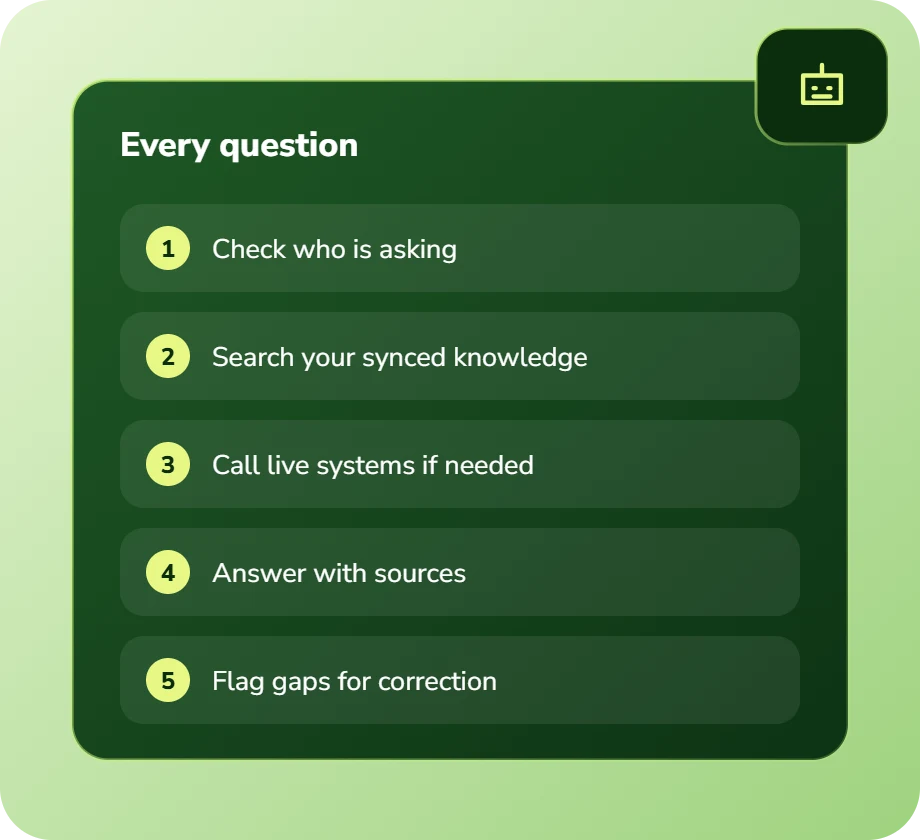
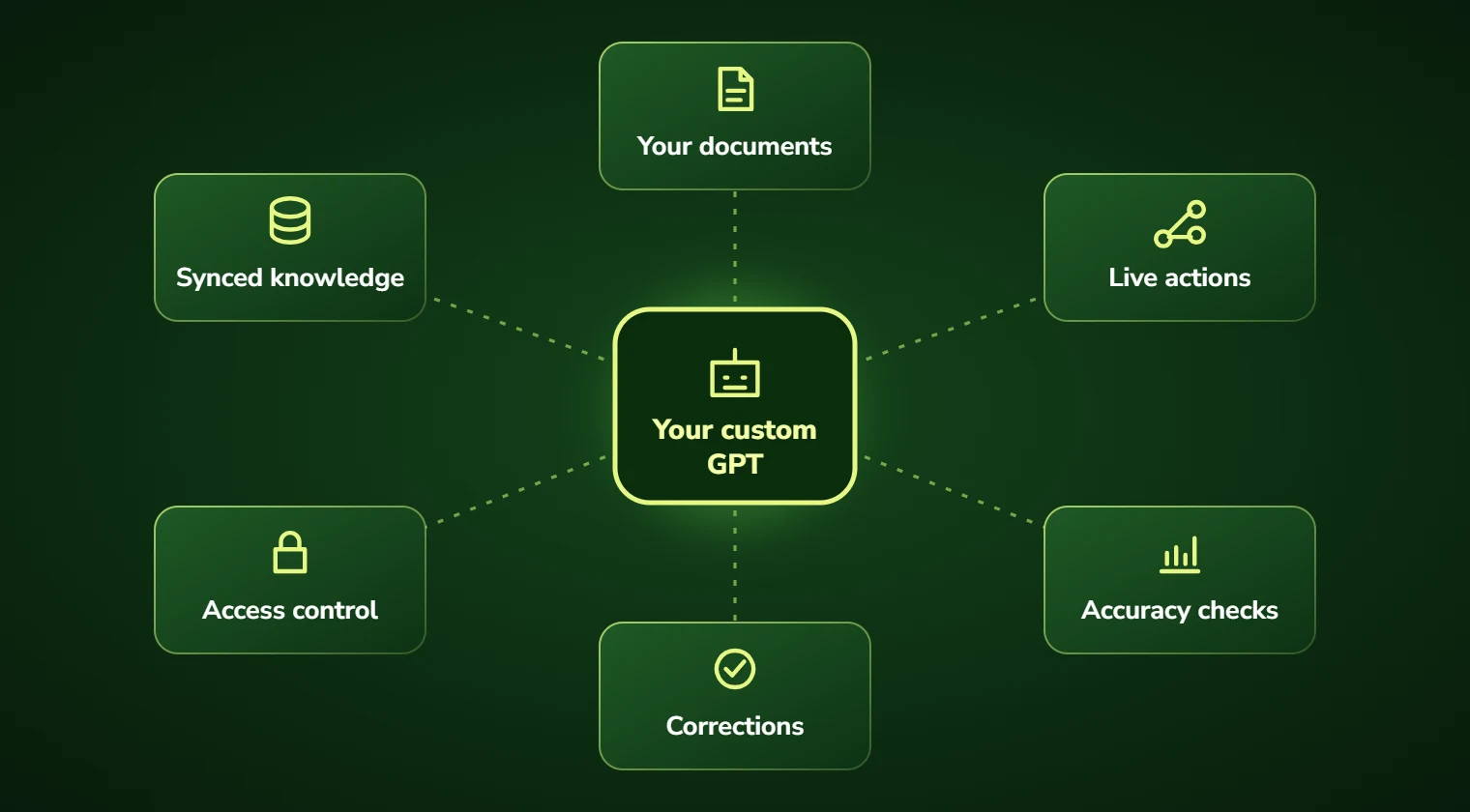
We connect it to live systems where that adds value, apply access controls and logging, and build an evaluation set so accuracy is a number rather than an impression.
Custom GPT development: scope and deliverables
Knowledge quality is the main differentiator. A handful of uploaded PDFs produces mediocre retrieval; a properly built index over synced sources produces answers people trust.
Actions are the second. A GPT that can look up a real order status or check live availability is substantially more useful than one that can only discuss policy, and that requires authenticated connections built and secured properly.
And governance: who can access it, what it may discuss, what is logged, and how a wrong answer gets traced to its source and corrected. Without that, accuracy degrades invisibly.
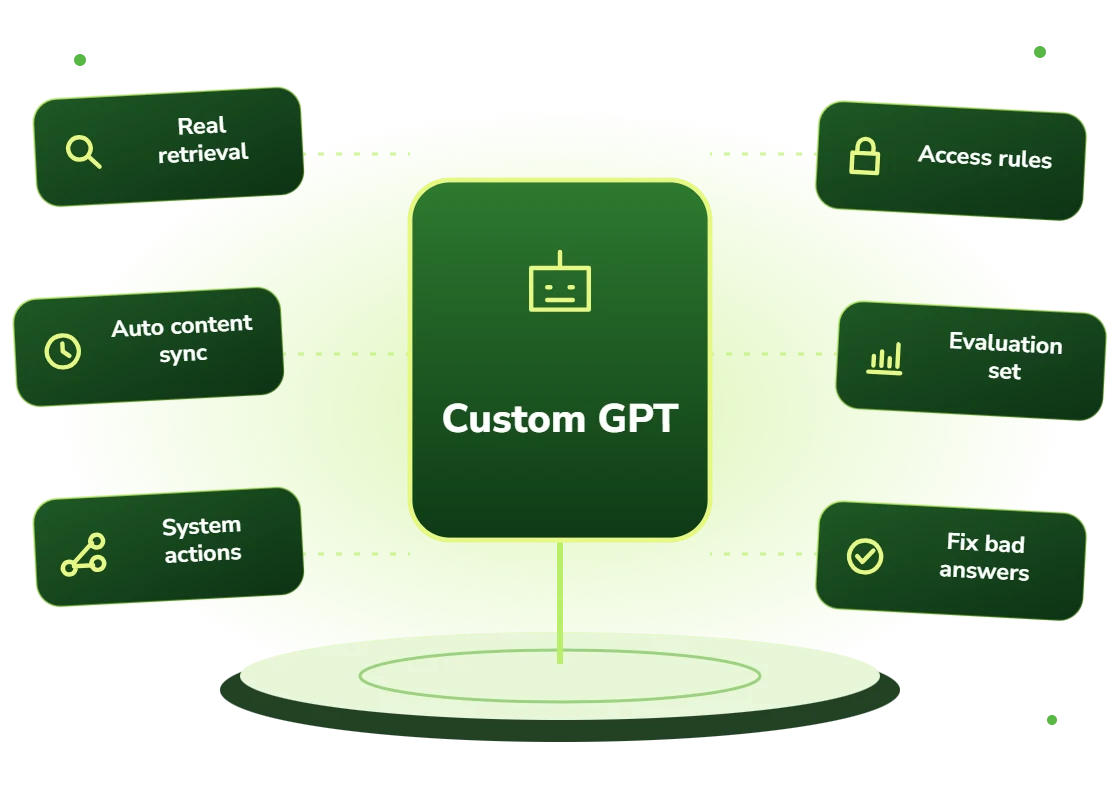
- Properly engineered retrieval rather than uploaded document folders
- Automatic content sync so knowledge does not go stale
- Authenticated actions into your live systems where useful
- Access control defining who may use it and what it may discuss
- Evaluation set measuring accuracy on real questions
- Correction workflow tracing bad answers to their source content
Who benefits from a custom GPT
Teams with a repeated, well-defined question domain: onboarding questions, policy queries, product specifications, standard operating procedures.
It is a good fit when the requirement is genuinely conversational and does not need to be embedded inside another application. If it needs to live inside your product, you want a copilot instead.
- Teams answering the same questions from documentation repeatedly
- Organizations wanting a governed alternative to ad-hoc consumer AI use
- Departments with well-defined procedure and policy domains
- Companies wanting role-specific assistants for particular functions
- Firms needing a quick, low-risk first AI deployment with real value
- Teams that tried a configured GPT and found the accuracy insufficient
Benefits of custom GPT development
Accuracy that holds up
Properly engineered retrieval rather than uploaded files, which is the difference between trusted and abandoned.
Knowledge that stays current
Automatic sync from your sources, so the assistant does not quietly become wrong as documents change.
Connected to live data
Authenticated actions returning real order status, availability or account details rather than general guidance.
Governed and logged
Access control, usage logging and topic boundaries, which configured GPTs generally lack.
Measured accuracy
An evaluation set so quality is a tracked number rather than a matter of who last complained.
Fast to deploy
Typically live in three to five weeks, which makes it a sensible first AI deployment for many organizations.
Business challenges custom GPT development solves
Configured GPTs nobody trusts
Poor retrieval from uploaded files. Proper indexing changes accuracy substantially.
Knowledge going stale
Documents uploaded once and never updated. Automatic sync keeps content current.
No connection to live data
Assistants that can only discuss policy. Authenticated actions make them genuinely useful.
No visibility into usage
No idea what is being asked or answered. Logging and analytics make it manageable.
Wrong answers with no fix path
Errors nobody can trace. Citation and correction workflow makes remediation possible.
Ungoverned consumer AI use
Staff using personal accounts with company data. A sanctioned alternative works better than a policy.
Features and deliverables
Everything below is in scope on a standard engagement. Nothing here is an upsell discovered halfway through the build.
Knowledge engineering
Content audited, structured, chunked and indexed properly rather than uploaded as a folder of PDFs.
Automatic content sync
Connections to SharePoint, Drive, Confluence or your document store so knowledge updates without manual re-upload.
System actions
Authenticated API connections letting the GPT retrieve live data and perform scoped actions.
Instruction engineering
Behaviour, tone, boundaries and refusal rules developed and tested rather than written once.
Access control
Who may use it, and permission-aware retrieval so content access respects existing rights.
Evaluation set
Real questions with verified answers, scored so accuracy is measured and regressions are caught.
Usage analytics
What is asked, what is answered well, and what fails, producing a content improvement backlog.
Correction workflow
Bad answers flagged, traced to their source document, and fixed at the content level rather than patched in instructions.
Technologies we use for custom GPT development
We are not tied to one vendor. Model and infrastructure choices are made on accuracy, cost per task, latency, and where your data is allowed to live.
Our AI development process
The same five stages on every engagement, so you always know what happens next and what you get at the end of it.
Discovery
We interview the people doing the work, map the workflow end to end, and audit the systems and data behind it.
AI Strategy
Every opportunity gets scored on cost to build, time to value, and annual savings, then ranked.
Pilot Build
We ship the top-ranked automation as a fixed-scope pilot so you see real output before committing further budget.
Implementation
Integration with your live systems, staff training, human-in-the-loop review gates, and a documented rollback path.
Optimization
Monthly accuracy reviews, prompt and retrieval tuning, and a written report on hours and dollars saved.
How long it takes
A typical first engagement, week by week. Complex integrations and regulated environments extend this, and we say so during discovery rather than after.
Scope and content audit
The question domain defined, source content assessed, and the evaluation set built.
Knowledge build
Content indexed properly, retrieval tuned and measured against the evaluation set.
Behaviour and actions
Instructions, boundaries and system connections built and tested.
Internal pilot
A small user group tests it live, flagging bad answers so content can be corrected.
Rollout and handover
Deployment, access configuration, training and documentation for ongoing content ownership.
Industries we deliver custom GPT development for
Professional Services
Proposal drafting, timesheet capture, research synthesis, and client reporting at scale.
SaaS & Technology
AI features inside your product, support deflection, onboarding assistants, and usage analytics.
Financial Services
Document extraction, reconciliation, KYC support, and audit-ready reporting with full traceability.
Healthcare
Intake, prior authorization, clinical documentation, and revenue-cycle workflows built to respect HIPAA boundaries.
Education
Enrollment support, content generation, tutoring assistants, and administrative automation.
Real Estate
Lead qualification, listing content, transaction coordination, and 24/7 inquiry response.
Insurance
First-notice-of-loss intake, claims triage, policy Q&A, and fraud signal detection.
Legal
Contract review, discovery triage, and matter intake with citation-checked outputs and attorney sign-off gates.
Real-world custom GPT development use cases
HR policy assistant
Staff questions about leave, benefits and procedure answered from current policy with citations.
Sales enablement GPT
Product capability, pricing rules and competitive positioning available during live calls.
Onboarding assistant
New starter questions answered from internal documentation without interrupting colleagues.
Technical product assistant
Specification and compatibility questions answered from product data with live inventory lookups.
Compliance procedure GPT
Internal procedure questions answered from controlled documents with version awareness.
Client-facing service assistant
Customer questions answered from public documentation with escalation into your support process.
Why choose DevSolutionsAI for custom GPT development
Business case before build
Every recommendation carries an estimated cost, timeline, and annual savings figure. If the math does not work, we say so before you spend.
Vendor-neutral by design
We resell nothing and take no platform commissions. Model and infrastructure choices are made on fit, cost, and your data-residency rules.
Fixed-scope pilots
The first engagement is a defined deliverable at a defined price, not an open-ended retainer that quietly grows each quarter.
Built for handover
You own the code, the prompts, the infrastructure, and the documentation. No lock-in to a proprietary wrapper you cannot leave.
Human-in-the-loop where it counts
Anything customer-facing, clinical, financial, or legal gets a review gate, a confidence threshold, and a logged audit trail.
Security reviewed early
Data flow diagrams, retention rules, and access boundaries are agreed in week one, not retrofitted after your security team objects.
Find out what custom GPT development would cost you, before you commit to anything
Every engagement is quoted after a short discovery, so you get a fixed written price built around your actual volumes rather than a rate card that assumes someone else’s business.
The first call is thirty minutes and free. Bring one workflow. We will tell you what it is likely costing you each year, roughly what automating it would take, and whether we think it is worth doing at all.
- A written savings estimate before any paid work
- Fixed scope and fixed price, agreed up front
- Full ownership of everything we build for you
- An honest recommendation when the numbers do not work
Figures are internal measurements across recent engagements, reported to every client monthly in writing.
Illustrative project scenario
Replacing four abandoned GPTs with one that gets used
Challenge. A firm had four self-configured GPTs built by different departments. Usage analysis showed all four had been effectively abandoned within two months. Investigation found the same cause each time: documents uploaded once, never updated, and retrieval poor enough that roughly a third of answers were wrong or outdated.
What we built. One properly engineered assistant with structure-aware indexing across four content sources, automatic sync from SharePoint so content never goes stale, permission-aware retrieval, live lookups into the practice management system, and an evaluation set of 180 real questions scored weekly.
Outcome. Measured accuracy reached 94% on the evaluation set, against roughly 68% for the previous configured GPTs. Weekly active usage stabilized at 71% of staff after four months rather than declining. Content gap reporting produced a documentation backlog the firm is working through.
Illustrative project scenario. The figures demonstrate how a project could be scoped and evaluated; they are not verified client results or an audited average.
What clients say about working with us
Custom GPT Development FAQs
Can we not just build a custom GPT ourselves?
You can, and for testing whether the idea has value you probably should. The limitation is retrieval quality: uploading a folder of documents produces mediocre search, which produces wrong answers, which kills adoption within a couple of months. That is the pattern we are usually called in to fix. If your content is small, stable and well-structured, a self-built GPT may be entirely sufficient and we will say so.
Why did our existing custom GPT stop being used?
Almost always one of three reasons: retrieval was poor enough that answers were unreliable, the uploaded content went stale and nobody re-uploaded it, or it could not access live data so answers stayed generic. All three are fixable, and diagnosing which applies is the first thing we do rather than rebuilding blindly.
How do you measure whether it is accurate?
We build an evaluation set of real questions from your team with verified correct answers, and score against it continuously. This is what turns “it seems okay” into a number you can track. On a recent engagement it revealed that previously trusted assistants were answering incorrectly about a third of the time, which nobody had quantified.
Can it access our live systems?
Yes, through authenticated actions. A GPT that can check real inventory, look up an actual case status or retrieve current account details is far more useful than one limited to discussing documentation. Access is scoped and read-only by default, with anything that changes data requiring explicit confirmation.
What does a custom GPT cost?
A properly engineered custom GPT with knowledge indexing, instruction design and an evaluation set runs $11,000 to $20,000 over four to five weeks. Adding live system actions, automatic content sync and access controls typically brings it to $26,000 to $45,000. It is one of the faster and lower-risk ways to get real value from AI, which is why we often recommend it as a first project.
Should we build a custom GPT or a full application?
A custom GPT if the need is conversational, the domain is well-defined, and users are content to go to an assistant. A full application or copilot if it needs to be embedded in another system, handle very large corpora, or serve external customers at scale. We will tell you which fits during the first call rather than defaulting to the larger engagement.
Services that pair well with this one
Most clients combine two or three of these. We will tell you the right sequence during discovery.
Ready to scope your custom GPT development project?
Book a free 30-minute consultation. Bring one workflow and leave with a realistic estimate of what it would cost to automate and what it would save.