Gemini AI Integration

Gemini AI integration for organizations already living in Google Cloud

Gemini AI integration can connect model capabilities to workflows in your Google Cloud environment. We assess your data, required system connections, deployment options and evaluation criteria before implementation.

Free 30-minute consultation
Fixed-scope pilots
U.S.-based team
Custom, not off-the-shelf
SOC 2-aligned practices
ROI tracked in writing
What is Google Gemini and when should you use it?

Gemini is Google’s family of multimodal AI models, available through the Gemini API and Google Cloud’s Vertex AI platform. It handles text, images, audio and video natively in a single model, supports very long context windows, and integrates closely with BigQuery, Google Workspace and other Google Cloud services, which makes it a natural fit for organizations already invested in that stack.

7+
Years building AI systems
240+
Projects delivered
4.8
Avg. months to payback
38
U.S. states served
The Problem

Moving data out of your platform to reason about it

Organizations with a mature Google Cloud footprint often end up exporting data to an external AI provider, processing it, and importing the results. That adds egress cost, latency, and a compliance question that did not previously exist.

The same applies to Workspace content. If the documents that matter live in Drive and the conversations happen in Chat, an AI system that cannot reach them is working from a copy that is already out of date.

Our Approach

Process where the data already lives

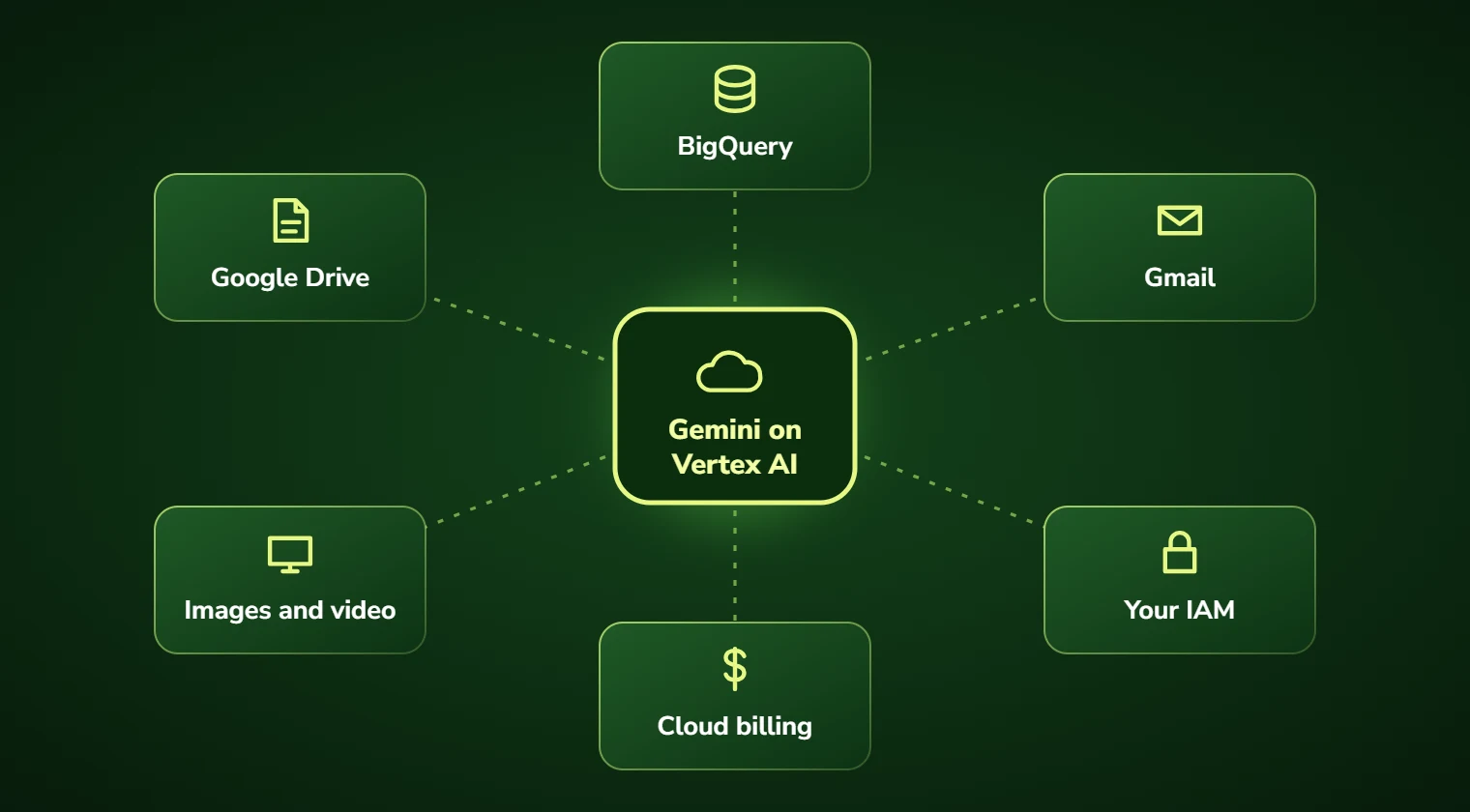
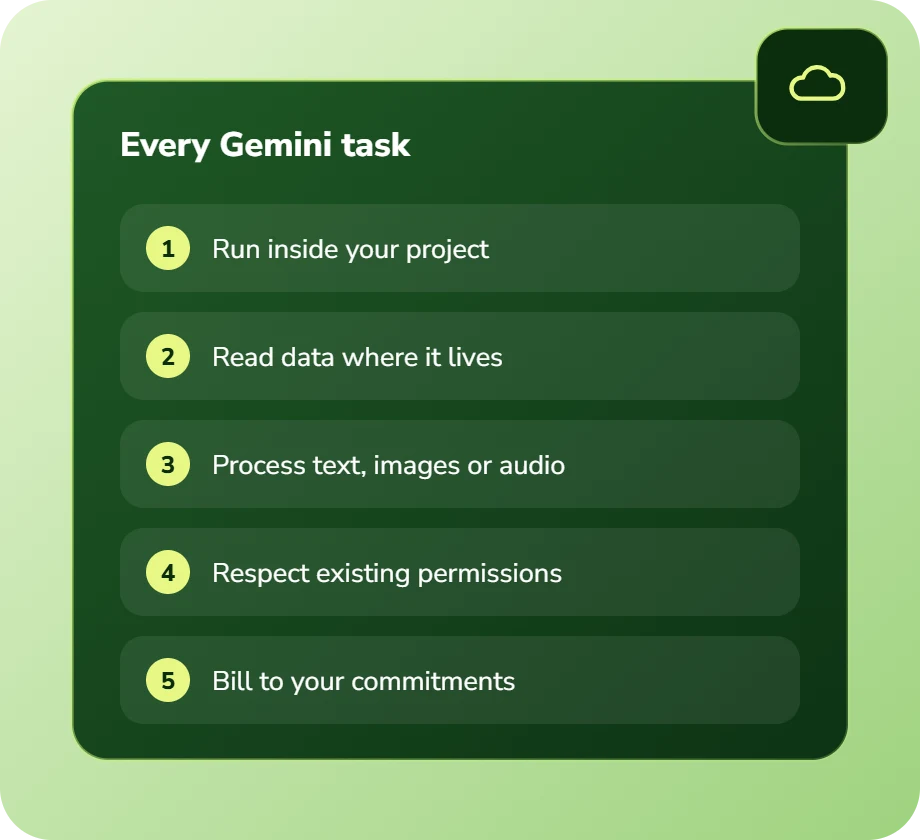
Vertex AI runs Gemini inside your Google Cloud project. Data in BigQuery can be processed without leaving your boundary, under IAM controls you already operate, billed through your existing commitment.

That adjacency is usually the deciding factor rather than model capability. It removes an egress path, a compliance review and a set of credentials to manage.

Diagram of AI services integrating a CRM, helpdesk and finance tools
Conceptual integration illustration
Service Overview

Gemini AI integration: scope and deliverables

Native multimodality is a genuine architectural difference. Gemini processes text, images, audio and video in one model rather than chaining separate models together, which simplifies pipelines that handle mixed media, product photography with descriptions, video with narration, scanned documents with images.

Very long context windows also open up whole-corpus reasoning for workloads that would otherwise require retrieval infrastructure to be built and maintained.

And for organizations on Workspace, the integration with Drive, Gmail and Chat means AI can work with live documents under existing permissions rather than an exported snapshot.

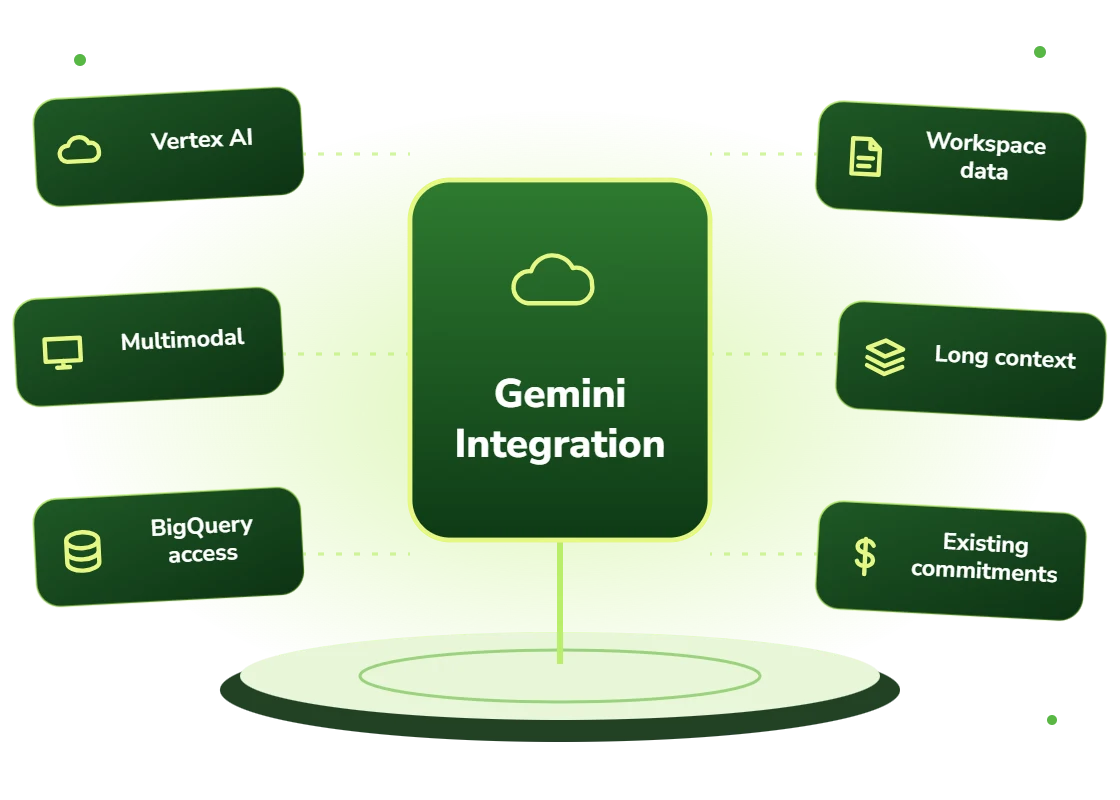
  • Vertex AI deployment inside your own Google Cloud project and IAM boundary
  • Native multimodal processing across text, image, audio and video
  • BigQuery integration so analytics data is processed without egress
  • Google Workspace integration across Drive, Gmail and Chat under existing permissions
  • Very long context windows for whole-corpus reasoning
  • Billing through existing Google Cloud commitments
Right Fit

Who Gemini suits best

Organizations with a significant Google Cloud footprint, particularly where the data that matters already sits in BigQuery. The adjacency advantage is real and often decisive.

Also teams with genuinely multimodal workloads. Where a pipeline currently chains an OCR model, a vision model and a text model, native multimodality removes moving parts.

  • Companies with substantial data in BigQuery they want to reason over
  • Google Workspace organizations wanting AI over live Drive and Gmail content
  • Teams with existing Google Cloud committed-use discounts
  • Workloads mixing text, image, audio and video in one pipeline
  • Organizations whose data residency rules are already satisfied by their GCP setup
  • Teams wanting to avoid building retrieval infrastructure for moderate corpora
Benefits

Benefits of Gemini AI integration

Data stays in your project

Vertex AI processes inside your GCP boundary under your existing IAM, removing an egress path and a compliance review.

One model for mixed media

Text, image, audio and video handled natively rather than by chaining three models and hoping the handoffs hold.

BigQuery without export

Analytics data reasoned over in place, avoiding egress cost and the staleness of exported snapshots.

Live Workspace content

AI working with current Drive and Gmail content under existing permissions rather than an outdated copy.

Existing commercial terms

Billed through your Google Cloud commitment, which often means better effective pricing and no new procurement.

Long context, less infrastructure

Very large context windows can serve moderate corpora without building and running a retrieval stack.

Problems We Solve

Business challenges this solves

01

Data egress to reach an AI provider

Exporting from BigQuery to process externally. Vertex keeps processing inside your project.

02

Multimodal pipelines with too many parts

Chained OCR, vision and text models. Native multimodality removes the handoffs.

03

AI working from stale exports

Snapshots of Drive content going out of date. Live Workspace integration reads current documents.

04

New vendor procurement friction

Another security review and contract. Existing GCP terms usually cover Vertex already.

05

Retrieval infrastructure for a modest corpus

Building a vector stack for content that fits in context. Long windows can be simpler and cheaper.

06

Compliance re-approval for a new path

Data leaving an approved boundary. Staying inside GCP avoids reopening the question.

What's Included

Features and deliverables

Everything below is in scope on a standard engagement. Nothing here is an upsell discovered halfway through the build.

01

Vertex AI deployment

Gemini deployed inside your Google Cloud project with IAM, VPC Service Controls and audit logging integrated.

02

BigQuery integration

AI processing over BigQuery datasets without export, including natural-language querying over structured data.

03

Multimodal pipelines

Unified processing of documents, images, audio and video in single pipelines rather than chained models.

04

Workspace integration

Drive, Gmail and Chat integration respecting existing Google permissions and sharing rules.

05

Long-context workflows

Whole-corpus reasoning where context windows make retrieval infrastructure unnecessary.

06

Grounding and citation

Responses grounded in your data or Google Search with citations, depending on the use case.

07

Cost governance

Context caching, model tier routing and budget controls integrated with GCP billing and quotas.

08

Provider abstraction

Integration behind an abstraction layer so Gemini can be mixed with or replaced by other models per task.

Technology Stack

Technologies we use for Gemini AI integration

We are not tied to one vendor. Model and infrastructure choices are made on accuracy, cost per task, latency, and where your data is allowed to live.

Language Models
C
Claude (Anthropic)
G
GPT (OpenAI)
G
Gemini (Google)
L
Llama
M
Mistral
A
Azure OpenAI Service
Data & Backend
P
Python
T
TypeScript / Node.js
P
PostgreSQL
S
Snowflake
d
dbt
A
Apache Airflow
Cloud & Infrastructure
A
AWS Bedrock
G
Google Vertex AI
M
Microsoft Azure
D
Docker
K
Kubernetes
T
Terraform
Business Systems
S
Salesforce
H
HubSpot
N
NetSuite
M
Microsoft 365
S
Slack
Z
Zapier / Make
How We Work

Our AI development process

The same five stages on every engagement, so you always know what happens next and what you get at the end of it.

01

Discovery

We interview the people doing the work, map the workflow end to end, and audit the systems and data behind it.

02

AI Strategy

Every opportunity gets scored on cost to build, time to value, and annual savings, then ranked.

03

Pilot Build

We ship the top-ranked automation as a fixed-scope pilot so you see real output before committing further budget.

04

Implementation

Integration with your live systems, staff training, human-in-the-loop review gates, and a documented rollback path.

05

Optimization

Monthly accuracy reviews, prompt and retrieval tuning, and a written report on hours and dollars saved.

Timeline

How long it takes

A typical first engagement, week by week. Complex integrations and regulated environments extend this, and we say so during discovery rather than after.

Weeks 1 to 2

Discovery and scoping

Process observation, systems audit, data review, and a written estimate of cost and expected saving before anything is built.

Week 3

Design sign-off

Architecture, data handling rules, review thresholds and success measures agreed in writing.

Weeks 4 to 7

Build and integration

Development against your real data, connected to your live systems, with weekly demos rather than a single reveal.

Week 8

Parallel run and testing

The system runs alongside the existing process so accuracy can be compared directly before anyone depends on it.

Weeks 9 to 10

Launch and handover

Cutover with a rollback path, staff training, full documentation, then 30 days of included tuning.

Who We Work With

Industries we deliver Gemini AI integration for

Retail & E-commerce

Product data enrichment, demand forecasting, support deflection, and personalized merchandising.

SaaS & Technology

AI features inside your product, support deflection, onboarding assistants, and usage analytics.

Logistics & Supply Chain

Document processing, carrier communication, exception handling, and inventory rebalancing.

Manufacturing

Quality inspection, maintenance prediction, supplier communication, and production scheduling.

Healthcare

Intake, prior authorization, clinical documentation, and revenue-cycle workflows built to respect HIPAA boundaries.

Financial Services

Document extraction, reconciliation, KYC support, and audit-ready reporting with full traceability.

Education

Enrollment support, content generation, tutoring assistants, and administrative automation.

Professional Services

Proposal drafting, timesheet capture, research synthesis, and client reporting at scale.

Use Cases

Real-world use cases

01

Natural-language BigQuery analytics

Business users querying warehouse data in plain language, with generated SQL shown for verification.

02

Product catalogue enrichment

Images and descriptions processed together to generate attributes, categories and marketing copy.

03

Video and call analysis

Recorded meetings, training material and support calls analysed natively without separate transcription.

04

Workspace document assistant

Staff querying live Drive content under existing permissions rather than an exported index.

05

Quality inspection with images

Manufacturing images assessed against written specifications in a single multimodal request.

06

Multimodal document processing

Scanned documents containing text, tables, diagrams and photographs handled in one pass.

Why DevSolutionsAI

Why choose DevSolutionsAI for Gemini AI integration

Business case before build

Every recommendation carries an estimated cost, timeline, and annual savings figure. If the math does not work, we say so before you spend.

Vendor-neutral by design

We resell nothing and take no platform commissions. Model and infrastructure choices are made on fit, cost, and your data-residency rules.

Fixed-scope pilots

The first engagement is a defined deliverable at a defined price, not an open-ended retainer that quietly grows each quarter.

Built for handover

You own the code, the prompts, the infrastructure, and the documentation. No lock-in to a proprietary wrapper you cannot leave.

Human-in-the-loop where it counts

Anything customer-facing, clinical, financial, or legal gets a review gate, a confidence threshold, and a logged audit trail.

Security reviewed early

Data flow diagrams, retention rules, and access boundaries are agreed in week one, not retrofitted after your security team objects.

Get Started

Find out what Gemini AI integration would cost you, before you commit to anything

Every engagement is quoted after a short discovery, so you get a fixed written price built around your actual volumes rather than a rate card that assumes someone else’s business.

The first call is thirty minutes and free. Bring one workflow. We will tell you what it is likely costing you each year, roughly what automating it would take, and whether we think it is worth doing at all.

  • A written savings estimate before any paid work
  • Fixed scope and fixed price, agreed up front
  • Full ownership of everything we build for you
  • An honest recommendation when the numbers do not work
What clients typically see
Across recent projects
Staff hours saved each week
31
Months to payback
4.8
Client retention
94%
Response to enquiries
4 hrs

Figures are internal measurements across recent engagements, reported to every client monthly in writing.

Illustrative project scenario

Illustrative project scenario

Multi-brand retailer · 1.1M products

Enriching a catalogue by reading the photographs

Challenge. A retailer held product data in BigQuery and imagery in Cloud Storage. Attribute completeness was poor because suppliers submitted inconsistent data, and much of the missing information, colour, material, style details, was visible in the product photography but had never been extracted.

What we built. A Vertex AI pipeline processing product images and existing text descriptions together in single multimodal requests, writing extracted attributes back to BigQuery without data leaving the project. Confidence thresholds route uncertain extractions to a merchandising review queue rather than writing them directly.

Outcome. Attribute completeness rose from 54% to 91% across the catalogue. Search filtering improved as a direct consequence, and the merchandising team’s manual enrichment work fell substantially. No data left the Google Cloud project at any stage, which removed a compliance review that an external provider would have triggered.

54% → 91%
Attribute completeness
1.1M
Products enriched
0 bytes
Data egress
1 pass
Image + text together

Illustrative project scenario. The figures demonstrate how a project could be scoped and evaluated; they are not verified client results or an audited average.

Client Feedback

What clients say about working with us

31
Avg. staff hours saved weekly
4.8
Avg. months to payback
94%
Client retention
4
Hour response to enquiries
Common Questions

Gemini AI Integration FAQs

The strongest structural reasons are adjacency rather than raw capability: your data already lives in BigQuery, your organization runs on Google Workspace, or you have existing Google Cloud committed-use discounts. Gemini is also genuinely strong on natively multimodal workloads mixing text, image, audio and video, and on very long context. If you have no Google Cloud footprint, that advantage disappears and the choice should be made on measured task performance.

The Gemini API is a direct endpoint, quick to start with and suitable for prototyping. Vertex AI runs the same models inside your own Google Cloud project with IAM, VPC Service Controls, audit logging and billing through your existing commitment. For anything production or compliance-sensitive, Vertex is generally the right choice.

Yes, through the Workspace APIs and respecting existing Google permissions, so a user only gets results from documents they can already access. This is genuinely useful because the AI reads current content rather than an exported index that goes stale, but it needs careful permission design so sharing rules are enforced at retrieval rather than after.

With Vertex AI, processing happens inside your project boundary under your own IAM controls, and data is not used to train Google’s models under the Vertex terms. This is frequently the deciding factor for organizations whose data residency position is already approved for GCP, since using an external provider would reopen that review.

For moderate corpora, sometimes yes, and that is a real simplification, no vector database to run, no chunking strategy to tune. For large corpora it is not: sending a million documents in context is neither possible nor affordable. The practical answer depends on your corpus size and query patterns, and we model the cost both ways during design.

Yes, and we usually recommend it. We build behind a provider abstraction so different tasks route to whichever model measures best and cheapest for them. A common pattern is Gemini for multimodal and BigQuery-adjacent work, with other models handling tasks where they benchmark better on the client’s own test cases.

Service Areas

Gemini AI Integration across the United States

We deliver gemini ai integration remotely to clients nationwide, with on-site workshops available in major metros.

Ready to scope your Gemini AI integration project?

Book a free 30-minute consultation. Bring one workflow and leave with a realistic estimate of what it would cost to automate and what it would save.

Free 30-minute consultation
Fixed-scope pilots
U.S.-based team
Custom, not off-the-shelf
SOC 2-aligned practices
ROI tracked in writing
Free 30-minute AI consultation