Generative AI Development

Generative AI development with quality controls

Our generative AI development work connects content, code or structured output to a defined production workflow. We design evaluation, brand controls and review so quality can be measured before release.

Free 30-minute consultation
Fixed-scope pilots
U.S.-based team
Custom, not off-the-shelf
SOC 2-aligned practices
ROI tracked in writing
What is generative AI development?

Generative AI development builds production systems that create content, images, code or structured data at scale using generative models. Beyond calling a model, it covers brand and tone controls, factual grounding, review workflows, quality evaluation, and the guardrails that keep output consistent and publishable without human rewriting.

7+
Years building AI systems
240+
Projects delivered
4.8
Avg. months to payback
38
U.S. states served
The Problem

Output that takes longer to fix than to write

The first generative AI pilot in most companies produces content that is fluent, generic, and slightly wrong about the product. Editors spend longer correcting it than they would have spent writing.

The causes are consistent: the model has no access to actual product facts, no encoding of brand voice beyond an adjective in the prompt, and no evaluation, so quality is a matter of whoever last looked at it.

Our Approach

Grounded, constrained and measured

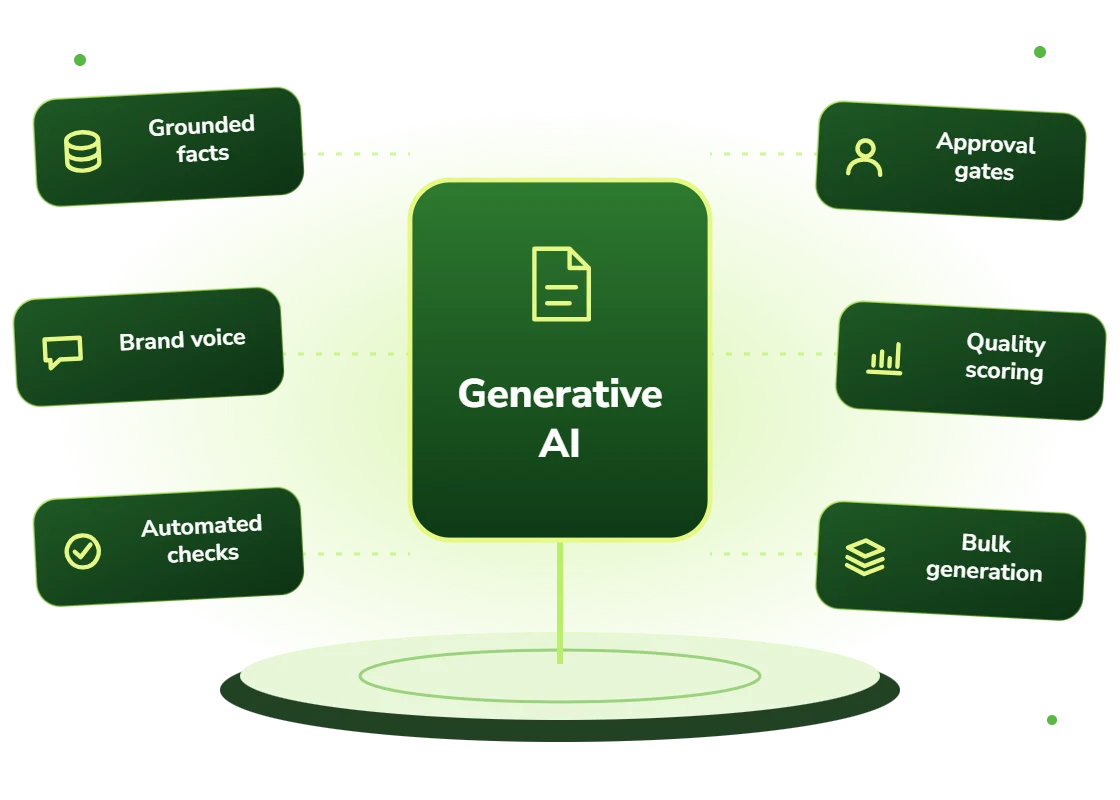
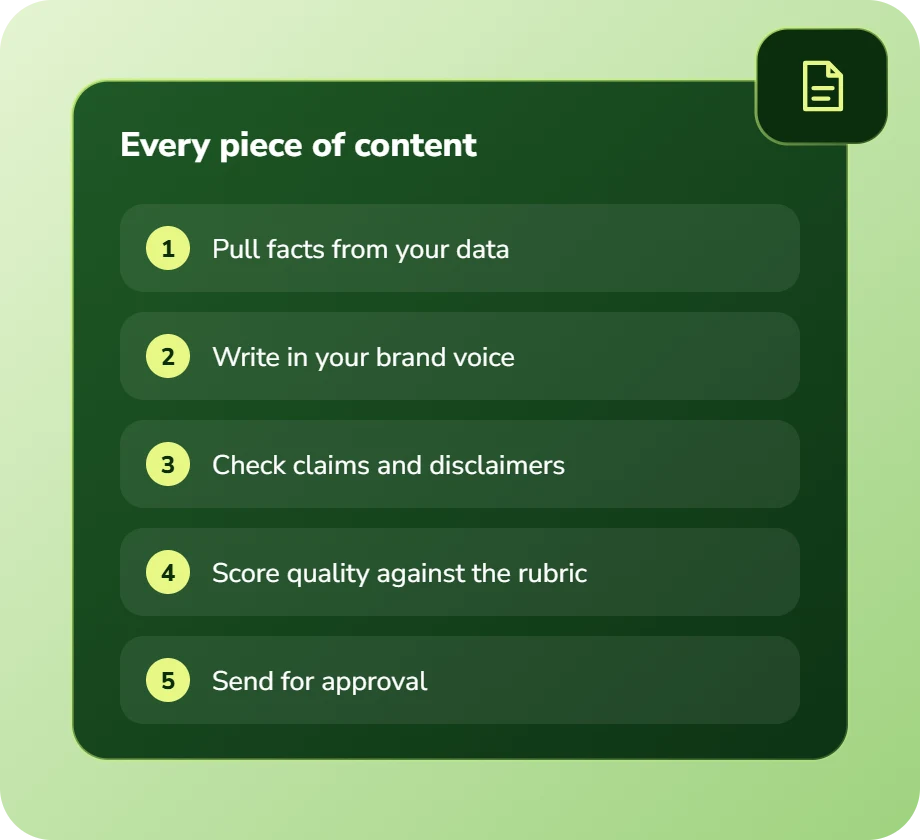
We ground generation in your real data, so the specifications in a product description come from your catalogue rather than from plausible invention.

Brand voice is encoded from your existing approved material rather than described adjectivally, output is validated against explicit rules before it reaches a human, and quality is scored against a rubric so improvement is measurable.

Diagram showing information extracted from a document into structured fields
Service Overview

Generative AI development: scope and deliverables

Grounding is the foundation. Generation from retrieved facts produces output that is specific and correct; generation from a prompt alone produces output that is fluent and unreliable.

Brand and tone controls come next. Encoding voice from a corpus of approved material works considerably better than instructing a model to be “professional yet approachable”, which every model interprets differently.

Then validation and review: automated checks for prohibited claims, required disclaimers, factual consistency against source data and format compliance, before anything reaches a human reviewer. The reviewer’s job should be judgement, not proofreading.

  • Retrieval grounding so generated facts come from your data
  • Brand voice encoded from approved material rather than described in adjectives
  • Automated validation: prohibited claims, required disclaimers, factual consistency
  • Human review workflow with approval gates before publication
  • Quality scoring against a rubric so improvement is measurable
  • Bulk generation pipelines with cost controls and progress tracking
Right Fit

Who this suits

Organizations producing large volumes of similar content: product descriptions, listings, reports, proposals, localized variants. The economics work because the marginal cost of the ten-thousandth item is the same as the first.

Also regulated businesses where content requires compliance review, and where automated validation before human review saves more time than the generation itself.

  • E-commerce and marketplaces producing thousands of product descriptions
  • Companies localizing content across many markets and languages
  • Firms producing recurring reports and client deliverables from data
  • Real estate and listing businesses generating property content at volume
  • Regulated industries where content requires compliance checking
  • Teams whose content backlog is a genuine constraint on revenue
Benefits

Benefits of generative AI development

Output that ships

Grounded and validated generation that needs approval rather than rewriting, which is where the time actually goes.

Consistent brand voice

Voice encoded from approved material, so output is consistent across ten thousand items rather than varying by prompt.

Facts from your data

Specifications and details retrieved from your systems rather than invented plausibly by the model.

Compliance checked first

Prohibited claims and missing disclaimers caught automatically before a reviewer sees the item.

Volume that was impossible

Content backlogs that were capacity-constrained become throughput-constrained, which is a solvable problem.

Quality you can track

Rubric scoring so quality is a number that trends rather than an argument in a meeting.

Problems We Solve

Business challenges this solves

01

Editing takes longer than writing

Generic output needing full rewrites. Grounding and voice encoding make output editable rather than disposable.

02

Invented product specifications

Plausible but wrong details. Retrieval grounding sources facts from your actual catalogue.

03

Inconsistent tone across output

Voice varying by prompt and author. Encoded brand voice applies consistently at any volume.

04

Compliance review as the bottleneck

Legal reviewing everything manually. Automated pre-checks remove the obvious failures first.

05

Content backlog capping revenue

Products unlisted because nobody wrote the copy. Bulk generation removes the constraint.

06

Localization cost per market

Translation and adaptation costs limiting expansion. Generation makes additional markets marginal.

What's Included

Features and deliverables

Everything below is in scope on a standard engagement. Nothing here is an upsell discovered halfway through the build.

01

Content grounding layer

Retrieval over product data, specifications and approved source material so generated facts are traceable.

02

Brand voice encoding

Voice and style derived from a corpus of your approved content, applied consistently rather than described in a prompt.

03

Template and structure control

Output conforming to required structure, length, format and mandatory sections through schema enforcement.

04

Compliance validation

Automated checks for prohibited claims, required disclaimers, regulated terminology and factual consistency.

05

Review and approval workflow

A queue where reviewers approve, edit or reject, with edits captured as signal for improving generation.

06

Bulk generation pipeline

Batch processing with progress tracking, cost controls and resumable runs for large catalogues.

07

Quality scoring

Rubric-based scoring of generated output plus tracking of human edit rates as a real quality signal.

08

Multilingual generation

Native generation per market rather than translation, preserving voice and adapting to local conventions.

Technology Stack

Technologies we use for generative AI development

We are not tied to one vendor. Model and infrastructure choices are made on accuracy, cost per task, latency, and where your data is allowed to live.

Language Models
C
Claude (Anthropic)
G
GPT (OpenAI)
G
Gemini (Google)
L
Llama
M
Mistral
A
Azure OpenAI Service
Vector & Retrieval
P
Pinecone
W
Weaviate
Q
Qdrant
p
pgvector
E
Elasticsearch
A
Amazon OpenSearch
Data & Backend
P
Python
T
TypeScript / Node.js
P
PostgreSQL
S
Snowflake
d
dbt
A
Apache Airflow
Business Systems
S
Salesforce
H
HubSpot
N
NetSuite
M
Microsoft 365
S
Slack
Z
Zapier / Make
How We Work

Our AI development process

The same five stages on every engagement, so you always know what happens next and what you get at the end of it.

01

Discovery

We interview the people doing the work, map the workflow end to end, and audit the systems and data behind it.

02

AI Strategy

Every opportunity gets scored on cost to build, time to value, and annual savings, then ranked.

03

Pilot Build

We ship the top-ranked automation as a fixed-scope pilot so you see real output before committing further budget.

04

Implementation

Integration with your live systems, staff training, human-in-the-loop review gates, and a documented rollback path.

05

Optimization

Monthly accuracy reviews, prompt and retrieval tuning, and a written report on hours and dollars saved.

Timeline

How long it takes

A typical first engagement, week by week. Complex integrations and regulated environments extend this, and we say so during discovery rather than after.

Weeks 1 to 2

Discovery and scoping

Process observation, systems audit, data review, and a written estimate of cost and expected saving before anything is built.

Week 3

Design sign-off

Architecture, data handling rules, review thresholds and success measures agreed in writing.

Weeks 4 to 7

Build and integration

Development against your real data, connected to your live systems, with weekly demos rather than a single reveal.

Week 8

Parallel run and testing

The system runs alongside the existing process so accuracy can be compared directly before anyone depends on it.

Weeks 9 to 10

Launch and handover

Cutover with a rollback path, staff training, full documentation, then 30 days of included tuning.

Who We Work With

Industries we deliver generative AI development for

Retail & E-commerce

Product data enrichment, demand forecasting, support deflection, and personalized merchandising.

SaaS & Technology

AI features inside your product, support deflection, onboarding assistants, and usage analytics.

Professional Services

Proposal drafting, timesheet capture, research synthesis, and client reporting at scale.

Real Estate

Lead qualification, listing content, transaction coordination, and 24/7 inquiry response.

Manufacturing

Quality inspection, maintenance prediction, supplier communication, and production scheduling.

Education

Enrollment support, content generation, tutoring assistants, and administrative automation.

Logistics & Supply Chain

Document processing, carrier communication, exception handling, and inventory rebalancing.

Insurance

First-notice-of-loss intake, claims triage, policy Q&A, and fraud signal detection.

Use Cases

Real-world use cases

01

Product description generation

Catalogue descriptions grounded in real specifications, in brand voice, at a volume no copy team could reach.

02

Property listing content

Listing descriptions from property data and images, consistent across agents and compliant with advertising rules.

03

Report and deliverable drafting

Recurring client reports drafted from source data with narrative explanation, reviewed rather than written.

04

Proposal and RFP responses

First drafts assembled from prior approved responses and the current requirement, cutting response time substantially.

05

Localized market content

Native content per market rather than translated, adapted to local conventions and regulation.

06

Internal documentation

Procedure and reference documentation generated from system data and subject-matter interviews.

Why DevSolutionsAI

Why choose DevSolutionsAI for generative AI development

Business case before build

Every recommendation carries an estimated cost, timeline, and annual savings figure. If the math does not work, we say so before you spend.

Vendor-neutral by design

We resell nothing and take no platform commissions. Model and infrastructure choices are made on fit, cost, and your data-residency rules.

Fixed-scope pilots

The first engagement is a defined deliverable at a defined price, not an open-ended retainer that quietly grows each quarter.

Built for handover

You own the code, the prompts, the infrastructure, and the documentation. No lock-in to a proprietary wrapper you cannot leave.

Human-in-the-loop where it counts

Anything customer-facing, clinical, financial, or legal gets a review gate, a confidence threshold, and a logged audit trail.

Security reviewed early

Data flow diagrams, retention rules, and access boundaries are agreed in week one, not retrofitted after your security team objects.

Get Started

Find out what generative AI development would cost you, before you commit to anything

Every engagement is quoted after a short discovery, so you get a fixed written price built around your actual volumes rather than a rate card that assumes someone else’s business.

The first call is thirty minutes and free. Bring one workflow. We will tell you what it is likely costing you each year, roughly what automating it would take, and whether we think it is worth doing at all.

  • A written savings estimate before any paid work
  • Fixed scope and fixed price, agreed up front
  • Full ownership of everything we build for you
  • An honest recommendation when the numbers do not work
What clients typically see
Across recent projects
Staff hours saved each week
31
Months to payback
4.8
Client retention
94%
Response to enquiries
4 hrs

Figures are internal measurements across recent engagements, reported to every client monthly in writing.

Illustrative project scenario

Illustrative project scenario

Home goods retailer · 240,000 SKUs

Listing 90,000 products that had no copy at all

Challenge. A retailer had 90,000 products in its catalogue with no descriptions, which meant they could not be listed on major marketplaces. The copy team produced roughly 200 descriptions a week. At that rate the backlog represented nearly nine years of work.

What we built. Generation grounded in the product specification database so dimensions, materials and compatibility come from actual data. Brand voice was encoded from 1,200 approved existing descriptions. Automated validation checks prohibited claims and required disclosures. Everything routes to human review before publication, with reviewer edits captured to improve subsequent generation.

Outcome. The full backlog was generated and reviewed in fourteen weeks. Reviewer edit rate settled at 22%, meaning roughly four in five descriptions were approved unchanged. The previously unlistable products became listable, which was the actual commercial objective.

90,000
Descriptions generated
9 yrs → 14 wks
Backlog clearance
22%
Reviewer edit rate
100%
Human-reviewed before publish

Illustrative project scenario. The figures demonstrate how a project could be scoped and evaluated; they are not verified client results or an audited average.

Client Feedback

What clients say about working with us

31
Avg. staff hours saved weekly
4.8
Avg. months to payback
94%
Client retention
4
Hour response to enquiries
Common Questions

Generative AI Development FAQs

It does if you prompt a model and hope, which is what most first attempts do. Two things fix it: grounding, so the content contains real specifics from your data rather than plausible generalities; and voice encoding derived from a corpus of your approved content rather than an adjective in a prompt. On a recent engagement four in five generated items were approved without edits, which is the practical test.
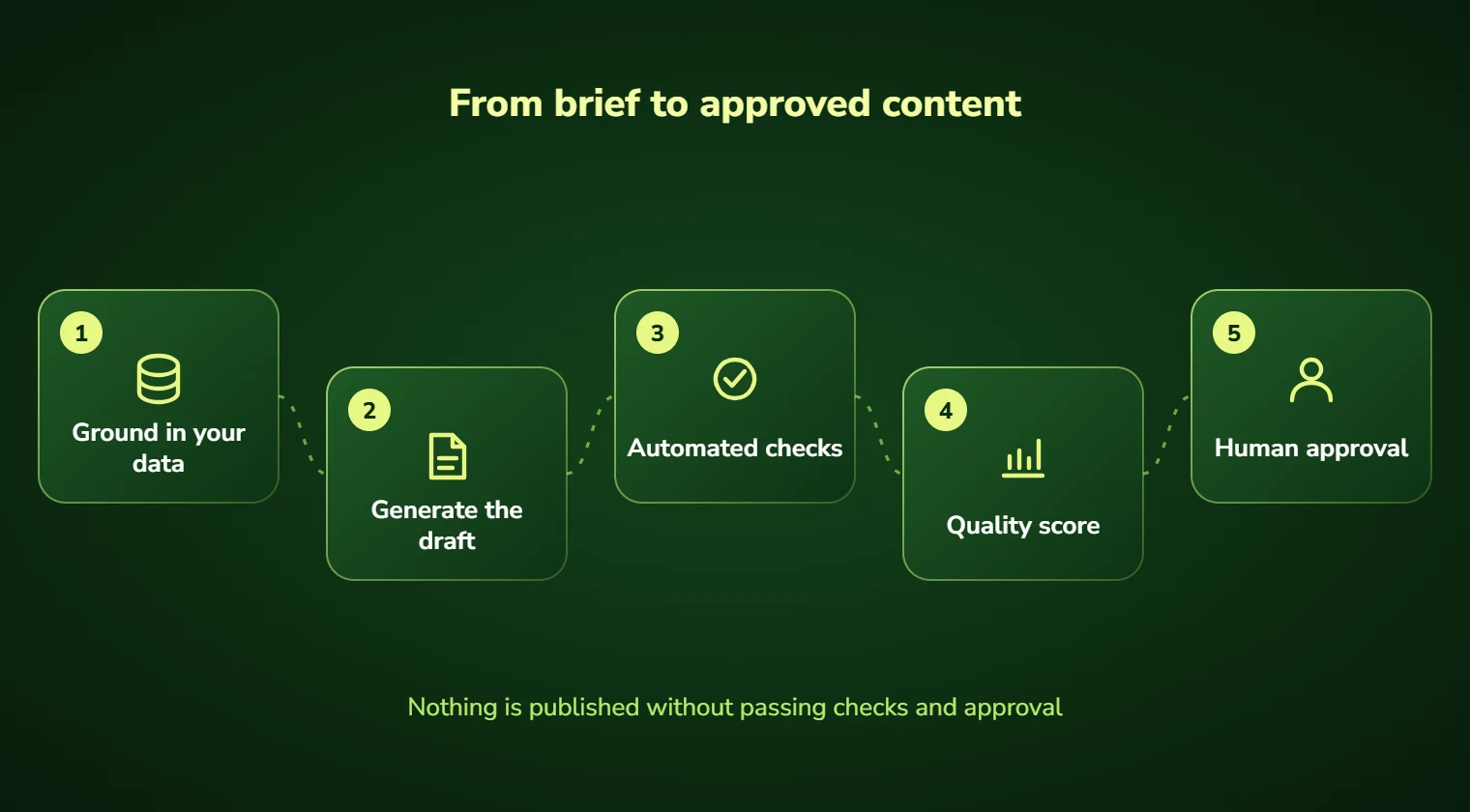
Not by default, and we would push back on it for customer-facing content. Standard design routes everything to human review with automated validation running first, so reviewers spend their time on judgement rather than catching obvious failures. Some clients later enable automatic publication for narrow low-risk categories after observing edit rates, but that is an opt-in decision per category.

Grounding. Generation draws facts from your actual product data through retrieval rather than from model knowledge, and automated validation checks generated claims against the source record. Where a fact is not available in your data, the system omits it rather than filling the gap plausibly, which is the failure mode that causes returns and complaints.

A legitimate concern with naive templated generation. We generate genuinely distinct content per item rather than substituting variables into a template, and we monitor for near-duplicate output across the corpus. The greater risk in practice is thin content rather than duplicate content, which is why grounding in real specifications matters, it produces substance rather than padding.

A generation pipeline with grounding, voice encoding, validation and review workflow typically runs $32,000 to $75,000 depending on content complexity and integration requirements. Per-item generation cost is usually a few cents. For a client with a large content backlog, payback is often measured against revenue unlocked rather than cost saved, which changes the calculation considerably.

We would advise against it, and this is one of the clearer lines. Brand-defining content, campaign concepts, homepage copy, thought leadership, benefits from human craft and judgement in ways generation does not replicate well. Generative AI earns its place on high-volume structured content: product descriptions, listings, localized variants, recurring reports. Using it for both tends to produce mediocre results on the creative half.

Service Areas

Generative AI Development across the United States

We deliver generative ai development remotely to clients nationwide, with on-site workshops available in major metros.

Ready to scope your generative AI development project?

Book a free 30-minute consultation. Bring one workflow and leave with a realistic estimate of what it would cost to automate and what it would save.

Free 30-minute consultation
Fixed-scope pilots
U.S.-based team
Custom, not off-the-shelf
SOC 2-aligned practices
ROI tracked in writing
Free 30-minute AI consultation