AI HR Automation

HR automation services built around the legal risk, not despite it

Our HR automation services focus on scheduling, onboarding, policy questions and case administration. We assess employee data, access and review requirements, with additional scrutiny for workflows that influence hiring decisions.

Free 30-minute consultation
Fixed-scope pilots
U.S.-based team
Custom, not off-the-shelf
SOC 2-aligned practices
ROI tracked in writing
What is HR automation?

HR automation applies AI and workflow technology to human resources processes: answering employee policy questions, coordinating onboarding, processing documentation, managing cases and supporting recruitment. In hiring contexts specifically, automated decision tools are subject to regulation in several U.S. jurisdictions, which shapes how they may lawfully be built and used.

7+
Years building AI systems
240+
Projects delivered
4.8
Avg. months to payback
38
U.S. states served
The Problem

HR spends its time on administration and its risk budget on hiring

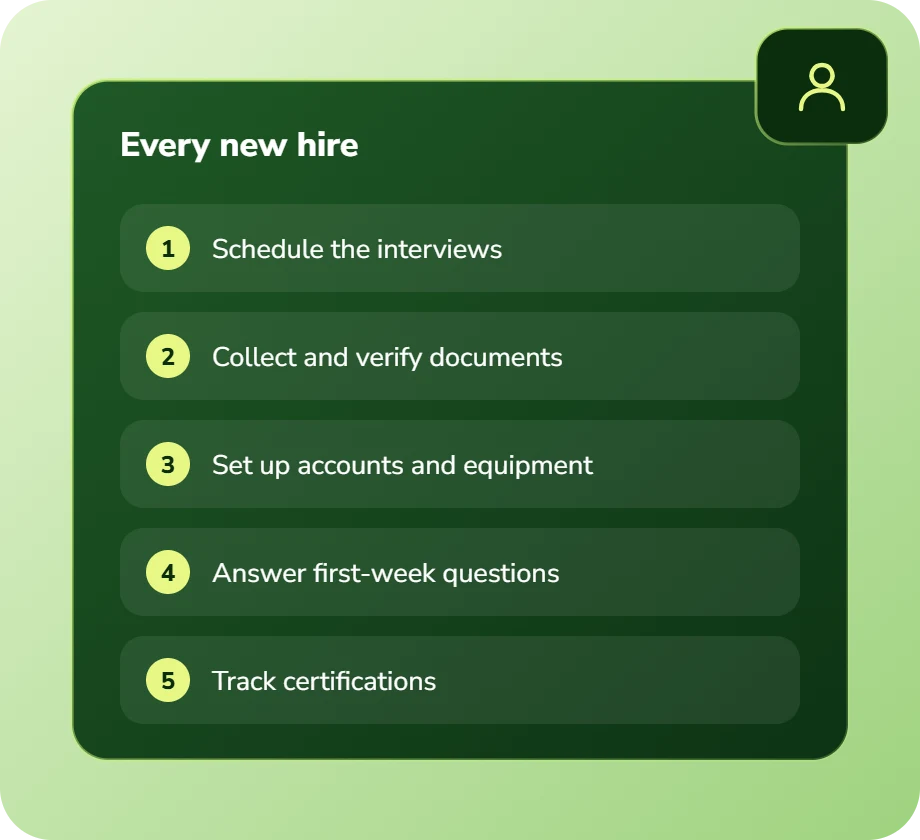
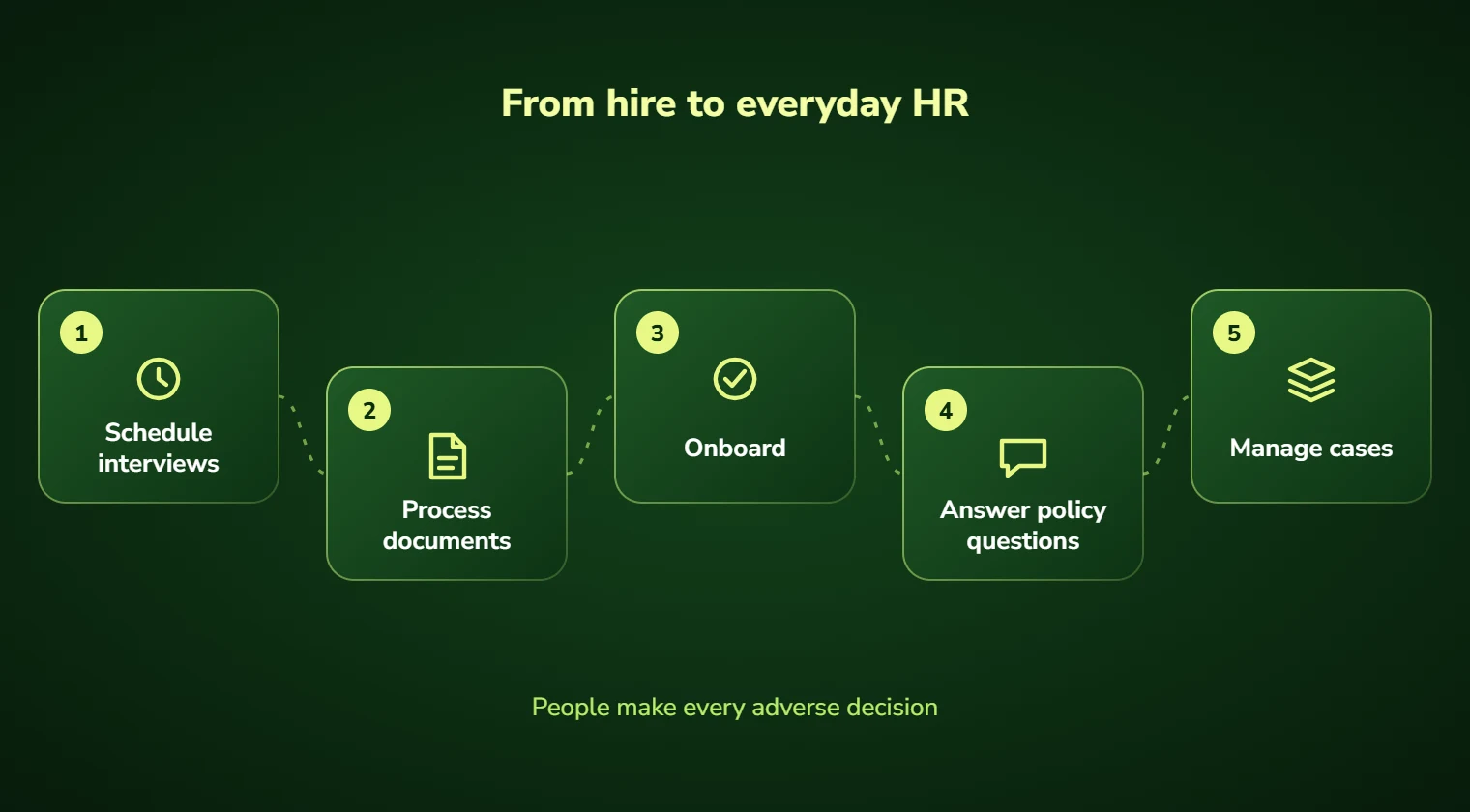
HR teams field the same policy questions repeatedly, coordinate onboarding across three departments by checklist, and process documentation by hand, work that consumes the capacity needed for the parts of HR that genuinely require judgement.

Meanwhile the area where AI is most heavily marketed to HR, resume screening, is the area carrying the most legal exposure. Several jurisdictions now regulate automated employment decision tools directly.

Our Approach

Automate the administration, be careful with the decisions

The large, safe wins are administrative: policy answering, onboarding coordination, document processing and case routing. These carry low risk and remove most of the volume.

Where hiring is in scope, we build with employment counsel involved, keep humans making every adverse decision, and design for the bias auditing and candidate notice requirements that apply in regulated jurisdictions.

Diagram of five connected workflow steps
Service Overview

HR automation services: scope and deliverables

Employee-facing support is the clearest win. A grounded assistant answering policy questions from current documentation removes a large volume of repetitive queries and gives more consistent answers than a rotating HR duty roster.

Onboarding and offboarding coordination is the second: triggering account creation, equipment, training and access changes across systems rather than relying on a checklist someone works through.

Recruitment is different. New York City requires bias audits and candidate notice for automated employment decision tools, Illinois regulates AI in video interviews, and several other states have or are developing requirements. We treat screening automation as a regulated build rather than a productivity feature.

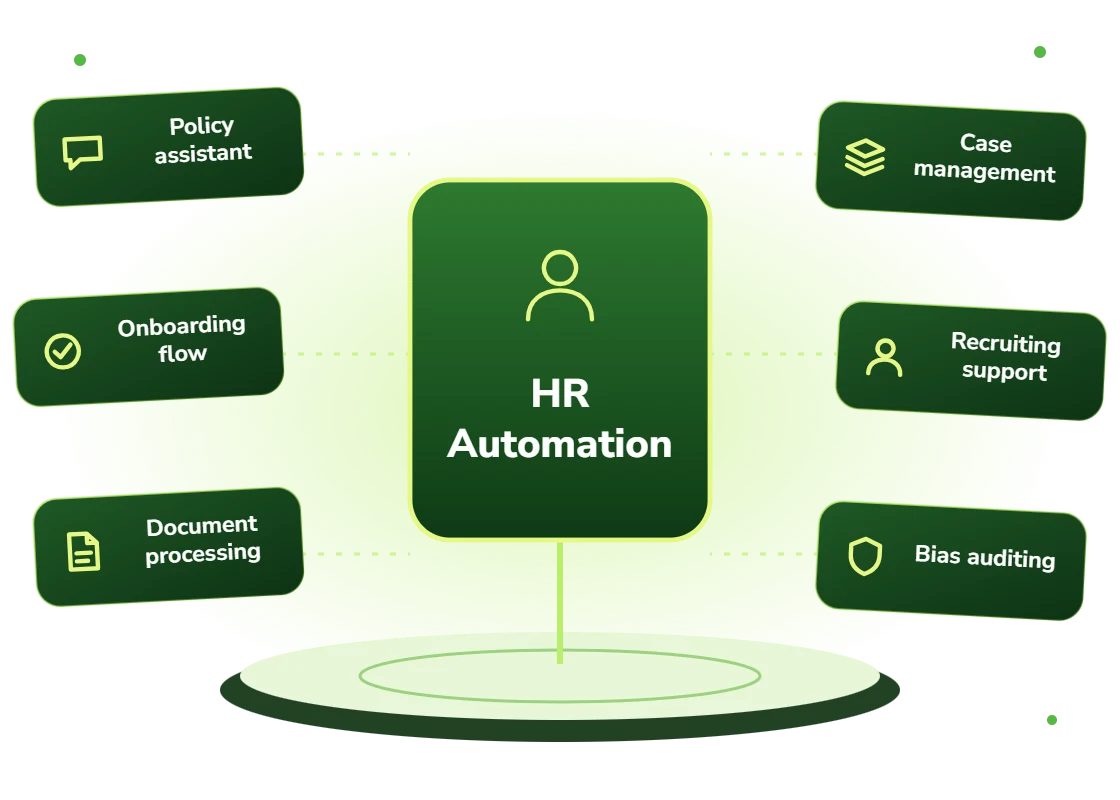
  • Employee policy assistant grounded in current HR documentation
  • Onboarding and offboarding orchestration across HR, IT and facilities
  • Document processing: forms, verifications, certifications and compliance records
  • Case management: routing, tracking and escalation of employee relations matters
  • Recruitment support with humans retained on every adverse decision
  • Bias auditing and candidate notice where jurisdictions require them
Right Fit

HR teams this suits

Teams whose administrative load prevents them doing the strategic work they are measured on. That is close to universal above a hundred employees.

And multi-state employers, where policy variation by jurisdiction makes consistent answers genuinely difficult for a small HR team to maintain.

  • HR teams fielding high volumes of repeated policy questions
  • Organizations onboarding regularly across multiple departments
  • Multi-state employers with policy variation by jurisdiction
  • Companies with heavy compliance documentation obligations
  • HR functions where administration prevents strategic work
  • Employers hiring at volume who need screening done lawfully
Benefits

Benefits of HR automation

Consistent policy answers

Grounded in current documentation, which is more reliable than whoever is on the HR duty rota that day.

Onboarding that does not drop steps

Account, equipment, training and access provisioning triggered automatically rather than worked through a checklist.

Compliance documentation kept current

Certification and verification tracking with automatic chasing before expiry rather than after.

HR capacity for actual HR

Administrative volume removed so the team can do the employee relations and development work it is measured on.

Multi-state answers handled correctly

Jurisdiction-aware policy responses, which is genuinely hard for a small team to maintain manually.

Hiring automation done lawfully

Bias auditing, candidate notice and human decision-making built in where jurisdictions require them.

Problems We Solve

Business challenges this solves

01

The same policy questions daily

HR answering identical queries repeatedly. A grounded assistant handles them consistently.

02

Onboarding steps missed

New starters without accounts on day one. Orchestration triggers every downstream task.

03

Certifications expiring unnoticed

Compliance lapses discovered during audit. Automatic tracking and chasing prevents them.

04

Policy varying by state

Different rules per jurisdiction. Jurisdiction-aware answering removes the guesswork.

05

Screening volume beyond capacity

More applications than can be reviewed. Automation helps, but must be built to the regulation.

06

Employee cases falling through

Matters untracked and unescalated. Case routing with SLA tracking closes the gap.

What's Included

Features and deliverables

Everything below is in scope on a standard engagement. Nothing here is an upsell discovered halfway through the build.

01

Policy assistant

Employee questions answered from current HR documentation with citations, jurisdiction-aware where policy varies by state.

02

Onboarding orchestration

Automated triggering of account creation, equipment, training assignment and access provisioning across systems.

03

Offboarding orchestration

Access revocation, equipment recovery, final documentation and compliance steps coordinated and tracked.

04

Document processing

Forms, I-9 documentation, certifications and verifications extracted, validated and filed with expiry tracking.

05

Case management

Employee relations matters classified, routed, tracked against SLAs and escalated where unresolved.

06

Recruitment support

Application processing and structured comparison against role requirements, with humans making every decision.

07

Bias auditing framework

Where screening automation is used, disparate impact monitoring and the audit trail required in regulated jurisdictions.

08

HRIS integration

Connection into Workday, BambooHR, ADP, Rippling or your existing HR information system.

Technology Stack

Technologies we use for HR automation

We are not tied to one vendor. Model and infrastructure choices are made on accuracy, cost per task, latency, and where your data is allowed to live.

Language Models
C
Claude (Anthropic)
G
GPT (OpenAI)
G
Gemini (Google)
L
Llama
M
Mistral
A
Azure OpenAI Service
Agent & Orchestration
M
Model Context Protocol
L
LangGraph
L
LangChain
L
LlamaIndex
T
Temporal
C
Celery
Vector & Retrieval
P
Pinecone
W
Weaviate
Q
Qdrant
p
pgvector
E
Elasticsearch
A
Amazon OpenSearch
Business Systems
S
Salesforce
H
HubSpot
N
NetSuite
M
Microsoft 365
S
Slack
Z
Zapier / Make
How We Work

Our AI development process

The same five stages on every engagement, so you always know what happens next and what you get at the end of it.

01

Discovery

We interview the people doing the work, map the workflow end to end, and audit the systems and data behind it.

02

AI Strategy

Every opportunity gets scored on cost to build, time to value, and annual savings, then ranked.

03

Pilot Build

We ship the top-ranked automation as a fixed-scope pilot so you see real output before committing further budget.

04

Implementation

Integration with your live systems, staff training, human-in-the-loop review gates, and a documented rollback path.

05

Optimization

Monthly accuracy reviews, prompt and retrieval tuning, and a written report on hours and dollars saved.

Timeline

How long it takes

A typical first engagement, week by week. Complex integrations and regulated environments extend this, and we say so during discovery rather than after.

Weeks 1 to 2

Discovery and scoping

Process observation, systems audit, data review, and a written estimate of cost and expected saving before anything is built.

Week 3

Design sign-off

Architecture, data handling rules, review thresholds and success measures agreed in writing.

Weeks 4 to 7

Build and integration

Development against your real data, connected to your live systems, with weekly demos rather than a single reveal.

Week 8

Parallel run and testing

The system runs alongside the existing process so accuracy can be compared directly before anyone depends on it.

Weeks 9 to 10

Launch and handover

Cutover with a rollback path, staff training, full documentation, then 30 days of included tuning.

Who We Work With

Industries we deliver HR automation for

Professional Services

Proposal drafting, timesheet capture, research synthesis, and client reporting at scale.

Healthcare

Intake, prior authorization, clinical documentation, and revenue-cycle workflows built to respect HIPAA boundaries.

Manufacturing

Quality inspection, maintenance prediction, supplier communication, and production scheduling.

Retail & E-commerce

Product data enrichment, demand forecasting, support deflection, and personalized merchandising.

Logistics & Supply Chain

Document processing, carrier communication, exception handling, and inventory rebalancing.

Financial Services

Document extraction, reconciliation, KYC support, and audit-ready reporting with full traceability.

Education

Enrollment support, content generation, tutoring assistants, and administrative automation.

Construction

Bid takeoffs, submittal review, RFI drafting, and field-report summarization.

Use Cases

Real-world use cases

01

Employee policy self-service

Leave, benefits and procedure questions answered instantly from current policy with jurisdiction awareness.

02

New starter onboarding

A signed offer triggering every downstream task across HR, IT and facilities automatically.

03

Certification compliance

Licences and certifications tracked with automatic chasing well before expiry.

04

Employee case routing

Relations matters classified by type and sensitivity, routed to the right person with escalation timers.

05

High-volume application processing

Applications processed and structured for human reviewers, with bias auditing where required.

06

Multi-state policy management

Jurisdiction-specific answers maintained centrally rather than in a spreadsheet someone updates occasionally.

Why DevSolutionsAI

Why choose DevSolutionsAI for HR automation

Business case before build

Every recommendation carries an estimated cost, timeline, and annual savings figure. If the math does not work, we say so before you spend.

Vendor-neutral by design

We resell nothing and take no platform commissions. Model and infrastructure choices are made on fit, cost, and your data-residency rules.

Fixed-scope pilots

The first engagement is a defined deliverable at a defined price, not an open-ended retainer that quietly grows each quarter.

Built for handover

You own the code, the prompts, the infrastructure, and the documentation. No lock-in to a proprietary wrapper you cannot leave.

Human-in-the-loop where it counts

Anything customer-facing, clinical, financial, or legal gets a review gate, a confidence threshold, and a logged audit trail.

Security reviewed early

Data flow diagrams, retention rules, and access boundaries are agreed in week one, not retrofitted after your security team objects.

Get Started

Find out what HR automation would cost you, before you commit to anything

Every engagement is quoted after a short discovery, so you get a fixed written price built around your actual volumes rather than a rate card that assumes someone else’s business.

The first call is thirty minutes and free. Bring one workflow. We will tell you what it is likely costing you each year, roughly what automating it would take, and whether we think it is worth doing at all.

  • A written savings estimate before any paid work
  • Fixed scope and fixed price, agreed up front
  • Full ownership of everything we build for you
  • An honest recommendation when the numbers do not work
What clients typically see
Across recent projects
Staff hours saved each week
31
Months to payback
4.8
Client retention
94%
Response to enquiries
4 hrs

Figures are internal measurements across recent engagements, reported to every client monthly in writing.

Illustrative project scenario

Illustrative project scenario

Multi-state healthcare employer · 3,100 staff

Handling 71% of HR queries without touching hiring decisions

Challenge. An HR team of nine supported 3,100 staff across eleven states. Policy questions consumed most of their week, and answers varied by state in ways individual HR staff could not reliably remember. Onboarding regularly missed steps, with new clinical staff occasionally lacking system access on day one.

What we built. A policy assistant grounded in current HR documentation with jurisdiction-aware answering, onboarding orchestration triggering provisioning across HR, IT, credentialing and facilities, and certification expiry tracking with automatic chasing. Recruitment was explicitly excluded from scope at the client’s and our recommendation.

Outcome. 71% of employee policy queries are now resolved without HR involvement, with jurisdiction-correct answers. Day-one access failures fell to near zero. The HR team redirected capacity to employee relations and retention work. No hiring decision is automated in any form.

71%
Policy queries self-served
11
States handled correctly
~0
Day-one access failures
0
Automated hiring decisions

Illustrative project scenario. The figures demonstrate how a project could be scoped and evaluated; they are not verified client results or an audited average.

Client Feedback

What clients say about working with us

31
Avg. staff hours saved weekly
4.8
Avg. months to payback
94%
Client retention
4
Hour response to enquiries
Common Questions

HR Automation FAQs

It depends on jurisdiction and how it is used, and this is genuinely an area where you need employment counsel rather than a vendor’s assurance. New York City Local Law 144 requires annual bias audits and candidate notice for automated employment decision tools. Illinois regulates AI analysis of video interviews. Several other states have enacted or are developing requirements. We build screening support only with your counsel involved, with humans making every adverse decision, and with the auditing and notice mechanisms the applicable rules require.

Policy question answering, onboarding and offboarding orchestration, document processing and certification tracking all carry low legal exposure and remove most of the administrative volume. These are where we recommend starting, and for many HR teams they deliver the large majority of the available benefit without touching the regulated area at all.

Jurisdiction awareness is built into retrieval, so an employee in California gets the California answer and one in Texas gets the Texas answer. Maintaining that consistently is genuinely difficult for a small HR team across many states, and it is one of the more valuable parts of these engagements for multi-state employers.

For factual policy questions, generally yes, and they often prefer it, asking an assistant about leave entitlement avoids the mild awkwardness of asking a person. For anything sensitive, the assistant should and does route immediately to a human. We design the boundaries carefully so it never attempts to handle employee relations matters conversationally.

Yes, Workday, BambooHR, ADP, Rippling, Paylocity and most others through their APIs. We build into your existing system rather than replacing it, and onboarding orchestration typically also connects to IT provisioning, learning management and facilities systems.
A policy assistant with onboarding orchestration typically runs $28,000 to $55,000. Adding document processing, case management and certification tracking increases that. Where recruitment is in scope, the compliance and auditing requirements add meaningfully to both cost and timeline, which is one reason we recommend starting elsewhere.

Service Areas

HR Automation across the United States

We deliver hr automation remotely to clients nationwide, with on-site workshops available in major metros.

Ready to scope your HR automation project?

Book a free 30-minute consultation. Bring one workflow and leave with a realistic estimate of what it would cost to automate and what it would save.

Free 30-minute consultation
Fixed-scope pilots
U.S.-based team
Custom, not off-the-shelf
SOC 2-aligned practices
ROI tracked in writing
Free 30-minute AI consultation