Legal AI solutions with source verification and review
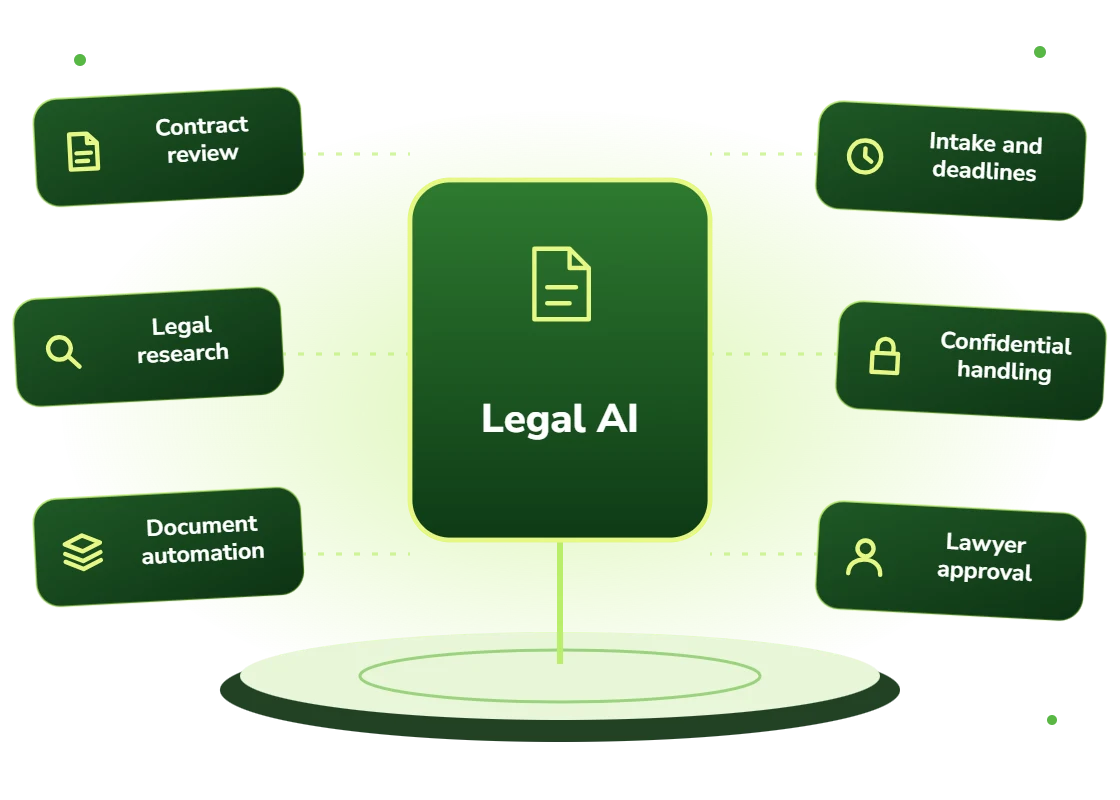
Our legal AI solutions support contract triage, matter intake and document review. We design confidentiality controls, source verification and lawyer oversight so outputs can be checked before use.
Legal AI solutions apply language models to legal work: reviewing contracts for specific terms, triaging discovery documents by relevance, drafting from precedent, and answering questions from a firm’s own document repository. Responsible implementations verify every citation against authoritative sources and retain attorney review on all substantive output.
The failure mode in legal AI is public and career-damaging
Courts across the United States have sanctioned attorneys for filings containing citations to cases that do not exist. The models generated plausible case names, reporters and holdings, and nobody checked.
The underlying problem is not that models hallucinate. It is that legal AI is frequently deployed without a verification layer, on the assumption that the attorney will catch it.
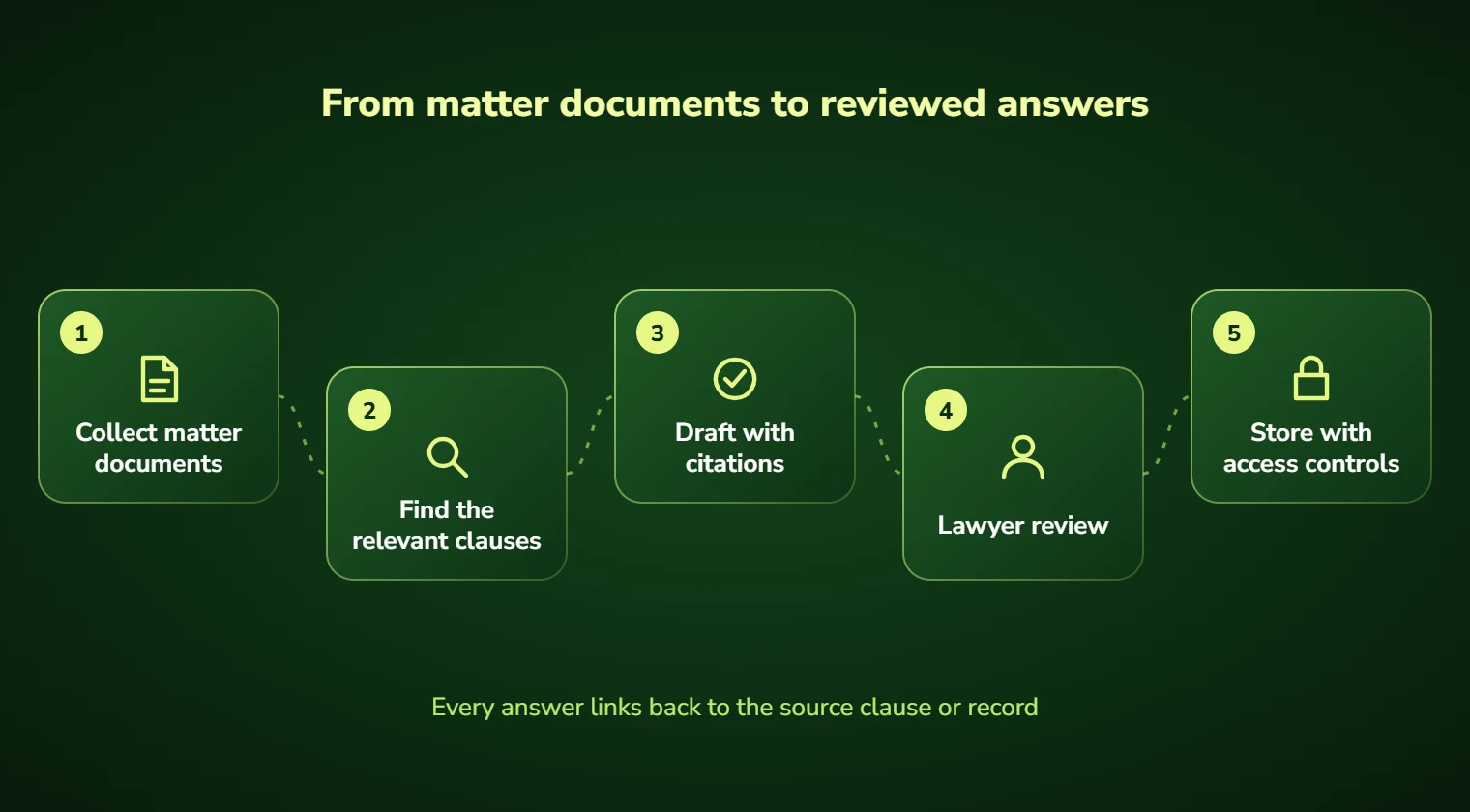
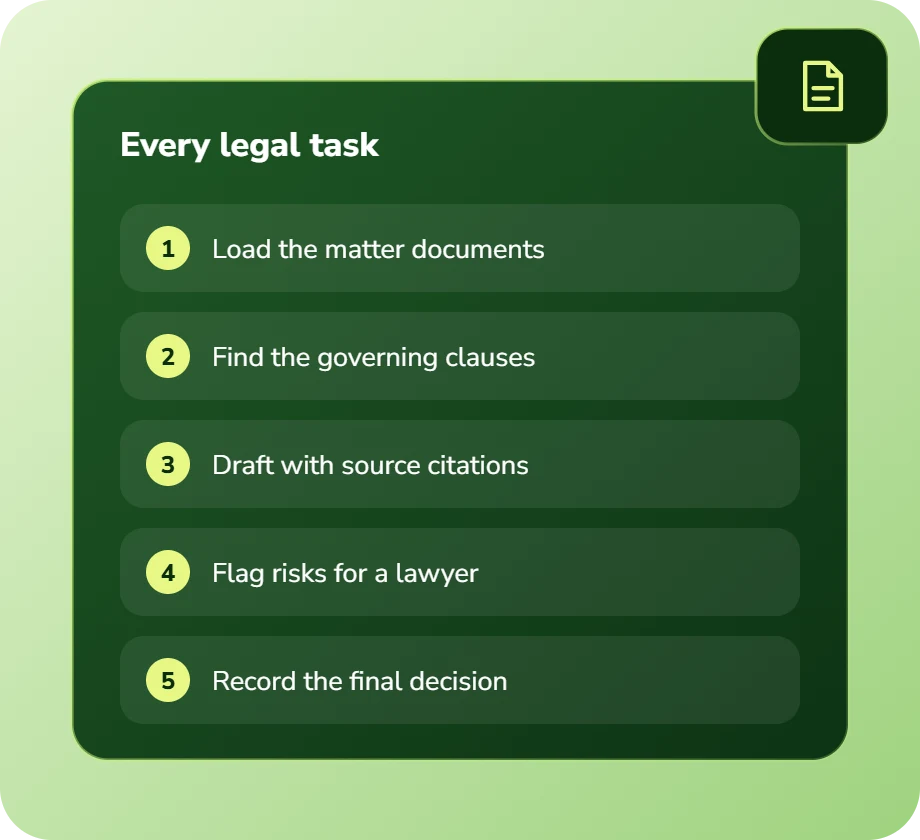
Verify every citation, cite every claim
Any citation the system produces is checked against an authoritative source before it appears. Unverifiable citations are removed and flagged rather than presented with a caveat.
Every substantive statement links to the source passage it came from, so verification takes seconds. And attorney review is retained on everything, because it should be.
Legal AI solutions: scope and deliverables
Contract review is the clearest application: extracting specific terms across a portfolio, identifying non-standard clauses, and flagging deviations from your playbook. The output is checkable against a source document, which is exactly the property legal work requires.
Discovery triage is the second. Ranking documents by likely relevance so review effort is directed rather than sequential, with the sampling and validation protocols that make the process defensible.
Matter intake, conflict checking and document retrieval round it out. What these share is that outputs are verifiable against a source; that is the property that makes an application suitable rather than dangerous.
- Contract review: term extraction, playbook deviation, obligation mapping
- Discovery triage with relevance ranking and defensible sampling
- Matter document retrieval with citation to the source page
- Drafting from firm precedent with every source identified
- Conflict checking with semantic matching beyond exact name comparison
- Citation verification against authoritative sources before anything is presented
Firms and legal teams this suits
Firms with substantial document volume where review effort is the constraint: contract portfolios, discovery, due diligence.
And in-house legal teams whose contract volume exceeds their capacity, where the alternative is either external counsel cost or contracts going unreviewed.
- Firms reviewing large contract portfolios or conducting due diligence
- Litigation practices with substantial document review volume
- In-house teams whose contract volume exceeds review capacity
- Firms with large precedent libraries nobody can search effectively
- Practices where associates spend heavily on document location
- Legal departments needing consistent playbook application at volume
Benefits of legal AI solutions
Citations that exist
Verification against authoritative sources before anything is presented, which is the difference between useful and career-ending.
Review effort directed
Relevance ranking so attention goes to the documents that matter rather than through the pile in order.
Consistent playbook application
The same standards applied to contract 400 as to contract 1, regardless of who is reviewing.
Precedent actually findable
Semantic search across the firm’s own work product, which keyword search over a document management system does not deliver.
Confidentiality preserved
Deployment inside your own environment so privileged material never reaches a third-party provider.
Attorney judgement retained
Every substantive output reviewed by an attorney, with sources linked so verification is fast rather than nominal.
Business challenges this solves
Fabricated citations
Plausible cases that do not exist. Verification against authoritative sources before presentation.
Contract review capacity
Volume exceeding what the team can review. Extraction and deviation flagging directs the effort.
Discovery cost
Sequential review of enormous document sets. Relevance ranking with defensible protocols.
Precedent nobody can find
Prior work product effectively lost in the DMS. Semantic search over the firm’s own material.
Confidentiality ruling out AI tools
Privileged material that cannot leave the firm. Private deployment resolves it.
Inconsistent review standards
Different reviewers applying different thresholds. Systematic extraction applies one standard.
Features and deliverables
Everything below is in scope on a standard engagement. Nothing here is an upsell discovered halfway through the build.
Citation verification
Every citation checked against an authoritative source; unverifiable citations removed and flagged rather than caveated.
Contract term extraction
Specific terms, obligations, dates and thresholds extracted across a portfolio with links to the source clause.
Playbook deviation flagging
Comparison against your standard positions with deviations identified and categorized by materiality.
Discovery relevance ranking
Documents ranked by likely relevance with sampling and validation protocols that support defensibility.
Precedent search
Semantic search across the firm’s own work product, matters and templates with source citation.
Conflict checking
Semantic matching across client, matter and party records to surface conflicts exact name matching misses.
Private deployment
Deployment inside your own environment or with zero-retention arrangements so privileged material stays privileged.
Attorney review workflow
Every substantive output routed for attorney review with sources linked for rapid verification.
Technologies we use for legal AI solutions
We are not tied to one vendor. Model and infrastructure choices are made on accuracy, cost per task, latency, and where your data is allowed to live.
Our AI development process
The same five stages on every engagement, so you always know what happens next and what you get at the end of it.
Discovery
We interview the people doing the work, map the workflow end to end, and audit the systems and data behind it.
AI Strategy
Every opportunity gets scored on cost to build, time to value, and annual savings, then ranked.
Pilot Build
We ship the top-ranked automation as a fixed-scope pilot so you see real output before committing further budget.
Implementation
Integration with your live systems, staff training, human-in-the-loop review gates, and a documented rollback path.
Optimization
Monthly accuracy reviews, prompt and retrieval tuning, and a written report on hours and dollars saved.
How long it takes
A typical first engagement, week by week. Complex integrations and regulated environments extend this, and we say so during discovery rather than after.
Discovery and scoping
Process observation, systems audit, data review, and a written estimate of cost and expected saving before anything is built.
Design sign-off
Architecture, data handling rules, review thresholds and success measures agreed in writing.
Build and integration
Development against your real data, connected to your live systems, with weekly demos rather than a single reveal.
Parallel run and testing
The system runs alongside the existing process so accuracy can be compared directly before anyone depends on it.
Launch and handover
Cutover with a rollback path, staff training, full documentation, then 30 days of included tuning.
Industries we deliver legal AI solutions for
Legal
Contract review, discovery triage, and matter intake with citation-checked outputs and attorney sign-off gates.
Financial Services
Document extraction, reconciliation, KYC support, and audit-ready reporting with full traceability.
Insurance
First-notice-of-loss intake, claims triage, policy Q&A, and fraud signal detection.
Real Estate
Lead qualification, listing content, transaction coordination, and 24/7 inquiry response.
Professional Services
Proposal drafting, timesheet capture, research synthesis, and client reporting at scale.
Healthcare
Intake, prior authorization, clinical documentation, and revenue-cycle workflows built to respect HIPAA boundaries.
Construction
Bid takeoffs, submittal review, RFI drafting, and field-report summarization.
Manufacturing
Quality inspection, maintenance prediction, supplier communication, and production scheduling.
Real-world use cases
Contract portfolio review
Extracting renewal dates, liability caps, assignment and change-of-control terms across thousands of agreements.
Due diligence
Transaction document review with issues surfaced and categorized rather than found by sequential reading.
Discovery triage
Relevance ranking directing review effort, with sampling protocols supporting the defensibility of the process.
Matter document retrieval
Attorneys locating documents and prior positions by natural-language query rather than folder navigation.
Contract drafting support
First drafts assembled from firm precedent with every source clause identified for review.
Regulatory comparison
Client policies compared against regulation to identify gaps, with citations to both sides.
Why choose DevSolutionsAI for legal AI solutions
Business case before build
Every recommendation carries an estimated cost, timeline, and annual savings figure. If the math does not work, we say so before you spend.
Vendor-neutral by design
We resell nothing and take no platform commissions. Model and infrastructure choices are made on fit, cost, and your data-residency rules.
Fixed-scope pilots
The first engagement is a defined deliverable at a defined price, not an open-ended retainer that quietly grows each quarter.
Built for handover
You own the code, the prompts, the infrastructure, and the documentation. No lock-in to a proprietary wrapper you cannot leave.
Human-in-the-loop where it counts
Anything customer-facing, clinical, financial, or legal gets a review gate, a confidence threshold, and a logged audit trail.
Security reviewed early
Data flow diagrams, retention rules, and access boundaries are agreed in week one, not retrofitted after your security team objects.
Find out what legal AI solutions would cost you, before you commit to anything
Every engagement is quoted after a short discovery, so you get a fixed written price built around your actual volumes rather than a rate card that assumes someone else’s business.
The first call is thirty minutes and free. Bring one workflow. We will tell you what it is likely costing you each year, roughly what automating it would take, and whether we think it is worth doing at all.
- A written savings estimate before any paid work
- Fixed scope and fixed price, agreed up front
- Full ownership of everything we build for you
- An honest recommendation when the numbers do not work
Figures are internal measurements across recent engagements, reported to every client monthly in writing.
Illustrative project scenario
Extracting change-of-control terms across a portfolio in nine days
Challenge. A firm’s client faced an acquisition requiring review of roughly 14,000 supplier and customer agreements for change-of-control, assignment and consent provisions. Manual review was estimated at several months of associate time against a transaction timeline that did not allow it.
What we built. Extraction of the relevant provisions across the portfolio with every finding linked to the specific clause and page. Non-standard formulations flagged for attorney attention rather than categorized automatically. Deployment ran inside the firm’s own environment so no client material left it. Sampling validation on 600 agreements confirmed extraction accuracy before the results were relied upon.
Outcome. The portfolio was processed in nine days. Validation sampling showed 96% extraction accuracy on the target provisions, with the residual concentrated in unusual drafting that had been flagged for attorney review anyway. Associate time went to the flagged agreements rather than to reading all 14,000.
Illustrative project scenario. The figures demonstrate how a project could be scoped and evaluated; they are not verified client results or an audited average.
What clients say about working with us
Legal AI Solutions FAQs
How do you prevent fabricated citations?
Every citation the system produces is verified against an authoritative source before it appears in any output. Citations that cannot be verified are removed and flagged rather than presented with a warning, because a warning relies on someone reading it. This is a build requirement rather than a feature, and we will not deliver legal research or drafting tooling without it.
Is client confidential material safe?
It is when deployment is designed for it. Systems can run entirely inside your own environment so privileged material never reaches a third-party provider, or use zero-retention arrangements where that is acceptable to you. We document the data flow for your general counsel or risk committee, and for many firms private deployment is the only arrangement that satisfies their professional obligations.
Can AI replace associate document review?
It can direct it rather than replace it. Relevance ranking means review effort goes to the documents most likely to matter rather than through the set sequentially, and extraction handles the mechanical identification of specific terms. Attorneys still review, and on the recent portfolio engagement the accuracy validation itself required attorney sampling to be defensible.
Is using AI in discovery defensible?
Technology-assisted review has an established acceptance history in U.S. courts, but defensibility depends on the process rather than the technology, documented protocols, statistical validation sampling, and transparency about methodology. We build those protocols in and produce the documentation, though whether a particular approach is defensible in your matter is a judgement for counsel rather than for us.

What does legal AI cost?
A contract review implementation typically runs $35,000 to $80,000 depending on document volume, the complexity of the terms being extracted and whether private deployment is required. Precedent search over a firm’s own repository generally runs $30,000 to $60,000. Private deployment adds infrastructure cost but is frequently non-negotiable for firms.
Which applications do you recommend starting with?
Contract term extraction and precedent retrieval, because outputs are directly verifiable against a source document, risk is low, and the return is immediate. We would avoid starting with legal research or drafting, where the verification requirements are heavier and the downside of getting it wrong is considerably worse.
Services that pair well with this one
Most clients combine two or three of these. We will tell you the right sequence during discovery.
Ready to scope your legal AI solutions project?
Book a free 30-minute consultation. Bring one workflow and leave with a realistic estimate of what it would cost to automate and what it would save.