LLM development services, including the part where we tell you not to fine-tune
Our LLM development services assess whether a task needs better prompting, retrieval, fine-tuning or a different deployment. Evaluation comes first so model decisions reflect measured requirements.
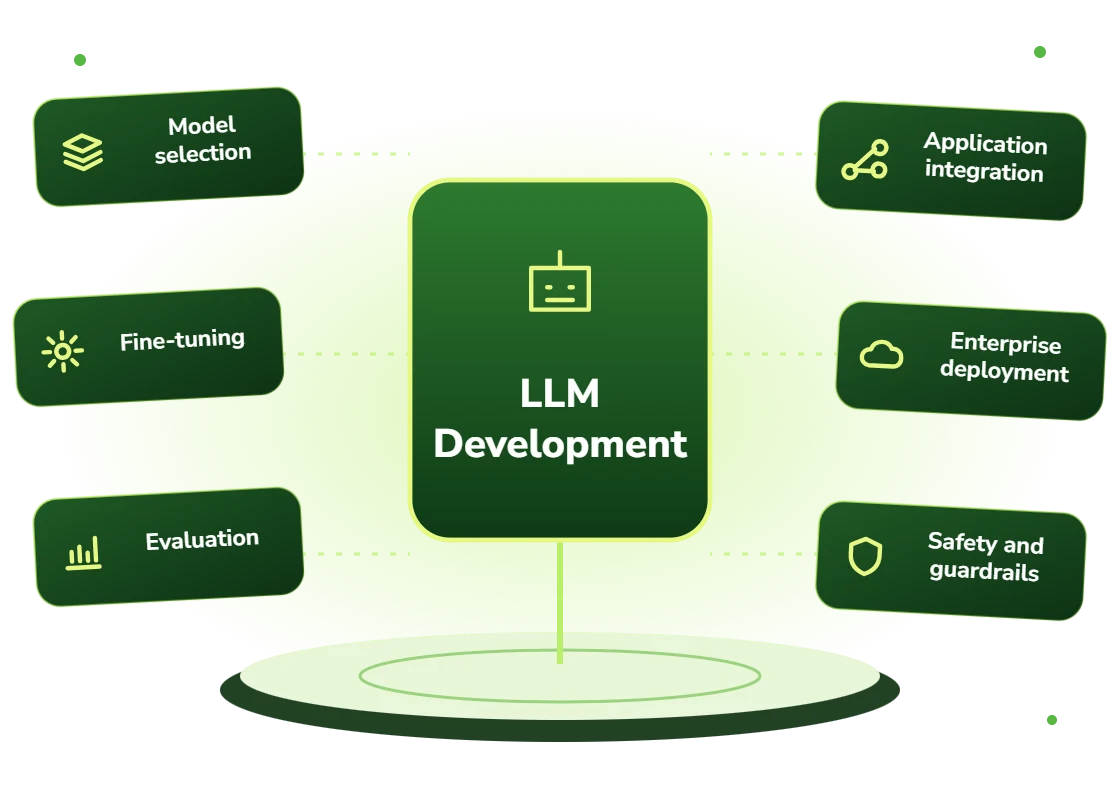
LLM development covers building production systems around large language models: prompt engineering, retrieval integration, evaluation harnesses, fine-tuning where justified, and deployment of open-weight models on private infrastructure. In most business cases, retrieval and prompt engineering deliver more improvement than fine-tuning, at far lower cost.
Fine-tuning as the answer to a question nobody measured
Teams frequently arrive certain they need a custom model. The reasoning is usually that a general model does not know their business, which is true and almost never solved by fine-tuning.
Fine-tuning teaches format, style and narrow task behaviour. It is a poor and expensive way to teach facts, because updating a fact means another training run and the model still cannot cite a source.
Measure first, then choose the cheapest thing that works
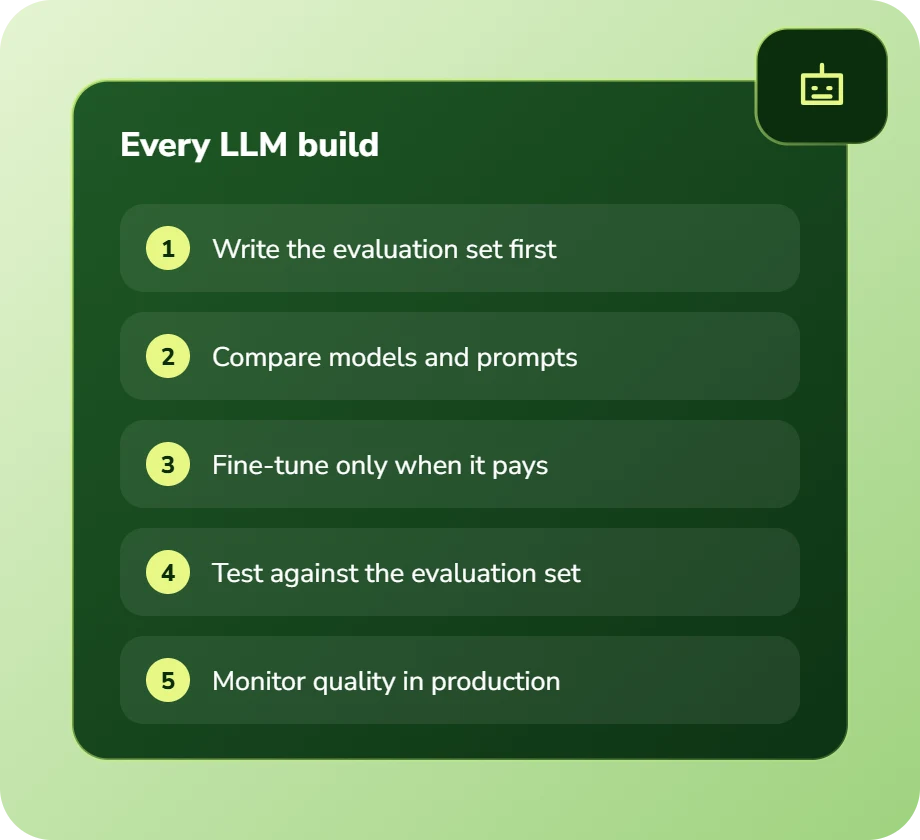
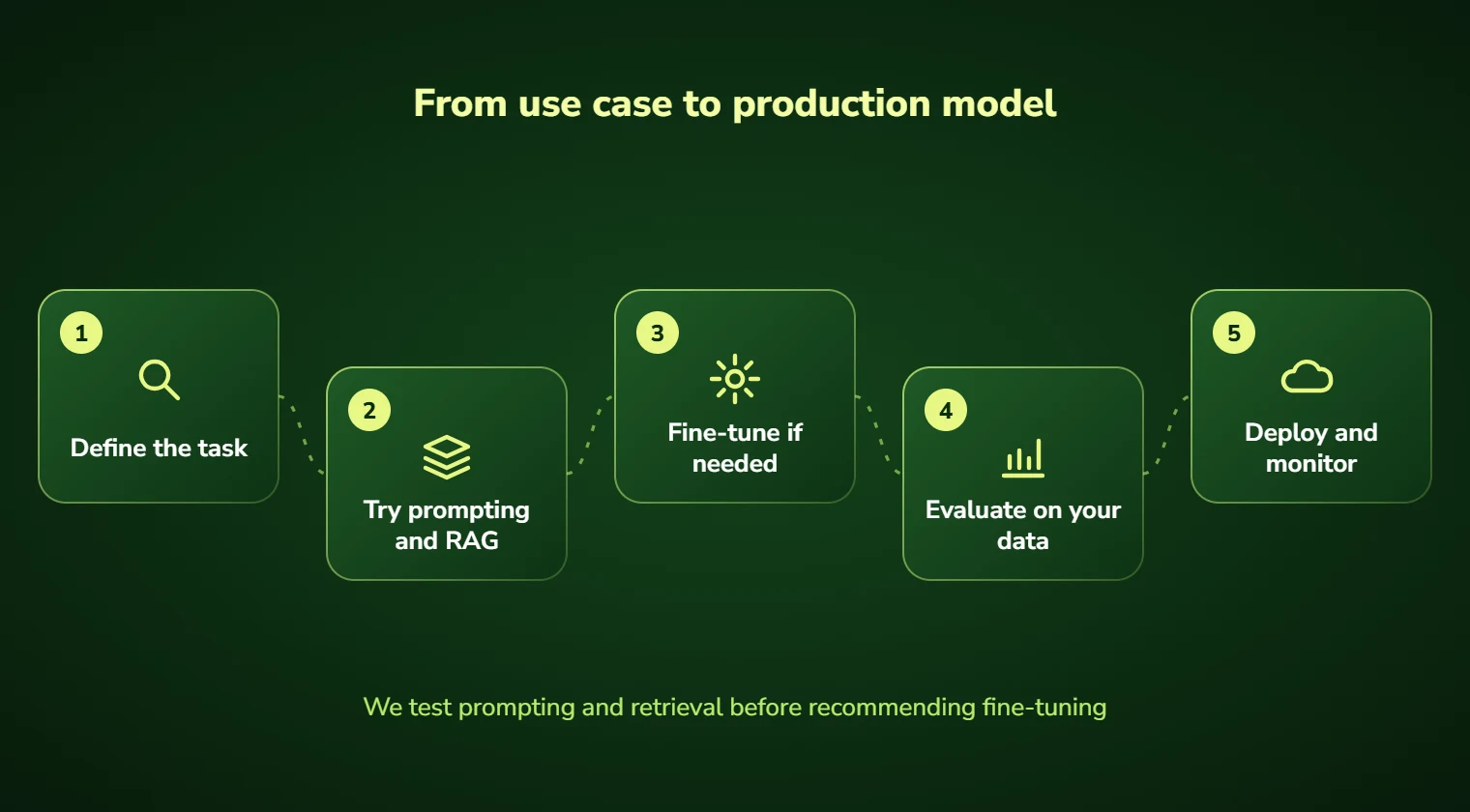
We build an evaluation set from your real cases, establish a baseline with careful prompting, then measure what retrieval adds. Only if a measured gap remains do we consider fine-tuning.
That order saves most clients the cost of a training pipeline entirely. When fine-tuning genuinely is warranted, specialized formats, domain vocabulary, latency-critical small models, we then have the evaluation infrastructure to prove it helped.
LLM development services: scope and deliverables
Prompt engineering, done systematically rather than by iteration in a playground: structured prompts, version control, and regression testing so a change that helps one case does not silently break five others.
Retrieval integration, which is how you give a model knowledge it can cite and you can update instantly.
Evaluation, which is the discipline that makes the rest measurable. Without it, LLM development is people disagreeing about outputs.
And where genuinely justified: fine-tuning, or deploying open-weight models on your own infrastructure for cost, latency or data residency reasons.
- Evaluation harness construction from your real cases and known-good outputs
- Systematic prompt engineering with versioning and regression testing
- Retrieval integration for knowledge that must be current and citable
- Fine-tuning where measurement shows a gap prompting cannot close
- Open-weight model deployment on your own infrastructure
- Inference optimization: quantization, batching, serving and cost tuning
When LLM development work is warranted
Teams whose output quality is not good enough and who do not know why. The evaluation work alone usually identifies the cause, which is more often retrieval or prompting than model capability.
And teams with genuine constraints that commercial APIs cannot meet: data that cannot leave their infrastructure, volume where API pricing exceeds self-hosting, or latency requirements a network round trip cannot satisfy.
- Teams whose LLM output quality is inconsistent and undiagnosed
- Organizations that cannot send data to a commercial API provider
- High-volume workloads where API costs exceed self-hosting economics
- Applications needing latency below what a network round trip allows
- Domains with vocabulary or formats general models handle poorly
- Teams shipping prompt changes with no way to detect regressions
Benefits of LLM development
Diagnosis before spend
Evaluation identifies whether your problem is prompting, retrieval or model capability, before anyone buys GPU time.
Regression safety
A test suite means a prompt change that fixes one case cannot silently break five others.
Self-hosting where it pays
At sufficient volume, open-weight models on your own hardware are dramatically cheaper than API pricing.
Data that never leaves
Fully private deployment for workloads where no commercial API is acceptable under your obligations.
Fine-tuning that is justified
Training only where measurement shows a gap prompting and retrieval cannot close, with proof it helped.
Portability preserved
Architecture that keeps you able to change models, rather than a fine-tune that locks in today’s choice.
Business challenges this solves
Quality problems with no diagnosis
Output that is not good enough for unclear reasons. Evaluation isolates the actual cause.
Prompt changes breaking other cases
Fixing one thing and breaking another silently. Regression suites catch it before deployment.
API costs exceeding self-hosting
High-volume workloads where owning inference is cheaper. We model the crossover point honestly.
Data that cannot leave the building
Obligations ruling out commercial APIs. Open-weight models deployed inside your boundary.
Latency budgets a round trip breaks
Applications needing sub-100ms responses. Local inference on small models can meet it.
Fine-tuning proposed without evidence
Expensive training as a first resort. Measurement usually shows cheaper options work.
Features and deliverables
Everything below is in scope on a standard engagement. Nothing here is an upsell discovered halfway through the build.
Evaluation harness
Test sets built from your real cases with known-good outputs, scoring every change and preventing regressions.
Systematic prompt engineering
Version-controlled prompts, structured techniques, and measured comparison rather than playground iteration.
Retrieval integration
Grounding in your own content, which for factual knowledge outperforms fine-tuning on cost, freshness and citability.
Fine-tuning pipeline
Dataset preparation, training, evaluation and versioning where measurement justifies it, typically for format, style or narrow tasks.
Open-weight deployment
Llama, Mistral and similar models deployed on your infrastructure with serving, scaling and monitoring.
Inference optimization
Quantization, batching, caching and serving configuration to cut latency and cost on self-hosted models.
Model comparison
Candidate models benchmarked on your tasks with cost, latency and quality reported together rather than separately.
Guardrails and safety
Input filtering, output validation, prompt-injection defences and refusal behaviour appropriate to your risk profile.
Technologies we use for LLM development
We are not tied to one vendor. Model and infrastructure choices are made on accuracy, cost per task, latency, and where your data is allowed to live.
Our AI development process
The same five stages on every engagement, so you always know what happens next and what you get at the end of it.
Discovery
We interview the people doing the work, map the workflow end to end, and audit the systems and data behind it.
AI Strategy
Every opportunity gets scored on cost to build, time to value, and annual savings, then ranked.
Pilot Build
We ship the top-ranked automation as a fixed-scope pilot so you see real output before committing further budget.
Implementation
Integration with your live systems, staff training, human-in-the-loop review gates, and a documented rollback path.
Optimization
Monthly accuracy reviews, prompt and retrieval tuning, and a written report on hours and dollars saved.
How long it takes
A typical first engagement, week by week. Complex integrations and regulated environments extend this, and we say so during discovery rather than after.
Evaluation and baseline
Test set built from real cases, baseline measured with careful prompting alone.
Retrieval assessment
What grounding adds, measured against the same set, before considering training.
Decision point
A written recommendation on whether fine-tuning or self-hosting is justified by the measured gap.
Build
Fine-tuning pipeline or self-hosted deployment implemented, depending on the decision.
Optimization and handover
Inference tuning, monitoring, documentation and enablement for your engineers.
Industries we deliver LLM development for
SaaS & Technology
AI features inside your product, support deflection, onboarding assistants, and usage analytics.
Healthcare
Intake, prior authorization, clinical documentation, and revenue-cycle workflows built to respect HIPAA boundaries.
Financial Services
Document extraction, reconciliation, KYC support, and audit-ready reporting with full traceability.
Legal
Contract review, discovery triage, and matter intake with citation-checked outputs and attorney sign-off gates.
Manufacturing
Quality inspection, maintenance prediction, supplier communication, and production scheduling.
Insurance
First-notice-of-loss intake, claims triage, policy Q&A, and fraud signal detection.
Professional Services
Proposal drafting, timesheet capture, research synthesis, and client reporting at scale.
Education
Enrollment support, content generation, tutoring assistants, and administrative automation.
Real-world use cases
Private deployment for sensitive data
Open-weight models on your own infrastructure where no data may reach a commercial provider.
High-volume cost reduction
Self-hosted small models handling millions of routine requests below API pricing.
Domain vocabulary adaptation
Fine-tuning for specialized terminology and formats that general models handle inconsistently.
Structured output reliability
Training a small model to produce a specific format reliably at lower cost than a large prompted one.
Latency-critical inference
Local model serving where a network round trip exceeds the application’s latency budget.
Evaluation infrastructure
Building the measurement capability an internal team needs to develop LLM features safely.
Why choose DevSolutionsAI for LLM development
Business case before build
Every recommendation carries an estimated cost, timeline, and annual savings figure. If the math does not work, we say so before you spend.
Vendor-neutral by design
We resell nothing and take no platform commissions. Model and infrastructure choices are made on fit, cost, and your data-residency rules.
Fixed-scope pilots
The first engagement is a defined deliverable at a defined price, not an open-ended retainer that quietly grows each quarter.
Built for handover
You own the code, the prompts, the infrastructure, and the documentation. No lock-in to a proprietary wrapper you cannot leave.
Human-in-the-loop where it counts
Anything customer-facing, clinical, financial, or legal gets a review gate, a confidence threshold, and a logged audit trail.
Security reviewed early
Data flow diagrams, retention rules, and access boundaries are agreed in week one, not retrofitted after your security team objects.
Find out what LLM development would cost you, before you commit to anything
Every engagement is quoted after a short discovery, so you get a fixed written price built around your actual volumes rather than a rate card that assumes someone else’s business.
The first call is thirty minutes and free. Bring one workflow. We will tell you what it is likely costing you each year, roughly what automating it would take, and whether we think it is worth doing at all.
- A written savings estimate before any paid work
- Fixed scope and fixed price, agreed up front
- Full ownership of everything we build for you
- An honest recommendation when the numbers do not work
Figures are internal measurements across recent engagements, reported to every client monthly in writing.
Illustrative project scenario
Self-hosting that cut cost 88% and satisfied compliance
Challenge. A healthcare technology company processed clinical documents containing PHI. Their compliance position ruled out sending data to commercial API providers, and volume was high enough that even a compliant API arrangement would have been expensive. They had assumed fine-tuning a custom model was the only route.
What we built. Evaluation first established that an open-weight model with good retrieval scored equivalently to a frontier API model on their specific task, making fine-tuning unnecessary. We deployed the open-weight model on their own GPU infrastructure with quantization and request batching, plus retrieval over their clinical documentation.
Outcome. Inference cost fell 88% against the projected compliant API arrangement. All processing occurs inside their own infrastructure, resolving the compliance question entirely. No fine-tuning was required, which removed a training pipeline they had budgeted for.
Illustrative project scenario. The figures demonstrate how a project could be scoped and evaluated; they are not verified client results or an audited average.
What clients say about working with us
LLM Development FAQs
Do we need to fine-tune a model?
Probably not, and this is the most common finding in these engagements. Fine-tuning is good at teaching format, style and narrow task behaviour. It is a poor and expensive way to teach facts, because updating a fact requires another training run and the model still cannot cite sources. Most teams who arrive certain they need fine-tuning actually need better retrieval, and measuring in the right order saves them the entire cost of a training pipeline.
When does self-hosting make financial sense?
It depends on volume, and there is a genuine crossover point we model with your actual numbers. Self-hosting has meaningful fixed costs, GPU infrastructure, serving, monitoring, engineering time, that only amortize at scale. Below that point commercial APIs are cheaper and much less work. Above it, and for data that cannot leave your infrastructure at any price, self-hosting wins clearly.
How do you measure whether an LLM is good enough?
By building an evaluation harness from your real cases with known-good outputs, then scoring every configuration against it. This is the foundational discipline and it is remarkable how many teams ship LLM changes without it. Once it exists, questions like “is this prompt better” or “can we use a cheaper model” become measurable rather than matters of opinion.
Which open-weight models do you work with?
Primarily the Llama and Mistral families, plus other open-weight models where they fit a specific need. Selection depends on your task, latency budget and available hardware. We benchmark candidates on your evaluation set rather than relying on public leaderboards, which rarely resemble real workloads.
How much GPU infrastructure do we need?
It depends heavily on model size, quantization and concurrent request volume, and we size it against your measured throughput requirements rather than guessing. Quantization frequently allows a much smaller footprint than teams expect, at a quality cost we measure rather than assume. We produce the sizing and cost projection during the evaluation phase, before any hardware is committed.
Can you help our team build this capability in-house?
Yes, and for teams intending to develop LLM features continuously this is usually the better investment. The evaluation infrastructure in particular is something your team should own, because it is what makes ongoing development safe. We build it with your engineers rather than for them, and enablement is a stated deliverable.
Services that pair well with this one
Most clients combine two or three of these. We will tell you the right sequence during discovery.
Ready to scope your LLM development project?
Book a free 30-minute consultation. Bring one workflow and leave with a realistic estimate of what it would cost to automate and what it would save.