Logistics AI solutions for operations where exceptions run the day
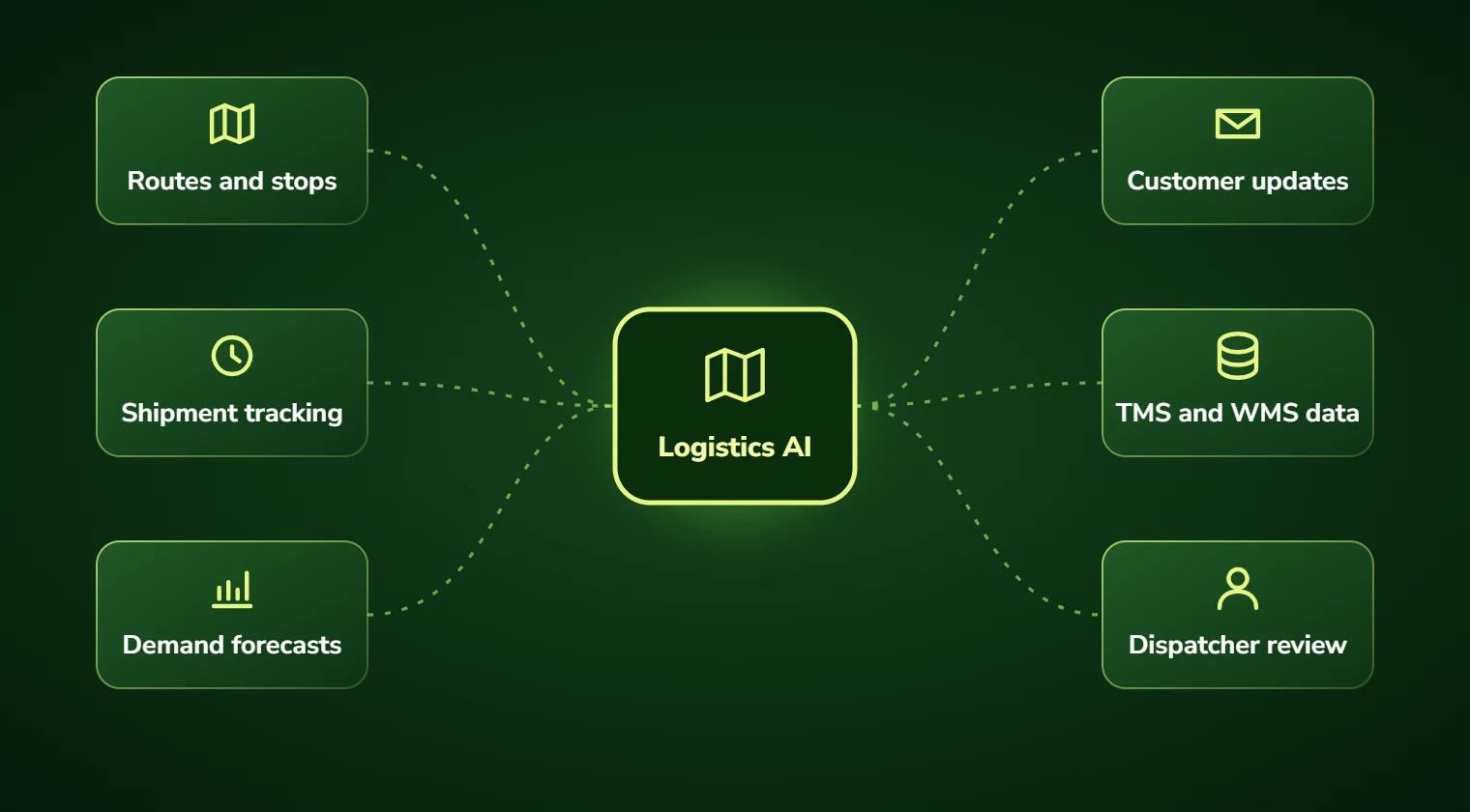
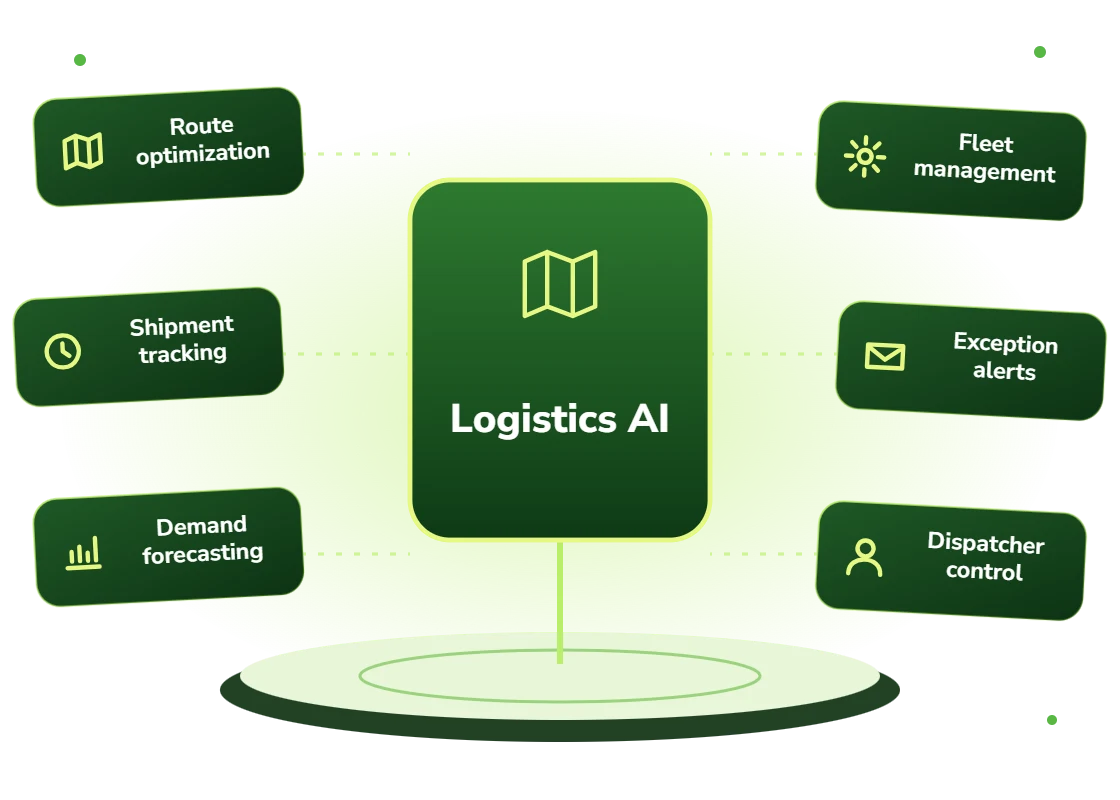
Our logistics AI solutions support document processing, exception handling, carrier reconciliation and tracking workflows. We map system connections and escalation rules around the operational cases your team handles.
Logistics AI solutions automate document-heavy and exception-driven work in transportation and distribution: extracting data from bills of lading, carrier invoices and customs documents, reconciling billing against contracted rates, triaging shipment exceptions, and answering track-and-trace enquiries automatically.
Thin margins and no time to check the invoices
Logistics operates on margins that make billing accuracy material, and volume that makes checking every carrier invoice impossible. So most operations sample, and the unchecked remainder contains errors that reliably favour the carrier.
Meanwhile exceptions, delays, damages, address failures, capacity shortfalls, consume operational staff disproportionately, because each one requires gathering information from several systems before anything can be decided.
Check everything, resolve exceptions faster
Automated reconciliation checks every invoice against contracted rates and documented service, rather than a sample. The discrepancies it finds are usually the clearest measurable return in the whole engagement.
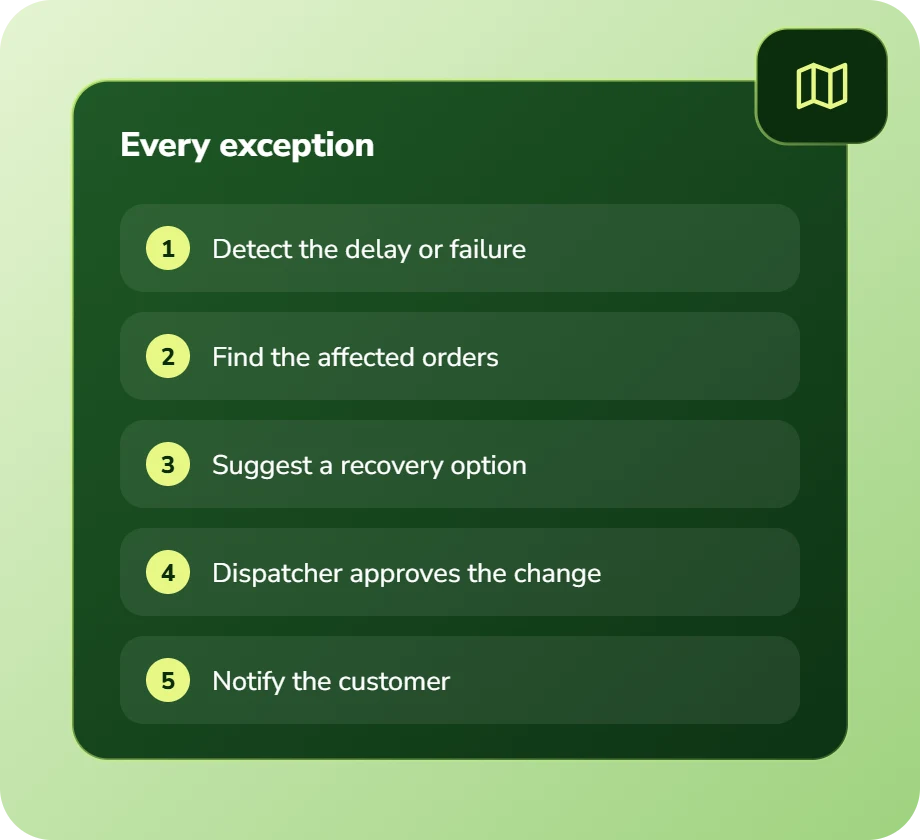
Exception handling follows: information gathered automatically across systems, the situation summarized, and routine resolutions executed within limits you set.
Logistics AI solutions: scope and deliverables
Document processing is the foundation. Bills of lading, delivery receipts, carrier invoices, customs paperwork and rate confirmations arriving in every format and channel imaginable, currently processed by hand.
Reconciliation is where the money is. Comparing what was invoiced against what was contracted and what was actually delivered, at full coverage rather than by sampling.
Exception handling is where the time is. Gathering context across the TMS, WMS, carrier portals and email before anyone can decide what to do about a delayed or damaged shipment.
And track-and-trace enquiries, which are high volume, low value, and interrupt operations staff constantly.
- Document extraction: BOLs, delivery receipts, invoices, customs paperwork
- Carrier invoice reconciliation against contracted rates at full coverage
- Exception triage with context gathered across systems automatically
- Track-and-trace enquiries answered without interrupting operations
- Customs classification support with human broker review retained
- Capacity and carrier selection support from historical performance data
Logistics operations this suits
Freight brokers, 3PLs and shippers with enough volume that manual invoice checking has become sampling rather than verification.
And operations where exception handling consumes a disproportionate share of staff time relative to the shipments involved.
- Operations reconciling more than a few hundred carrier invoices monthly
- 3PLs and brokers handling documents across many carriers and formats
- Businesses where exception handling dominates operational staff time
- Companies fielding high volumes of track-and-trace enquiries
- Cross-border operations with customs documentation burden
- Shippers unable to verify whether accessorial charges are legitimate
Benefits of logistics AI solutions
Every invoice checked
Full reconciliation coverage rather than sampling, which is usually the clearest measurable return available.
Exceptions resolved faster
Context gathered automatically so staff decide rather than investigate, cutting resolution time substantially.
Documents handled in any format
Carrier paperwork processed regardless of layout, which template systems never managed across the long tail.
Track-and-trace deflected
Status enquiries answered automatically instead of interrupting the operations team constantly.
Overnight coverage
Exceptions triaged during the sort cycle rather than waiting for the day shift to arrive.
Carrier performance visible
Historical accuracy and service data made usable for carrier selection and rate negotiation.
Business challenges this solves
Invoices checked by sampling
Volume making full verification impossible. Automated reconciliation covers everything.
Exceptions consuming the day
Staff investigating across systems before deciding. Automated context gathering removes the search.
Documents in every format
Carrier paperwork templates never covered. Template-free extraction handles the long tail.
Track-and-trace interruptions
Operations staff answering status calls constantly. Automated lookups deflect them.
Overnight exceptions waiting
Problems discovered at 3am and handled at 8am. Automated triage acts immediately.
Accessorial charges unverifiable
Charges accepted because checking is impractical. Automated matching against documented service.
Features and deliverables
Everything below is in scope on a standard engagement. Nothing here is an upsell discovered halfway through the build.
Multi-format document extraction
BOLs, delivery receipts, carrier invoices, rate confirmations and customs documents extracted regardless of layout or channel.
Invoice reconciliation
Every invoice matched against contracted rates, documented service and delivery evidence, with discrepancies itemized.
Accessorial verification
Detention, layover and other accessorial charges checked against documented events rather than accepted.
Exception triage
Context gathered across TMS, WMS, carrier portals and email, summarized, with routine resolutions executed within limits.
Track-and-trace automation
Status enquiries answered from live system data through email, chat or voice without operations involvement.
Customs support
Classification suggestions and documentation checking with licensed broker review retained on every determination.
Carrier performance analytics
On-time, damage, and billing accuracy history compiled per carrier and lane for selection and negotiation.
TMS and WMS integration
Connection into your existing transportation and warehouse management systems rather than replacing them.
Technologies we use for logistics AI solutions
We are not tied to one vendor. Model and infrastructure choices are made on accuracy, cost per task, latency, and where your data is allowed to live.
Our AI development process
The same five stages on every engagement, so you always know what happens next and what you get at the end of it.
Discovery
We interview the people doing the work, map the workflow end to end, and audit the systems and data behind it.
AI Strategy
Every opportunity gets scored on cost to build, time to value, and annual savings, then ranked.
Pilot Build
We ship the top-ranked automation as a fixed-scope pilot so you see real output before committing further budget.
Implementation
Integration with your live systems, staff training, human-in-the-loop review gates, and a documented rollback path.
Optimization
Monthly accuracy reviews, prompt and retrieval tuning, and a written report on hours and dollars saved.
How long it takes
A typical first engagement, week by week. Complex integrations and regulated environments extend this, and we say so during discovery rather than after.
Discovery and scoping
Process observation, systems audit, data review, and a written estimate of cost and expected saving before anything is built.
Design sign-off
Architecture, data handling rules, review thresholds and success measures agreed in writing.
Build and integration
Development against your real data, connected to your live systems, with weekly demos rather than a single reveal.
Parallel run and testing
The system runs alongside the existing process so accuracy can be compared directly before anyone depends on it.
Launch and handover
Cutover with a rollback path, staff training, full documentation, then 30 days of included tuning.
Industries we deliver logistics AI solutions for
Logistics & Supply Chain
Document processing, carrier communication, exception handling, and inventory rebalancing.
Manufacturing
Quality inspection, maintenance prediction, supplier communication, and production scheduling.
Retail & E-commerce
Product data enrichment, demand forecasting, support deflection, and personalized merchandising.
Construction
Bid takeoffs, submittal review, RFI drafting, and field-report summarization.
Professional Services
Proposal drafting, timesheet capture, research synthesis, and client reporting at scale.
Insurance
First-notice-of-loss intake, claims triage, policy Q&A, and fraud signal detection.
Financial Services
Document extraction, reconciliation, KYC support, and audit-ready reporting with full traceability.
Healthcare
Intake, prior authorization, clinical documentation, and revenue-cycle workflows built to respect HIPAA boundaries.
Real-world use cases
Carrier invoice audit
Every invoice reconciled against rate agreements and delivery evidence rather than a monthly sample.
Shipment exception handling
Delays, damages and address failures triaged with full context and routine resolutions applied automatically.
Document intake
BOLs and delivery receipts arriving by email, EDI and portal extracted and matched to shipments.
Track-and-trace deflection
Customer status enquiries answered automatically across channels without interrupting operations.
Customs documentation
Classification and documentation checked before submission with broker review retained.
Carrier scorecarding
Performance and billing accuracy tracked per carrier to support rate negotiation with evidence.
Why choose DevSolutionsAI for logistics AI solutions
Business case before build
Every recommendation carries an estimated cost, timeline, and annual savings figure. If the math does not work, we say so before you spend.
Vendor-neutral by design
We resell nothing and take no platform commissions. Model and infrastructure choices are made on fit, cost, and your data-residency rules.
Fixed-scope pilots
The first engagement is a defined deliverable at a defined price, not an open-ended retainer that quietly grows each quarter.
Built for handover
You own the code, the prompts, the infrastructure, and the documentation. No lock-in to a proprietary wrapper you cannot leave.
Human-in-the-loop where it counts
Anything customer-facing, clinical, financial, or legal gets a review gate, a confidence threshold, and a logged audit trail.
Security reviewed early
Data flow diagrams, retention rules, and access boundaries are agreed in week one, not retrofitted after your security team objects.
Find out what logistics AI solutions would cost you, before you commit to anything
Every engagement is quoted after a short discovery, so you get a fixed written price built around your actual volumes rather than a rate card that assumes someone else’s business.
The first call is thirty minutes and free. Bring one workflow. We will tell you what it is likely costing you each year, roughly what automating it would take, and whether we think it is worth doing at all.
- A written savings estimate before any paid work
- Fixed scope and fixed price, agreed up front
- Full ownership of everything we build for you
- An honest recommendation when the numbers do not work
Figures are internal measurements across recent engagements, reported to every client monthly in writing.
Illustrative project scenario
Full invoice coverage replacing a 10% sample
Challenge. A third-party logistics provider reconciled carrier invoices by sampling roughly 10% monthly. Staff suspected accessorial charges were frequently unsupported but had no practical way to verify at volume. Exception handling also consumed most of two operations staff.
What we built. Document extraction across carrier invoices, BOLs and delivery receipts arriving through email and EDI, with automated matching of every invoice against rate agreements and documented delivery events. Accessorial charges are checked against timestamped evidence. Exceptions are triaged with context gathered across systems.
Outcome. Reconciliation moved from a 10% sample to full coverage. In the first year the system identified roughly $340,000 in billing discrepancies, most of them unsupported accessorial charges. Exception resolution time fell substantially, and reconciliation staff time dropped despite checking ten times the volume.
Illustrative project scenario. The figures demonstrate how a project could be scoped and evaluated; they are not verified client results or an audited average.
What clients say about working with us
Logistics AI Solutions FAQs
Where does logistics AI produce the clearest return?
Carrier invoice reconciliation, in most operations. It is directly measurable in dollars recovered, the data required already exists, and the discrepancies found reliably exceed the cost of the system. Most operations sample rather than verify because volume makes full checking impractical, and the unchecked remainder contains errors that consistently favour the carrier.
Can it handle documents from every carrier?
Yes, because extraction works by understanding the document rather than matching a template. That is the main advantage over traditional capture in logistics specifically, where the long tail of smaller carriers with unusual formats is exactly where manual processing effort concentrates.
Does it work overnight?
Yes, and for many logistics operations that is the point. Exceptions arising during the overnight sort are triaged and, within defined limits, resolved immediately rather than waiting for the day shift. Anything above a defined value threshold or involving customer credit routes to a person with the full investigation attached.
Can it handle customs classification?
It can suggest classifications and check documentation completeness, but every determination goes to a licensed customs broker for review. Classification carries legal liability and regulatory consequence, and we design so the AI accelerates the broker’s work rather than substituting for their judgement.
Will it integrate with our TMS?
Yes, we build into existing transportation and warehouse management systems through their APIs, or through file and EDI interfaces for older platforms. We do not replace the TMS; that is a much larger project with its own risks and should be justified independently.
What does logistics AI cost?
Document extraction and invoice reconciliation typically runs $35,000 to $70,000 depending on carrier count and system integration complexity. Exception triage automation runs $40,000 to $80,000. For operations above roughly 500 shipments weekly, reconciliation alone frequently pays for the engagement within the first year on recovered discrepancies.
Services that pair well with this one
Most clients combine two or three of these. We will tell you the right sequence during discovery.
Ready to scope your logistics AI solutions project?
Book a free 30-minute consultation. Bring one workflow and leave with a realistic estimate of what it would cost to automate and what it would save.