Machine Learning Solutions

Machine learning solutions designed for production

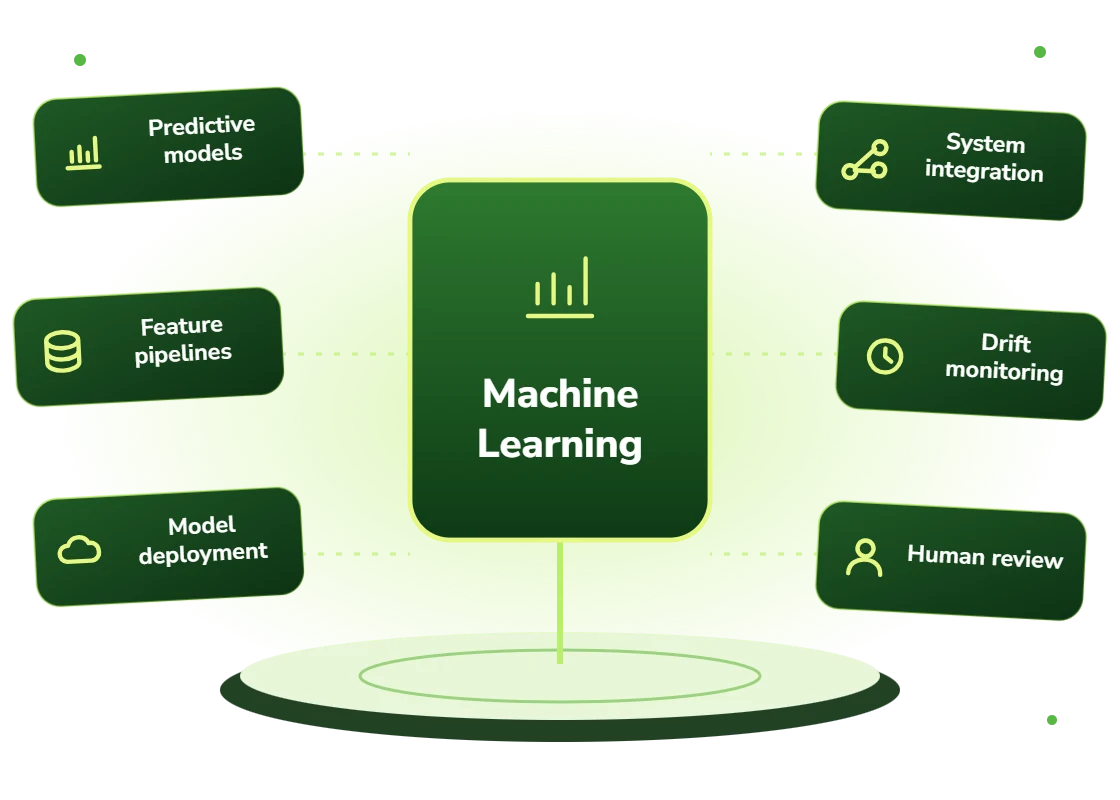
Our machine learning solutions combine model development with data pipelines, evaluation and monitoring. We define the operational decision and ownership needed to take a model into production.

Free 30-minute consultation
Fixed-scope pilots
U.S.-based team
Custom, not off-the-shelf
SOC 2-aligned practices
ROI tracked in writing
What are machine learning solutions?

Machine learning solutions are systems that learn patterns from historical data to make predictions or classifications on new data. Unlike language models, they work on structured data such as transactions, sensor readings and customer records, and are typically used for forecasting, risk scoring, classification, anomaly detection and recommendation.

7+
Years building AI systems
240+
Projects delivered
4.8
Avg. months to payback
38
U.S. states served
The Problem

The model works and the project still fails

The pattern is consistent. A data scientist builds a model that performs well on historical data. Then it needs a live data pipeline, a serving endpoint, monitoring, retraining, and integration into the process where a decision actually happens.

That engineering is most of the work and rarely the data scientist’s specialism, so the model stays in a notebook and the project quietly ends.

Our Approach

Build for deployment from the start

We scope machine learning projects around the decision they will inform and the system that decision lives in, before building any model. That constrains the design usefully.

Data pipelines, serving infrastructure, monitoring and retraining are built alongside the model rather than afterwards, because afterwards is when projects die.

Analytics illustration
Conceptual analytics illustration
Service Overview

Machine learning solutions: scope and deliverables

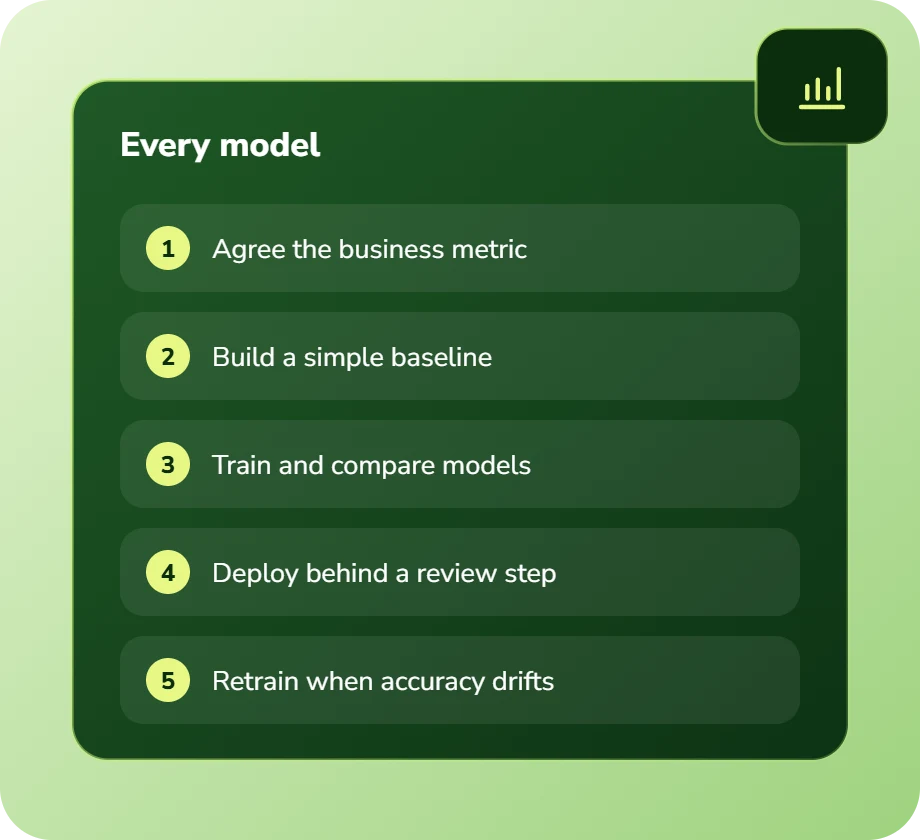
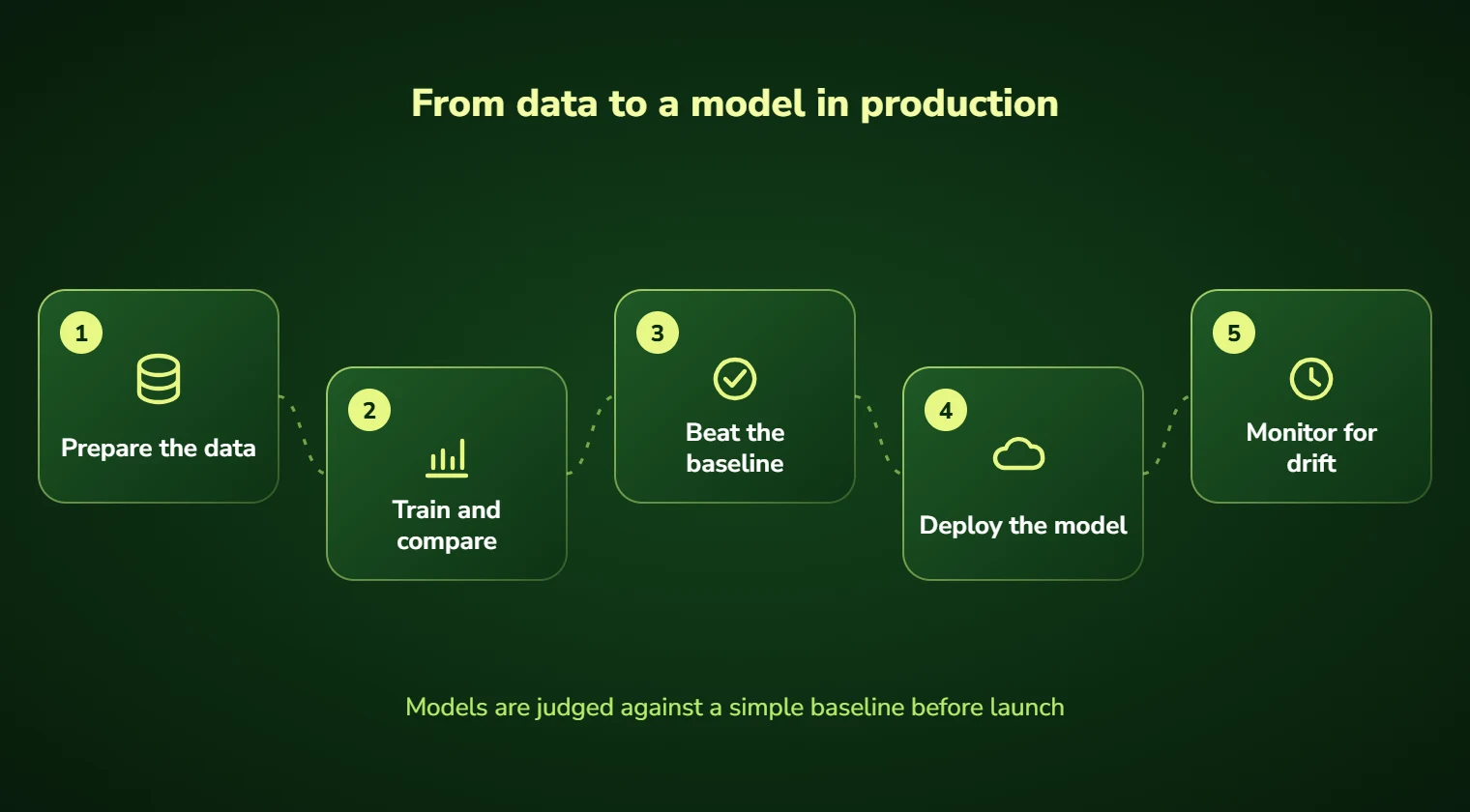
Feasibility first. Whether the signal you need exists in the data you have is an empirical question, and answering it takes two to three weeks rather than a full project.

Then the model, which is genuinely the smaller part. Feature engineering, validation design that avoids leakage, and honest evaluation against a baseline, frequently the baseline is a simple rule that performs almost as well, which is worth knowing.

Then the engineering: pipelines, serving, monitoring for drift, retraining triggers, and integration into the system where the decision happens.

  • Feasibility assessment: does the signal exist in the data you have
  • Baseline comparison so the model has to beat a simple rule to justify itself
  • Feature engineering and validation design that avoids leakage
  • Production serving infrastructure with latency and cost appropriate to use
  • Drift monitoring on inputs and outputs with retraining triggers
  • Integration into the system where the decision is actually made
Right Fit

When machine learning is the right tool

Problems with structured historical data, a clear outcome to predict, and enough volume that a percentage point of accuracy is worth money. Risk scoring, churn prediction, demand forecasting, anomaly detection.

It is the wrong tool when the data is unstructured text or images, where language and vision models are usually better and cheaper, and when a simple rule performs adequately, which is more often than people expect.

  • Problems with structured historical data and a clear outcome to predict
  • High decision volume where small accuracy gains are financially material
  • Organizations with models built but never deployed
  • Teams whose deployed models have degraded without anyone noticing
  • Businesses where rules-based scoring has plateaued
  • Companies needing to know whether ML is feasible before committing budget
Benefits

Benefits of machine learning solutions

Models that actually deploy

Engineering built alongside the model rather than assumed, which is the difference between a project and a notebook.

Honest baseline comparison

Models measured against a simple rule, so you know whether the complexity is earning anything.

Feasibility answered cheaply

Two to three weeks to establish whether the signal exists, rather than finding out at month five.

Drift detected

Input and output monitoring so degradation surfaces before it shows up in business results.

Validation without leakage

Careful validation design, because leakage produces excellent test scores and useless production models.

Owned by your team

Pipelines, code and documentation handed over so the model survives the person who built it leaving.

Problems We Solve

Business challenges this solves

01

Models that never deployed

Good notebooks with no path to production. Engineering built alongside from the start.

02

Deployed models silently degrading

Accuracy falling with no alerting. Drift monitoring surfaces it before business impact.

03

Great test scores, poor production

Data leakage in validation. Careful design avoids the most common cause of ML disappointment.

04

Complexity without benefit

Models barely beating a simple rule. Baseline comparison makes that visible before deployment.

05

Nobody owns it after handover

Models orphaned when a data scientist leaves. Documentation and enablement built in.

06

Not knowing if it is feasible

Budget committed before knowing the signal exists. A short feasibility phase answers it cheaply.

What's Included

Features and deliverables

Everything below is in scope on a standard engagement. Nothing here is an upsell discovered halfway through the build.

01

Feasibility assessment

A short empirical study establishing whether predictive signal exists in your data before a full project is funded.

02

Baseline benchmarking

A simple rule or heuristic built first, so the model must demonstrably beat it to justify its complexity.

03

Feature engineering

Feature construction from your data with careful attention to what would actually be available at prediction time.

04

Validation design

Temporal and group-aware validation that avoids leakage, which is the most common cause of models that fail in production.

05

Serving infrastructure

Batch or real-time serving sized to your latency and volume requirements, deployed on your own infrastructure.

06

Drift monitoring

Input distribution and output monitoring with alerting when either moves outside expected bounds.

07

Retraining pipeline

Automated retraining on a schedule or trigger, with validation gates before a new model replaces the old one.

08

Documentation and handover

Model cards, pipeline documentation and enablement so your team can operate and retrain independently.

Technology Stack

Technologies we use for machine learning solutions

We are not tied to one vendor. Model and infrastructure choices are made on accuracy, cost per task, latency, and where your data is allowed to live.

Language Models
C
Claude (Anthropic)
G
GPT (OpenAI)
G
Gemini (Google)
L
Llama
M
Mistral
A
Azure OpenAI Service
Data & Backend
P
Python
T
TypeScript / Node.js
P
PostgreSQL
S
Snowflake
d
dbt
A
Apache Airflow
Cloud & Infrastructure
A
AWS Bedrock
G
Google Vertex AI
M
Microsoft Azure
D
Docker
K
Kubernetes
T
Terraform
Business Systems
S
Salesforce
H
HubSpot
N
NetSuite
M
Microsoft 365
S
Slack
Z
Zapier / Make
How We Work

Our AI development process

The same five stages on every engagement, so you always know what happens next and what you get at the end of it.

01

Discovery

We interview the people doing the work, map the workflow end to end, and audit the systems and data behind it.

02

AI Strategy

Every opportunity gets scored on cost to build, time to value, and annual savings, then ranked.

03

Pilot Build

We ship the top-ranked automation as a fixed-scope pilot so you see real output before committing further budget.

04

Implementation

Integration with your live systems, staff training, human-in-the-loop review gates, and a documented rollback path.

05

Optimization

Monthly accuracy reviews, prompt and retrieval tuning, and a written report on hours and dollars saved.

Timeline

How long it takes

A typical first engagement, week by week. Complex integrations and regulated environments extend this, and we say so during discovery rather than after.

Weeks 1 to 3

Feasibility

Data assessment and an empirical test of whether the required signal exists, with a go/no-go recommendation.

Weeks 4 to 7

Model development

Feature engineering, baseline comparison, model training and honest validation.

Weeks 8 to 11

Production engineering

Data pipelines, serving infrastructure, monitoring and retraining automation.

Weeks 12 to 13

Integration

Connection into the system where the decision happens, with shadow running against current process.

Week 14

Handover

Documentation, model cards, enablement sessions and 30 days of included support.

Who We Work With

Industries we deliver machine learning solutions for

Financial Services

Document extraction, reconciliation, KYC support, and audit-ready reporting with full traceability.

Insurance

First-notice-of-loss intake, claims triage, policy Q&A, and fraud signal detection.

Manufacturing

Quality inspection, maintenance prediction, supplier communication, and production scheduling.

Retail & E-commerce

Product data enrichment, demand forecasting, support deflection, and personalized merchandising.

Logistics & Supply Chain

Document processing, carrier communication, exception handling, and inventory rebalancing.

Healthcare

Intake, prior authorization, clinical documentation, and revenue-cycle workflows built to respect HIPAA boundaries.

SaaS & Technology

AI features inside your product, support deflection, onboarding assistants, and usage analytics.

Professional Services

Proposal drafting, timesheet capture, research synthesis, and client reporting at scale.

Use Cases

Real-world use cases

01

Churn prediction

Identifying accounts at risk early enough that intervention is possible, with the drivers surfaced.

02

Credit and risk scoring

Risk models with explainability appropriate to regulatory requirements and adverse action notice obligations.

03

Demand forecasting

Item-level forecasting from sales history with seasonality and external signals incorporated.

04

Anomaly and fraud detection

Unusual transaction and behaviour patterns flagged for investigation with the reasoning shown.

05

Predictive maintenance

Equipment failure prediction where sufficient labelled failure history genuinely exists.

06

Lead and opportunity scoring

Conversion likelihood from historical outcomes rather than from assumed ideal-customer criteria.

Why DevSolutionsAI

Why choose DevSolutionsAI for machine learning solutions

Business case before build

Every recommendation carries an estimated cost, timeline, and annual savings figure. If the math does not work, we say so before you spend.

Vendor-neutral by design

We resell nothing and take no platform commissions. Model and infrastructure choices are made on fit, cost, and your data-residency rules.

Fixed-scope pilots

The first engagement is a defined deliverable at a defined price, not an open-ended retainer that quietly grows each quarter.

Built for handover

You own the code, the prompts, the infrastructure, and the documentation. No lock-in to a proprietary wrapper you cannot leave.

Human-in-the-loop where it counts

Anything customer-facing, clinical, financial, or legal gets a review gate, a confidence threshold, and a logged audit trail.

Security reviewed early

Data flow diagrams, retention rules, and access boundaries are agreed in week one, not retrofitted after your security team objects.

Get Started

Find out what machine learning solutions would cost you, before you commit to anything

Every engagement is quoted after a short discovery, so you get a fixed written price built around your actual volumes rather than a rate card that assumes someone else’s business.

The first call is thirty minutes and free. Bring one workflow. We will tell you what it is likely costing you each year, roughly what automating it would take, and whether we think it is worth doing at all.

  • A written savings estimate before any paid work
  • Fixed scope and fixed price, agreed up front
  • Full ownership of everything we build for you
  • An honest recommendation when the numbers do not work
What clients typically see
Across recent projects
Staff hours saved each week
31
Months to payback
4.8
Client retention
94%
Response to enquiries
4 hrs

Figures are internal measurements across recent engagements, reported to every client monthly in writing.

Illustrative project scenario

Illustrative project scenario

Equipment leasing · risk scoring

A model that beat the rules by enough to justify itself, and not by more

Challenge. A leasing company scored applications with a rules-based system built over a decade. They wanted machine learning, expecting a substantial improvement. Nobody had established what the existing rules actually achieved as a baseline.

What we built. A feasibility phase first, which established the rules baseline properly and then tested achievable model performance. The model improved default prediction meaningfully but less dramatically than expected. We reported that honestly, including the finding that roughly half the improvement came from three features the rules did not use, which could have been added to the rules directly.

Outcome. The client proceeded with the model, but with realistic expectations and a clear understanding of where the gain came from. Explainability was built in for adverse action notice requirements. The model was deployed with shadow running against the rules for two months before it took over decisions.

2 mo
Shadow run before cutover
3
Features driving half the gain
100%
Decisions explainable
Honest
Baseline established first

Illustrative project scenario. The figures demonstrate how a project could be scoped and evaluated; they are not verified client results or an audited average.

Client Feedback

What clients say about working with us

31
Avg. staff hours saved weekly
4.8
Avg. months to payback
94%
Client retention
4
Hour response to enquiries
Common Questions

Machine Learning Solutions FAQs

Because the model is the smaller part of the work and frequently the only part that was scoped. Production requires live data pipelines, serving infrastructure, monitoring, retraining, and integration into the system where a decision actually happens. That engineering is rarely a data scientist’s specialism, so the model stays in a notebook. We build the engineering alongside the model rather than afterwards.
A two to three week feasibility study answers it empirically. We test whether predictive signal exists in your data, establish what a simple rule achieves as a baseline, and estimate achievable accuracy. It is far cheaper to find out that the signal is not there in week three than in month five, and we do recommend against proceeding on a meaningful share of these studies.

Because it is frequently competitive, and you should know that before committing to a model with ongoing retraining and monitoring costs. On a recent risk scoring engagement the model beat the rules baseline, but half the improvement came from three features the rules simply did not use, which could have been added directly for a fraction of the cost. That is worth knowing.

Leakage is when information that would not be available at prediction time leaks into training data, producing excellent test scores and a model that fails in production. It is the single most common cause of ML disappointment and it is subtle, a feature computed after the outcome, or a temporal split that lets the model see the future. Careful validation design is unglamorous and it is what separates models that work from models that scored well.

Drift monitoring watches both input distributions and output patterns, alerting when either moves outside expected bounds. Retraining runs on a schedule or on a drift trigger, with validation gates so a worse model cannot silently replace a better one. Models degrade as the world changes; the failure is not degradation but not noticing it.

A feasibility study is $14,000 to $25,000 over two to three weeks. A production model including serving, monitoring, retraining and integration typically runs $70,000 to $180,000 depending on data complexity and integration requirements. Ongoing operations run monthly. We would rather sell you the feasibility study and then recommend against the build than deliver a model on insufficient signal.

Service Areas

Machine Learning Solutions across the United States

We deliver machine learning solutions remotely to clients nationwide, with on-site workshops available in major metros.

Ready to scope your machine learning solutions project?

Book a free 30-minute consultation. Bring one workflow and leave with a realistic estimate of what it would cost to automate and what it would save.

Free 30-minute consultation
Fixed-scope pilots
U.S.-based team
Custom, not off-the-shelf
SOC 2-aligned practices
ROI tracked in writing
Free 30-minute AI consultation