Manufacturing AI Solutions

Manufacturing AI solutions for plants, not for conference keynotes

Our manufacturing AI solutions address inspection, maintenance and supplier documentation within existing plant constraints. We assess available data, equipment connections and production requirements before proposing changes.

Free 30-minute consultation
Fixed-scope pilots
U.S.-based team
Custom, not off-the-shelf
SOC 2-aligned practices
ROI tracked in writing
What are manufacturing AI solutions?

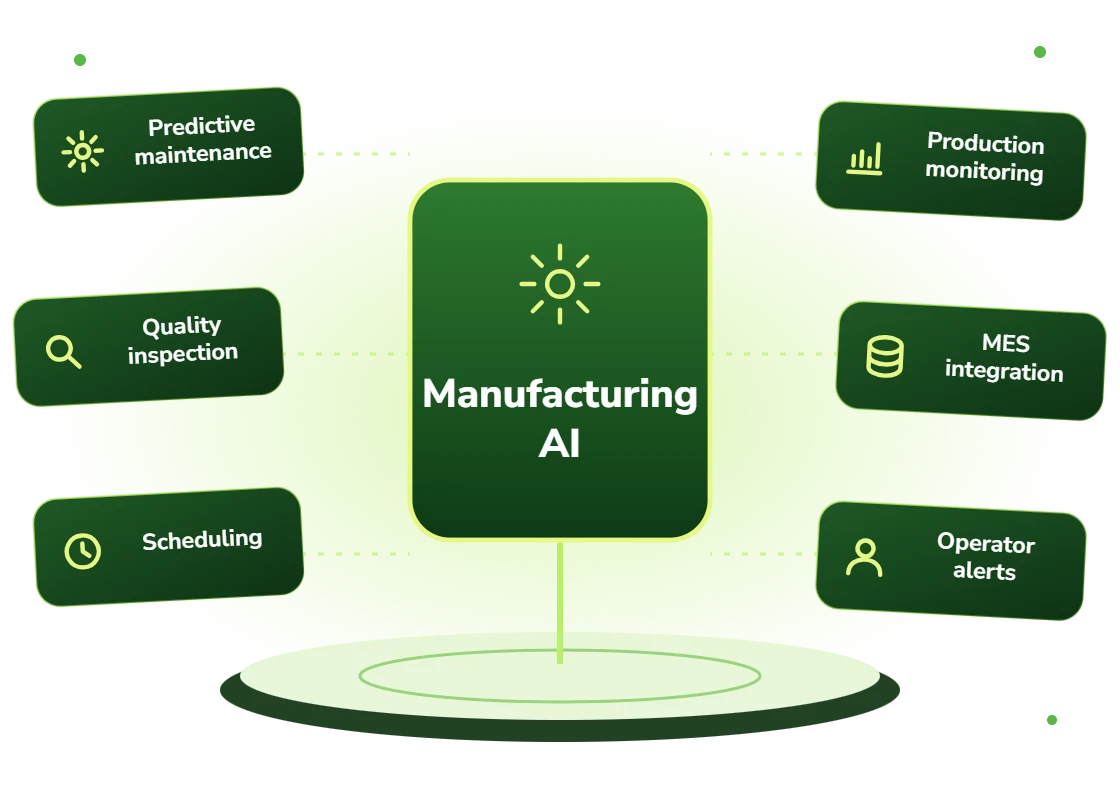
Manufacturing AI solutions apply artificial intelligence to production and plant operations: visual quality inspection, predictive maintenance from sensor and maintenance data, automated quoting and estimating, supplier documentation processing, and production scheduling. Practical implementations work with existing equipment and systems rather than requiring plant modernization first.

7+
Years building AI systems
240+
Projects delivered
4.8
Avg. months to payback
38
U.S. states served
The Problem

The AI pitch assumes a factory you do not have

Industrial AI marketing assumes connected machines, clean historical data and a greenfield deployment. Most U.S. plants have equipment spanning decades, an ERP older than some of the staff, and maintenance records in a mix of software and paper.

So projects stall in feasibility, and the plant concludes AI is not for them, when the actual barrier was that the proposal assumed conditions that do not exist anywhere.

Our Approach

Work with the plant as it is

We start with what data actually exists and what it would cost to get more. Frequently the answer is that enough exists for a useful first project, even where it is messy.

And we design around production reality: no line stoppages for installation, operator interfaces that work with gloves on, and systems that fail visibly rather than silently.

Vision illustration
Conceptual vision illustration
Service Overview

Manufacturing AI solutions: scope and deliverables

Visual quality inspection is the most mature application. Cameras on the line, defect classification, and flagging for operator decision. It works on existing equipment and the return is directly measurable in scrap and escape rates.

Predictive maintenance is more variable. It depends heavily on whether you have enough historical failure data, and we assess that honestly rather than assuming it, many plants do not, and starting there wastes a year.

Quoting and estimating is the most underrated. Make-to-order manufacturers frequently have senior engineers spending days on quotes, and the historical quote and cost data to automate much of it.

And supplier documentation: certificates, quality records and change notices arriving in every format imaginable, processed by hand.

  • Visual quality inspection using cameras on existing line equipment
  • Predictive maintenance where historical failure data actually supports it
  • Quoting and estimating from historical quote, cost and drawing data
  • Supplier documentation: certificates, quality records, change notices
  • Production scheduling optimization against real constraints
  • Engineering document search across decades of specifications and drawings
Right Fit

Plants and manufacturers this suits

Manufacturers with measurable quality costs, scrap, rework, escapes to customers, where inspection is currently manual and sampling-based.

And make-to-order operations where quoting is a bottleneck consuming senior engineering time that should be on production problems.

  • Manufacturers with measurable scrap, rework or customer escape costs
  • Plants where quality inspection is manual and sample-based
  • Make-to-order operations where quoting consumes senior engineering time
  • Suppliers handling heavy OEM documentation and reporting requirements
  • Operations with decades of engineering documents nobody can search
  • Plants with maintenance data they have never used analytically
Benefits

Benefits of manufacturing AI solutions

Inspection on every part

Full coverage rather than sampling, which changes what escape rate is achievable.

Works on existing equipment

Cameras and sensors added without replacing machines or stopping production to install.

Quoting turnaround

Estimates produced in hours rather than days, which affects win rate directly on time-sensitive bids.

Senior engineers on engineering

Quote preparation and documentation moved off the people who should be solving production problems.

Supplier paperwork absorbed

Certificates and quality documents processed regardless of format rather than keyed by hand.

Honest feasibility first

We assess whether your data supports predictive maintenance before you fund it, rather than after.

Problems We Solve

Business challenges this solves

01

Quality escapes to customers

Sampling inspection missing defects. Full-coverage vision inspection changes the achievable rate.

02

Quoting as the bottleneck

Senior engineers spending days on estimates. Historical data supports automating much of it.

03

OEM documentation demands

Reporting requirements assuming a corporate back office. Automated processing absorbs the load.

04

Maintenance data never used

Years of records with no analysis. We assess honestly whether they support prediction.

05

Engineering knowledge unfindable

Decades of specifications nobody can search. Semantic search over technical documents.

06

AI proposals assuming a smart factory

Projects stalling on infrastructure that does not exist. We design for the plant you actually have.

What's Included

Features and deliverables

Everything below is in scope on a standard engagement. Nothing here is an upsell discovered halfway through the build.

01

Data feasibility assessment

Honest evaluation of what data exists, its quality, and whether it supports the proposed application before you fund a build.

02

Visual inspection systems

Camera-based defect detection trained on your specific defect types, running on existing line equipment.

03

Predictive maintenance

Failure prediction from sensor and maintenance history, built only where the historical data genuinely supports it.

04

Automated quoting

Estimates generated from drawings, specifications and historical quote and actual-cost data, for engineer review.

05

Supplier document processing

Certificates of conformance, material certifications, quality records and change notices extracted regardless of format.

06

Engineering document search

Semantic search across specifications, drawings, test reports and prior design decisions spanning decades.

07

Production scheduling support

Schedule optimization against real constraints including changeover, tooling and labour availability.

08

Shop-floor interfaces

Operator interfaces designed for plant conditions: glove-friendly, high-contrast, and functional without a keyboard.

Technology Stack

Technologies we use for manufacturing AI solutions

We are not tied to one vendor. Model and infrastructure choices are made on accuracy, cost per task, latency, and where your data is allowed to live.

Language Models
C
Claude (Anthropic)
G
GPT (OpenAI)
G
Gemini (Google)
L
Llama
M
Mistral
A
Azure OpenAI Service
Agent & Orchestration
M
Model Context Protocol
L
LangGraph
L
LangChain
L
LlamaIndex
T
Temporal
C
Celery
Data & Backend
P
Python
T
TypeScript / Node.js
P
PostgreSQL
S
Snowflake
d
dbt
A
Apache Airflow
Cloud & Infrastructure
A
AWS Bedrock
G
Google Vertex AI
M
Microsoft Azure
D
Docker
K
Kubernetes
T
Terraform
Business Systems
S
Salesforce
H
HubSpot
N
NetSuite
M
Microsoft 365
S
Slack
Z
Zapier / Make
How We Work

Our AI development process

The same five stages on every engagement, so you always know what happens next and what you get at the end of it.

01

Discovery

We interview the people doing the work, map the workflow end to end, and audit the systems and data behind it.

02

AI Strategy

Every opportunity gets scored on cost to build, time to value, and annual savings, then ranked.

03

Pilot Build

We ship the top-ranked automation as a fixed-scope pilot so you see real output before committing further budget.

04

Implementation

Integration with your live systems, staff training, human-in-the-loop review gates, and a documented rollback path.

05

Optimization

Monthly accuracy reviews, prompt and retrieval tuning, and a written report on hours and dollars saved.

Timeline

How long it takes

A typical first engagement, week by week. Complex integrations and regulated environments extend this, and we say so during discovery rather than after.

Weeks 1 to 2

Discovery and scoping

Process observation, systems audit, data review, and a written estimate of cost and expected saving before anything is built.

Week 3

Design sign-off

Architecture, data handling rules, review thresholds and success measures agreed in writing.

Weeks 4 to 7

Build and integration

Development against your real data, connected to your live systems, with weekly demos rather than a single reveal.

Week 8

Parallel run and testing

The system runs alongside the existing process so accuracy can be compared directly before anyone depends on it.

Weeks 9 to 10

Launch and handover

Cutover with a rollback path, staff training, full documentation, then 30 days of included tuning.

Who We Work With

Industries we deliver manufacturing AI solutions for

Manufacturing

Quality inspection, maintenance prediction, supplier communication, and production scheduling.

Logistics & Supply Chain

Document processing, carrier communication, exception handling, and inventory rebalancing.

Construction

Bid takeoffs, submittal review, RFI drafting, and field-report summarization.

Retail & E-commerce

Product data enrichment, demand forecasting, support deflection, and personalized merchandising.

Professional Services

Proposal drafting, timesheet capture, research synthesis, and client reporting at scale.

Financial Services

Document extraction, reconciliation, KYC support, and audit-ready reporting with full traceability.

Healthcare

Intake, prior authorization, clinical documentation, and revenue-cycle workflows built to respect HIPAA boundaries.

Insurance

First-notice-of-loss intake, claims triage, policy Q&A, and fraud signal detection.

Use Cases

Real-world use cases

01

Visual defect detection

Surface, dimensional and assembly defects identified on every part rather than on a sample.

02

Automated quoting

Make-to-order estimates generated from drawings and historical cost data for engineer review.

03

Certificate processing

Material certifications and conformance documents extracted and matched to receipts automatically.

04

Predictive maintenance

Failure prediction on critical assets where historical data supports it, with honest assessment where it does not.

05

Engineering knowledge search

Locating prior designs, tolerances and decisions across decades of technical documentation.

06

Change order processing

Engineering change notices from OEM customers extracted, assessed for impact and routed.

Why DevSolutionsAI

Why choose DevSolutionsAI for manufacturing AI solutions

Business case before build

Every recommendation carries an estimated cost, timeline, and annual savings figure. If the math does not work, we say so before you spend.

Vendor-neutral by design

We resell nothing and take no platform commissions. Model and infrastructure choices are made on fit, cost, and your data-residency rules.

Fixed-scope pilots

The first engagement is a defined deliverable at a defined price, not an open-ended retainer that quietly grows each quarter.

Built for handover

You own the code, the prompts, the infrastructure, and the documentation. No lock-in to a proprietary wrapper you cannot leave.

Human-in-the-loop where it counts

Anything customer-facing, clinical, financial, or legal gets a review gate, a confidence threshold, and a logged audit trail.

Security reviewed early

Data flow diagrams, retention rules, and access boundaries are agreed in week one, not retrofitted after your security team objects.

Get Started

Find out what manufacturing AI solutions would cost you, before you commit to anything

Every engagement is quoted after a short discovery, so you get a fixed written price built around your actual volumes rather than a rate card that assumes someone else’s business.

The first call is thirty minutes and free. Bring one workflow. We will tell you what it is likely costing you each year, roughly what automating it would take, and whether we think it is worth doing at all.

  • A written savings estimate before any paid work
  • Fixed scope and fixed price, agreed up front
  • Full ownership of everything we build for you
  • An honest recommendation when the numbers do not work
What clients typically see
Across recent projects
Staff hours saved each week
31
Months to payback
4.8
Client retention
94%
Response to enquiries
4 hrs

Figures are internal measurements across recent engagements, reported to every client monthly in writing.

Illustrative project scenario

Illustrative project scenario

Precision components · make-to-order

Cutting quote turnaround from 4 days to 6 hours

Challenge. A precision components manufacturer quoted make-to-order work by having senior engineers review drawings and estimate from experience. Turnaround averaged four days, and win rate analysis suggested slow quoting was costing them work on time-sensitive enquiries. Two of the three engineers doing it were near retirement.

What we built. Extraction of features, tolerances and material requirements from customer drawings, matched against eleven years of historical quotes and actual production costs to produce an estimate with comparable jobs cited. Engineers review and adjust rather than estimating from scratch, and their adjustments feed back as signal.

Outcome. Quote turnaround fell from four days to six hours. Win rate on time-sensitive enquiries improved measurably. Perhaps more importantly, the estimating logic accumulated over decades by three engineers is now documented and applied consistently rather than resident in two people about to retire.

4 days → 6 hrs
Quote turnaround
11 yrs
Of cost history used
3
Engineers' knowledge captured
100%
Engineer-reviewed quotes

Illustrative project scenario. The figures demonstrate how a project could be scoped and evaluated; they are not verified client results or an audited average.

Client Feedback

What clients say about working with us

31
Avg. staff hours saved weekly
4.8
Avg. months to payback
94%
Client retention
4
Hour response to enquiries
Common Questions

Manufacturing AI Solutions FAQs

Usually not, and proposals that assume otherwise are why many manufacturing AI projects never start. Visual inspection works with cameras added to existing line equipment. Document processing works with documents you already receive. Quoting works with historical data you already hold. Full production optimization does require connected machine data, and for most plants that is a later project rather than a prerequisite.
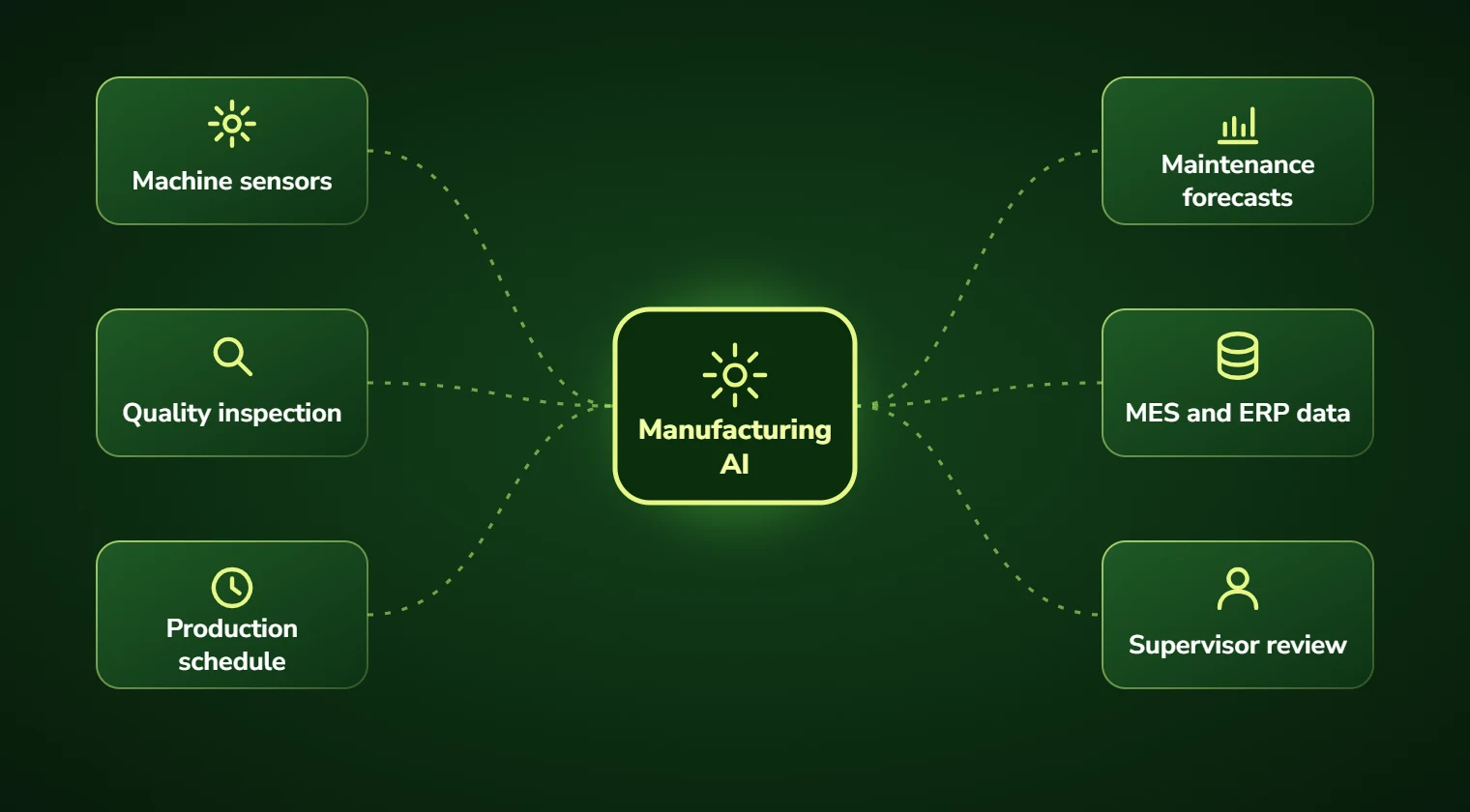
It depends on whether you have years of labelled failure history, and many plants do not. This is the most requested and most frequently premature manufacturing AI application. We assess your maintenance data honestly during discovery and will tell you if it does not support prediction yet, in which case the useful first step is often improving data capture rather than building a model on insufficient history.

It depends on defect type and image quality, and we measure it on your actual parts and defects during a pilot rather than quoting a benchmark. Some defect classes are detected extremely reliably; others are genuinely hard and are better handled as flagging for operator review than as automated rejection. The pilot tells you which is which before you commit to a line installation.

Generally yes. We integrate with legacy ERP systems regularly, through APIs where they exist and through database access or file interfaces where they do not. Legacy integration is frequently the longest part of the project rather than the AI, and we scope it realistically after looking at your actual system.

For visual inspection, cameras and lighting need mounting, which we plan around your production schedule rather than requiring a stoppage. We work with your maintenance team or an integrator you already use for the physical installation. The design constraint we hold throughout is that nothing requires stopping production to deploy or update.

A visual inspection pilot on one line typically runs $30,000 to $60,000 including camera hardware. Automated quoting runs $40,000 to $85,000 depending on drawing complexity and ERP integration. Document processing runs $25,000 to $50,000. Payback varies widely with your scrap and quality costs, which is why we start with a measured assessment.

Service Areas

Manufacturing AI Solutions across the United States

We deliver manufacturing ai solutions remotely to clients nationwide, with on-site workshops available in major metros.

Ready to scope your manufacturing AI solutions project?

Book a free 30-minute consultation. Bring one workflow and leave with a realistic estimate of what it would cost to automate and what it would save.

Free 30-minute consultation
Fixed-scope pilots
U.S.-based team
Custom, not off-the-shelf
SOC 2-aligned practices
ROI tracked in writing
Free 30-minute AI consultation