AI Marketing Automation

AI marketing automation for teams whose bottleneck is production, not ideas

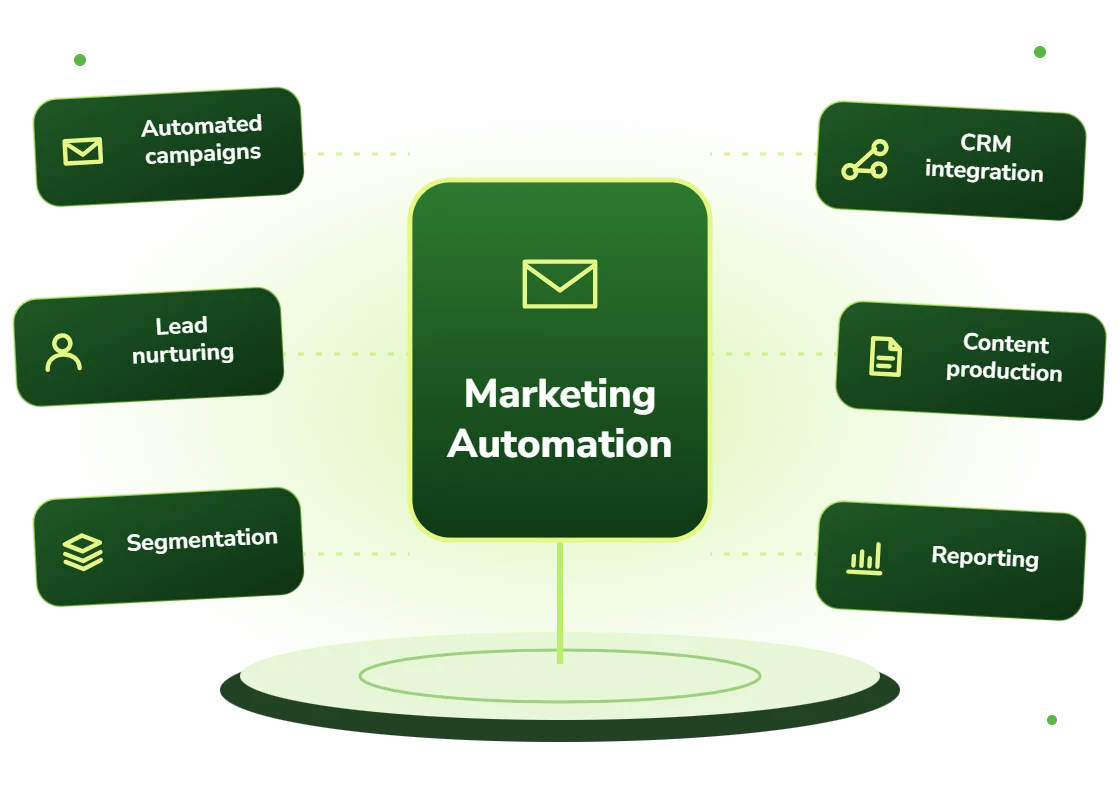
AI marketing automation helps teams produce content, manage segmentation and prepare reports. We connect those tasks to your strategy, brand controls and review process rather than automating decisions without context.

Free 30-minute consultation
Fixed-scope pilots
U.S.-based team
Custom, not off-the-shelf
SOC 2-aligned practices
ROI tracked in writing
What is AI marketing automation?

AI marketing automation applies language and generative models to marketing execution: producing content variants at scale, personalizing messaging by segment, analysing campaign performance, and automating the repetitive production and reporting work that limits how much a marketing team can ship.

7+
Years building AI systems
240+
Projects delivered
4.8
Avg. months to payback
38
U.S. states served
The Problem

The strategy is fine, the team cannot ship it

Marketing plans routinely call for segment-specific messaging across six personas and four channels. Execution then defaults to one generic version for everyone, because producing twenty-four variants was never realistic.

The same applies to testing. Teams know they should test more variants; they test two, because each one costs a person a morning.

Our Approach

Remove the production ceiling, keep the judgement

AI does not decide the positioning or the segments. It produces the variants once you have decided, at a volume that makes genuine segmentation and testing practical rather than aspirational.

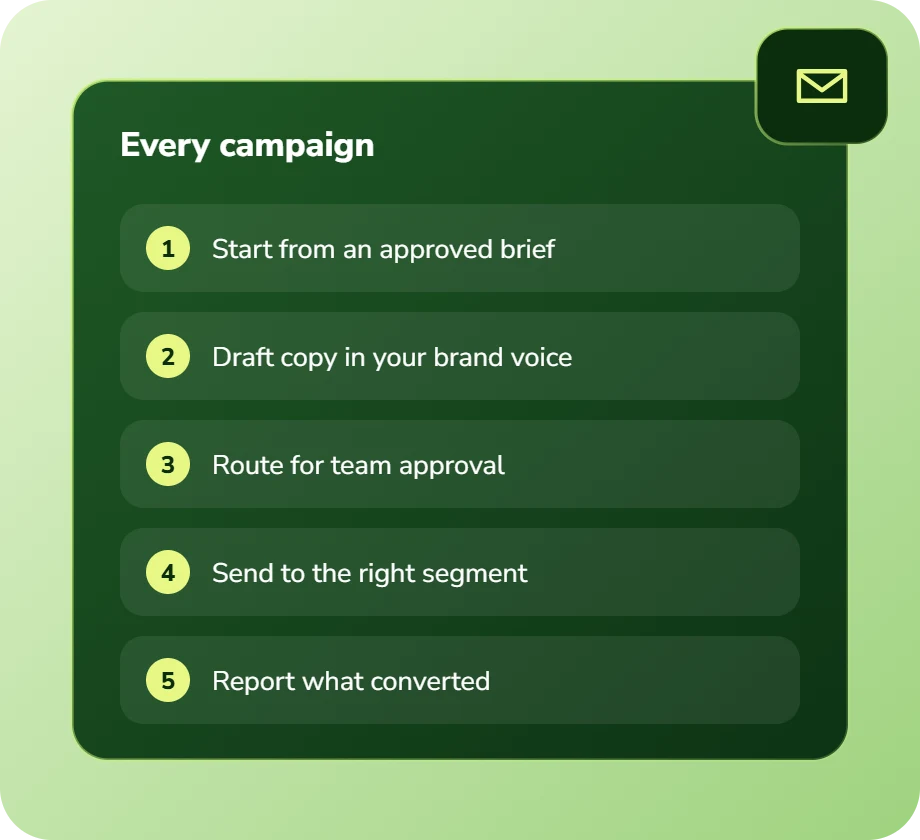
Brand voice is encoded from your approved material, compliance rules are checked automatically, and everything routes to human review before it goes out.

Diagram showing information extracted from a document into structured fields
Service Overview

AI marketing automation: scope and deliverables

Production scale is the clearest win: variants per segment, per channel, per market, produced at a cost that makes real personalization viable.

Analysis is the second and more underrated. Reading a thousand pieces of customer feedback, support tickets and review content to find recurring themes is work no team does thoroughly, and it is exactly what language models are good at.

Reporting is the third: assembling performance data from six platforms into a narrative every month is hours of work that produces no insight until it is finished.

  • Content variants at volume: per segment, channel, market and test cell
  • Brand voice encoded from approved material and applied consistently
  • Compliance and claim validation before anything reaches review
  • Customer feedback and review analysis for recurring themes
  • Campaign performance reporting assembled and narrated automatically
  • SEO content production grounded in real product and service detail
Right Fit

Marketing teams this suits

Teams whose content backlog is the constraint on campaign execution, particularly where segmentation strategy exists on paper but not in practice.

And organizations operating across many markets or product lines, where localization and variation multiply the production requirement beyond what headcount can serve.

  • Marketing teams whose production capacity limits campaign execution
  • Companies with segmentation strategy they cannot execute at variant level
  • Businesses operating across multiple markets or languages
  • Organizations with large product catalogues needing content
  • Teams spending significant time on manual performance reporting
  • Regulated industries where marketing content requires compliance review
Benefits

Benefits of marketing automation

Segmentation you can actually execute

Variants per persona and channel become viable, so the strategy stops collapsing into one generic message.

More testing, cheaper

Test cells cost minutes rather than mornings, which changes how much you can learn per campaign.

Consistent brand voice

Voice encoded from approved material, applied identically across a thousand variants.

Compliance checked automatically

Prohibited claims and missing disclaimers caught before legal review, not during it.

Feedback actually analysed

Thousands of reviews and tickets read for themes, which no team does thoroughly by hand.

Reporting that writes itself

Performance narratives assembled from platform data, freeing the analysis time for actual analysis.

Problems We Solve

Business challenges this solves

01

One message for six segments

Segmentation strategy defeated by production cost. Variant generation makes it executable.

02

Testing two variants, not twenty

Learning limited by production capacity. Cheap variants change the testing economics.

03

Localization too expensive to expand

New markets blocked by content cost. Native generation per market makes expansion marginal.

04

Compliance review as a bottleneck

Legal reviewing everything manually. Automated pre-checks remove the obvious failures.

05

Customer feedback never analysed

Thousands of reviews nobody reads systematically. Theme extraction surfaces what matters.

06

Monthly reporting consuming days

Data assembly from six platforms. Automated reporting returns the time to analysis.

What's Included

Features and deliverables

Everything below is in scope on a standard engagement. Nothing here is an upsell discovered halfway through the build.

01

Brand voice encoding

Voice derived from your approved content corpus rather than described in adjectives, applied consistently at any volume.

02

Variant generation

Content produced per segment, channel, market and test cell from a single approved brief.

03

Compliance validation

Automated checking for prohibited claims, required disclaimers and regulated terminology before human review.

04

Personalization engine

Messaging adapted to segment, behaviour and lifecycle stage within rules you define.

05

Feedback and review analysis

Themes, sentiment and emerging issues extracted from customer feedback, reviews and support content at full coverage.

06

Campaign reporting

Performance data assembled across platforms with narrative explanation and anomaly flagging.

07

SEO content pipelines

Search content grounded in real product detail, produced at volume with duplicate and thin-content monitoring.

08

Marketing platform integration

Connection into HubSpot, Marketo, Klaviyo, Braze or your existing marketing stack.

Technology Stack

Technologies we use for marketing automation

We are not tied to one vendor. Model and infrastructure choices are made on accuracy, cost per task, latency, and where your data is allowed to live.

Language Models
C
Claude (Anthropic)
G
GPT (OpenAI)
G
Gemini (Google)
L
Llama
M
Mistral
A
Azure OpenAI Service
Vector & Retrieval
P
Pinecone
W
Weaviate
Q
Qdrant
p
pgvector
E
Elasticsearch
A
Amazon OpenSearch
Data & Backend
P
Python
T
TypeScript / Node.js
P
PostgreSQL
S
Snowflake
d
dbt
A
Apache Airflow
Business Systems
S
Salesforce
H
HubSpot
N
NetSuite
M
Microsoft 365
S
Slack
Z
Zapier / Make
How We Work

Our AI development process

The same five stages on every engagement, so you always know what happens next and what you get at the end of it.

01

Discovery

We interview the people doing the work, map the workflow end to end, and audit the systems and data behind it.

02

AI Strategy

Every opportunity gets scored on cost to build, time to value, and annual savings, then ranked.

03

Pilot Build

We ship the top-ranked automation as a fixed-scope pilot so you see real output before committing further budget.

04

Implementation

Integration with your live systems, staff training, human-in-the-loop review gates, and a documented rollback path.

05

Optimization

Monthly accuracy reviews, prompt and retrieval tuning, and a written report on hours and dollars saved.

Timeline

How long it takes

A typical first engagement, week by week. Complex integrations and regulated environments extend this, and we say so during discovery rather than after.

Weeks 1 to 2

Discovery and scoping

Process observation, systems audit, data review, and a written estimate of cost and expected saving before anything is built.

Week 3

Design sign-off

Architecture, data handling rules, review thresholds and success measures agreed in writing.

Weeks 4 to 7

Build and integration

Development against your real data, connected to your live systems, with weekly demos rather than a single reveal.

Week 8

Parallel run and testing

The system runs alongside the existing process so accuracy can be compared directly before anyone depends on it.

Weeks 9 to 10

Launch and handover

Cutover with a rollback path, staff training, full documentation, then 30 days of included tuning.

Who We Work With

Industries we deliver marketing automation for

Retail & E-commerce

Product data enrichment, demand forecasting, support deflection, and personalized merchandising.

SaaS & Technology

AI features inside your product, support deflection, onboarding assistants, and usage analytics.

Real Estate

Lead qualification, listing content, transaction coordination, and 24/7 inquiry response.

Professional Services

Proposal drafting, timesheet capture, research synthesis, and client reporting at scale.

Education

Enrollment support, content generation, tutoring assistants, and administrative automation.

Insurance

First-notice-of-loss intake, claims triage, policy Q&A, and fraud signal detection.

Healthcare

Intake, prior authorization, clinical documentation, and revenue-cycle workflows built to respect HIPAA boundaries.

Logistics & Supply Chain

Document processing, carrier communication, exception handling, and inventory rebalancing.

Use Cases

Real-world use cases

01

Segment-specific campaign variants

One brief producing tailored messaging across every persona and channel in the plan.

02

Product content at catalogue scale

Descriptions and marketing copy for thousands of products grounded in real specifications.

03

Multi-market localization

Native content per market rather than translation, adapted to local convention and regulation.

04

Review and feedback mining

Recurring themes across reviews and tickets informing positioning and product decisions.

05

Lifecycle email personalization

Messaging adapted to behaviour and stage rather than one sequence for every recipient.

06

Automated campaign reporting

Monthly performance narratives assembled from platform data with anomalies flagged.

Why DevSolutionsAI

Why choose DevSolutionsAI for marketing automation

Business case before build

Every recommendation carries an estimated cost, timeline, and annual savings figure. If the math does not work, we say so before you spend.

Vendor-neutral by design

We resell nothing and take no platform commissions. Model and infrastructure choices are made on fit, cost, and your data-residency rules.

Fixed-scope pilots

The first engagement is a defined deliverable at a defined price, not an open-ended retainer that quietly grows each quarter.

Built for handover

You own the code, the prompts, the infrastructure, and the documentation. No lock-in to a proprietary wrapper you cannot leave.

Human-in-the-loop where it counts

Anything customer-facing, clinical, financial, or legal gets a review gate, a confidence threshold, and a logged audit trail.

Security reviewed early

Data flow diagrams, retention rules, and access boundaries are agreed in week one, not retrofitted after your security team objects.

Get Started

Find out what marketing automation would cost you, before you commit to anything

Every engagement is quoted after a short discovery, so you get a fixed written price built around your actual volumes rather than a rate card that assumes someone else’s business.

The first call is thirty minutes and free. Bring one workflow. We will tell you what it is likely costing you each year, roughly what automating it would take, and whether we think it is worth doing at all.

  • A written savings estimate before any paid work
  • Fixed scope and fixed price, agreed up front
  • Full ownership of everything we build for you
  • An honest recommendation when the numbers do not work
What clients typically see
Across recent projects
Staff hours saved each week
31
Months to payback
4.8
Client retention
94%
Response to enquiries
4 hrs

Figures are internal measurements across recent engagements, reported to every client monthly in writing.

Illustrative project scenario

Illustrative project scenario

Multi-market e-commerce · 9 countries

Executing a segmentation strategy that had existed on paper for two years

Challenge. A retailer had a documented six-segment strategy across nine markets that had never been executed. Producing 54 campaign variants was beyond the team, so every campaign shipped one generic version translated into nine languages, and performance varied wildly by market with no diagnosis.

What we built. Brand voice encoded per market from approved local content. A generation pipeline producing segment-specific variants natively per market rather than translating. Automated compliance checking against each market’s advertising rules, with everything routed to local reviewers before release.

Outcome. The full 54-variant matrix now ships per campaign, produced in roughly two days rather than the six weeks it would have required. Local reviewer edit rates settled around 18%. Campaign-level performance differences between markets became diagnosable because the messaging was finally controlled per segment.

1 → 54
Variants per campaign
6 weeks → 2 days
Production time
18%
Local reviewer edit rate
9
Markets served natively

Illustrative project scenario. The figures demonstrate how a project could be scoped and evaluated; they are not verified client results or an audited average.

Client Feedback

What clients say about working with us

31
Avg. staff hours saved weekly
4.8
Avg. months to payback
94%
Client retention
4
Hour response to enquiries
Common Questions

Marketing Automation FAQs

Not inherently, search engines evaluate quality and usefulness rather than production method. The genuine risks are thin content and near-duplicate pages, both of which come from naive templated generation. We ground content in real product and service detail so it has substance, generate genuinely distinct content rather than variable substitution, and monitor for near-duplicates across the corpus.

For high-volume structured content, largely yes. For brand-defining work, campaign concepts, positioning, thought leadership, no, and we would advise against trying. What typically happens is that copywriters move from producing variant 47 of a product description to the creative and strategic work they were hired for and rarely had time to do.
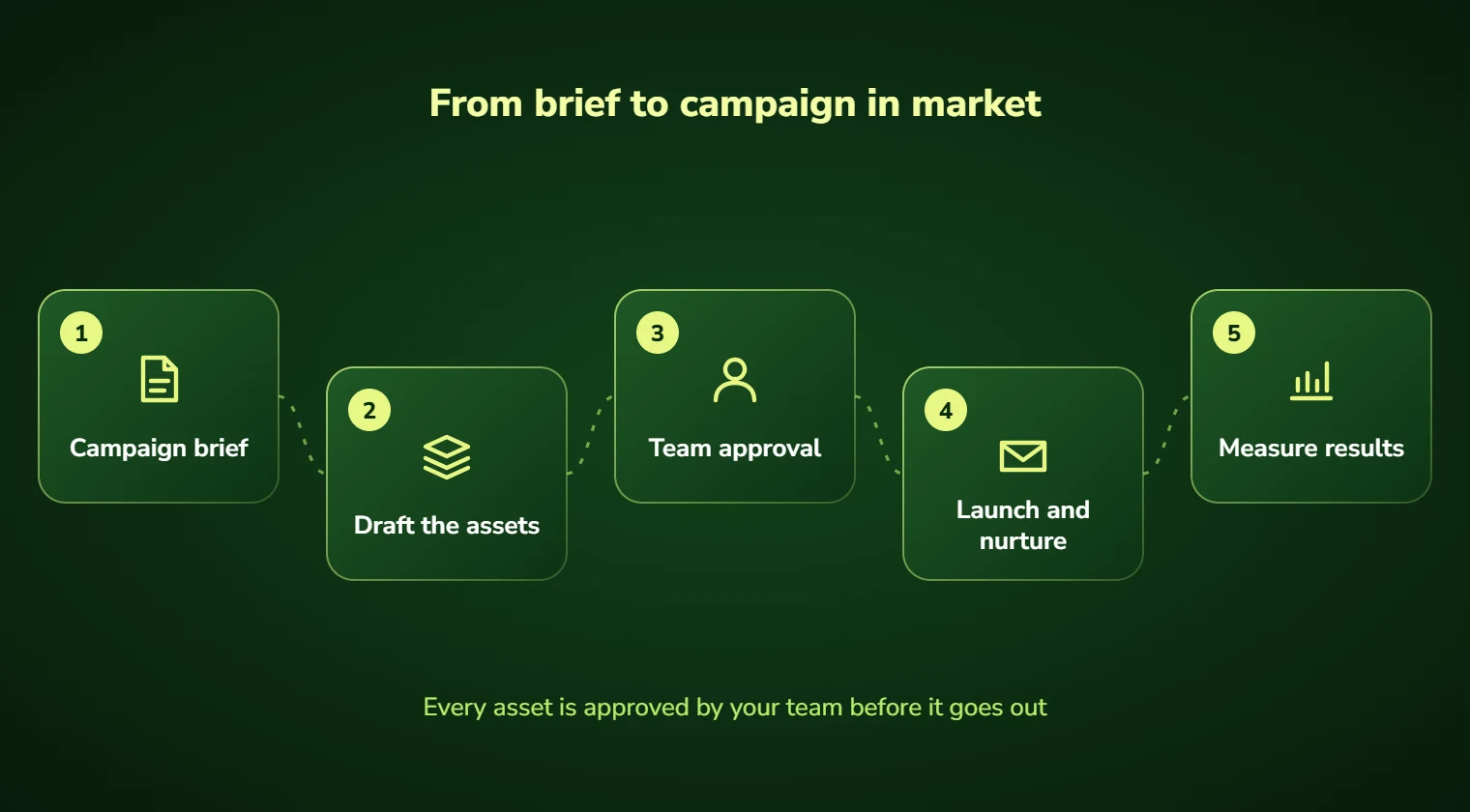
Voice is encoded from a corpus of your approved existing content rather than described with adjectives, which every model interprets differently. That produces materially more consistent output than prompting. Everything then routes to human review, and reviewer edits are captured as signal to improve subsequent generation.

Yes, and automated compliance checking is often the largest time saving rather than the generation itself. We build validation for prohibited claims, required disclaimers and regulated terminology specific to your industry, so obvious failures are caught before anything reaches legal review. Human compliance sign-off remains in the process.

HubSpot, Marketo, Klaviyo, Braze, Salesforce Marketing Cloud and most others through their APIs. We build into your existing stack rather than replacing it, a marketing platform migration is a separate and much larger project that should be justified on its own merits.

A content generation pipeline with brand encoding, compliance validation and review workflow typically runs $30,000 to $65,000. Adding feedback analysis and automated reporting increases that. For teams where content production is genuinely the constraint on campaign execution, the return is usually measured in campaigns shipped rather than cost saved.

Service Areas

Marketing Automation across the United States

We deliver marketing automation remotely to clients nationwide, with on-site workshops available in major metros.

Ready to scope your marketing automation project?

Book a free 30-minute consultation. Bring one workflow and leave with a realistic estimate of what it would cost to automate and what it would save.

Free 30-minute consultation
Fixed-scope pilots
U.S.-based team
Custom, not off-the-shelf
SOC 2-aligned practices
ROI tracked in writing
Free 30-minute AI consultation