Natural language processing services for business documents
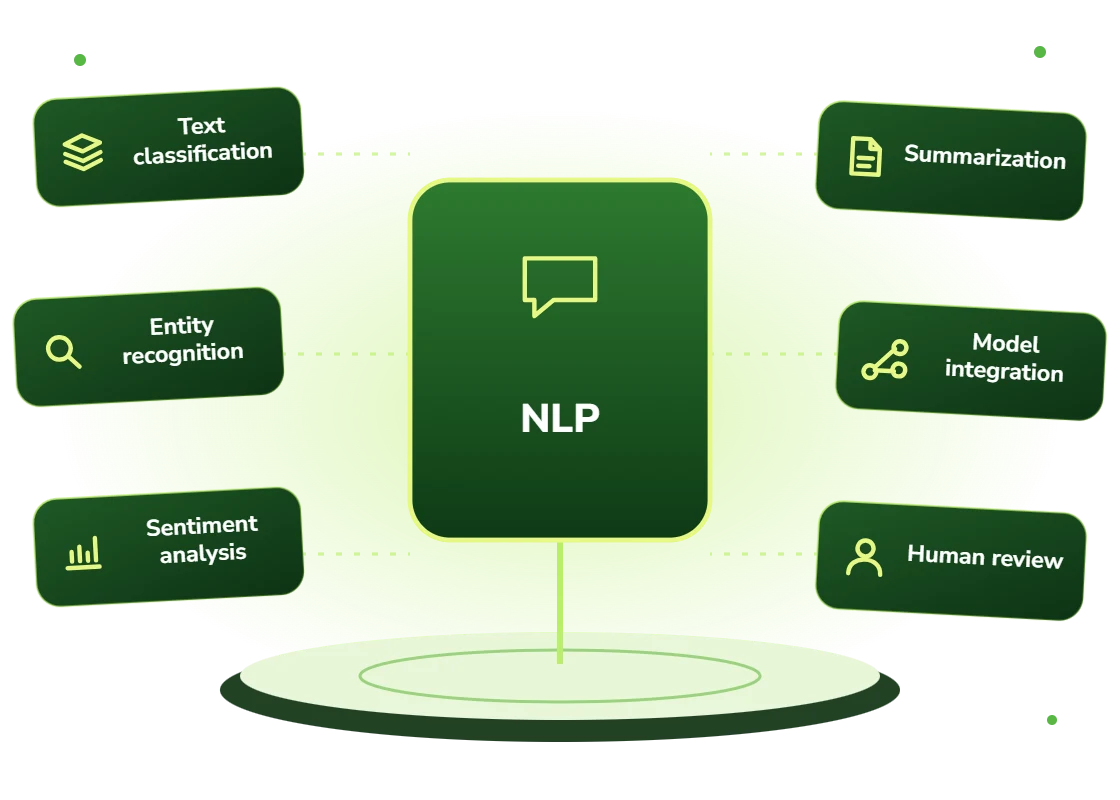
Our natural language processing services cover classification, extraction, routing and summarization. We compare approaches on your documents and choose a model that meets the required accuracy, latency and cost.
Natural language processing is the field of computing concerned with understanding and generating human language. In business applications it covers classifying text by category, extracting structured data from documents, analysing sentiment, summarizing long content, and matching text by meaning rather than keywords.
Every document going through the most expensive model available
The default architecture is one integration pointing every text task at whichever model was chosen first. Sentiment analysis, category assignment and field extraction all run through a model built for complex reasoning.
At low volume that is a rounding error. At a million documents a month it is the largest line in the AI budget, and most of it is unnecessary.
Measure the task, then pick the cheapest model that passes
We build an evaluation set for each task type, then test across model tiers to find the cheapest one that meets your accuracy bar. Frequently a small model performs equivalently on classification and extraction.
Where a task genuinely needs reasoning, it gets a capable model. The point is that the decision is made per task with evidence rather than once for everything.
Natural language processing services: scope and deliverables
Classification is the highest-volume application: routing tickets, categorizing documents, tagging content, detecting intent. It is also the task where model size matters least, which makes it the biggest cost-saving opportunity.
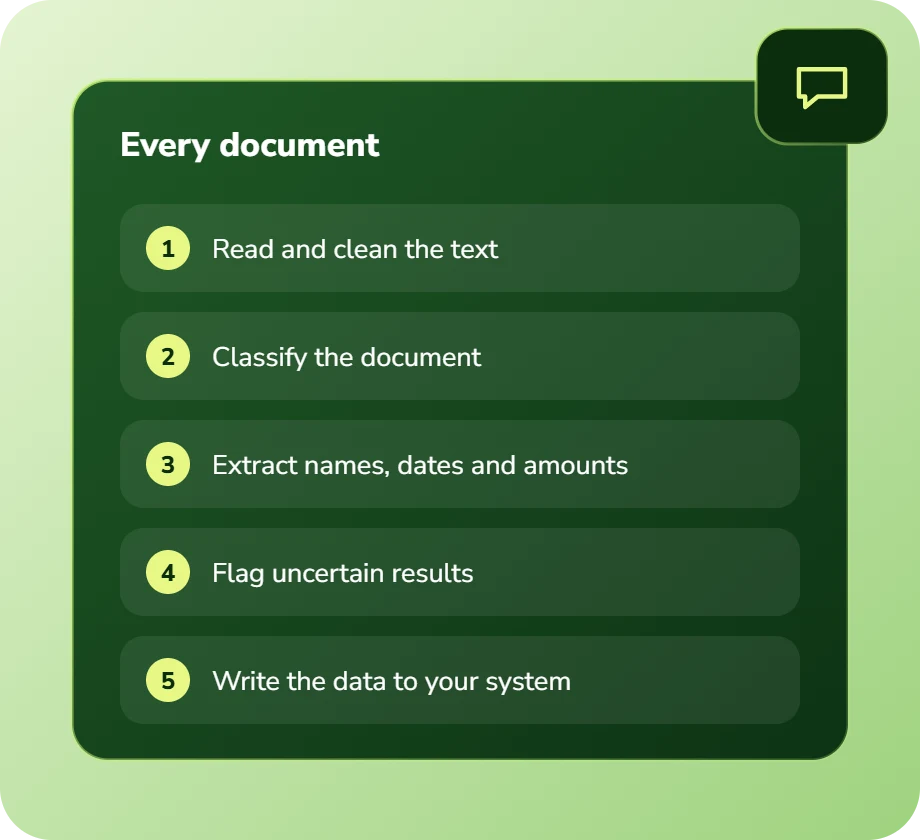
Extraction pulls structured data out of unstructured text: entities, dates, amounts, relationships. Schema enforcement matters here so downstream systems get reliable data.
Summarization and sentiment round it out, along with semantic matching for deduplication, similarity and search.
Across all of them, the engineering question is the same: what is the cheapest approach that meets the accuracy requirement for this specific task on this specific data.
- Classification: routing, categorization, intent detection, tagging at volume
- Extraction: entities, dates, amounts and relationships with schema validation
- Summarization of long documents, threads and transcripts
- Sentiment and theme analysis across feedback, reviews and support content
- Semantic similarity for deduplication, matching and clustering
- Model tier selection per task based on measured accuracy and cost
Who needs NLP work
Teams processing text at volume where per-document cost is material, and teams whose text processing accuracy is inconsistent without a clear diagnosis.
Also teams whose downstream systems keep breaking on malformed model output, which is a schema enforcement problem rather than a model problem.
- Operations classifying or extracting from thousands of documents monthly
- Teams whose text processing costs are growing faster than volume
- Companies analysing customer feedback, reviews or support content at scale
- Businesses whose downstream systems break on unstructured model output
- Organizations needing text processing in multiple languages
- Teams with text processing accuracy problems and no diagnosis
Benefits of natural language processing
Dramatically lower cost per document
Task-appropriate model selection typically cuts text processing spend by most of its original value.
Accuracy measured per task
An evaluation set per task type, so model choices are evidence-based rather than defaulted.
Output downstream can rely on
Schema enforcement and validation, so consuming systems stop handling malformed responses.
Multilingual without separate builds
Text in many languages handled by the same pipeline rather than by language-specific systems.
Throughput at volume
Batch processing and smaller models raise throughput as well as cutting cost.
Portable across providers
Built behind an abstraction so a better or cheaper model can be adopted with evidence.
Business challenges this solves
Text processing costs escalating
Every task on a frontier model. Task-appropriate routing cuts spend substantially.
Inconsistent classification accuracy
Quality varying with no diagnosis. Evaluation sets make the problem measurable.
Malformed output breaking systems
Downstream parsing failures. Schema enforcement guarantees valid structure.
Multilingual content underserved
Separate handling per language or none at all. One pipeline covers them.
Feedback never analysed
Thousands of reviews and tickets unread. Theme extraction at full coverage.
Throughput limits at peak
Rate limits capping volume. Batching and smaller models raise effective capacity.
Features and deliverables
Everything below is in scope on a standard engagement. Nothing here is an upsell discovered halfway through the build.
Task evaluation sets
Labelled examples per task type establishing an accuracy bar that model choices must meet.
Model tier benchmarking
Candidate models across price points tested on your data, so the cheapest adequate option is chosen with evidence.
Classification pipelines
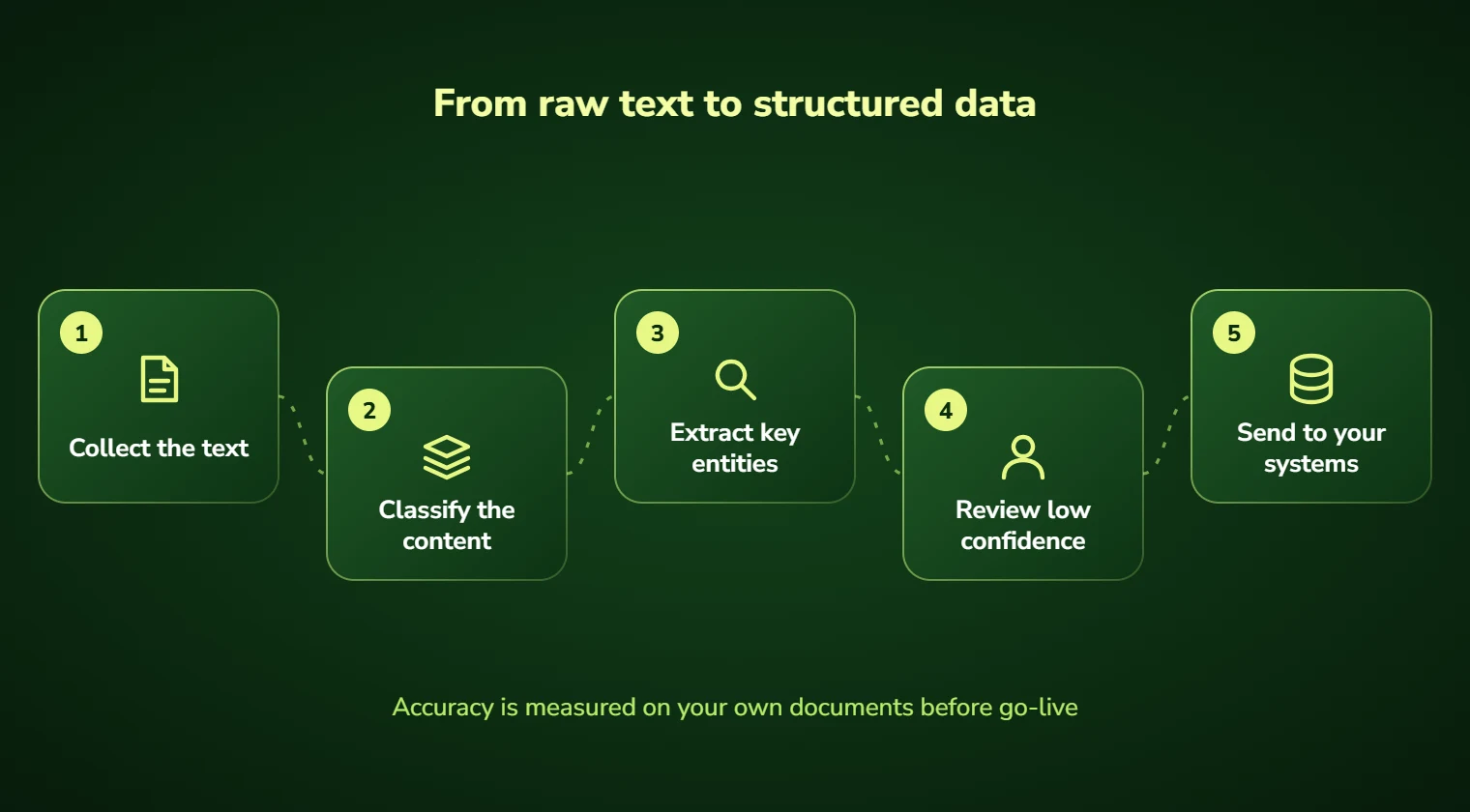
High-volume categorization and routing with confidence scoring and review routing for uncertain cases.
Structured extraction
Entity, date, amount and relationship extraction with schema validation and retry on malformed output.
Summarization
Long documents, email threads and transcripts summarized with configurable length and focus.
Sentiment and theme analysis
Feedback and review content analysed at full coverage for sentiment, themes and emerging issues.
Semantic matching
Similarity, deduplication and clustering using embeddings rather than expensive model comparison.
Batch processing
Latency-tolerant workloads routed through batch tiers at substantially lower cost.
Technologies we use for natural language processing
We are not tied to one vendor. Model and infrastructure choices are made on accuracy, cost per task, latency, and where your data is allowed to live.
Our AI development process
The same five stages on every engagement, so you always know what happens next and what you get at the end of it.
Discovery
We interview the people doing the work, map the workflow end to end, and audit the systems and data behind it.
AI Strategy
Every opportunity gets scored on cost to build, time to value, and annual savings, then ranked.
Pilot Build
We ship the top-ranked automation as a fixed-scope pilot so you see real output before committing further budget.
Implementation
Integration with your live systems, staff training, human-in-the-loop review gates, and a documented rollback path.
Optimization
Monthly accuracy reviews, prompt and retrieval tuning, and a written report on hours and dollars saved.
How long it takes
A typical first engagement, week by week. Complex integrations and regulated environments extend this, and we say so during discovery rather than after.
Discovery and scoping
Process observation, systems audit, data review, and a written estimate of cost and expected saving before anything is built.
Design sign-off
Architecture, data handling rules, review thresholds and success measures agreed in writing.
Build and integration
Development against your real data, connected to your live systems, with weekly demos rather than a single reveal.
Parallel run and testing
The system runs alongside the existing process so accuracy can be compared directly before anyone depends on it.
Launch and handover
Cutover with a rollback path, staff training, full documentation, then 30 days of included tuning.
Industries we deliver natural language processing for
SaaS & Technology
AI features inside your product, support deflection, onboarding assistants, and usage analytics.
Financial Services
Document extraction, reconciliation, KYC support, and audit-ready reporting with full traceability.
Insurance
First-notice-of-loss intake, claims triage, policy Q&A, and fraud signal detection.
Healthcare
Intake, prior authorization, clinical documentation, and revenue-cycle workflows built to respect HIPAA boundaries.
Legal
Contract review, discovery triage, and matter intake with citation-checked outputs and attorney sign-off gates.
Retail & E-commerce
Product data enrichment, demand forecasting, support deflection, and personalized merchandising.
Logistics & Supply Chain
Document processing, carrier communication, exception handling, and inventory rebalancing.
Professional Services
Proposal drafting, timesheet capture, research synthesis, and client reporting at scale.
Real-world use cases
Support ticket classification
High-volume categorization and routing at a fraction of frontier-model cost.
Document type identification
Inbound documents classified and split before extraction, at scale.
Review and feedback analysis
Every review and survey response analysed for theme and sentiment rather than a sample.
Contract and clause extraction
Structured extraction of terms and obligations with schema-validated output.
Call and meeting summarization
Transcripts summarized into structured records for CRM and knowledge systems.
Record deduplication
Near-duplicate detection using embeddings across customer, product or document records.
Why choose DevSolutionsAI for natural language processing
Business case before build
Every recommendation carries an estimated cost, timeline, and annual savings figure. If the math does not work, we say so before you spend.
Vendor-neutral by design
We resell nothing and take no platform commissions. Model and infrastructure choices are made on fit, cost, and your data-residency rules.
Fixed-scope pilots
The first engagement is a defined deliverable at a defined price, not an open-ended retainer that quietly grows each quarter.
Built for handover
You own the code, the prompts, the infrastructure, and the documentation. No lock-in to a proprietary wrapper you cannot leave.
Human-in-the-loop where it counts
Anything customer-facing, clinical, financial, or legal gets a review gate, a confidence threshold, and a logged audit trail.
Security reviewed early
Data flow diagrams, retention rules, and access boundaries are agreed in week one, not retrofitted after your security team objects.
Find out what natural language processing would cost you, before you commit to anything
Every engagement is quoted after a short discovery, so you get a fixed written price built around your actual volumes rather than a rate card that assumes someone else’s business.
The first call is thirty minutes and free. Bring one workflow. We will tell you what it is likely costing you each year, roughly what automating it would take, and whether we think it is worth doing at all.
- A written savings estimate before any paid work
- Fixed scope and fixed price, agreed up front
- Full ownership of everything we build for you
- An honest recommendation when the numbers do not work
Figures are internal measurements across recent engagements, reported to every client monthly in writing.
Illustrative project scenario
Cutting NLP cost 82% by routing tasks to the right model
Challenge. An insurer processed roughly 900,000 documents monthly across four text tasks: document type classification, field extraction, urgency scoring and duplicate detection. All four ran on the same frontier model. Costs had become the largest line in their AI budget.
What we built. Evaluation sets built per task from human-labelled examples. Benchmarking established that classification and urgency scoring performed equivalently on a much smaller model, extraction performed equivalently on a mid-tier model, and duplicate detection did not need a chat model at all, embeddings did it better and far cheaper. Latency-tolerant work moved to batch processing.
Outcome. Total text processing cost fell 82%. Measured accuracy across all four tasks was statistically unchanged. Throughput improved because smaller models are faster and batch processing removed real-time rate limit pressure at peak.
Illustrative project scenario. The figures demonstrate how a project could be scoped and evaluated; they are not verified client results or an audited average.
What clients say about working with us
Natural Language Processing FAQs
Do we need a large language model for text classification?
Usually not, and this is where most NLP cost savings sit. Classification and simple extraction typically perform equivalently on much smaller models at a fraction of the price. We establish that with an evaluation set rather than assuming it, on a recent insurance engagement, routing four tasks to appropriate model tiers cut text processing cost by 82% with no measurable accuracy loss.
What is the most expensive common NLP mistake?
Using a chat model for similarity and deduplication instead of embeddings. Comparing documents by asking a language model whether they are similar costs orders of magnitude more than computing embedding similarity, and usually produces worse results. It is a surprisingly frequent pattern and one of the easiest large savings to capture.
How do you stop model output breaking our downstream systems?
Schema enforcement with validation and retry. Output is constrained to a defined structure, validated before it leaves the pipeline, and regenerated if invalid. Parsing free-text responses with regex is fragile and it is the usual cause of downstream breakage; structured output makes it a solved problem.
Can it handle multiple languages?
Yes, and generally through one pipeline rather than language-specific builds. Modern models handle many languages natively, though accuracy varies by language and we measure it per language rather than assuming uniformity. Where a language performs poorly we will tell you and design review accordingly.
How do you measure NLP accuracy?
With labelled evaluation sets per task, built from your actual data with human-verified correct answers. This is what makes model selection an engineering decision rather than a preference. Without it, questions like “can we use a cheaper model” have no answer, which is why teams default to the most expensive option.
What does NLP work cost?
A two-week assessment building evaluation sets and benchmarking model tiers runs $8,000 to $15,000, and typically identifies substantial cost savings on its own. A full pipeline implementation runs $32,000 to $70,000 depending on task count and integration requirements. For high-volume operations the assessment frequently pays for itself several times over in the first year.
Services that pair well with this one
Most clients combine two or three of these. We will tell you the right sequence during discovery.
Ready to scope your natural language processing project?
Book a free 30-minute consultation. Bring one workflow and leave with a realistic estimate of what it would cost to automate and what it would save.