OpenAI integration services across the full model family, not just chat
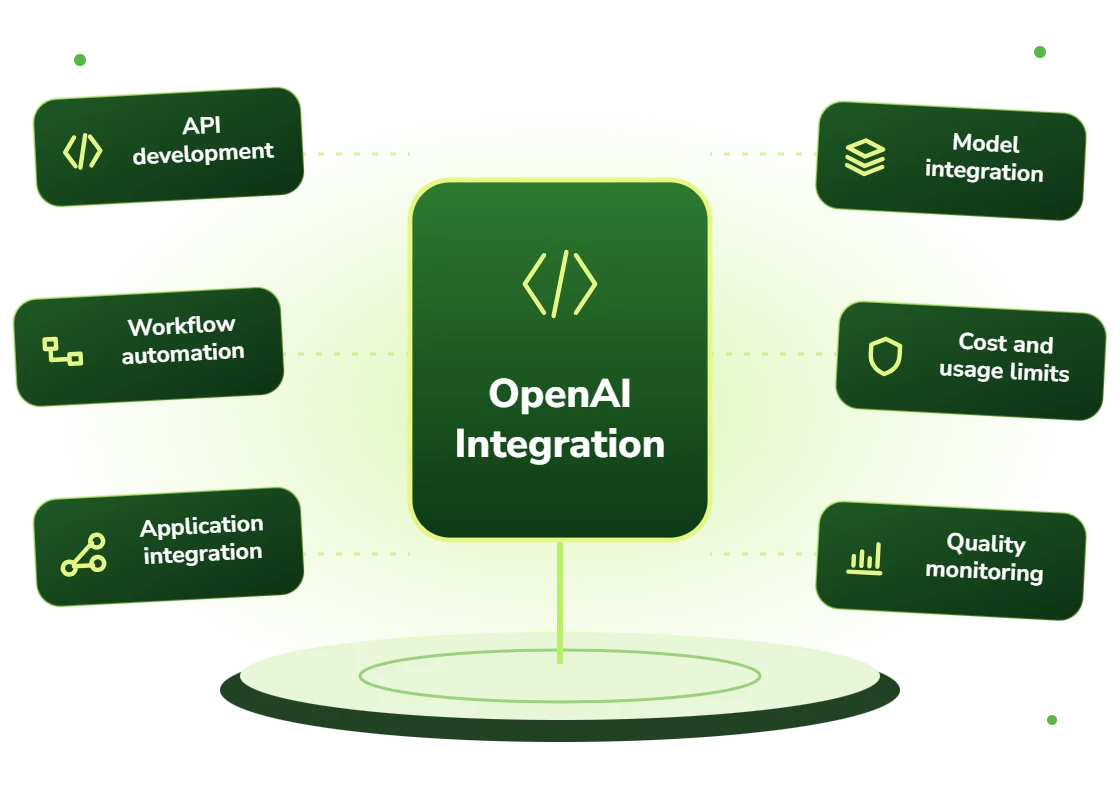
Our OpenAI integration services connect model capabilities to defined application workflows. We assess text, retrieval, image or audio requirements and design evaluation, system connections and usage controls around them.
OpenAI integration covers connecting any of OpenAI’s model APIs to business systems: GPT models for generation and reasoning, embedding models for semantic search and retrieval, vision models for image and document understanding, and speech models for transcription and synthesis. Production integration adds cost governance, evaluation, error handling and provider abstraction.
One model doing every job, expensively
The common pattern is a single integration pointing every request at the most capable model available. It works, and it costs several times what it needs to.
Classification, extraction and routing tasks run perfectly well on small models at a fraction of the price. Embedding tasks should not touch a chat model at all. Batch work that tolerates latency has its own much cheaper pricing tier that most integrations never use.
Route by task, measure the result
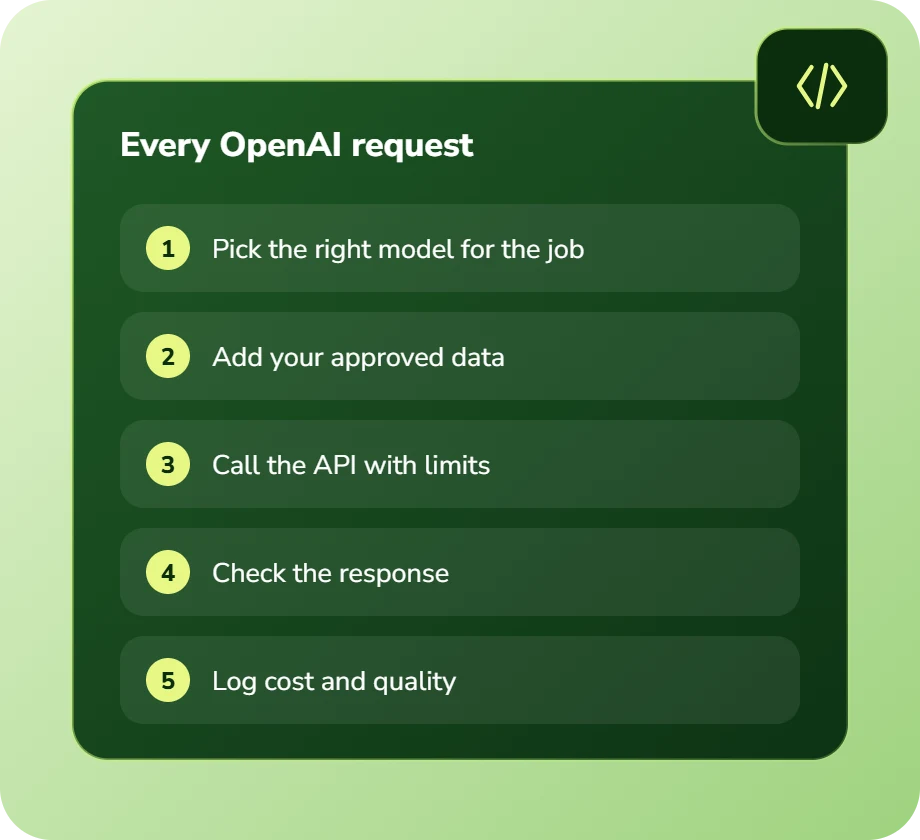
We profile your actual workload, then route each task type to the cheapest model that meets a measured quality bar. That bar is set with an evaluation suite, not by impression.
The savings are usually substantial and entirely invisible to users, because the routing only downgrades tasks where the smaller model scored equivalently on your own test cases.
OpenAI integration services: scope and deliverables
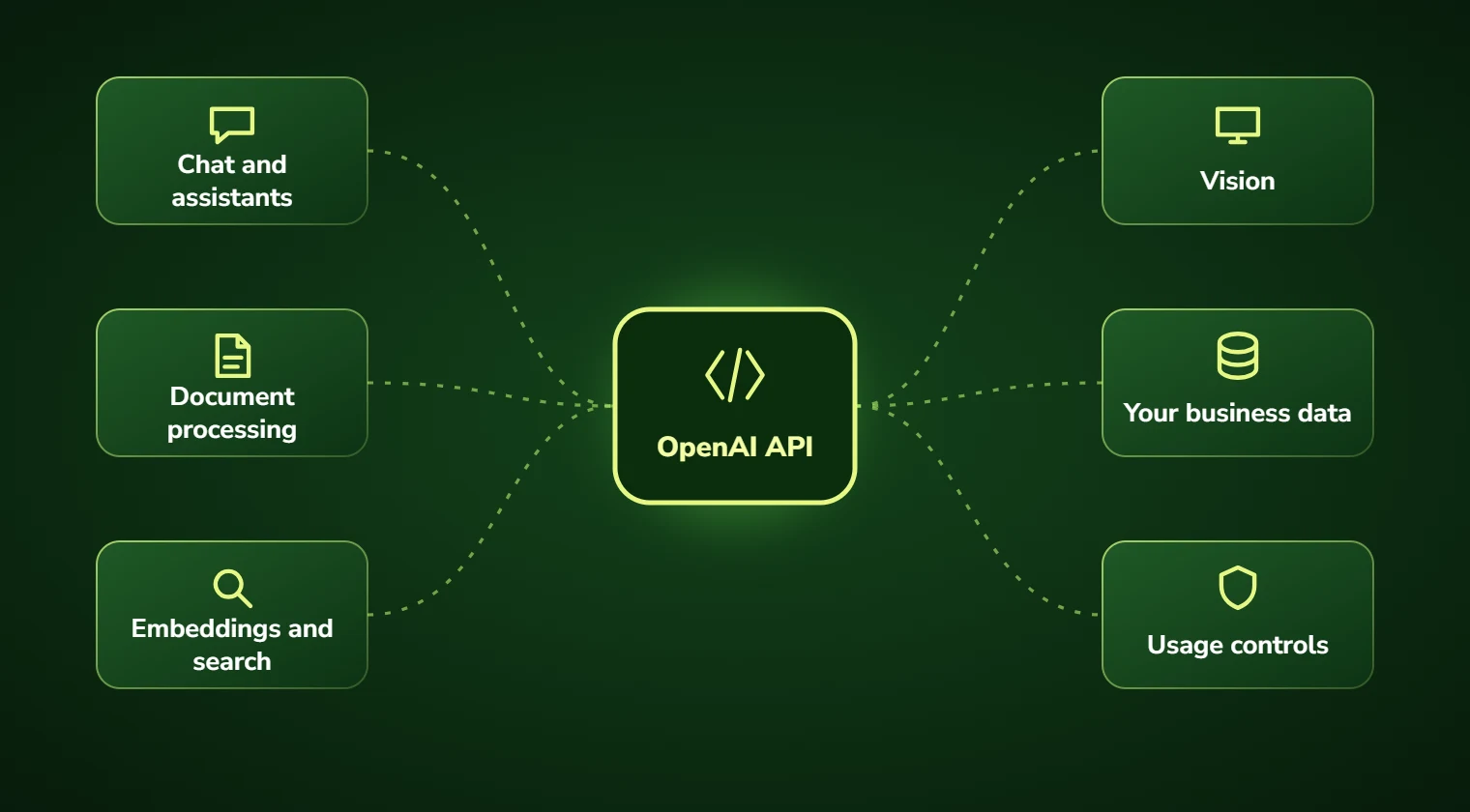
The model family is broader than most integrations use. Embeddings power semantic search and retrieval far more cheaply than asking a chat model to compare things. Vision models read documents and images. Speech models handle transcription and synthesis. Structured outputs guarantee schema-valid responses rather than prose you have to parse.
Batch processing deserves particular mention: for work that does not need an immediate answer, OpenAI’s batch tier is substantially cheaper. Overnight document processing, backfills and bulk classification are natural fits that most integrations run at full price.
Everything sits behind an abstraction layer, and for clients with compliance requirements we deploy through Azure OpenAI Service so data stays inside their Azure tenancy.
- GPT models for generation, reasoning, classification and tool calling
- Embedding models for semantic search, retrieval, clustering and deduplication
- Vision models for document, image and screenshot understanding
- Speech models for transcription and voice synthesis
- Structured outputs with schema validation for reliable downstream parsing
- Batch API for latency-tolerant work at substantially lower cost
For an assistant centered on ChatGPT, see ChatGPT integration services. This service focuses on API-powered capabilities embedded in your own systems.
Who needs OpenAI integration work
Engineering teams that have a working integration and now need it to be cheaper, more reliable, or better measured. Cost is usually the trigger.
And teams building something more involved than chat, document pipelines, semantic search, voice interfaces, where knowing which model to use for which step is most of the engineering.
- Teams whose OpenAI costs are growing faster than usage justifies
- Companies building document, search or voice systems on OpenAI models
- Organizations needing Azure OpenAI for data residency or compliance
- Engineering groups wanting evaluation before shipping prompt changes
- Teams hitting rate limits or reliability problems at scale
- Businesses that need structured, schema-valid output rather than prose
Benefits of OpenAI integration
Substantially lower cost
Task-appropriate model routing, batch processing and caching typically cut spend by half or more with no quality change.
The right model per task
Embeddings for search, vision for documents, small models for classification, rather than one expensive model doing everything.
Output you can parse reliably
Structured outputs with schema validation, so downstream code stops handling malformed responses.
Quality measured, not assumed
Evaluation suites so a model downgrade or prompt change is validated against real cases before shipping.
Compliance-ready deployment
Azure OpenAI Service where data must stay inside your tenancy, with the same integration code.
Resilient under load
Rate limit handling, retries with backoff, fallback routing and circuit breakers built in.
Business challenges this solves
Every request hitting the top model
Expensive models doing trivial classification. Task-based routing cuts cost dramatically without quality loss.
Rate limits at peak
Throughput capped by tier limits. Batching, queuing and multi-key routing raise effective capacity.
Parsing prose into data
Fragile regex over free-text responses. Structured outputs guarantee schema-valid data.
Bulk work at real-time prices
Overnight processing paying full rate. The batch tier is substantially cheaper for latency-tolerant work.
Compliance blocking deployment
Data residency rules preventing use. Azure OpenAI keeps data inside your own tenancy.
Prompt changes shipped blind
No way to tell if a change helped. Evaluation suites make it measurable.
Features and deliverables
Everything below is in scope on a standard engagement. Nothing here is an upsell discovered halfway through the build.
Workload profiling
Analysis of your actual request mix by task type, volume and complexity, which drives every routing decision.
Model routing
Task-appropriate model selection validated against an evaluation suite, so cheaper models are only used where they measure equivalently.
Embedding pipelines
Embedding generation, storage and search for retrieval, clustering, deduplication and similarity matching.
Vision and document processing
Image and document understanding pipelines with preprocessing and confidence-based routing.
Speech integration
Transcription and synthesis for voice interfaces, call analysis and accessibility features.
Structured output enforcement
JSON schema definitions with validation and retry, so downstream systems receive reliable data.
Batch processing
Latency-tolerant work routed through the batch API at substantially lower cost, with job orchestration and monitoring.
Azure OpenAI deployment
Deployment through Azure where data residency, compliance or existing Azure commitments require it.
Technologies we use for OpenAI integration
We are not tied to one vendor. Model and infrastructure choices are made on accuracy, cost per task, latency, and where your data is allowed to live.
Our AI development process
The same five stages on every engagement, so you always know what happens next and what you get at the end of it.
Discovery
We interview the people doing the work, map the workflow end to end, and audit the systems and data behind it.
AI Strategy
Every opportunity gets scored on cost to build, time to value, and annual savings, then ranked.
Pilot Build
We ship the top-ranked automation as a fixed-scope pilot so you see real output before committing further budget.
Implementation
Integration with your live systems, staff training, human-in-the-loop review gates, and a documented rollback path.
Optimization
Monthly accuracy reviews, prompt and retrieval tuning, and a written report on hours and dollars saved.
How long it takes
A typical first engagement, week by week. Complex integrations and regulated environments extend this, and we say so during discovery rather than after.
Discovery and scoping
Process observation, systems audit, data review, and a written estimate of cost and expected saving before anything is built.
Design sign-off
Architecture, data handling rules, review thresholds and success measures agreed in writing.
Build and integration
Development against your real data, connected to your live systems, with weekly demos rather than a single reveal.
Parallel run and testing
The system runs alongside the existing process so accuracy can be compared directly before anyone depends on it.
Launch and handover
Cutover with a rollback path, staff training, full documentation, then 30 days of included tuning.
Industries we deliver OpenAI integration for
SaaS & Technology
AI features inside your product, support deflection, onboarding assistants, and usage analytics.
Financial Services
Document extraction, reconciliation, KYC support, and audit-ready reporting with full traceability.
Retail & E-commerce
Product data enrichment, demand forecasting, support deflection, and personalized merchandising.
Healthcare
Intake, prior authorization, clinical documentation, and revenue-cycle workflows built to respect HIPAA boundaries.
Logistics & Supply Chain
Document processing, carrier communication, exception handling, and inventory rebalancing.
Manufacturing
Quality inspection, maintenance prediction, supplier communication, and production scheduling.
Professional Services
Proposal drafting, timesheet capture, research synthesis, and client reporting at scale.
Insurance
First-notice-of-loss intake, claims triage, policy Q&A, and fraud signal detection.
Real-world use cases
High-volume classification
Inbound email, ticket and document classification routed to small models at a fraction of frontier pricing.
Semantic search backend
Embedding generation and similarity search replacing keyword-only matching across content and products.
Document understanding
Vision models reading invoices, forms and scans, with structured output written directly into systems.
Call transcription and analysis
Sales and support calls transcribed, summarized and analysed for themes, objections and compliance.
Overnight bulk processing
Catalogue enrichment, backfills and bulk classification run through the batch tier at lower cost.
Content generation pipelines
Product descriptions, summaries and drafts generated at scale with structured output and review workflow.
Why choose DevSolutionsAI for OpenAI integration
Business case before build
Every recommendation carries an estimated cost, timeline, and annual savings figure. If the math does not work, we say so before you spend.
Vendor-neutral by design
We resell nothing and take no platform commissions. Model and infrastructure choices are made on fit, cost, and your data-residency rules.
Fixed-scope pilots
The first engagement is a defined deliverable at a defined price, not an open-ended retainer that quietly grows each quarter.
Built for handover
You own the code, the prompts, the infrastructure, and the documentation. No lock-in to a proprietary wrapper you cannot leave.
Human-in-the-loop where it counts
Anything customer-facing, clinical, financial, or legal gets a review gate, a confidence threshold, and a logged audit trail.
Security reviewed early
Data flow diagrams, retention rules, and access boundaries are agreed in week one, not retrofitted after your security team objects.
Find out what OpenAI integration would cost you, before you commit to anything
Every engagement is quoted after a short discovery, so you get a fixed written price built around your actual volumes rather than a rate card that assumes someone else’s business.
The first call is thirty minutes and free. Bring one workflow. We will tell you what it is likely costing you each year, roughly what automating it would take, and whether we think it is worth doing at all.
- A written savings estimate before any paid work
- Fixed scope and fixed price, agreed up front
- Full ownership of everything we build for you
- An honest recommendation when the numbers do not work
Figures are internal measurements across recent engagements, reported to every client monthly in writing.
Illustrative project scenario
Cutting OpenAI spend 71% with no measurable quality change
Challenge. A platform enriching product data with AI was spending heavily and growing. Every request, category classification, attribute extraction, description generation, duplicate detection, went to the same frontier model in real time.
What we built. Workload profiling showed 78% of requests were classification and extraction. We built an evaluation suite from human-labelled examples, established that a much smaller model scored equivalently on those task types, and routed accordingly. Duplicate detection moved to embeddings rather than chat comparison, and nightly catalogue enrichment moved to the batch API.
Outcome. Total OpenAI spend fell 71%. Measured quality on the evaluation suite was statistically unchanged across all task types. Throughput increased because smaller models are faster and the batch tier removed real-time rate limit pressure.
Illustrative project scenario. The figures demonstrate how a project could be scoped and evaluated; they are not verified client results or an audited average.
What clients say about working with us
OpenAI Integration FAQs
How do you reduce OpenAI API costs?
Four levers, in rough order of impact. Task-based model routing, since classification and extraction usually run equivalently on much smaller models. Semantic caching, so repeated similar requests are not re-inferred. The batch API for latency-tolerant work, which is substantially cheaper. And prompt efficiency, since context length drives cost directly. On a recent engagement these combined to cut spend 71% with no measurable quality change.
Should we use OpenAI direct or Azure OpenAI?
Azure OpenAI if you have existing Azure commitments, need data to stay inside your own tenancy, or have compliance requirements that direct API access cannot satisfy. Direct if you want the newest models as they release, since Azure availability typically lags. We build the same integration code against either, so the decision is not irreversible.
Is our data used to train OpenAI models?
Data submitted through the API is not used for training by default under OpenAI’s API data usage policy, which differs from the consumer product terms. Zero-retention endpoints are available for eligible use cases, and Azure OpenAI keeps data within your Azure tenancy. We verify the current terms during design rather than relying on what was accurate previously.
Which OpenAI model should we use?
Almost never just one. Complex reasoning and multi-step tool use justify frontier models. High-volume classification, extraction and routing usually run equivalently on much smaller and cheaper ones. Embeddings should handle semantic search rather than a chat model. We profile your workload and validate each routing decision against an evaluation suite rather than guessing.
How do you handle rate limits at scale?
Request queuing with priority tiers, exponential backoff on 429 responses, routing across multiple deployments or keys, and moving latency-tolerant work to the batch API which has separate limits. Where throughput requirements are genuinely high we will also discuss tier upgrades with usage projections, since that is sometimes simply the correct answer.
Can you help if we already have an OpenAI integration?
That is a large share of this work. Common engagements are cost reduction through routing and caching, adding evaluation so changes can be validated, improving reliability under load, migrating to Azure for compliance, and refactoring behind an abstraction layer so provider choice stops being permanent.
Services that pair well with this one
Most clients combine two or three of these. We will tell you the right sequence during discovery.
Ready to scope your OpenAI integration project?
Book a free 30-minute consultation. Bring one workflow and leave with a realistic estimate of what it would cost to automate and what it would save.