Prompt Engineering Services

Prompt engineering services with a way to tell whether it worked

Our prompt engineering services start with an evaluation set drawn from your tasks. Version control and regression checks help measure whether a prompt change improves quality without breaking other cases.

Free 30-minute consultation
Fixed-scope pilots
U.S.-based team
Custom, not off-the-shelf
SOC 2-aligned practices
ROI tracked in writing
What is prompt engineering?

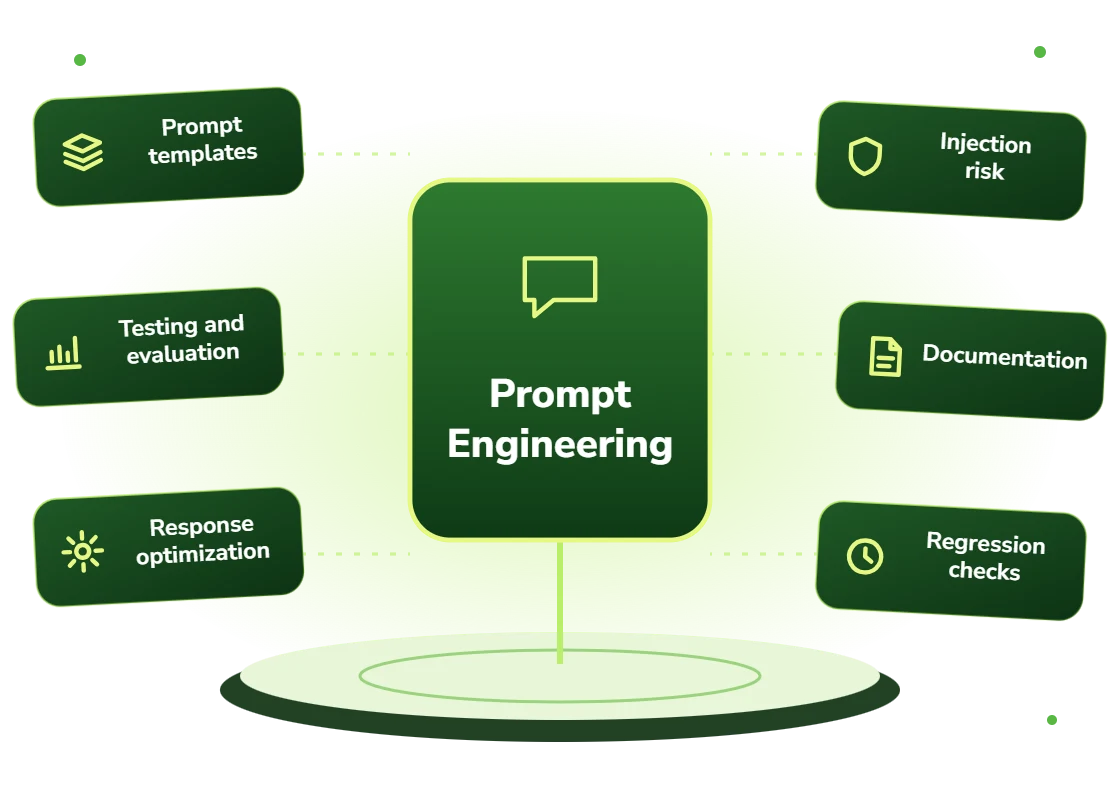
Prompt engineering is the systematic design and optimization of the instructions given to a language model to improve output quality, consistency and cost. Done professionally it includes building evaluation sets with known-good outputs, version-controlling prompts, and running regression tests so changes are measured rather than assessed by impression.

7+
Years building AI systems
240+
Projects delivered
4.8
Avg. months to payback
38
U.S. states served
The Problem

Prompt changes that fix one thing and break three

The usual workflow is: someone notices a bad output, edits the prompt until that case works, and ships it. Nobody checks the other cases, because there is no way to.

Quality then drifts in both directions invisibly. Six months later the prompt is a thousand words of accumulated patches, nobody knows which parts matter, and everyone is afraid to touch it.

Our Approach

Evaluate first, then optimize

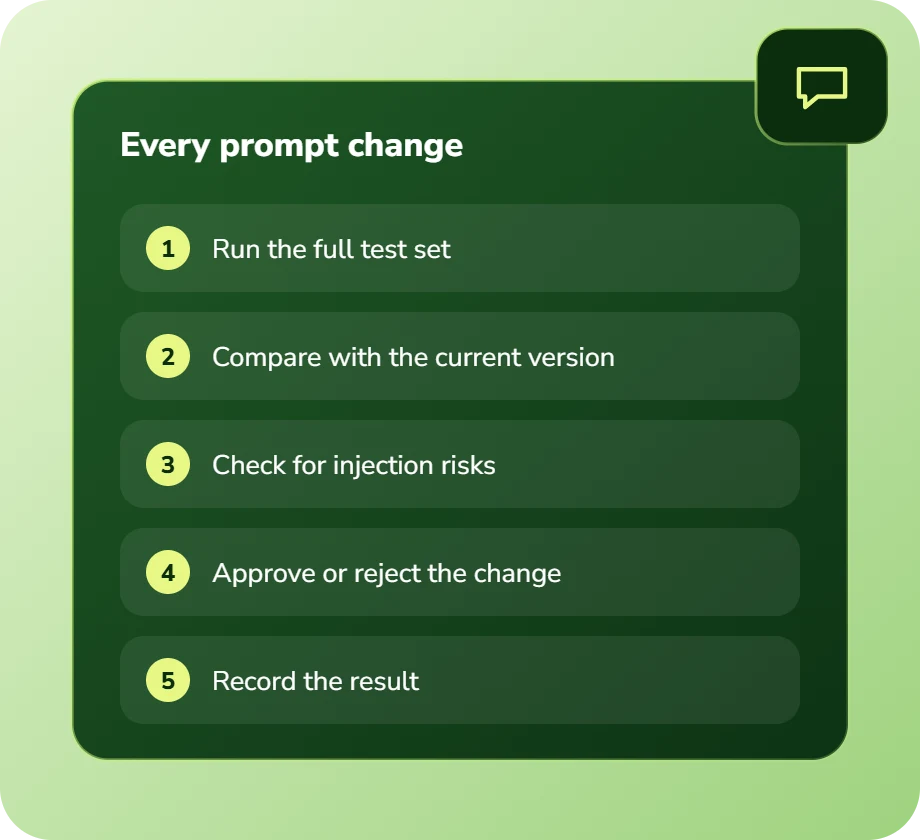
We build an evaluation set from your real cases with known-good outputs, establishing a baseline score. Every prompt change is then scored against the full set rather than the one case that prompted it.

That makes prompt work an engineering discipline: changes are measured, regressions are caught before deployment, and prompts live in version control with their test results.

Analytics illustration
Conceptual analytics illustration
Service Overview

Prompt engineering services: scope and deliverables

The evaluation infrastructure is the foundation and the part most teams skip. Without it, prompt engineering is people disagreeing about outputs, and there is no way to tell whether a change was an improvement.

Then optimization itself: structure, examples, output format enforcement, and reasoning approach. There are real techniques here that reliably outperform casual instruction-writing, and applying them systematically usually produces significant gains.

And cost. Prompt length drives token cost directly, so a prompt that is half the size at equal quality halves that portion of your bill. On high-volume workloads this is frequently the largest available saving.

  • Evaluation set built from real cases with verified correct outputs
  • Baseline measurement before any change is made
  • Systematic optimization: structure, examples, format enforcement, reasoning approach
  • Token reduction at equal or better quality
  • Version control with test results attached to every prompt version
  • Regression testing in CI so a bad change cannot reach production
Right Fit

Who needs prompt engineering work

Teams whose output quality is inconsistent, where nobody can say why or whether changes help. The evaluation work alone usually resolves the confusion.

And teams with high-volume workloads where token costs are material, since prompt efficiency is frequently the cheapest large saving available.

  • Teams whose LLM output quality varies unpredictably
  • Organizations shipping prompt changes with no regression testing
  • High-volume workloads where token cost is a material line item
  • Products where output format must be reliable for downstream systems
  • Teams whose prompts have grown into unmaintainable accumulated patches
  • Companies wanting to move to a cheaper model without losing quality
Benefits

Benefits of prompt engineering services

Improvement you can prove

A baseline and a score, so “is this better” has an answer rather than an opinion.

No silent regressions

Every change scored against the full set, so fixing one case cannot quietly break five others.

Lower token costs

Prompt efficiency at equal quality, frequently the largest single cost saving on high-volume workloads.

Cheaper models made viable

Good prompting often lets a smaller model match a larger one on your task, which changes the economics substantially.

Reliable output format

Schema enforcement and validation so downstream systems stop handling malformed responses.

Maintainable prompts

Version control, documented reasoning and tests, so prompts stop being untouchable accumulated patches.

Problems We Solve

Business challenges this solves

01

Fixes that break other cases

Patching one output and breaking others invisibly. Regression sets catch it before deployment.

02

No way to compare approaches

Arguments about which prompt is better. Scoring settles it with evidence.

03

Token costs growing with prompt length

Bloated prompts driving spend. Efficiency work cuts cost at equal quality.

04

Output format unreliable

Downstream parsing failures. Schema enforcement and validation make output dependable.

05

Prompts nobody dares change

A thousand words of accumulated patches. Tests make refactoring safe.

06

Stuck on an expensive model

Assuming the large model is required. Better prompting often makes a cheaper one sufficient.

What's Included

Features and deliverables

Everything below is in scope on a standard engagement. Nothing here is an upsell discovered halfway through the build.

01

Evaluation set construction

Real cases with verified correct outputs, covering both typical and edge scenarios, built with your subject-matter experts.

02

Baseline measurement

Current performance scored before any change, so improvement is measured against a known starting point.

03

Systematic optimization

Structured prompting, few-shot example selection, reasoning approach and instruction ordering applied methodically.

04

Output schema enforcement

Structured output definitions with validation and retry, so downstream systems receive reliable data.

05

Token efficiency

Prompt compression at equal quality, plus context pruning and caching where repeated context allows.

06

Model comparison

The optimized prompt tested across models so a cheaper option can be adopted with evidence rather than hope.

07

Prompt version control

Prompts as versioned artefacts with test results, change reasoning and rollback attached.

08

CI regression testing

Evaluation running automatically on every prompt change so regressions are blocked before deployment.

Technology Stack

Technologies we use for prompt engineering services

We are not tied to one vendor. Model and infrastructure choices are made on accuracy, cost per task, latency, and where your data is allowed to live.

Language Models
C
Claude (Anthropic)
G
GPT (OpenAI)
G
Gemini (Google)
L
Llama
M
Mistral
A
Azure OpenAI Service
Vector & Retrieval
P
Pinecone
W
Weaviate
Q
Qdrant
p
pgvector
E
Elasticsearch
A
Amazon OpenSearch
Data & Backend
P
Python
T
TypeScript / Node.js
P
PostgreSQL
S
Snowflake
d
dbt
A
Apache Airflow
How We Work

Our AI development process

The same five stages on every engagement, so you always know what happens next and what you get at the end of it.

01

Discovery

We interview the people doing the work, map the workflow end to end, and audit the systems and data behind it.

02

AI Strategy

Every opportunity gets scored on cost to build, time to value, and annual savings, then ranked.

03

Pilot Build

We ship the top-ranked automation as a fixed-scope pilot so you see real output before committing further budget.

04

Implementation

Integration with your live systems, staff training, human-in-the-loop review gates, and a documented rollback path.

05

Optimization

Monthly accuracy reviews, prompt and retrieval tuning, and a written report on hours and dollars saved.

Timeline

How long it takes

A typical first engagement, week by week. Complex integrations and regulated environments extend this, and we say so during discovery rather than after.

Week 1

Evaluation set build

Real cases collected with your experts, correct outputs verified, baseline measured.

Weeks 2 to 3

Optimization

Systematic prompt improvement scored against the full set on every iteration.

Week 4

Cost and model testing

Token reduction and cheaper-model viability tested against the same quality bar.

Week 5

Infrastructure and handover

Version control, CI regression testing, documentation and team enablement.

Who We Work With

Industries we deliver prompt engineering services for

SaaS & Technology

AI features inside your product, support deflection, onboarding assistants, and usage analytics.

Financial Services

Document extraction, reconciliation, KYC support, and audit-ready reporting with full traceability.

Healthcare

Intake, prior authorization, clinical documentation, and revenue-cycle workflows built to respect HIPAA boundaries.

Retail & E-commerce

Product data enrichment, demand forecasting, support deflection, and personalized merchandising.

Legal

Contract review, discovery triage, and matter intake with citation-checked outputs and attorney sign-off gates.

Insurance

First-notice-of-loss intake, claims triage, policy Q&A, and fraud signal detection.

Professional Services

Proposal drafting, timesheet capture, research synthesis, and client reporting at scale.

Manufacturing

Quality inspection, maintenance prediction, supplier communication, and production scheduling.

Use Cases

Real-world use cases

01

Classification accuracy improvement

Raising accuracy on ticket, document or content classification without changing model.

02

Extraction reliability

Making field extraction consistent and schema-valid so downstream systems can depend on it.

03

Cost reduction at volume

Cutting token spend on high-volume workloads through prompt efficiency and caching.

04

Model downgrade validation

Proving a smaller cheaper model performs equivalently on your task with better prompting.

05

Tone and brand consistency

Making generated content match voice reliably rather than varying by request.

06

Evaluation capability build

Establishing the measurement infrastructure an internal team needs to iterate safely.

Why DevSolutionsAI

Why choose DevSolutionsAI for prompt engineering services

Business case before build

Every recommendation carries an estimated cost, timeline, and annual savings figure. If the math does not work, we say so before you spend.

Vendor-neutral by design

We resell nothing and take no platform commissions. Model and infrastructure choices are made on fit, cost, and your data-residency rules.

Fixed-scope pilots

The first engagement is a defined deliverable at a defined price, not an open-ended retainer that quietly grows each quarter.

Built for handover

You own the code, the prompts, the infrastructure, and the documentation. No lock-in to a proprietary wrapper you cannot leave.

Human-in-the-loop where it counts

Anything customer-facing, clinical, financial, or legal gets a review gate, a confidence threshold, and a logged audit trail.

Security reviewed early

Data flow diagrams, retention rules, and access boundaries are agreed in week one, not retrofitted after your security team objects.

Get Started

Find out what prompt engineering services would cost you, before you commit to anything

Every engagement is quoted after a short discovery, so you get a fixed written price built around your actual volumes rather than a rate card that assumes someone else’s business.

The first call is thirty minutes and free. Bring one workflow. We will tell you what it is likely costing you each year, roughly what automating it would take, and whether we think it is worth doing at all.

  • A written savings estimate before any paid work
  • Fixed scope and fixed price, agreed up front
  • Full ownership of everything we build for you
  • An honest recommendation when the numbers do not work
What clients typically see
Across recent projects
Staff hours saved each week
31
Months to payback
4.8
Client retention
94%
Response to enquiries
4 hrs

Figures are internal measurements across recent engagements, reported to every client monthly in writing.

Illustrative project scenario

Illustrative project scenario

Fintech · 2.4M classifications/month

Same accuracy on a model costing a twentieth as much

Challenge. A fintech classified 2.4 million transaction descriptions monthly using a frontier model, assuming the task required it. Accuracy was acceptable but costs were growing with transaction volume, and nobody had tested whether a smaller model would suffice because there was no way to compare.

What we built. An evaluation set of 3,000 human-labelled transactions covering common and edge cases, establishing a baseline. Systematic prompt optimization, structured output enforcement, carefully selected few-shot examples, and reduced instruction verbosity, was then tested across five models at different price points.

Outcome. The optimized prompt on a small model matched the original frontier-model accuracy within statistical noise, at roughly one twentieth of the per-request cost. Prompt length was also reduced by 61%, compounding the saving. Regression tests now run in CI on every prompt change.

~95%
Cost reduction
−61%
Prompt token length
0
Accuracy loss measured
3,000
Labelled evaluation cases

Illustrative project scenario. The figures demonstrate how a project could be scoped and evaluated; they are not verified client results or an audited average.

Client Feedback

What clients say about working with us

31
Avg. staff hours saved weekly
4.8
Avg. months to payback
94%
Client retention
4
Hour response to enquiries
Common Questions

Prompt Engineering Services FAQs

More relevant, not less, though the emphasis has shifted. Newer models need less coaxing to produce reasonable output, which means the value has moved from getting it to work at all toward consistency, cost and reliability of format. The largest wins now are usually enabling a cheaper model to match an expensive one, and cutting token spend at equal quality, both of which require measurement rather than intuition.
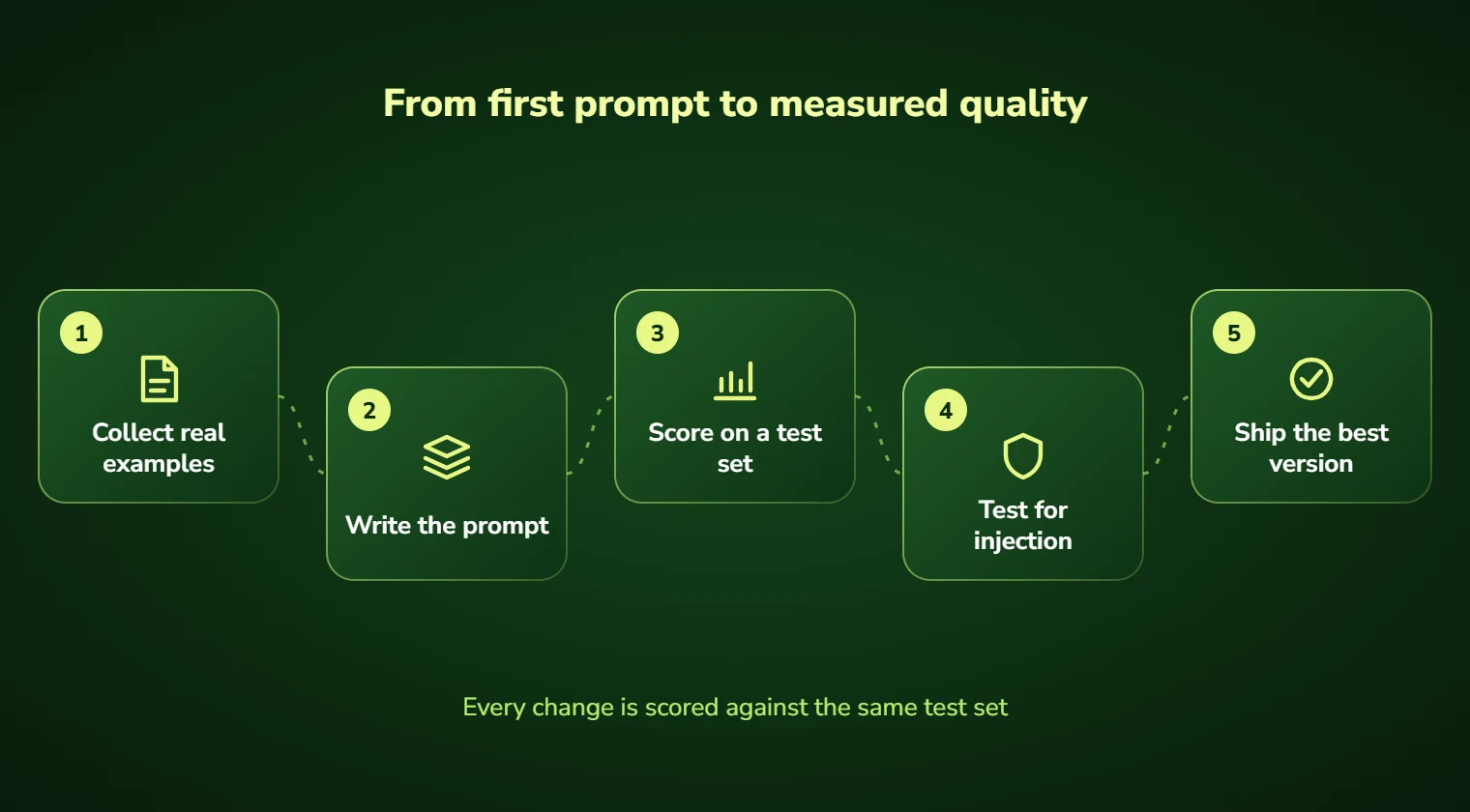
Because without one you cannot tell whether a prompt change helped. The standard workflow, notice a bad output, edit the prompt until that case works, ship it, has no visibility into whether five other cases broke. Building the evaluation set is usually the highest-value part of the engagement, and it is infrastructure your team keeps and uses long after we are gone.

It varies with how unoptimized the starting point is, and we will not quote a figure before measuring. On a recent fintech engagement, prompt optimization plus a validated model downgrade cut per-request cost by roughly 95% with no measurable accuracy loss. More typical results are in the 30 to 60% range. The audit gives you an estimate before you commit to the full engagement.

Frequently, yes, and it should always be tried first because it is far cheaper and updates instantly. Systematic prompting closes the gap in most cases where teams assume training is required. Fine-tuning retains genuine advantages for specialized output formats, domain-specific style, and getting small models to perform narrow tasks reliably, but those should be established by measurement rather than assumed.

Yes, and for teams developing LLM features continuously it is the better investment. The evaluation infrastructure in particular should be owned internally, because it is what makes ongoing iteration safe. We build it alongside your engineers and hand over the tooling, techniques and CI integration rather than creating a dependency.

A one to two week audit produces an evaluation set, a baseline and a quantified improvement estimate. A full optimization engagement including cost reduction, model testing, version control and CI integration takes four to five weeks. Ongoing optimization is available monthly, though many clients take it in-house after the initial engagement.

Service Areas

Prompt Engineering Services across the United States

We deliver prompt engineering services remotely to clients nationwide, with on-site workshops available in major metros.

Ready to scope your prompt engineering services project?

Book a free 30-minute consultation. Bring one workflow and leave with a realistic estimate of what it would cost to automate and what it would save.

Free 30-minute consultation
Fixed-scope pilots
U.S.-based team
Custom, not off-the-shelf
SOC 2-aligned practices
ROI tracked in writing
Free 30-minute AI consultation