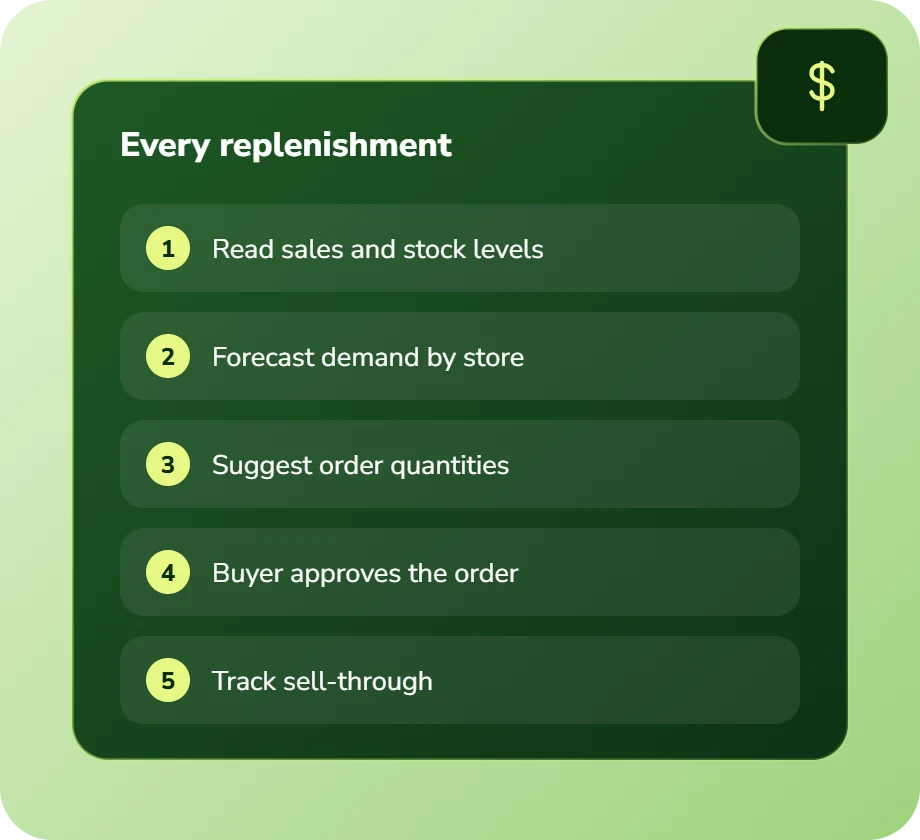
Retail AI solutions aimed at conversion, margin and returns
Our retail AI solutions focus on product data, search relevance, demand forecasting and support. We start with a measurable outcome and test whether the proposed workflow can contribute to it.
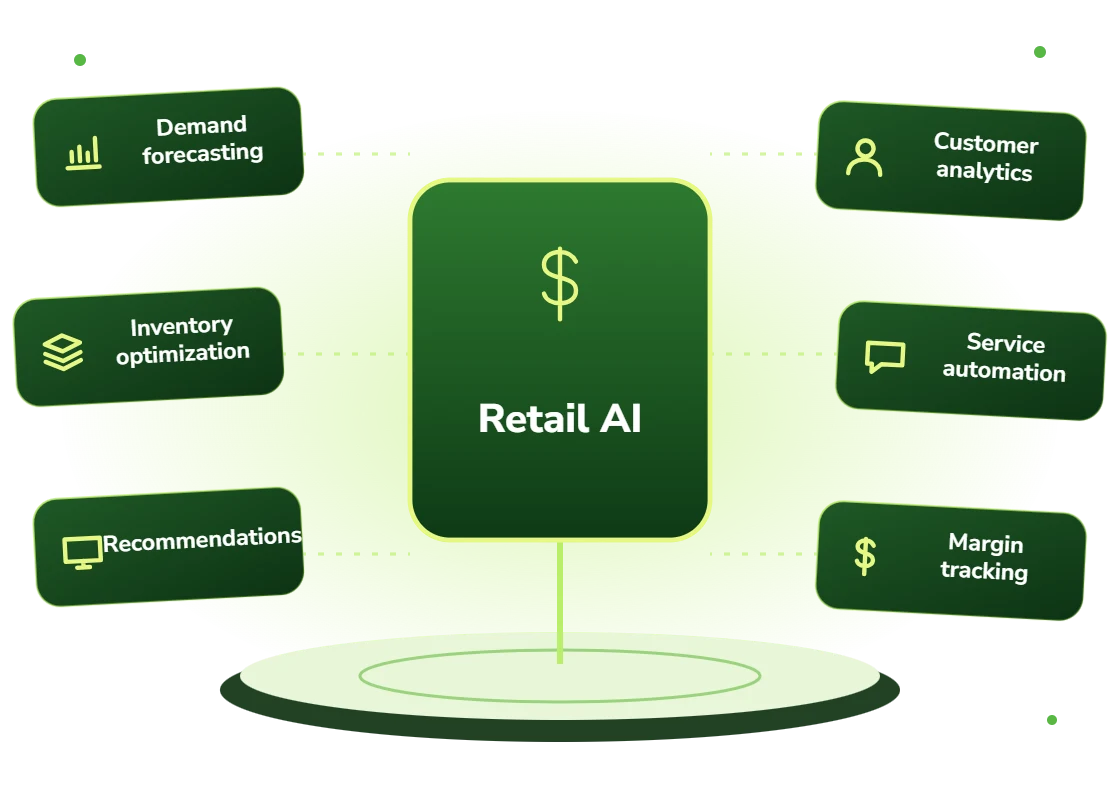
Retail AI solutions apply artificial intelligence to commerce operations: enriching and standardizing product data, improving search and discovery relevance, forecasting demand and optimizing inventory, personalizing merchandising, and deflecting routine customer support contacts. The measurable returns concentrate in product data quality and search relevance.
Product data is bad, and everything downstream inherits it
Suppliers submit inconsistent data, attributes are missing, categories are wrong, and descriptions are copied. Every downstream system inherits that: search cannot filter on attributes that do not exist, recommendations match on nothing, and customers return items that were not what they expected.
Retail AI projects frequently target the downstream symptom, better recommendations, better search, without fixing the data those systems depend on.
Fix the data, then the systems that use it
We start with product data because it is the foundation: extracting attributes from imagery and descriptions, standardizing across suppliers, and filling the gaps that make filtering and matching impossible.
With that in place, search relevance, recommendations and forecasting all improve substantially, frequently more than a dedicated project on any one of them would have delivered alone.
Retail AI solutions: scope and deliverables
Product data enrichment is the highest-leverage starting point because everything else depends on it. Extracting attributes from photographs and copy, standardizing supplier variation, and completing the fields that filtering requires.
Search relevance is the most direct revenue lever. Search users convert substantially better than browsers, so zero-result and no-click rates are revenue leaks that can be measured and closed.
Support deflection is the clearest cost lever, with order status and returns questions dominating contact volume in most operations.
Demand forecasting is valuable but data-dependent, and we assess honestly whether your history supports it before building.
- Product attribute extraction from imagery, copy and supplier feeds
- Category and taxonomy standardization across supplier variation
- Search relevance: hybrid semantic and keyword retrieval, measured
- Demand forecasting where historical data genuinely supports it
- Support deflection on order status, returns and product questions
- Review and returns analysis identifying product and content problems
Retailers this suits
Operations with large or fast-changing catalogues where product data quality is a known problem and manual enrichment cannot keep pace.
And retailers whose search analytics show meaningful zero-result or no-click rates, which is a directly measurable revenue leak.
- Retailers with catalogues above roughly 10,000 SKUs
- Marketplaces with supplier-submitted data of variable quality
- Operations with measurable zero-result or no-click search rates
- Businesses with high return rates linked to product expectation mismatch
- Support teams dominated by order status and returns enquiries
- Retailers unable to list products because content does not exist
Benefits of retail AI solutions
Filterable product data
Attributes extracted and standardized, which makes faceted search and matching possible rather than aspirational.
Search that finds things
Zero-result rates cut substantially, which is a direct and measurable revenue effect for search users.
Lower return rates
Accurate, complete product information reduces the expectation mismatch that drives a share of returns.
Support cost down
Order status and returns questions handled instantly, which is usually the majority of contact volume.
Products actually listed
Catalogue items that could not be listed for lack of content become sellable.
Returns analysed for cause
Return reasons and reviews mined for product and content problems that would otherwise stay invisible.
Business challenges this solves
Supplier data inconsistent
Every supplier submitting different formats and completeness. Extraction and standardization normalizes it.
Search returning nothing
Customers unable to find products that exist. Hybrid semantic search closes the vocabulary gap.
Returns from expectation mismatch
Products not matching their description. Complete accurate attributes reduce the gap.
Support queue full of order status
Repetitive questions dominating contact volume. Instant lookups deflect the majority.
Products unlistable without content
Catalogue items blocked on missing descriptions. Generation removes the constraint.
No idea why products are returned
Return reasons unanalysed. Mining reviews and return data surfaces the causes.
Features and deliverables
Everything below is in scope on a standard engagement. Nothing here is an upsell discovered halfway through the build.
Attribute extraction
Product attributes extracted from imagery, descriptions and supplier feeds, including details visible only in photography.
Taxonomy standardization
Categories and attribute values normalized across supplier variation into one consistent structure.
Content generation
Descriptions and marketing copy generated from real specifications in consistent brand voice with review workflow.
Search relevance engineering
Hybrid semantic and keyword retrieval with reranking, measured against a relevance evaluation set.
Demand forecasting
Forecasting from sales history, seasonality and external signals, built where data quality genuinely supports it.
Support deflection
Order status, returns eligibility and product questions answered instantly with live system lookups.
Review and returns mining
Themes extracted from reviews and return reasons identifying product quality and content accuracy problems.
Platform integration
Connection into Shopify, Magento, BigCommerce, commercetools or your existing commerce and PIM systems.
Technologies we use for retail AI solutions
We are not tied to one vendor. Model and infrastructure choices are made on accuracy, cost per task, latency, and where your data is allowed to live.
Our AI development process
The same five stages on every engagement, so you always know what happens next and what you get at the end of it.
Discovery
We interview the people doing the work, map the workflow end to end, and audit the systems and data behind it.
AI Strategy
Every opportunity gets scored on cost to build, time to value, and annual savings, then ranked.
Pilot Build
We ship the top-ranked automation as a fixed-scope pilot so you see real output before committing further budget.
Implementation
Integration with your live systems, staff training, human-in-the-loop review gates, and a documented rollback path.
Optimization
Monthly accuracy reviews, prompt and retrieval tuning, and a written report on hours and dollars saved.
How long it takes
A typical first engagement, week by week. Complex integrations and regulated environments extend this, and we say so during discovery rather than after.
Discovery and scoping
Process observation, systems audit, data review, and a written estimate of cost and expected saving before anything is built.
Design sign-off
Architecture, data handling rules, review thresholds and success measures agreed in writing.
Build and integration
Development against your real data, connected to your live systems, with weekly demos rather than a single reveal.
Parallel run and testing
The system runs alongside the existing process so accuracy can be compared directly before anyone depends on it.
Launch and handover
Cutover with a rollback path, staff training, full documentation, then 30 days of included tuning.
Industries we deliver retail AI solutions for
Retail & E-commerce
Product data enrichment, demand forecasting, support deflection, and personalized merchandising.
Logistics & Supply Chain
Document processing, carrier communication, exception handling, and inventory rebalancing.
Manufacturing
Quality inspection, maintenance prediction, supplier communication, and production scheduling.
SaaS & Technology
AI features inside your product, support deflection, onboarding assistants, and usage analytics.
Professional Services
Proposal drafting, timesheet capture, research synthesis, and client reporting at scale.
Financial Services
Document extraction, reconciliation, KYC support, and audit-ready reporting with full traceability.
Construction
Bid takeoffs, submittal review, RFI drafting, and field-report summarization.
Insurance
First-notice-of-loss intake, claims triage, policy Q&A, and fraud signal detection.
Real-world use cases
Catalogue enrichment
Attributes extracted from imagery and copy across the full catalogue, enabling filtering that was previously impossible.
Search relevance improvement
Zero-result and no-click rates reduced through hybrid retrieval, measured against a relevance baseline.
Product content generation
Descriptions produced for products that could not previously be listed for lack of copy.
Support deflection
Order, shipping and returns questions handled instantly with authenticated live lookups.
Return reason analysis
Returns and reviews mined for recurring product and content problems, feeding merchandising decisions.
Supplier data normalization
Inconsistent supplier submissions standardized into one usable catalogue structure automatically.
Why choose DevSolutionsAI for retail AI solutions
Business case before build
Every recommendation carries an estimated cost, timeline, and annual savings figure. If the math does not work, we say so before you spend.
Vendor-neutral by design
We resell nothing and take no platform commissions. Model and infrastructure choices are made on fit, cost, and your data-residency rules.
Fixed-scope pilots
The first engagement is a defined deliverable at a defined price, not an open-ended retainer that quietly grows each quarter.
Built for handover
You own the code, the prompts, the infrastructure, and the documentation. No lock-in to a proprietary wrapper you cannot leave.
Human-in-the-loop where it counts
Anything customer-facing, clinical, financial, or legal gets a review gate, a confidence threshold, and a logged audit trail.
Security reviewed early
Data flow diagrams, retention rules, and access boundaries are agreed in week one, not retrofitted after your security team objects.
Find out what retail AI solutions would cost you, before you commit to anything
Every engagement is quoted after a short discovery, so you get a fixed written price built around your actual volumes rather than a rate card that assumes someone else’s business.
The first call is thirty minutes and free. Bring one workflow. We will tell you what it is likely costing you each year, roughly what automating it would take, and whether we think it is worth doing at all.
- A written savings estimate before any paid work
- Fixed scope and fixed price, agreed up front
- Full ownership of everything we build for you
- An honest recommendation when the numbers do not work
Figures are internal measurements across recent engagements, reported to every client monthly in writing.
Illustrative project scenario
Attribute extraction that fixed search without touching search
Challenge. A marketplace had 480,000 seller-submitted listings with wildly inconsistent attribute completeness. Faceted search was largely unusable because most products lacked the attributes to filter on. Zero-result search rate was 19%, and the team had budgeted for a search platform replacement.
What we built. Attribute extraction from listing imagery and seller descriptions, normalized against a standardized taxonomy, with confidence thresholds routing uncertain extractions to seller confirmation. No changes were made to the search platform itself in the first phase.
Outcome. Attribute completeness rose from 38% to 87%. Zero-result search rate fell from 19% to 7% with no change to the search engine, purely because filtering and matching finally had data to work with. The search platform replacement was deferred, and the eventual relevance work started from a much better position.
Illustrative project scenario. The figures demonstrate how a project could be scoped and evaluated; they are not verified client results or an audited average.
What clients say about working with us
Retail AI Solutions FAQs
Where should a retailer start with AI?
Product data quality, in most cases, because everything downstream depends on it. Search cannot filter on attributes that do not exist, recommendations cannot match on missing data, and customers return items whose descriptions were incomplete. On a recent engagement, fixing attribute data alone cut the zero-result search rate from 19% to 7% without touching the search engine at all.
Can AI extract product attributes from photographs?
Yes, and it is frequently the only way to get them. Colour, material, style details and construction are often visible in imagery but absent from supplier data. Multimodal models process the image and text together, which produces better results than either alone. Uncertain extractions route to review rather than being written directly.
Will AI-generated product descriptions hurt our SEO?
Not inherently, but thin or near-duplicate content will. We ground generation in real specifications so descriptions have substance, generate genuinely distinct content per product rather than substituting variables into a template, and monitor for near-duplicates across the catalogue. The greater risk in practice is having no content at all, which makes products unlistable.
Can you do demand forecasting?
Where your data supports it, which is not universal. Forecasting needs several years of clean sales history with the promotional and stockout periods identifiable, otherwise the model learns from distorted data. We assess this honestly during discovery and will tell you if the history is insufficient, in which case improving data capture is the useful first step.
What about personalization?
We are cautious here, and it is the most heavily marketed retail AI application. Attribution is genuinely difficult, isolating personalization’s effect from seasonality, merchandising and traffic mix requires careful experimental design that most implementations skip. We usually recommend product data and search first, both of which improve personalization outcomes anyway and are far easier to measure.
What does retail AI cost?
Catalogue enrichment typically runs $30,000 to $70,000 depending on catalogue size and how much comes from imagery. Search relevance work runs $34,000 to $65,000. Support deflection runs $25,000 to $50,000. For enrichment specifically, return is usually measured on search performance and listable SKUs rather than on labour saved.
Services that pair well with this one
Most clients combine two or three of these. We will tell you the right sequence during discovery.
Ready to scope your retail AI solutions project?
Book a free 30-minute consultation. Bring one workflow and leave with a realistic estimate of what it would cost to automate and what it would save.