Vector database solutions selected on your workload, not on a benchmark blog post
Our vector database solutions start with workload sizing and retrieval requirements. We compare access filters, latency, operating cost and maintenance needs before choosing or tuning a database.
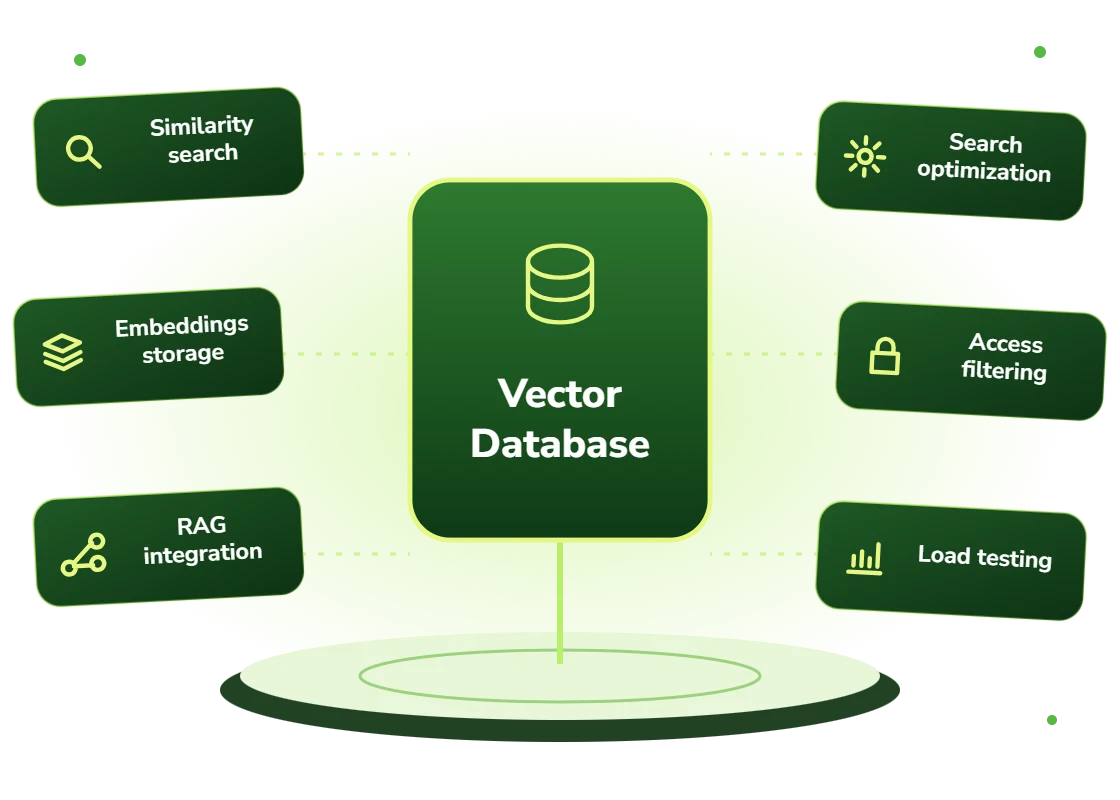
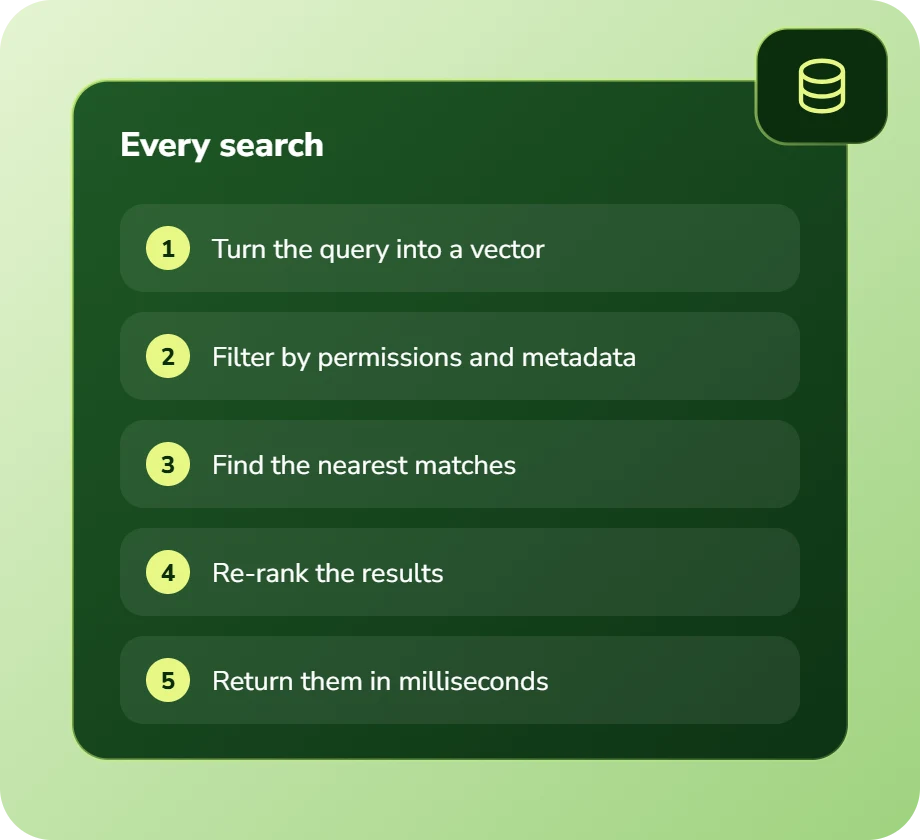
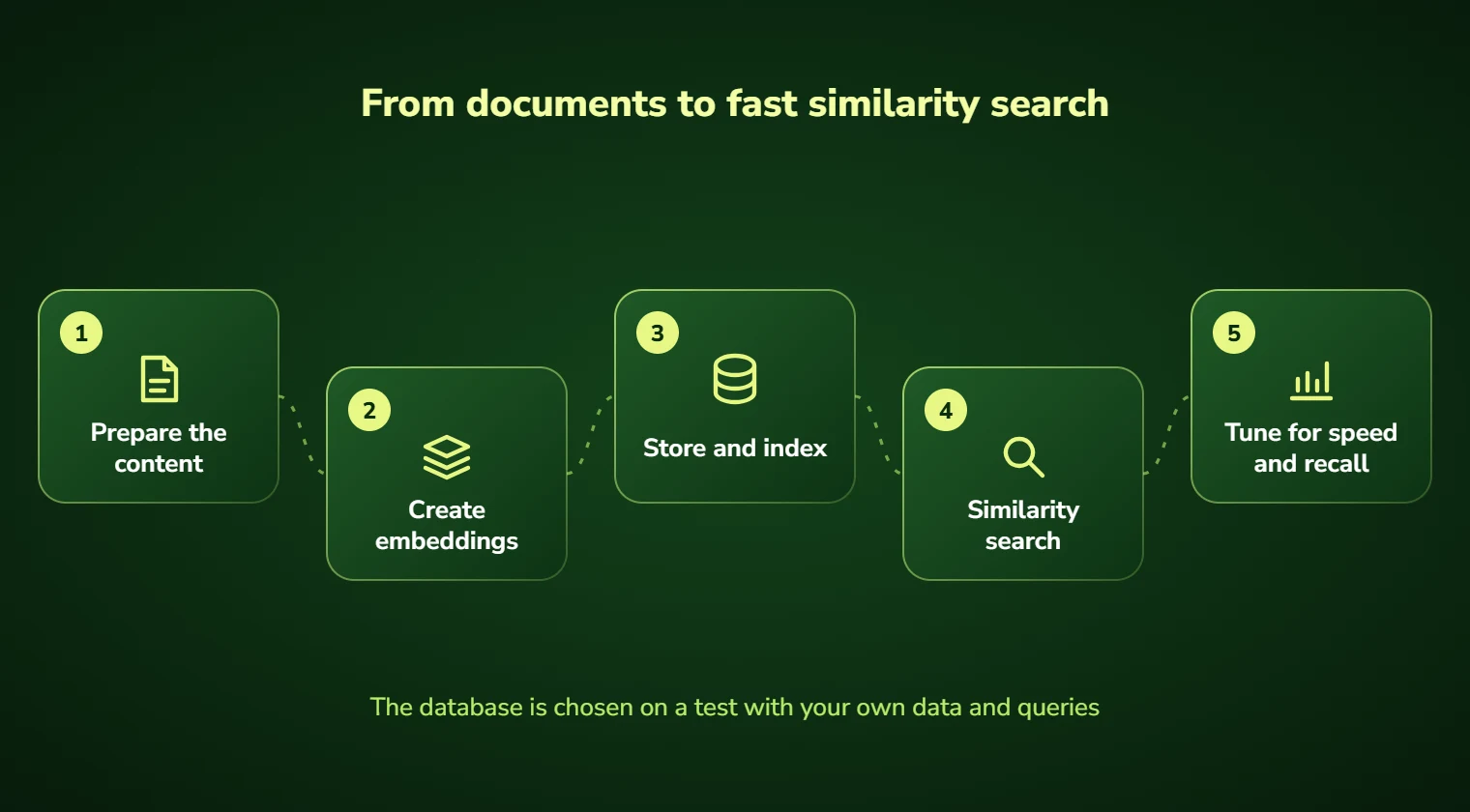
A vector database stores numerical embeddings that represent the meaning of text, images or other data, and finds the most similar items to a query quickly. It is the storage and search layer beneath semantic search, retrieval-augmented generation and recommendation systems, where results are matched by meaning rather than exact keywords.
The database chosen before the workload was known
Vector database selection usually happens at the prototype stage, when the corpus is small and everything is fast. The decision then calcifies, and the constraints surface at production scale when migration is expensive.
The other common outcome is over-engineering. Teams deploy a dedicated distributed vector store for two hundred thousand documents, which Postgres with pgvector would have served on hardware they already run.
Size the workload, then pick
We start with the numbers that actually determine the choice: corpus size, growth rate, query volume, latency budget, filtering complexity, update frequency and whether data can leave your infrastructure.
Those answers usually narrow the field to one or two options quickly. We will frequently recommend pgvector on a database you already operate, because adding infrastructure has a real ongoing cost that comparison articles never count.
Vector database solutions: scope and deliverables
Choosing the database is the smaller half. The larger half is index configuration, and it is where most performance and cost problems originate.
Index type, dimensionality, quantization, and the recall-versus-latency trade-off all need deciding against your actual query patterns. A configuration that returns 95% recall in 40 milliseconds may cost four times one returning 92% in 60 milliseconds, and whether that matters depends entirely on the application.
We also design for the operational realities: how documents get updated and deleted, how re-indexing happens without downtime, how filtered queries stay fast, and what happens when the embedding model changes.
- Workload sizing: corpus, growth, query volume, latency budget, filter complexity
- Database selection with the reasoning and trade-offs documented
- Index design: type, parameters, quantization, recall/latency/cost tuning
- Embedding model selection and dimensionality decisions
- Update, deletion and re-indexing strategy without downtime
- Monitoring, cost tracking and capacity planning
Who needs vector database work
Teams building semantic search, RAG or recommendation features where the prototype worked and production did not. Latency creeping upward as the corpus grows is the classic symptom.
Also teams facing a cost surprise. Managed vector services price on stored vectors and query volume, and a corpus that grows tenfold produces a bill that grows with it, often to the point where self-hosting becomes clearly cheaper.
- Prototypes that degraded when the corpus reached production scale
- Teams whose managed vector service bill is growing faster than usage
- Applications where filtered queries have become unacceptably slow
- Organizations with data residency rules that rule out managed services
- Teams planning an embedding model change and needing a migration path
- Engineering groups wanting an independent second opinion before committing
Benefits of vector database solutions
A choice you can defend
Selection driven by your workload numbers, with the trade-offs and rejected options documented for future reference.
Predictable cost
Cost modelled at projected scale before commitment, so the bill at ten times the corpus is not a surprise.
Latency that holds under growth
Index configuration tuned against real query patterns, not defaults, so performance survives corpus growth.
Filters that stay fast
Pre-filtering and index design that keeps metadata-filtered queries performant, which is where naive setups collapse.
No unnecessary infrastructure
We regularly recommend pgvector on your existing database, because a new system to operate has real ongoing cost.
A migration path
Embedding models change. We design so re-embedding and re-indexing is a planned operation rather than an emergency.
Business challenges vector database solutions solve
Latency growing with the corpus
Queries fine at 10k documents, slow at 2M. Index type and parameter tuning is usually the fix rather than more hardware.
Managed service bill escalating
Pricing scaling with stored vectors. We model self-hosted alternatives and show the crossover point.
Filtered queries collapsing
Metadata filters causing timeouts. Pre-filtering strategy and index design fix what post-filtering cannot.
Data residency blocking a managed service
Compliance ruling out a hosted vector store. We design self-hosted equivalents inside your boundary.
No way to change embedding models
Locked to one model because re-embedding is unplanned. We build the migration path from the start.
Over-engineered from day one
Distributed clusters for a modest corpus. Right-sizing frees both budget and operational attention.
Vector database solutions features and deliverables
Everything below is in scope on a standard engagement. Nothing here is an upsell discovered halfway through the build.
Workload analysis
Corpus size and growth, query volume and shape, latency budget, filter cardinality and update patterns, quantified before any recommendation.
Database evaluation
Candidates benchmarked against your actual data and queries rather than public benchmarks, with results documented.
Index design and tuning
HNSW, IVF or flat index selection, parameter tuning, and quantization decisions balancing recall, latency and memory.
Embedding strategy
Model selection, dimensionality trade-offs, and whether domain-specific embeddings justify their cost for your content.
Hybrid search implementation
Combining dense vector search with keyword matching and reciprocal rank fusion, since pure semantic search misses exact identifiers.
Update and re-index pipeline
Incremental updates, soft deletion, and zero-downtime re-indexing for when the embedding model or chunking changes.
Monitoring and capacity planning
Query latency percentiles, recall sampling, index size, and cost tracking with projections against growth.
Migration execution
Where a change is warranted, we plan and run the migration with dual-write and verification rather than a cutover.
Technologies we use for vector database solutions
We are not tied to one vendor. Model and infrastructure choices are made on accuracy, cost per task, latency, and where your data is allowed to live.
Our AI development process
The same five stages on every engagement, so you always know what happens next and what you get at the end of it.
Discovery
We interview the people doing the work, map the workflow end to end, and audit the systems and data behind it.
AI Strategy
Every opportunity gets scored on cost to build, time to value, and annual savings, then ranked.
Pilot Build
We ship the top-ranked automation as a fixed-scope pilot so you see real output before committing further budget.
Implementation
Integration with your live systems, staff training, human-in-the-loop review gates, and a documented rollback path.
Optimization
Monthly accuracy reviews, prompt and retrieval tuning, and a written report on hours and dollars saved.
How long it takes
A typical first engagement, week by week. Complex integrations and regulated environments extend this, and we say so during discovery rather than after.
Discovery and scoping
Process observation, systems audit, data review, and a written estimate of cost and expected saving before anything is built.
Design sign-off
Architecture, data handling rules, review thresholds and success measures agreed in writing.
Build and integration
Development against your real data, connected to your live systems, with weekly demos rather than a single reveal.
Parallel run and testing
The system runs alongside the existing process so accuracy can be compared directly before anyone depends on it.
Launch and handover
Cutover with a rollback path, staff training, full documentation, then 30 days of included tuning.
Industries we deliver vector database solutions for
SaaS & Technology
AI features inside your product, support deflection, onboarding assistants, and usage analytics.
Retail & E-commerce
Product data enrichment, demand forecasting, support deflection, and personalized merchandising.
Financial Services
Document extraction, reconciliation, KYC support, and audit-ready reporting with full traceability.
Healthcare
Intake, prior authorization, clinical documentation, and revenue-cycle workflows built to respect HIPAA boundaries.
Legal
Contract review, discovery triage, and matter intake with citation-checked outputs and attorney sign-off gates.
Manufacturing
Quality inspection, maintenance prediction, supplier communication, and production scheduling.
Logistics & Supply Chain
Document processing, carrier communication, exception handling, and inventory rebalancing.
Professional Services
Proposal drafting, timesheet capture, research synthesis, and client reporting at scale.
Real-world vector database solutions use cases
Product semantic search
Catalogue search matching intent rather than keywords, with fast filtering on price, availability and category.
RAG retrieval backend
The storage and search layer beneath a retrieval-augmented system, tuned for recall at acceptable latency.
Document deduplication
Finding near-duplicate documents and records across large corpora where exact matching fails.
Recommendation retrieval
Candidate generation for recommendation systems using item and user embeddings at low latency.
Support ticket similarity
Finding prior resolved tickets similar to a new one, surfacing the resolution that already worked.
Compliance and conflict checking
Semantic matching across client and matter records to surface conflicts that name matching misses.
Why choose DevSolutionsAI for vector database solutions
Business case before build
Every recommendation carries an estimated cost, timeline, and annual savings figure. If the math does not work, we say so before you spend.
Vendor-neutral by design
We resell nothing and take no platform commissions. Model and infrastructure choices are made on fit, cost, and your data-residency rules.
Fixed-scope pilots
The first engagement is a defined deliverable at a defined price, not an open-ended retainer that quietly grows each quarter.
Built for handover
You own the code, the prompts, the infrastructure, and the documentation. No lock-in to a proprietary wrapper you cannot leave.
Human-in-the-loop where it counts
Anything customer-facing, clinical, financial, or legal gets a review gate, a confidence threshold, and a logged audit trail.
Security reviewed early
Data flow diagrams, retention rules, and access boundaries are agreed in week one, not retrofitted after your security team objects.
Find out what vector database solutions would cost you, before you commit to anything
Every engagement is quoted after a short discovery, so you get a fixed written price built around your actual volumes rather than a rate card that assumes someone else’s business.
The first call is thirty minutes and free. Bring one workflow. We will tell you what it is likely costing you each year, roughly what automating it would take, and whether we think it is worth doing at all.
- A written savings estimate before any paid work
- Fixed scope and fixed price, agreed up front
- Full ownership of everything we build for you
- An honest recommendation when the numbers do not work
Figures are internal measurements across recent engagements, reported to every client monthly in writing.
Illustrative project scenario
Cutting vector search cost 74% by changing nothing users could see
Challenge. A marketplace ran semantic product search on a managed vector service. As the catalogue grew past twelve million listings the monthly bill approached six figures annually, and filtered queries by category and region had degraded past two seconds at the 95th percentile.
What we built. Workload analysis showed the filter cardinality was the real problem, not raw vector count. We migrated to a self-hosted Qdrant deployment with payload indexing for pre-filtering, applied scalar quantization to reduce memory, and implemented hybrid search so exact SKU lookups stopped going through semantic search at all.
Outcome. Infrastructure cost fell 74% against the previous managed service bill. Filtered query latency at the 95th percentile dropped from 2.1 seconds to 180 milliseconds. Search relevance measured on the existing evaluation set improved slightly, attributed to the hybrid search addition.
Illustrative project scenario. The figures demonstrate how a project could be scoped and evaluated; they are not verified client results or an audited average.
What clients say about working with us
Vector Database Solutions FAQs
Do we actually need a dedicated vector database?
Often not, and this is the most common finding in our selection engagements. If you are under roughly five million vectors and already run Postgres, pgvector will usually serve you well at essentially no additional infrastructure cost or operational burden. Dedicated vector databases earn their keep at larger scale, with demanding latency requirements, or with complex metadata filtering.
Which vector database is best?
There is no general answer, and any article claiming one is selling something. The decision is driven by corpus size, growth rate, query volume, latency budget, filter complexity, data residency rules and how much operational capacity your team has. We benchmark candidates against your actual data and queries rather than relying on published benchmarks, which almost never resemble real workloads.
Our vector search has become slow. What usually causes that?
In order of frequency: index parameters left at defaults that suited a small prototype, metadata filtering applied after retrieval instead of before, index type mismatched to the corpus size, and memory pressure causing the index to spill to disk. It is rarely solved by adding hardware, which is usually the first thing teams try.
What happens when we want to change embedding models?
Every vector needs regenerating and re-indexing, which is why we build the re-embedding pipeline during the initial engagement rather than after. Done properly it is a planned dual-index operation with verification and no downtime. Done unplanned it is a weekend outage, which is how many teams first discover the problem.
Can you keep everything inside our own infrastructure?
Yes. Self-hosted Qdrant, Weaviate, Elasticsearch or pgvector all run entirely within your own cloud account or data centre, with no data leaving your boundary. This is the standard approach for clients with HIPAA, federal contracting or strict data residency requirements.
How much does this cost?
A selection and design engagement is $8,000 to $15,000 over two weeks and produces a documented recommendation with cost modelling. A full build and tuning engagement runs $24,000 to $50,000. A migration from an existing system typically runs $30,000 to $70,000 depending on corpus size and whether re-embedding is required.
Services that pair well with this one
Most clients combine two or three of these. We will tell you the right sequence during discovery.
Ready to scope your vector database solutions project?
Book a free 30-minute consultation. Bring one workflow and leave with a realistic estimate of what it would cost to automate and what it would save.