AI process optimization that looks at every case, not a sample of twenty
AI process optimization uses available event data to examine bottlenecks, variation and rework across a process. We check data coverage first, then compare proposed changes against a measured baseline.
AI process optimization analyses complete event data from business systems to reconstruct how processes actually run across every case, rather than from a sampled study. It identifies variation, bottlenecks, rework loops and non-compliant paths at full coverage, and applies AI to the improvements identified.
The process improvement study that sampled twenty cases
Conventional process improvement observes a sample, maps what it saw, and reasons about the rest. That works when variation is low and fails when it is not, which is most of the time.
The cases nobody sampled are frequently the expensive ones: the unusual paths, the rework loops, the workarounds that developed in one region and never spread.
Reconstruct every case from system data
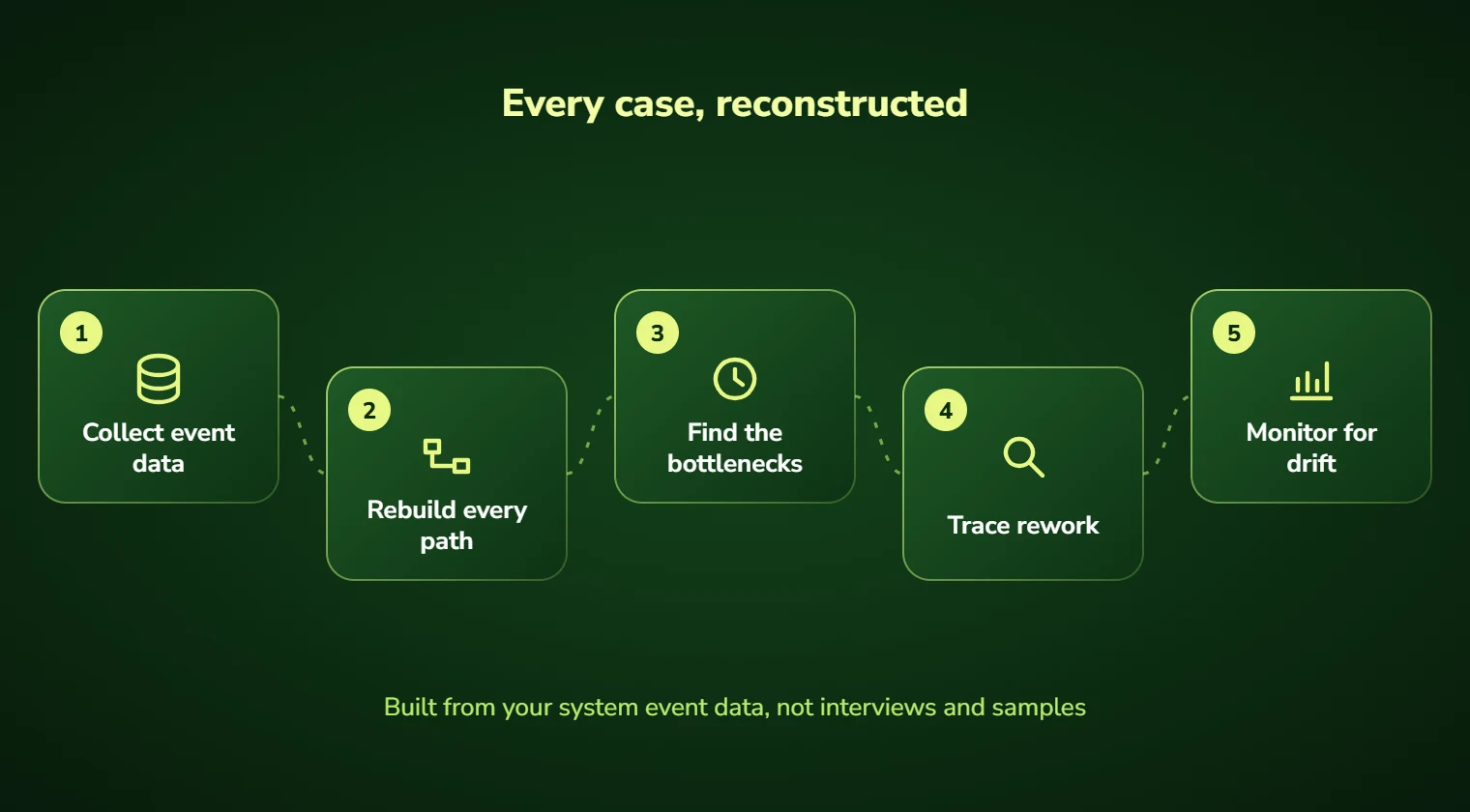
Business systems record timestamps for the events that make up a process. Reconstructing paths from that data shows how the process actually ran for every case, not for a sample.
That routinely reveals variation nobody knew existed: dozens of distinct paths where the documented process shows one, and rework loops consuming effort nobody had attributed.
AI process optimization: scope and deliverables
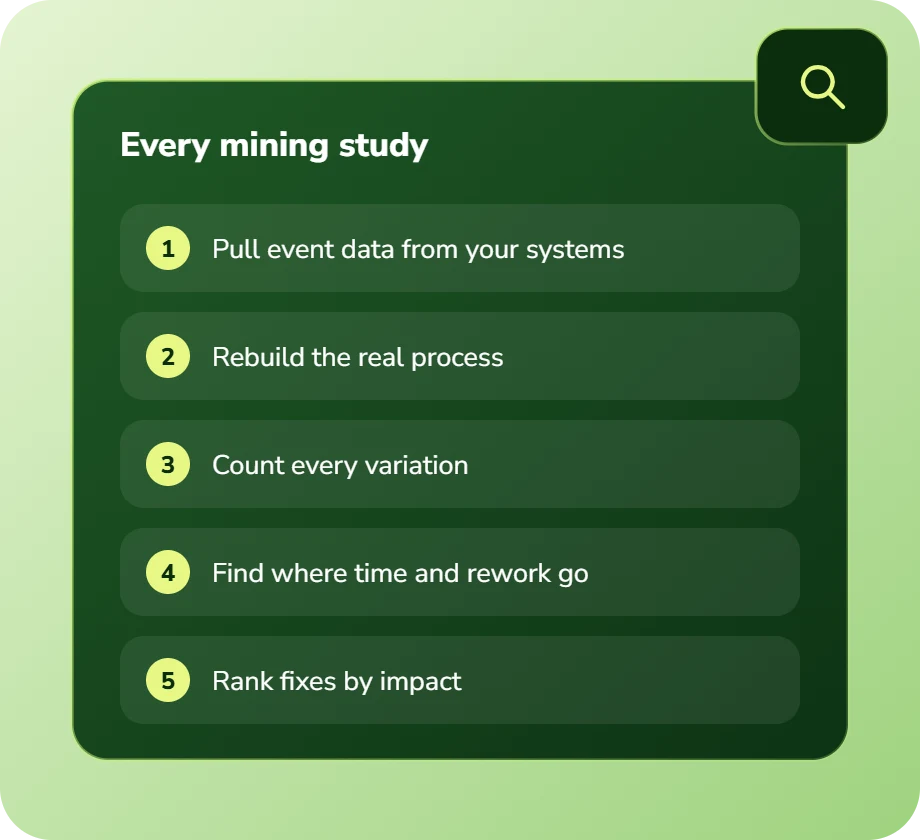
Reconstruction first: pulling event data with timestamps and case identifiers from your systems and rebuilding the actual process paths.
Then analysis: which paths are common, which are expensive, where the bottlenecks are, how much rework occurs and what triggers it, and which cases deviate from the intended process.
Then improvement: eliminating unnecessary variation, addressing bottlenecks, and applying automation where it now clearly pays.
And continuous monitoring, so the process is measured going forward rather than studied once and left to drift.
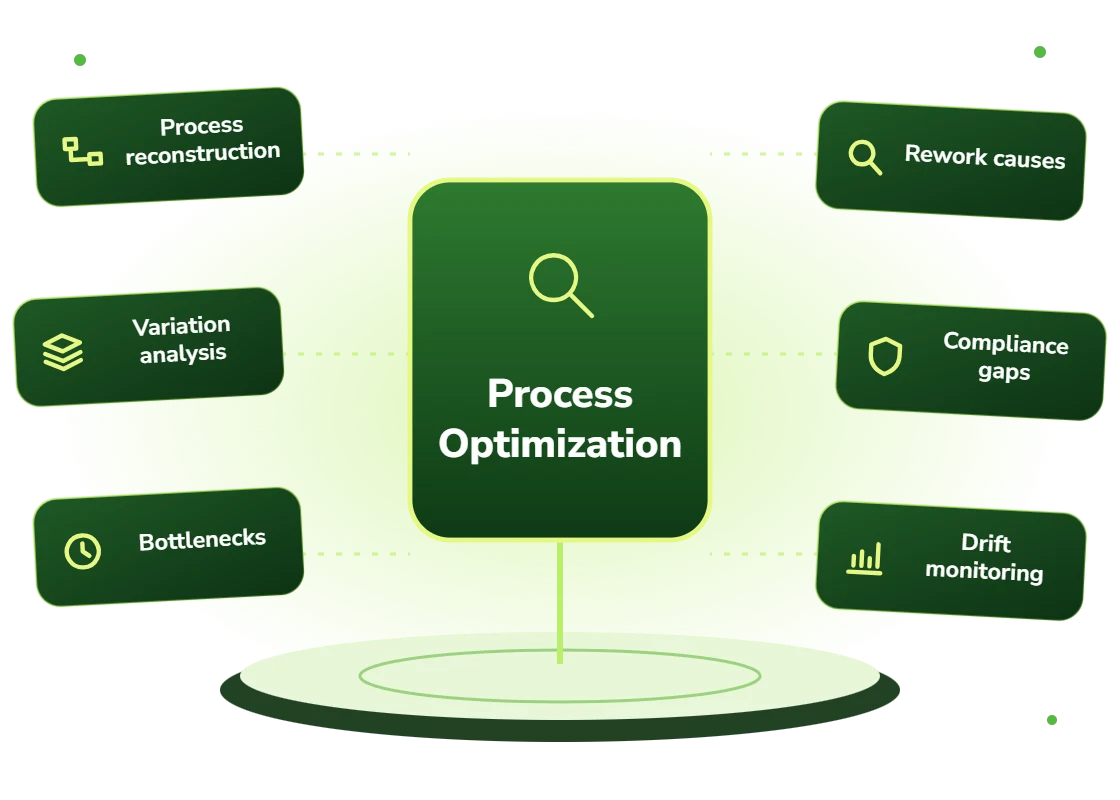
- Process reconstruction from system event data across every case
- Variation analysis: how many distinct paths actually exist
- Bottleneck and queue time identification with volume weighting
- Rework loop detection and root cause attribution
- Compliance deviation: cases that skipped required steps
- Ongoing monitoring so drift is detected rather than discovered later
For task-level delays and handoffs inside one workflow, compare AI workflow optimization. Process optimization examines variation and rework across the broader process.
Who this suits
Organizations with continuous improvement functions whose analysis is limited by manual data gathering, and operations with high case volume where variation is suspected but unquantified.
Also compliance functions needing to know how often the documented process is actually followed, which sampling cannot establish reliably.
- Operations with high case volume and suspected process variation
- Continuous improvement teams limited by manual data gathering
- Multi-site organizations where each location does things differently
- Compliance functions needing actual rather than sampled adherence rates
- Companies whose improvement initiatives have stopped delivering
- Organizations with system event data they have never analysed
Benefits of AI process optimization
Every case, not a sample
Full coverage reveals the variation and rework that sampled studies systematically miss.
Variation quantified
How many distinct paths actually exist, which is routinely far more than the documented process suggests.
Bottlenecks volume-weighted
Constraints ranked by total time consumed rather than by how slow they feel.
Rework attributed to cause
Loops traced back to the upstream step that caused them rather than treated where they surface.
Compliance measured properly
Actual adherence rates across all cases rather than inferred from an audit sample.
Ongoing rather than one-off
Continuous monitoring so process drift is detected rather than discovered in the next study.
Business challenges this solves
Improvement based on samples
Studies missing the expensive unusual cases. Full coverage sees all of them.
Unknown process variation
One documented process, dozens of actual paths. Reconstruction quantifies it.
Rework treated where it surfaces
Symptoms addressed, causes upstream. Attribution finds the real source.
Multi-site inconsistency
Each location doing it differently with no visibility. Comparison across sites.
Compliance inferred from samples
Adherence estimated rather than measured. Full coverage gives actual rates.
Improvements that decay
Gains lost over time unnoticed. Continuous monitoring detects drift.
Features and deliverables
Everything below is in scope on a standard engagement. Nothing here is an upsell discovered halfway through the build.
Event data extraction
Timestamped event data pulled from ERP, CRM, workflow and operational systems with case correlation.
Process reconstruction
Actual process paths rebuilt for every case, showing what really happened rather than what was documented.
Variation analysis
Distinct path identification with frequency and cost weighting, revealing how much variation actually exists.
Bottleneck analysis
Queue and processing time per step, weighted by volume, so constraints are ranked by total impact.
Rework detection
Loop identification with attribution to the upstream step or condition that triggered it.
Conformance checking
Comparison of actual paths against the intended process, quantifying deviation rates and types.
AI-assisted interpretation
Language models used to summarize patterns and generate hypotheses for human verification.
Continuous monitoring
Ongoing process measurement with alerting on drift, so improvements are maintained rather than decaying.
Technologies we use for AI process optimization
We are not tied to one vendor. Model and infrastructure choices are made on accuracy, cost per task, latency, and where your data is allowed to live.
Our AI development process
The same five stages on every engagement, so you always know what happens next and what you get at the end of it.
Discovery
We interview the people doing the work, map the workflow end to end, and audit the systems and data behind it.
AI Strategy
Every opportunity gets scored on cost to build, time to value, and annual savings, then ranked.
Pilot Build
We ship the top-ranked automation as a fixed-scope pilot so you see real output before committing further budget.
Implementation
Integration with your live systems, staff training, human-in-the-loop review gates, and a documented rollback path.
Optimization
Monthly accuracy reviews, prompt and retrieval tuning, and a written report on hours and dollars saved.
How long it takes
A typical first engagement, week by week. Complex integrations and regulated environments extend this, and we say so during discovery rather than after.
Discovery and scoping
Process observation, systems audit, data review, and a written estimate of cost and expected saving before anything is built.
Design sign-off
Architecture, data handling rules, review thresholds and success measures agreed in writing.
Build and integration
Development against your real data, connected to your live systems, with weekly demos rather than a single reveal.
Parallel run and testing
The system runs alongside the existing process so accuracy can be compared directly before anyone depends on it.
Launch and handover
Cutover with a rollback path, staff training, full documentation, then 30 days of included tuning.
Industries we deliver AI process optimization for
Manufacturing
Quality inspection, maintenance prediction, supplier communication, and production scheduling.
Financial Services
Document extraction, reconciliation, KYC support, and audit-ready reporting with full traceability.
Insurance
First-notice-of-loss intake, claims triage, policy Q&A, and fraud signal detection.
Logistics & Supply Chain
Document processing, carrier communication, exception handling, and inventory rebalancing.
Healthcare
Intake, prior authorization, clinical documentation, and revenue-cycle workflows built to respect HIPAA boundaries.
Professional Services
Proposal drafting, timesheet capture, research synthesis, and client reporting at scale.
Retail & E-commerce
Product data enrichment, demand forecasting, support deflection, and personalized merchandising.
Construction
Bid takeoffs, submittal review, RFI drafting, and field-report summarization.
Real-world use cases
Order-to-cash analysis
Reconstructing every order through fulfilment and payment to find where cycle time and rework concentrate.
Claims process variation
Identifying how many distinct paths claims actually take and which ones cost most.
Multi-site comparison
Comparing how the same process runs across locations to identify best practice and outliers.
Compliance adherence
Measuring actual conformance to required process steps across every case rather than a sample.
Improvement verification
Confirming whether a previous improvement initiative actually changed behaviour at scale.
Automation targeting
Identifying which paths and steps carry enough volume and consistency to justify automation.
Why choose DevSolutionsAI for AI process optimization
Business case before build
Every recommendation carries an estimated cost, timeline, and annual savings figure. If the math does not work, we say so before you spend.
Vendor-neutral by design
We resell nothing and take no platform commissions. Model and infrastructure choices are made on fit, cost, and your data-residency rules.
Fixed-scope pilots
The first engagement is a defined deliverable at a defined price, not an open-ended retainer that quietly grows each quarter.
Built for handover
You own the code, the prompts, the infrastructure, and the documentation. No lock-in to a proprietary wrapper you cannot leave.
Human-in-the-loop where it counts
Anything customer-facing, clinical, financial, or legal gets a review gate, a confidence threshold, and a logged audit trail.
Security reviewed early
Data flow diagrams, retention rules, and access boundaries are agreed in week one, not retrofitted after your security team objects.
Find out what AI process optimization would cost you, before you commit to anything
Every engagement is quoted after a short discovery, so you get a fixed written price built around your actual volumes rather than a rate card that assumes someone else’s business.
The first call is thirty minutes and free. Bring one workflow. We will tell you what it is likely costing you each year, roughly what automating it would take, and whether we think it is worth doing at all.
- A written savings estimate before any paid work
- Fixed scope and fixed price, agreed up front
- Full ownership of everything we build for you
- An honest recommendation when the numbers do not work
Figures are internal measurements across recent engagements, reported to every client monthly in writing.
Illustrative project scenario
Finding 94 distinct paths where the documented process showed one
Challenge. An insurer’s documented claims process had eleven steps. Regional performance varied substantially and nobody could explain why. Previous improvement studies had sampled cases in two regions and produced recommendations that did not transfer.
What we built. Event data extracted from the claims system across two years and every case reconstructed. The analysis found 94 distinct paths, of which six accounted for most volume. Two regions had developed rework loops around a validation step that others had informally bypassed. Conformance to the documented process was under 40%.
Outcome. Variation was reduced by standardizing on the two most efficient paths and fixing the upstream data quality issue causing the validation rework. Conformance rose substantially. Continuous monitoring now detects when a region begins diverging rather than discovering it in the next study.
Illustrative project scenario. The figures demonstrate how a project could be scoped and evaluated; they are not verified client results or an audited average.
What clients say about working with us
AI Process Optimization FAQs
How is this different from traditional process improvement?
Coverage. A conventional study observes ten to fifty cases and reasons about the rest, which works when variation is low. Process mining reconstructs every case from system event data. On a recent claims engagement that revealed 94 distinct paths where the documented process showed one, and a conformance rate under 40%, neither of which a sampled study would have found.
What data do you need?
Timestamped event records with a case identifier: when each step started and finished, for which case, by whom. Most ERP, CRM, workflow and operational systems record this even when nobody has ever used it. Where the data is incomplete we say so and scope accordingly rather than reconstructing from partial records and presenting it as complete.
What if work happens outside our systems?
Then process mining cannot see it, and this is the technique’s main limitation. Work in email, spreadsheets and conversation is invisible. That is why we combine mining with interviews and observation rather than treating it as a replacement, the data shows what happened, and people explain why.
Do we need a process mining platform?
Not necessarily. Commercial platforms are good and carry licence costs that are worth it for organizations mining continuously across many processes. For a focused study on a few processes, we can do the analysis without one and hand over the approach. We will tell you which applies rather than defaulting to whichever generates more work.
How does this relate to workflow optimization?
Process mining is a measurement technique; workflow optimization is the improvement engagement. Mining suits high-volume processes with good event data where variation is the question. Direct observation and time study suits lower-volume processes or where much of the work happens outside systems. We frequently use both on the same engagement.
What does process optimization cost?
A three to four week mining study with reconstruction, analysis and prioritized findings runs $16,000 to $30,000. A combined study and implementation engagement runs $50,000 to $110,000 depending on how much automation is involved. Continuous monitoring is available monthly for organizations wanting ongoing measurement.
Services that pair well with this one
Most clients combine two or three of these. We will tell you the right sequence during discovery.
Ready to scope your AI process optimization project?
Book a free 30-minute consultation. Bring one workflow and leave with a realistic estimate of what it would cost to automate and what it would save.