Healthcare AI Solutions

Healthcare AI solutions for administrative workflows

Our healthcare AI solutions focus on intake, documentation and revenue-cycle administration. We assess protected health information, access requirements and human review with your team before designing the workflow.

Free 30-minute consultation
Fixed-scope pilots
U.S.-based team
Custom, not off-the-shelf
SOC 2-aligned practices
ROI tracked in writing
What are healthcare AI solutions?

Healthcare AI solutions apply artificial intelligence to clinical and administrative workflows in medical organizations. The largest measurable returns are typically administrative: patient intake, prior authorization, clinical documentation support, referral management and revenue cycle. Deployments handling protected health information require HIPAA-aligned architecture and a Business Associate Agreement.

7+
Years building AI systems
240+
Projects delivered
4.8
Avg. months to payback
38
U.S. states served
The Problem

Clinicians spend a large share of their time not treating patients

Documentation, prior authorization, referral coordination and coding consume hours that were supposed to be clinical. Burnout in U.S. healthcare is driven substantially by administrative load rather than by clinical difficulty.

Meanwhile the AI conversation in healthcare centres on diagnosis, which is the highest-risk, most heavily regulated and slowest-to-deploy application available.

Our Approach

Start where the risk is low and the volume is high

Administrative workflows carry lower clinical risk, clearer measurement and far shorter approval paths. They are also where most of the recoverable hours actually sit.

Everything is built with PHI handling designed first: minimum-necessary access, deployment inside your boundary where required, complete audit logging, and clinician review retained on anything touching care.

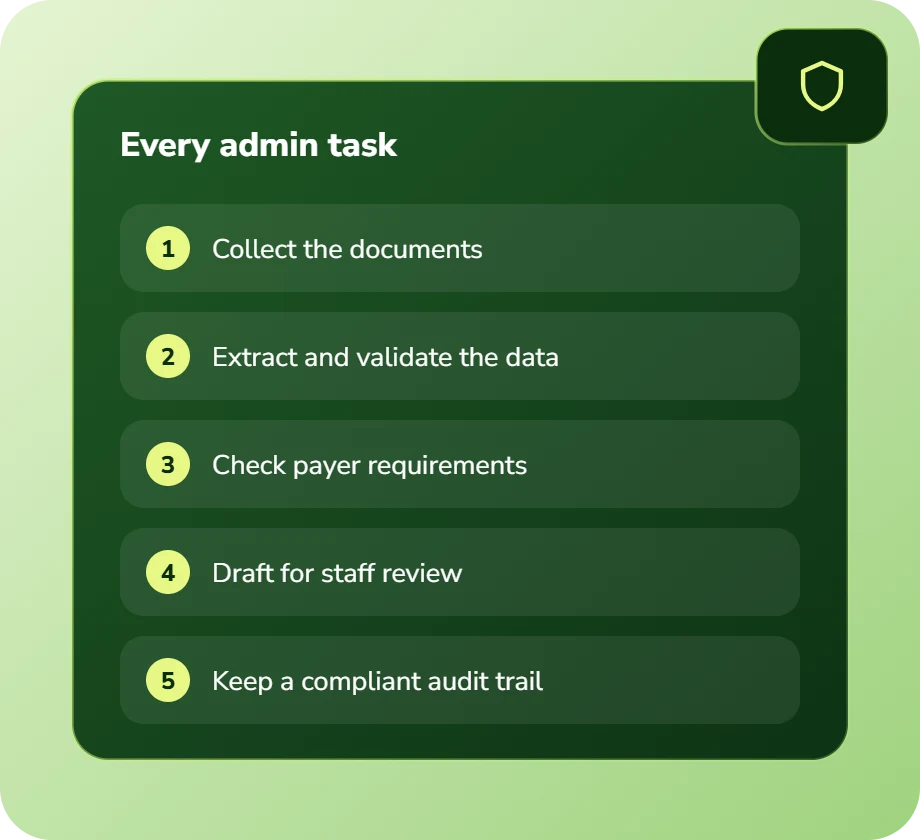
Diagram showing information extracted from a document into structured fields
Service Overview

Healthcare AI solutions: scope and deliverables

Prior authorization is often the single largest opportunity. Assembling the clinical documentation a payer requires, checking it against their published criteria, and submitting it is high-volume, rules-heavy work that delays care when it backs up.

Patient intake and referral processing is the second: extracting data from referral letters, insurance cards and forms, validating against existing records, and flagging conflicts.

Documentation support is third, and here the boundary matters. Drafting a note from an encounter for clinician review is administrative support; generating clinical content the clinician did not verify is not, and we design firmly on the correct side of that line.

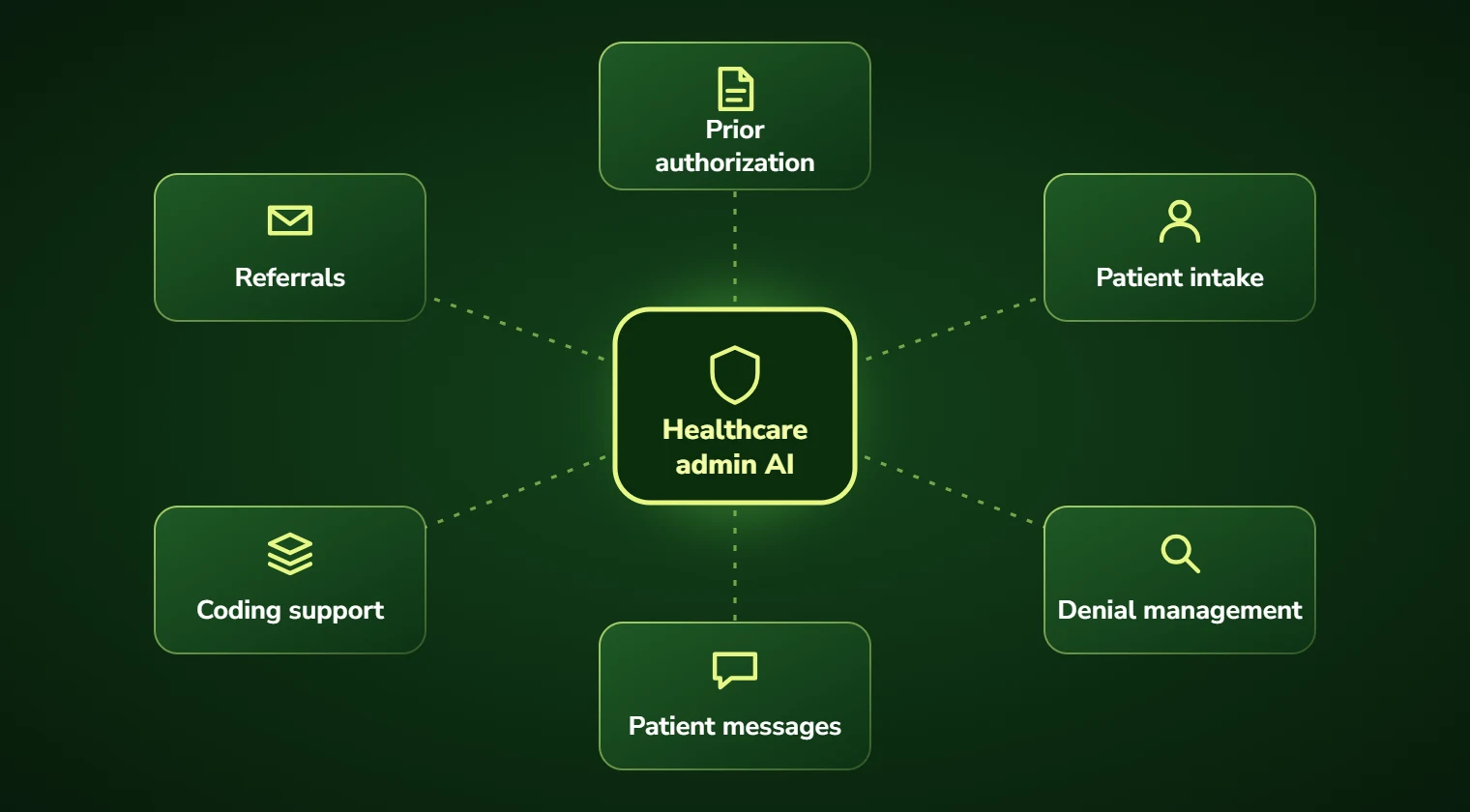
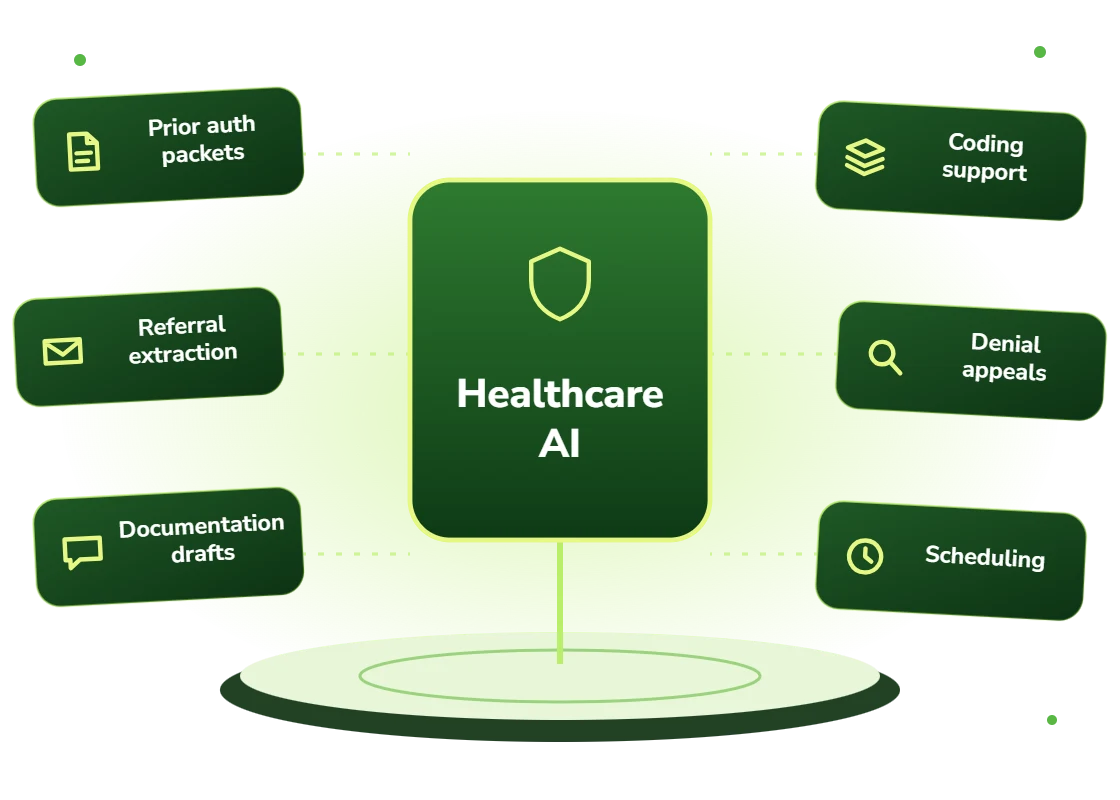
  • Prior authorization packet assembly and payer criteria checking
  • Referral and intake document extraction with record validation
  • Clinical documentation drafting for clinician review and sign-off
  • Coding support with human coder review retained
  • Denial management: reason analysis and appeal drafting
  • Patient communication: scheduling, preparation and administrative questions
Right Fit

Healthcare organizations this suits

Provider organizations where administrative staffing is the constraint, particularly in prior authorization and revenue cycle where backlogs directly delay both care and cash.

And multi-site groups where the same administrative process runs slightly differently at each location with no shared measurement.

  • Provider groups with prior authorization backlogs delaying care
  • Organizations where clinicians report heavy documentation burden
  • Revenue cycle teams with high denial rates and manual appeals
  • Practices processing high volumes of inbound referrals
  • Multi-site groups with inconsistent administrative processes
  • Health systems with large archives of unsearchable historical records
Benefits

Benefits of healthcare AI solutions

Prior auth turnaround

Packets assembled and criteria-checked in minutes rather than days, which shortens the delay between decision and treatment.

Documentation time returned

Notes drafted for review rather than composed, returning clinical hours that administrative load had taken.

Fewer denials

Payer criteria checked before submission rather than learned from the denial letter.

Faster intake

Referral and insurance documents extracted and validated on arrival rather than queued for keying.

HIPAA-aligned by design

PHI handling, minimum-necessary access and audit logging designed before build rather than reviewed after.

Clinician judgement retained

Every clinical determination stays with a clinician. AI assembles and drafts; people decide.

Problems We Solve

Business challenges this solves

01

Prior auth backlogs delaying care

Days of assembly work per authorization. Automated packet assembly cuts it to minutes.

02

Documentation driving burnout

Clinical hours consumed by notes. Drafting for review returns much of that time.

03

Denials from avoidable errors

Submissions missing required criteria. Pre-submission checking catches them.

04

Referrals sitting in a queue

Inbound documents waiting to be keyed. Extraction on arrival removes the delay.

05

Records that cannot be found

Archives retained but unsearchable. Digitization and indexing makes them producible.

06

Compliance blocking every pilot

Projects stalling in security review. Designing to HIPAA from week one avoids the rework.

What's Included

Features and deliverables

Everything below is in scope on a standard engagement. Nothing here is an upsell discovered halfway through the build.

01

HIPAA-aligned architecture

PHI flow mapping, minimum-necessary access, encryption, retention rules and complete audit logging designed before build.

02

Business Associate Agreement

BAAs executed as standard, with subprocessor arrangements documented for your compliance review.

03

Prior authorization automation

Clinical documentation assembled, checked against payer criteria, and submitted after staff review.

04

Intake and referral processing

Referral letters, insurance cards and forms extracted and validated against existing patient records.

05

Documentation support

Encounter notes drafted from available inputs for clinician review, edit and sign-off.

06

Denial analysis and appeals

Denial reasons categorized, patterns surfaced, and appeal letters drafted with supporting documentation assembled.

07

Patient communication

Scheduling, preparation instructions and administrative questions handled, bounded firmly from clinical advice.

08

EHR integration

Connection into Epic, Cerner, athenahealth, eClinicalWorks and other systems through supported interfaces.

Technology Stack

Technologies we use for healthcare AI solutions

We are not tied to one vendor. Model and infrastructure choices are made on accuracy, cost per task, latency, and where your data is allowed to live.

Language Models
C
Claude (Anthropic)
G
GPT (OpenAI)
G
Gemini (Google)
L
Llama
M
Mistral
A
Azure OpenAI Service
Vector & Retrieval
P
Pinecone
W
Weaviate
Q
Qdrant
p
pgvector
E
Elasticsearch
A
Amazon OpenSearch
Data & Backend
P
Python
T
TypeScript / Node.js
P
PostgreSQL
S
Snowflake
d
dbt
A
Apache Airflow
Cloud & Infrastructure
A
AWS Bedrock
G
Google Vertex AI
M
Microsoft Azure
D
Docker
K
Kubernetes
T
Terraform
Business Systems
S
Salesforce
H
HubSpot
N
NetSuite
M
Microsoft 365
S
Slack
Z
Zapier / Make
How We Work

Our AI development process

The same five stages on every engagement, so you always know what happens next and what you get at the end of it.

01

Discovery

We interview the people doing the work, map the workflow end to end, and audit the systems and data behind it.

02

AI Strategy

Every opportunity gets scored on cost to build, time to value, and annual savings, then ranked.

03

Pilot Build

We ship the top-ranked automation as a fixed-scope pilot so you see real output before committing further budget.

04

Implementation

Integration with your live systems, staff training, human-in-the-loop review gates, and a documented rollback path.

05

Optimization

Monthly accuracy reviews, prompt and retrieval tuning, and a written report on hours and dollars saved.

Timeline

How long it takes

A typical first engagement, week by week. Complex integrations and regulated environments extend this, and we say so during discovery rather than after.

Weeks 1 to 2

Discovery and scoping

Process observation, systems audit, data review, and a written estimate of cost and expected saving before anything is built.

Week 3

Design sign-off

Architecture, data handling rules, review thresholds and success measures agreed in writing.

Weeks 4 to 7

Build and integration

Development against your real data, connected to your live systems, with weekly demos rather than a single reveal.

Week 8

Parallel run and testing

The system runs alongside the existing process so accuracy can be compared directly before anyone depends on it.

Weeks 9 to 10

Launch and handover

Cutover with a rollback path, staff training, full documentation, then 30 days of included tuning.

Who We Work With

Industries we deliver healthcare AI solutions for

Healthcare

Intake, prior authorization, clinical documentation, and revenue-cycle workflows built to respect HIPAA boundaries.

Insurance

First-notice-of-loss intake, claims triage, policy Q&A, and fraud signal detection.

Professional Services

Proposal drafting, timesheet capture, research synthesis, and client reporting at scale.

Legal

Contract review, discovery triage, and matter intake with citation-checked outputs and attorney sign-off gates.

Financial Services

Document extraction, reconciliation, KYC support, and audit-ready reporting with full traceability.

Education

Enrollment support, content generation, tutoring assistants, and administrative automation.

Logistics & Supply Chain

Document processing, carrier communication, exception handling, and inventory rebalancing.

SaaS & Technology

AI features inside your product, support deflection, onboarding assistants, and usage analytics.

Use Cases

Real-world use cases

01

Prior authorization

Documentation assembled and criteria-checked against payer policy before submission.

02

Referral intake

Inbound referrals extracted, validated, triaged by urgency and scheduled.

03

Clinical documentation

Draft notes prepared from encounter inputs for clinician review and sign-off.

04

Denial management

Denials analysed for pattern, appeals drafted with supporting evidence assembled automatically.

05

Records digitization

Historical paper and scanned records made searchable for continuity of care and audit response.

06

Patient scheduling support

Appointment booking, rescheduling and preparation instructions, with clinical questions routed to staff.

Why DevSolutionsAI

Why choose DevSolutionsAI for healthcare AI solutions

Business case before build

Every recommendation carries an estimated cost, timeline, and annual savings figure. If the math does not work, we say so before you spend.

Vendor-neutral by design

We resell nothing and take no platform commissions. Model and infrastructure choices are made on fit, cost, and your data-residency rules.

Fixed-scope pilots

The first engagement is a defined deliverable at a defined price, not an open-ended retainer that quietly grows each quarter.

Built for handover

You own the code, the prompts, the infrastructure, and the documentation. No lock-in to a proprietary wrapper you cannot leave.

Human-in-the-loop where it counts

Anything customer-facing, clinical, financial, or legal gets a review gate, a confidence threshold, and a logged audit trail.

Security reviewed early

Data flow diagrams, retention rules, and access boundaries are agreed in week one, not retrofitted after your security team objects.

Get Started

Find out what healthcare AI solutions would cost you, before you commit to anything

Every engagement is quoted after a short discovery, so you get a fixed written price built around your actual volumes rather than a rate card that assumes someone else’s business.

The first call is thirty minutes and free. Bring one workflow. We will tell you what it is likely costing you each year, roughly what automating it would take, and whether we think it is worth doing at all.

  • A written savings estimate before any paid work
  • Fixed scope and fixed price, agreed up front
  • Full ownership of everything we build for you
  • An honest recommendation when the numbers do not work
What clients typically see
Across recent projects
Staff hours saved each week
31
Months to payback
4.8
Client retention
94%
Response to enquiries
4 hrs

Figures are internal measurements across recent engagements, reported to every client monthly in writing.

Illustrative project scenario

Illustrative project scenario

Multi-specialty group · 41 providers

Cutting prior authorization turnaround from 6 days to under 1

Challenge. A multi-specialty group’s prior authorization backlog averaged six days, delaying treatment and generating patient complaints. Three staff assembled documentation manually against payer criteria that differed by plan and changed without notice. Denial rate on first submission was 23%.

What we built. Automated assembly of required clinical documentation from the EHR, checked against a maintained library of payer-specific criteria before submission. Missing elements are flagged with the specific requirement cited. Staff review and submit; nothing goes to a payer without human approval. All processing runs inside the client’s environment under an executed BAA.

Outcome. Turnaround fell from six days to under one. First-submission denial rate dropped from 23% to 9%, with the residual largely genuine coverage disputes rather than documentation gaps. Two of the three staff moved to denial appeals and payer relations.

6 days → <1
Prior auth turnaround
23% → 9%
First-submission denials
100%
Staff-reviewed before submission
41
Providers supported

Illustrative project scenario. The figures demonstrate how a project could be scoped and evaluated; they are not verified client results or an audited average.

Client Feedback

What clients say about working with us

31
Avg. staff hours saved weekly
4.8
Avg. months to payback
94%
Client retention
4
Hour response to enquiries
Common Questions

Healthcare AI Solutions FAQs

HIPAA compliance is a property of a deployment rather than a product, so the accurate answer is that we build HIPAA-aligned systems and execute Business Associate Agreements. Practically that means PHI flow mapping before build, minimum-necessary access, encryption in transit and at rest, complete audit logging, and deployment inside your own environment where required so PHI never reaches a third-party model provider. We document the architecture for your privacy officer rather than asking them to trust a claim.

No, and we will tell you that on the first call. Software intended to inform clinical diagnosis or treatment may be regulated as a medical device requiring FDA clearance, and that work belongs with firms specializing in it. Our practice is administrative and revenue cycle work, where the recoverable cost is large and the regulatory path is short.

Prior authorization, in our experience, followed by referral intake and denial management. All three are high-volume, rules-heavy, low clinical risk, and directly connected to both care delays and cash. They also have short internal approval paths compared to anything touching clinical decision-making.
It can draft them for clinician review and sign-off, which is administrative support. The line we hold firmly is that no clinical content reaches a record without a clinician reviewing and signing it. Drafting reduces the time a clinician spends composing; it does not replace their judgement about what the note should say.

Yes, Epic, Cerner, athenahealth, eClinicalWorks and others through their supported interfaces including FHIR and HL7 where available. EHR integration is frequently the longest part of the timeline because of vendor processes and security review, and we scope it realistically rather than optimistically.

Longer than in most sectors, and we say so upfront. Discovery is three to four weeks, build is eight to twelve, but security review, BAA execution and EHR integration approval frequently add four to eight weeks that are outside our control. We plan for that rather than presenting a timeline that ignores it.

Service Areas

Healthcare AI Solutions across the United States

We deliver healthcare ai solutions remotely to clients nationwide, with on-site workshops available in major metros.

Ready to scope your healthcare AI solutions project?

Book a free 30-minute consultation. Bring one workflow and leave with a realistic estimate of what it would cost to automate and what it would save.

Free 30-minute consultation
Fixed-scope pilots
U.S.-based team
Custom, not off-the-shelf
SOC 2-aligned practices
ROI tracked in writing
Free 30-minute AI consultation