

AI services in Baltimore: automation and consulting
Our AI services in Baltimore center on the documents behind the city’s hospitals, labs and harbor. Specifically, that means research agreements at academic medical centers and quality records at life sciences companies. It also covers vehicle manifests moving through the Port of Baltimore, as well as invoice backup for federal contractors. We work with Baltimore teams remotely, over video, during U.S. business hours. To begin with, a free consultation ends with a written estimate of what the work would save.
Medicine, the harbor and the federal corridor: where Baltimore's paperwork comes from
Academic medical centers and nearby universities are among Baltimore’s anchors. They manage research agreements, grant files and patient correspondence. For example, life sciences firms in the region add quality records and lab documentation. On the waterfront, the Port of Baltimore handles autos and other cargo, so forwarders trade manifests and customs paperwork. Federal agencies and contractors along the corridor toward Washington run on proposals and reports. Similarly, cybersecurity firms and asset managers handle tickets and client reporting.
Since October 1, 2025, the Maryland Online Data Privacy Act has set firm data limits for covered businesses. In particular, collection must be reasonably necessary and proportionate to the product or service a consumer requested. Businesses may only process sensitive data, including consumer health data, when strictly necessary, and they may not sell it. Controllers must also assess high-risk processing, including each algorithm they use.
As a result, AI services in Baltimore should collect less, not more. Therefore, we limit each automation to the fields it needs, and a person checks every uncertain result.

Research, port and contract work our AI services in Baltimore take on
We choose work that is repetitive, well defined and easy to undo. For instance, a research office might want incoming data use agreements sorted by type and urgency. Likewise, a forwarder near Dundalk might want vehicle manifests checked against booking records. Either way, clinical, legal and customs decisions stay with your staff, whereas the system handles the reading and cross-checking.
Document & Data Processing
Data use agreements, deviation reports, vehicle manifests and contract invoices read into structured fields. Every value then points back to its page.
Customer Response Automation
Assistants that answer routine patient, shipper or client questions from approved content. Anything unusual, however, goes to a person with full context.
Workflow Automation
Agreement reviews, shipment holds and invoice approvals connected across your contract, ERP and ticketing systems, so nobody rekeys details.
Custom AI Agents
Agents that finish multi-step tasks, for instance assembling invoice backup for a contract period, within limits you set.
Internal Knowledge Search
SOPs, research policies and contract clauses searchable in plain English, while each answer cites its document and section.
Reporting Automation
Portfolio commentary drafts, ticket summaries and terminal status reports built from your systems, then explained in plain words for reviewers.

Medical campuses, marine terminals and the Baltimore sectors between them
Overall, these are the sectors where our AI services in Baltimore find the most repeatable, document-heavy work. However, the fit always depends on your workflow, your data and the contracts or rules you operate under.
Academic Medicine & Hospitals
Research agreement intake, grant paperwork and patient correspondence for medical centers and universities, while investigators and staff approve every output.
Life Sciences
Deviation reports, lab documentation and supplier quality records for biotech and contract manufacturing teams. Specifically, builds stay within systems your quality unit validates.
Port & Logistics
Vehicle manifests, customs paperwork and terminal updates for forwarders at the Port of Baltimore, in addition to customer notices.
Federal Contractors
Invoice backup, proposal libraries and status reports for firms supporting federal agencies, so that work stays within contract data limits.
Cybersecurity Services
Ticket summaries, client reports and knowledge search for security service providers, because analysts lose hours writing up routine alerts.
Asset Management & Finance
Client report commentary, onboarding paperwork and policy search for asset managers, as well as reconciliation of internal data.

Good first automation projects for Baltimore teams
Data Use Agreement Intake
The system reads incoming data use and material transfer agreements and sorts them by type and urgency. It also flags clauses that differ from your templates. A research contracts officer then reviews every flagged clause, so negotiating positions stay with your office.
Deviation Report Drafting
When staff log a deviation, the system drafts the report from batch notes, equipment logs and earlier investigations. Even so, root cause and impact remain quality decisions. A QA reviewer edits and approves each report before closing it.
Auto Cargo Manifest Reconciliation
The system compares vehicle manifests with booking records and VIN lists before cargo moves through the terminal. Whenever a VIN, weight or consignee is missing or mismatched, it flags the entry. A logistics coordinator then approves the corrected manifest.
Invoice Backup Assembly
At each billing period, the system gathers timesheets, receipts and deliverable records for a contract invoice. It then checks them against the contract line items. A contracts administrator reviews the package and approves it before submission.
Alert Ticket Summaries
The system condenses long alert and incident tickets into plain summaries for client reports. Each summary lists affected assets, actions taken and open items. An analyst then confirms the summary before a client sees it.
Client Report Commentary
Every quarter, the system drafts portfolio commentary from performance data, holdings changes and approved market notes. A portfolio manager then edits and approves every draft, so client-facing views always come from your team.
The Baltimore delivery plan: interviews, a pilot, then monthly tuning
Our AI services in Baltimore follow five stages, all delivered over video. Since our hours are 9:00 AM to 7:00 PM Central, Baltimore sessions run 10:00 AM to 8:00 PM on weekdays.
Discovery
Before we suggest anything, we interview the people doing the work over video. We then map the process and list every data field it collects, along with any sensitive data.
AI Strategy
After that, we score each opportunity on build cost, time to value and annual savings. We also mark processing that may need a Maryland data protection assessment.
Pilot Build
Then we build the top-ranked automation as a fixed-scope pilot. Consequently, your team reviews real output from its own documents before committing further budget.
Implementation
Following the pilot, we connect the system to your live tools and train staff over video. In addition, we set review gates, a rollback path and a written incident contact plan.
Optimization
Finally, we review accuracy every month and tune prompts and retrieval. A written report on hours saved follows each remote video call.
What clients say
AI services in Baltimore: data limits, interviews and pilot questions
Do you work with businesses in Baltimore?
Yes. We provide AI services in Baltimore to organizations downtown and across the region, from Towson to Columbia and Glen Burnie. Delivery is fully remote from our base in Canterbury in the UK, so we never visit offices or terminals. Instead, discovery sessions, demos and training run over video, Monday to Friday, 9:00 AM to 7:00 PM Central. In Baltimore, that means 10:00 AM to 8:00 PM.
Does the Maryland Online Data Privacy Act limit what an AI tool can collect?
Yes, for covered businesses. The act generally covers businesses handling personal data of 35,000 or more Maryland consumers. The threshold drops to 10,000 when over 20% of revenue comes from selling data. Collection must be reasonably necessary and proportionate to what the consumer asked for. For that reason, we strip unneeded fields before data reaches a model. Maryland’s breach law also requires reasonable security, and any third-party service provider must commit to it by contract.
Is facial analysis allowed in Maryland job interviews?
Only with consent. Maryland law bars employers from using facial recognition to create a facial template during an interview. The only exception is a signed waiver from the applicant. The waiver must state, in plain language, the applicant’s name, the interview date, their consent and whether they read it. Accordingly, we do not build face analysis into hiring tools by default. Instead, we focus on scheduling, document checks and interview notes that your recruiters review.
Who on our team needs to be involved in a pilot?
Usually, a process owner, someone who does the work every day and a contact from IT or security. For example, a hospital research office pilot might involve a contracts officer and an analyst. For AI services in Baltimore, we quote each pilot at a fixed price before work starts. Meanwhile, sessions are short and run over video. The written estimate from your free consultation shows the hours we expect to save, too.
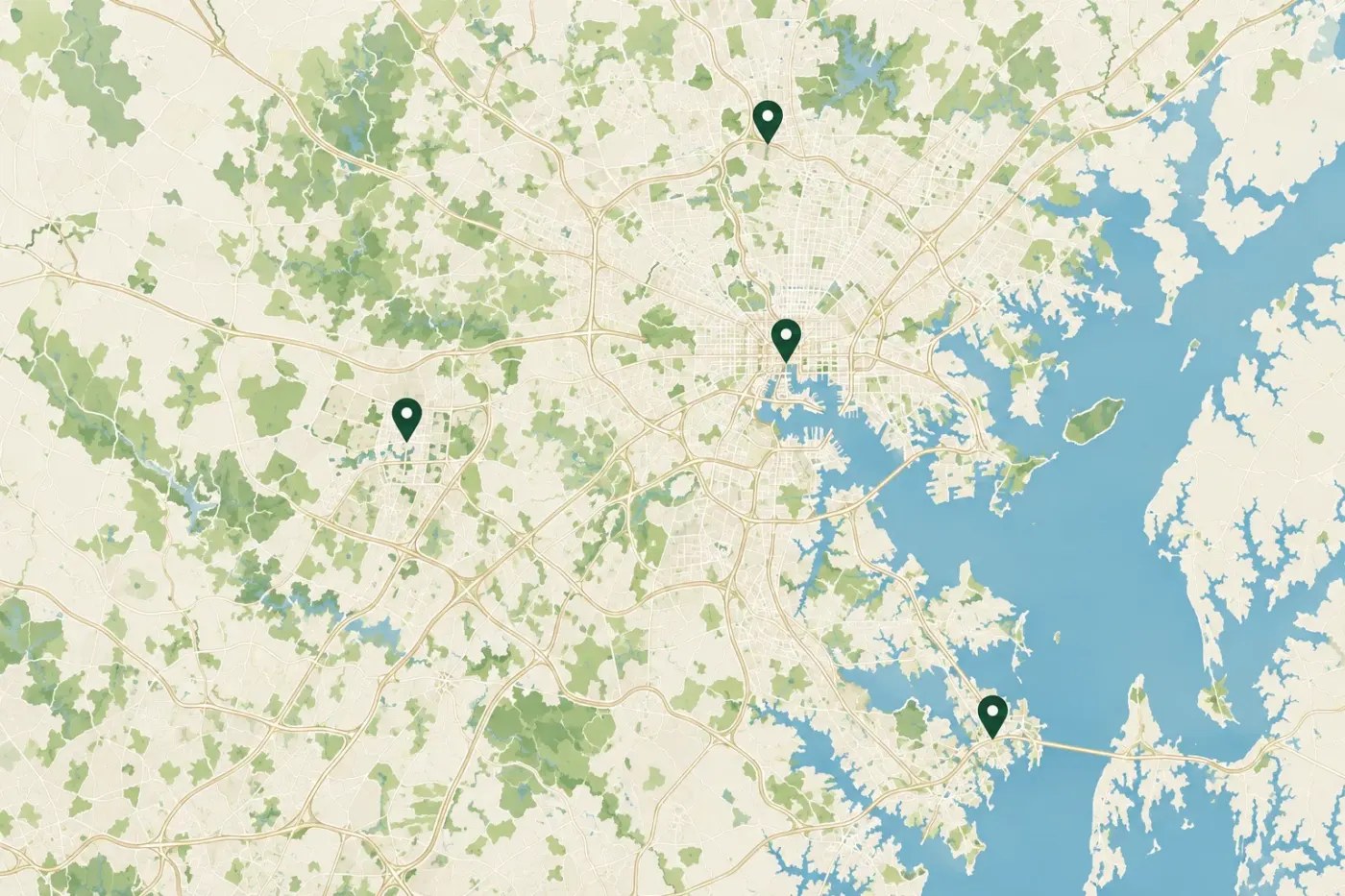

Nearby areas we also serve
Clients frequently operate across state and metro lines. We work throughout the region.

Ready to find out what AI could save your Baltimore business?
Book a free 30-minute consultation. Bring one workflow that eats your team’s week and we will tell you honestly whether automating it is worth the money.