

AI services in Columbus: automation and consulting
Our AI services in Columbus focus on the paperwork behind central Ohio’s largest employers. For example, that includes deliverables for state agencies downtown, claims files at insurance headquarters and grant reports at Ohio State. It also covers bills of lading for distribution centers around Rickenbacker. We work with Columbus teams remotely, during U.S. business hours, and every session runs over video. To begin, a free consultation ends with a written estimate of what the work would cost and save.
How the Statehouse, insurers and warehouses shape Columbus workloads
As the state capital, Columbus runs on a steady flow of agency contracts, status reports and public records requests. In addition, several national insurers keep headquarters and claims operations here, while Ohio State University anchors research and medical work. Meanwhile, warehouses around Rickenbacker handle freight paperwork, and data center and semiconductor projects keep spreading east into Licking County.
For state vendors, the rule that matters most is Ohio Administrative Policy IT-17, which covers AI in state solutions. Specifically, agencies must make sure suppliers disclose any generative AI used to produce work the state will own. Agencies also review every AI software service for security and privacy, even a free tool or a pilot. Insurers, for their part, answer to Ohio’s insurance data security law.
Therefore, AI services in Columbus start with a disclosure plan and a data map. As a result, an agency, insurer or carrier can see which tool touched each deliverable. A person also approves every uncertain result.

What AI services in Columbus take off agency, claims and freight desks
We start with work that is repetitive, well defined and easy to reverse. For instance, a state vendor might need help tracking contract deliverables and their due dates. Similarly, a claims team might want loss reports summarized before an adjuster opens the file. In each case, coverage, compliance and contract decisions stay with your staff. The system simply does the reading, matching and formatting.
Document & Data Processing
Claim forms, adjuster notes, bills of lading and grant budget sheets read into structured fields. That way, every value links back to its source page.
Customer Response Automation
Chat and email agents answer routine policyholder, student or shipper questions. Then they hand anything unusual to staff, with the full thread attached.
Workflow Automation
Contract deliverables, claim assignments and dock appointments move across your case system, CRM and warehouse software. Because of that, nobody retypes the same record.
Custom AI Agents
Agents complete multi-step tasks, such as assembling a state contract deliverable with its AI disclosure note. Each one stays within the permissions you set.
Internal Knowledge Search
Policy manuals, underwriting guidelines and state contract terms become searchable in plain English. Better still, every answer cites the clause it came from.
Reporting Automation
Weekly claims aging, deliverable status and warehouse throughput reports build automatically from your systems. Afterward, a plain-language summary sits on top of each one.

Central Ohio sectors, from the Statehouse to the Rickenbacker freight hub
In particular, these are the sectors where our AI services in Columbus find the most repeatable, document-heavy work. Even so, the right fit depends on your workflow, your data and the contracts you operate under.
State Government Contracting
Deliverable tracking, proposal responses and AI-use disclosures for consultancies and IT vendors working with Ohio agencies. Staff still approve every submission.
Insurance Claims & Servicing
Loss report intake, adjuster file summaries and policy servicing emails for carriers and agencies. In particular, vendor oversight under Ohio’s insurance data security law stays simple.
Higher Education & Research
Sponsored award spending, research compliance paperwork and student inquiries for university departments, as well as research centers and nearby colleges.
Retail & Fashion Corporate
Product spec sheets, vendor setup packets and merchandising reports for retail and apparel head offices. Their sourcing teams benefit too, since vendor files move faster.
Logistics & Distribution
Bills of lading, dock appointment requests and freight claims for warehouses and carriers around Rickenbacker. Consequently, loads leave with clean paperwork.
Data Centers & Advanced Manufacturing
Equipment documentation, construction submittals and supplier compliance files for data center builders. Similarly, the semiconductor supply chain in Licking County needs the same discipline.

Good first automation projects for Columbus teams
Deliverable AI Disclosure Log
To begin with, the system records which parts of a state contract deliverable used generative AI, and how. Then a project manager reviews the log and approves the disclosure note. Only after that does the package go to the agency.
Loss Report Summaries
The system reads loss reports, photos and policy details, then drafts a one-page summary with open coverage questions flagged. However, an adjuster reviews every summary and makes each coverage call, so the tool speeds up triage without deciding claims.
Sponsored Award Spending Reviews
The system compares monthly spending on a sponsored award against the approved budget and sponsor rules. Consequently, questionable or late charges surface early. A research administrator then reviews each flag and decides on any correction.
New Vendor Setup Packets
The system checks a new apparel or home-goods vendor’s forms, tax documents and compliance certificates against your requirements. It lists anything missing, and then a sourcing coordinator approves the vendor record before anyone places an order.
Damaged Freight Claim Packets
When a load arrives damaged, the system gathers the bill of lading, delivery receipt, photos and invoice into one claim packet. A logistics coordinator then reviews the packet and approves it before anything goes to the carrier.
Equipment Document Pre-Checks
For a data center or fab project, the system checks equipment data sheets, test reports and warranties against the specification. A project engineer then reviews each flagged gap and signs off before the package moves to the owner.
How a Columbus engagement runs, from first video call to monthly tuning
Overall, our AI services in Columbus follow the same five stages, all delivered over video. Because our hours run 9:00 AM to 7:00 PM Central, Columbus sessions fall between 10:00 AM and 8:00 PM Eastern.
Discovery
To start, we interview the people doing the work over video while they share their screens. Then we map the process end to end and note every system and data type involved.
AI Strategy
After that, we score each opportunity on build cost, time to value and annual savings. We also flag any deliverable where a state contract or an insurer’s vendor terms call for AI disclosure.
Pilot Build
Next, we build the top-ranked automation as a fixed-scope pilot. As a result, your team reviews real output from your own documents before you commit more budget.
Implementation
Once the pilot proves itself, we connect the system to your live tools and train staff over video. In addition, we add human review gates and a documented rollback path.
Optimization
Finally, each month we review accuracy, tune prompts and retrieval, and send a written report on hours saved. Meanwhile, your team can raise issues at any time by email or video.
What clients say
AI services in Columbus: state contracts, insurance data and estimates
Do you work with businesses in Columbus?
Yes. We provide AI services in Columbus to businesses from downtown and the Short North to Dublin, Westerville and Grove City. However, delivery is fully remote from our base in Canterbury, UK, so we do not visit offices in person. Instead, discovery, demos and training run over video, Monday to Friday, 9:00 AM to 7:00 PM Central. For Columbus, that means 10:00 AM to 8:00 PM Eastern.
Can a state vendor in Columbus use generative AI on agency work?
Often yes, with disclosure. Ohio Administrative Policy IT-17 governs AI in state solutions. Under it, agencies must make sure suppliers disclose generative AI used to produce work the state will own. Agencies also review AI software for security and privacy, even when it is free or part of a pilot. Therefore, we keep a log of where AI touched each deliverable. Your contract decides what is allowed, so confirm the terms with the agency first.
What does Ohio's insurance data security law expect from an AI vendor?
Ohio Revised Code Chapter 3965 requires insurance licensees to keep a written information security program based on a risk assessment. Some small licensees are exempt. Specifically, a licensee must vet each third-party service provider with due diligence. It must also require that provider to protect the data it can reach. Separately, certain cybersecurity events must reach the superintendent of insurance within three business days. So, for a Columbus carrier or agency, we document access, data flows and incident contacts up front.
What does the free consultation and written estimate cover?
The consultation is a video call with the people who actually do the work. For instance, we review one or two workflows, such as loss report intake, and the systems behind them. Afterward, you receive a written estimate of build cost, expected hours saved and the scope of a first pilot. If the numbers do not support automation, we say so plainly. That way, you can decide on AI services in Columbus without any obligation.
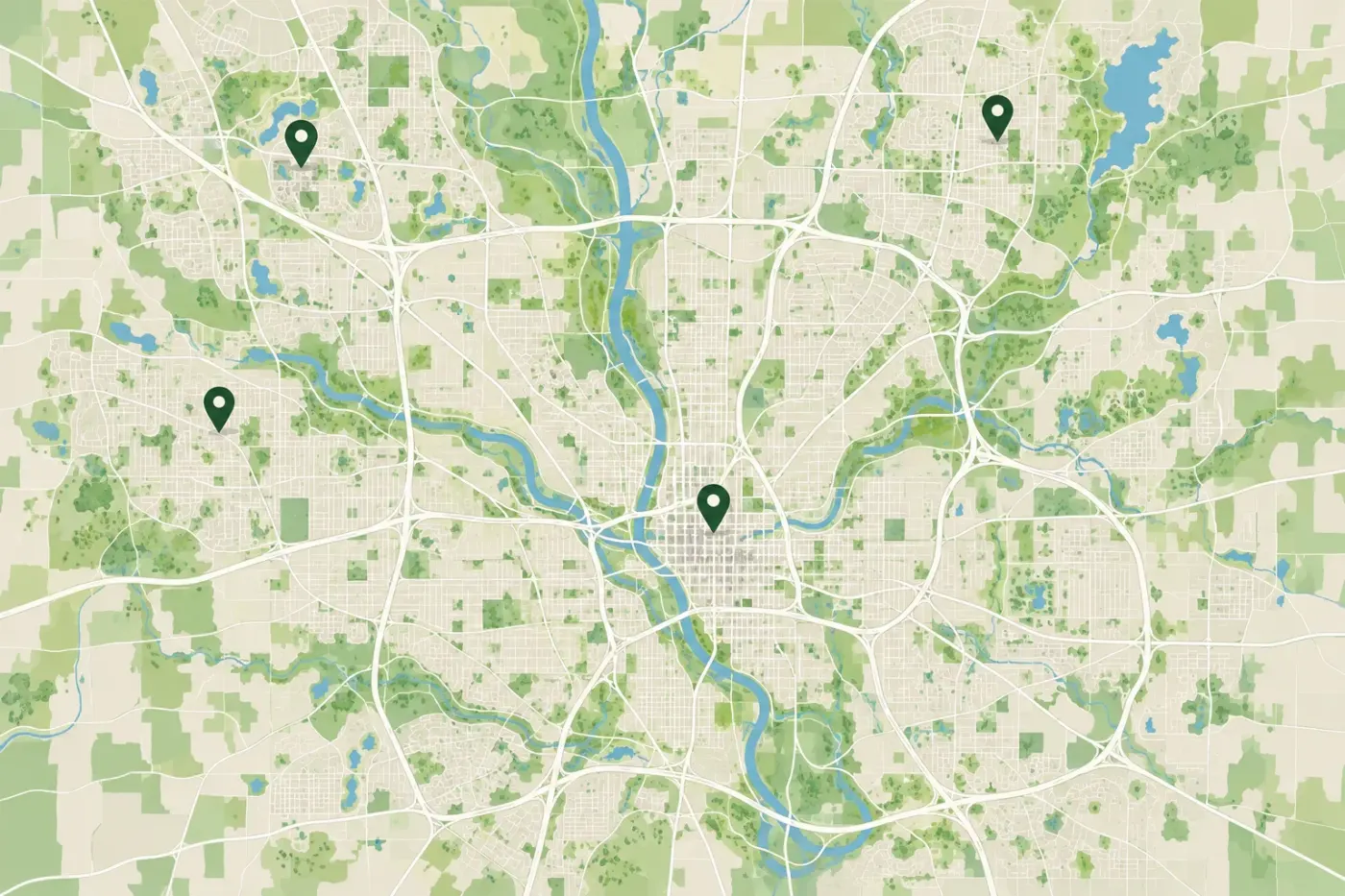

Nearby areas we also serve
Clients frequently operate across state and metro lines. We work throughout the region.

Ready to find out what AI could save your Columbus business?
Book a free 30-minute consultation. Bring one workflow that eats your team’s week and we will tell you honestly whether automating it is worth the money.