

AI services in Nashville: automation and consulting
Our AI services in Nashville target the paperwork behind the city’s biggest employers. For example, that means claims and credentialing files at healthcare management companies, and royalty statements on Music Row. It also covers group bookings for hotels and venues around Broadway and Opryland. In addition, it includes supplier documents for the auto plants south of the city. We work with Nashville teams remotely, during U.S. business hours on Central time, over video. To begin, a free consultation ends with a written estimate of what the work would save.
What Nashville's health care, music and hotel firms spend hours on
Nashville is a center for healthcare management companies, from hospital operators to revenue-cycle and physician-practice firms. In particular, their back offices handle credentialing files, payer contracts and claim denials every day. Meanwhile, publishers, labels and rights administrators on Music Row reconcile royalty statements, split sheets and licensing requests. Similarly, insurers, hotels, universities and auto suppliers around Franklin, Smyrna and Spring Hill add their own document loads.
In addition, two Tennessee laws shape that work. First, the Tennessee Information Protection Act took effect on July 1, 2025. Specifically, it gives consumers rights to access, correct and delete their data and to opt out of profiling. However, HIPAA-covered entities and financial institutions are exempt. Second, the ELVIS Act has been in force since July 1, 2024. It protects a person’s voice, including a simulated one, as a property right.
As a result, AI services in Nashville need clear data boundaries from the start. So we map which records fall under HIPAA, TIPA or neither. We also tie any use of a performer’s voice or likeness to written authorization.

Where AI services in Nashville fit claims, royalties and bookings
We look for work that is repetitive, well defined and easy to correct if it goes wrong. For most AI services in Nashville, that work sits around the decision rather than inside it. For instance, a coder still assigns the code, and a royalty analyst still signs off the statement. Meanwhile, the system gathers, checks and formats the records those people rely on.
Document & Data Processing
Explanation-of-benefits forms, credentialing packets, royalty statements and supplier invoices read into structured data, with every field traced back to its page.
Customer Response Automation
Chat and voice agents that answer routine patient-billing, guest or policyholder questions at any hour. Anything unusual then passes to staff with the conversation attached.
Workflow Automation
Provider onboarding, group contracts and claims follow-up connected across your practice management system, CRM and finance tools, so nobody re-keys details.
Custom AI Agents
Agents that complete multi-step tasks, such as assembling a payer appeal packet or a sync licensing quote, within the permissions and limits you set.
Internal Knowledge Search
Payer policies, catalog metadata and internal procedures searchable in plain English. Each answer also cites its source document, so staff can check it.
Reporting Automation
Weekly denial trends, royalty variances or group pickup reports built from your systems automatically, then summarized in plain words for managers.

The Nashville sectors we build automations for
Overall, these are the sectors where our AI services in Nashville tend to find steady, document-heavy work. Even so, the right fit depends on your workflow, your data and whether HIPAA, TIPA or neither covers it.
Healthcare Management
Claims follow-up, denial appeals, credentialing and payer-contract tracking for hospital operators, physician practice firms and revenue-cycle companies, all inside HIPAA boundaries.
Music & Entertainment
Royalty statement reconciliation, split-sheet and metadata cleanup, and licensing request intake for publishers, labels and rights administrators, while staying within ELVIS Act limits.
Insurance
First-notice-of-loss intake, policy document comparison and agent support for carriers and agencies, while any profiling decision stays under human review.
Hospitality & Tourism
Group-booking contracts, event orders, guest inquiries and vendor invoices for hotels, music venues and event planners around downtown and Music City Center.
Automotive Suppliers
Purchase orders, advance ship notices, quality documentation and supplier correspondence for parts makers serving the auto plants across Middle Tennessee.
Higher Education
Admissions document intake, student service questions, research grant paperwork and policy search for the universities and colleges across the city.

Good first automation projects for Nashville teams
Claim Denial Appeals
The system reads each denial, pulls the matching clinical notes and payer policy, and drafts an appeal letter. Then a billing specialist reviews the draft, corrects anything off and approves it before it goes to the payer.
Provider Credentialing Packets
Licenses and board certifications, as well as insurance certificates, are collected, read and checked for gaps or expiry dates. A credentialing coordinator then approves each packet, so new providers reach payers sooner and staff stop chasing every page.
Royalty Statement Reconciliation
To begin with, royalty statements from different sources are standardized and matched against your catalog and split agreements. Next, a royalty analyst reviews every variance the system flags and decides which ones to raise with the payer.
Sync License Request Intake
Licensing requests arriving by email and web form are read, matched to the right song and rights holders, and drafted into a quote. A licensing manager then checks the terms and approves the quote before anything is sent.
Group Contract Review
Group and event contracts are checked against your standard terms for attrition, cancellation and room-block dates. For example, an unusual clause is flagged, and a sales manager decides whether to accept it or push back.
Supplier Quality Checks
Certificates, inspection reports and advance ship notices are compared against each purchase order and part specification. Also, a quality engineer reviews every mismatch and approves the shipment before it is released to the line.
From discovery call to rollout: the Nashville project path
Every engagement for AI services in Nashville follows the same five stages, all over video. In addition, we time reviews around your calendar, for example outside open enrollment, month-end close or a major event weekend downtown.
Discovery
First, we interview the people doing the work over video and watch the process on screen share. Then we map it end to end and audit the systems and data behind it.
AI Strategy
Next, we score every opportunity on build cost, time to value and annual savings. We also note whether HIPAA, TIPA or the ELVIS Act touches it, then rank the list.
Pilot Build
After that, we ship the top-ranked automation as a fixed-scope pilot. That way, you see real output on your own documents before committing further budget to the project.
Implementation
Then we integrate the system with your live tools and train your staff over video. We also add human review gates and a documented rollback path before launch.
Optimization
Finally, each month we review accuracy and tune prompts and retrieval. You also receive a written report on the hours and dollars the system saved that month.
What clients say
Nashville questions about AI services, TIPA and the ELVIS Act
Do you work with businesses in Nashville?
Yes. We provide AI services in Nashville to businesses across Davidson County and nearby counties such as Williamson and Rutherford. However, we are based in Canterbury in the UK, and we have no office or staff in Tennessee. Instead, delivery is fully remote, during U.S. business hours on Central time. Consequently, discovery sessions, demos, training and leadership readouts all run live over video.
Does the Tennessee Information Protection Act apply to our AI project?
It depends on your business. TIPA took effect on July 1, 2025. It generally applies to companies with more than $25 million in annual revenue that also meet a data test. For example, one test is controlling or processing the personal information of at least 175,000 Tennessee consumers in a calendar year. However, HIPAA-covered entities, financial institutions, nonprofits and colleges are exempt. So we flag where the law may apply, and your counsel confirms it.
Could AI tools for a music company conflict with the ELVIS Act?
They could if they misuse a real person’s voice. The ELVIS Act took effect on July 1, 2024, and treats an individual’s name, photograph, voice and likeness as a property right. Notably, it covers simulated voices too. It also creates liability for tools whose primary purpose is producing a specific person’s voice or likeness without authorization. For that reason, our music-industry work focuses on royalties, metadata and licensing paperwork, not voice cloning.
What does a first pilot cost a Nashville business?
It depends on the workflow, so we quote every pilot at a fixed price before work starts. First, the free consultation gives you a written estimate of what the automation would cost and save. Then the pilot covers one workflow, such as denial appeals or royalty reconciliation, using your own documents. As a result, you see real output before deciding whether to expand. Afterward, ongoing support is monthly and cancellable with 30 days notice.
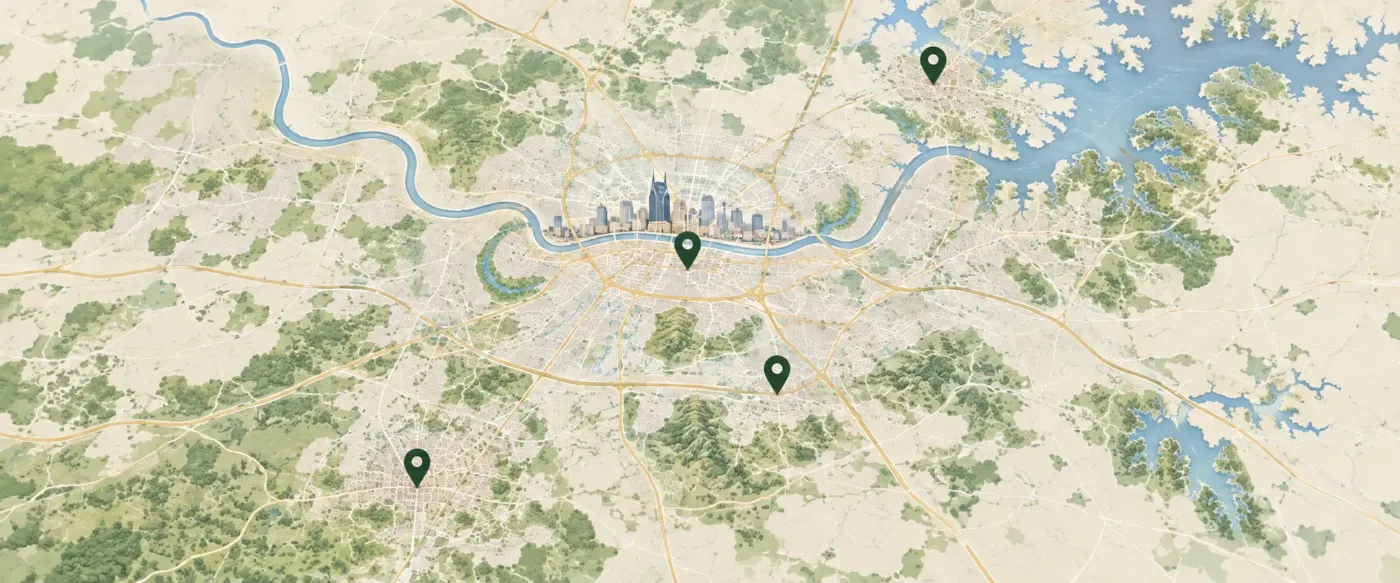

Nearby areas we also serve
Clients frequently operate across state and metro lines. We work throughout the region.

Ready to find out what AI could save your Nashville business?
Book a free 30-minute consultation. Bring one workflow that eats your team’s week and we will tell you honestly whether automating it is worth the money.