

AI services in Raleigh: automation and consulting
Our AI services in Raleigh focus on the documents behind the Triangle’s research and government economy. For example, that includes monitoring reports and site questionnaires for contract research organizations in Research Triangle Park. Likewise, it covers deviation reports for biomanufacturers, release notes for Cary software firms and proposals from state agency vendors. We work with Raleigh teams remotely, during U.S. business hours on Central time, over video. To begin with, a free consultation comes with a written estimate of what the work would save.
Research Triangle trials, code and contracts: Raleigh's paperwork load
Raleigh sits at one corner of the Research Triangle, and its economy reflects that. For example, contract research organizations and drug developers in Research Triangle Park run clinical trials. Those trials generate monitoring reports, site files and safety records. Meanwhile, SAS in Cary and Red Hat downtown anchor a large software sector. As the state capital, Raleigh hosts agencies that buy from vendors statewide, too. NC State adds research and agtech work as well.
Several rules shape AI work here. Specifically, FDA’s Part 11 sets controls for regulated electronic records, including validation and secure, time-stamped audit trails. In addition, Executive Order 24, signed in September 2025, created an AI Accelerator in the state’s IT department. It reviews agency AI use cases. Similarly, state law protects a vendor’s trade secrets only when the vendor marks them confidential at submission.
As a result, AI services in Raleigh must show who changed what, and when. So we keep AI drafts apart from the official record until a qualified person approves them.

How AI services in Raleigh lighten trial, software and bid work
We start with work that is repetitive, well defined and recoverable if it goes wrong. For instance, a Raleigh CRO might need help drafting monitoring visit reports from CRA notes. Likewise, a state vendor might need help checking a proposal before submission. Scientific, quality and bid decisions stay with your people, because the paperwork around them is where the time disappears.
Document & Data Processing
Site questionnaires, batch deviations, field trial sheets and vendor forms read into structured data. Each value also links to its source page.
Customer Response Automation
Chat and voice agents that answer routine sponsor, site or applicant questions. Otherwise, they hand off to staff with full context.
Workflow Automation
Study start-up, quality and proposal steps connected across your CTMS, QMS or CRM, so that nobody re-keys documents.
Custom AI Agents
Agents that finish multi-step tasks, such as building a site feasibility response from past study records, within your limits.
Internal Knowledge Search
SOPs, protocols, product documentation and state contract terms searchable in plain English, and every answer cites the document behind it.
Reporting Automation
Instead of hand-built spreadsheets, enrollment, deviation or support reports assemble themselves weekly and explain changes in plain words.

Triangle sectors with documents, data and deadlines to automate
Our AI services in Raleigh concentrate on sectors where regulated documents and tight deadlines meet. That said, fit depends on your workflow and data, as well as the oversight your sponsors or auditors expect.
Contract Research & Clinical Trials
Site feasibility, monitoring visit reports and safety case intake for CROs and sponsors, so that Part 11 audit trails stay intact.
Biomanufacturing
Deviation reports, CAPA tracking and supplier documents for biologics plants, while quality decisions always stay with qualified staff.
Software & IT Services
Release notes, support escalations and customer onboarding for software and IT service firms, particularly across Raleigh, Cary and Durham.
State Government Vendors
Proposal checks, confidential-marking reviews and contract reporting for state agency vendors, because cost pages are never confidential.
Agtech & Crop Science
Field trial data, grower inquiries and regulatory drafts for crop science and agtech companies, in particular those near RTP.
Higher Education
Student inquiries, research compliance paperwork and policy search for universities and colleges, whereas faculty and staff keep every academic decision.
Good first automation projects for Raleigh teams
Site Feasibility Responses
The system drafts answers to sponsor feasibility questionnaires from the site’s past enrollment, staffing and equipment records. Each answer cites its source, so a site coordinator can check it quickly. Afterward, the coordinator edits and approves every response before it reaches the sponsor.
Monitoring Visit Report Drafts
Notes from a clinical research associate’s visit become a draft report in the sponsor’s template, with open issues listed. However, the CRA reviews, corrects and signs the final report inside your validated system, so the audit trail stays complete.
Deviation Report Triage
The system sorts new deviation reports by product, process step and likely severity, and links similar past events. Consequently, QA sees patterns sooner. Even so, a quality reviewer classifies each deviation and decides whether it needs a CAPA.
Confidential Marking Review
Before a proposal goes to a state agency, the system flags likely trade-secret pages that lack the required CONFIDENTIAL marking. Similarly, it flags cost pages, which the state never treats as confidential. A proposal manager makes every final call.
Release Note Drafting
The system turns merged tickets and commit messages into draft release notes grouped by feature and fix. Additionally, it keeps customer-facing wording separate from internal detail. A product manager approves the notes before publication.
Field Trial Data Intake
Plot data sheets and photos from trial sites arrive in many formats, so the system standardizes them into one dataset. Furthermore, it flags missing plots or odd values, and an agronomist reviews each flag before analysis begins.
The checkpoints a Raleigh project passes, each one over video
Each Raleigh project moves through the same five stages, all over video. Meanwhile, we time stage reviews around your calendar, for instance a database lock or a bid deadline.
Discovery
To begin with, we interview the people doing the work over video and watch how they use each system. We then map the workflow and flag the regulated records.
AI Strategy
Subsequently, we score each opportunity on build cost, time to value and annual savings. In particular, we mark where Part 11, public records or client rules limit what AI can touch.
Pilot Build
Then we build the top-ranked automation as a fixed-scope pilot on sample data. As a result, your team judges real output before you commit any further budget.
Implementation
Following the pilot, we connect the system to your live tools remotely and train staff over video. Moreover, we document review gates, access controls and a rollback path for your quality team.
Optimization
Finally, we review accuracy every month and tune prompts and retrieval. Each month you also get a written report on hours saved and on corrections that reviewers made.
What clients say
AI services in Raleigh: Part 11, public records and pilot questions
Do you work with businesses in Raleigh?
Yes. We provide AI services in Raleigh and across the Triangle, from downtown to Research Triangle Park, Cary and Durham. Still, delivery is remote, from our base in the UK, and we have no North Carolina office or local team. Instead, every session runs live over video, Monday to Friday, from 9:00 AM to 7:00 PM Central. For Raleigh, that means 10:00 AM to 8:00 PM Eastern.
Does FDA's Part 11 apply to AI tools in our clinical research?
It can. Part 11 covers electronic records that FDA rules require you to keep or submit. It calls for controls such as system validation and secure, time-stamped audit trails. FDA’s guidance says it will use enforcement discretion on some of those requirements, although the underlying record rules still apply. For that reason, our tools usually draft outside the regulated record. A qualified person reviews each draft and enters the final version. Your quality team should confirm the approach.
Will our proposal to a North Carolina agency stay confidential?
Only the parts that qualify. Under G.S. 132-1.2, a trade secret in a bid or proposal stays protected only if you mark it confidential at first submission. Moreover, the state’s vendor instructions require a bold CONFIDENTIAL label at the top and bottom of each such page. The state never treats cost information as confidential. Therefore, our marking review flags unmarked pages, while your team decides what counts as a trade secret. Your counsel should confirm the details.
Can a pilot run without disrupting an active clinical study?
Yes, in most cases. Our AI services in Raleigh usually run a pilot on copies of past or de-identified documents. That leaves live study systems untouched. In fact, CRAs and coordinators only join short review sessions over video. We fix the pilot’s price and scope in writing; therefore, you know the cost and end date before work starts. If the results don’t justify a wider rollout, we will say so plainly.
Nearby areas we also serve
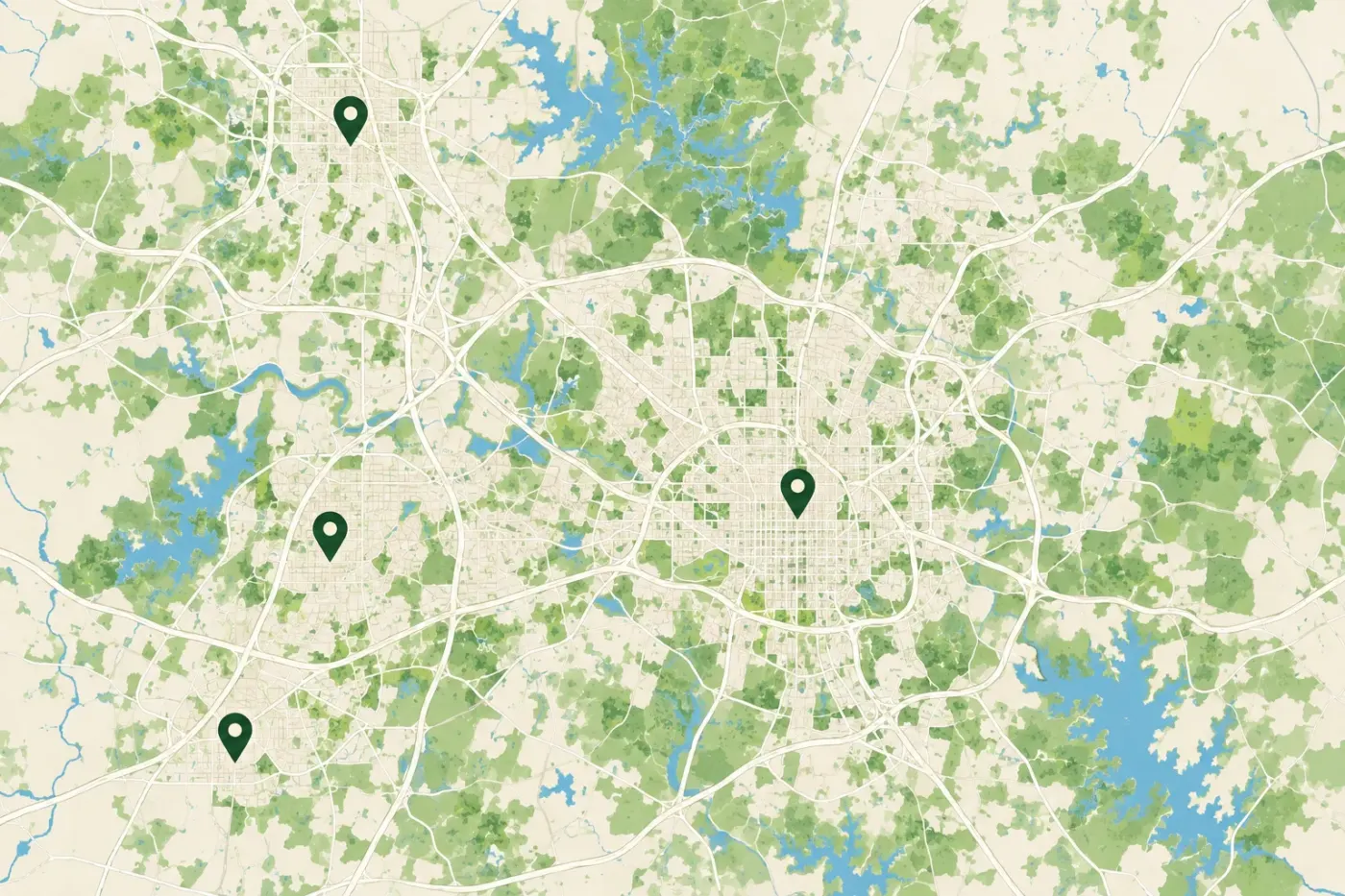
Clients frequently operate across state and metro lines. We work throughout the region.

Ready to find out what AI could save your Raleigh business?
Book a free 30-minute consultation. Bring one workflow that eats your team’s week and we will tell you honestly whether automating it is worth the money.