

AI services in San Francisco: automation and consulting
Our AI services in San Francisco help SaaS, fintech, life sciences and professional services teams clear repetitive, document-heavy work.
To begin with, we map one process and measure the hours it takes. Then we build the automation, track the time it gives back and report it in writing. Before any of that, though, it starts with a free consultation.
What San Francisco's economy asks of automation
San Francisco’s economy leans on software and SaaS, venture-backed startups and fintech. Banking also clusters in the Financial District, while life sciences grow around Mission Bay. Meanwhile, hospitality and tourism add a large customer-service workload.
Despite their differences, these sectors share one trait. Specifically, each wraps a small core of expert judgment in a lot of reading, chasing and formatting. For example, a vendor security questionnaire, a clinical study document and an engagement letter all need careful but repetitive handling.
Also, engineering time usually goes to the product. As a result, internal tooling waits, and operations staff fill the gap by hand. Therefore, that gap is often where AI services in San Francisco earn their cost back first.

AI services in San Francisco for the work behind the product
We look for work that is repetitive, well defined and easy to correct if it goes wrong. For example, a SaaS company might start with support ticket triage, while a law firm might start with matter intake. However, judgment calls stay with your people, because automating judgment badly is how AI projects lose trust.
Document & Data Processing
Contracts, invoices, security questionnaires and research PDFs turned into structured data, so nobody builds a template per layout.
Customer Response Automation
Support bots and voice agents that resolve routine customer and guest questions at any hour, then hand the rest to a person.
Workflow Automation
The SaaS tools your teams already use, from CRM to billing to ticketing, connected so nobody copies data between tabs.
Custom AI Agents
Multi-step agents that finish whole tasks, such as preparing a renewal pack, inside permissions and limits you set.
Internal Knowledge Search
Staff questions answered from your own wiki, policies and runbooks with citations, instead of from whoever happens to remember.
Reporting Automation
The weekly board, pipeline or burn report somebody rebuilds by hand, replaced by one that assembles and explains itself instead.

San Francisco sectors where automation pays off
Below are the sectors where AI services in San Francisco usually find the most repetitive work, although every business differs. Suitability still depends on your workflow, your data and the rules you operate under.
SaaS & Technology
AI features inside your product, support deflection, onboarding assistants, as well as security-questionnaire drafting for B2B sales cycles.
Financial Services
Document extraction, reconciliation, KYC support and audit-ready reporting, so fintechs and banks around the Financial District close faster.
Professional Services
Proposal drafting, timesheet capture, research synthesis and client reporting for consulting, accounting and design firms.
Healthcare
Intake, prior authorization and clinical documentation for providers and life sciences teams, while respecting HIPAA and California privacy law.
Legal
Contract review, discovery triage and matter intake with citation-checked outputs and attorney sign-off before anything leaves the firm.

Good first automation projects for San Francisco teams
Security Questionnaire Drafting
Vendor security questionnaires are answered in draft from your approved policies and past responses. A security lead then reviews every answer and edits anything that does not match current practice.
Support Ticket Tagging
New support tickets are tagged by product area, urgency and plan, then routed to the right queue. Also, suggested replies are drafted, while your support engineers decide what actually goes to the customer.
Payment Dispute Intake
Chargeback and dispute notices are read, matched to the transaction and bundled with the relevant records. So a dispute analyst reviews a complete case and decides whether to accept or contest it.
Study Document Indexing
Protocols, amendments and site documents are indexed by study, version and type so teams can find them. A clinical operations lead reviews each entry before it is filed in the trial master file.
Guest Inquiry Responses
Questions from hotel and venue guests arrive by email and chat, and the system drafts answers from your own policies. Then staff approve or edit each reply, especially for refunds and special requests.
Contract Clause Extraction
Customer and vendor contracts are read for renewal dates, liability caps and data terms, which land in a tracker. An attorney or deal desk reviewer confirms each clause before anyone relies on it.
Five stages, run over video for San Francisco teams
Every project follows the same five stages on shared video calls. As a result, your San Francisco team always knows what comes next and what it receives.
Discovery
Initially, we interview the people doing the work over video and map the workflow end to end. Then we audit the systems and data behind it, including any personal information in CCPA scope.
AI Strategy
Every opportunity gets scored on cost to build, time to value, and annual savings, then ranked.
Pilot Build
We ship the top-ranked automation as a fixed-scope pilot so you see real output before committing further budget.
Implementation
Integration with your live systems, staff training and human-in-the-loop review gates, as well as a documented rollback path.
Optimization
Monthly accuracy reviews and prompt and retrieval tuning, then a written report on hours and dollars saved.
What clients say
Questions about AI services in San Francisco: cost, data and timing
What happens if you conclude AI is not worth it for us?
We say so plainly, and it happens regularly. In those cases the discovery usually still identifies process or integration improvements worth making, because mapping a workflow exposes waste regardless of whether AI is the right fix. Either way, you still keep the analysis.
How long before a business in San Francisco sees results?
First of all, discovery takes two to four weeks. After that, a first production automation typically goes live within six to ten weeks. Clients usually see measurable time savings within the first month of the system being live, and we report those hours in writing each month rather than asking you to take our word for it.
Will this replace jobs at our San Francisco business?
In our engagements it usually does not, because the constraint is rarely too many people but a backlog that never clears. Instead, staff doing data entry typically move to exception handling, customer relationships and the work that was being neglected. However, if headcount reduction is your explicit goal, we will tell you honestly what the numbers support.
Which San Francisco industries are the best fit?
Generally, the best candidates match the city’s economic anchors. These include SaaS and technology, fintech and banking, life sciences, law and consulting, and hospitality. However, industry matters less than the workflow. If a process is repetitive, well defined and document-heavy, it is worth a look whatever sector you are in.
Do you serve areas near San Francisco as well?
Yes. We also work with teams in Oakland, Berkeley, Daly City, South San Francisco and across the Bay Area. Because delivery is remote, location does not limit where we can help. Instead, the same video-based process applies everywhere.
Do you work with businesses in San Francisco?
Yes. We provide AI services in San Francisco to companies in SoMa, the Financial District, Mission Bay, the Mission and nearby neighborhoods. Delivery is fully remote, so you get the specialists the project needs rather than whoever is nearest. Discovery sessions and leadership readouts also run live over video, between 7:00 AM and 5:00 PM Pacific.
Is our data safe, and where does it go?
Data flow, retention and residency are agreed in week one, before anything is built. For example, we can deploy inside your own cloud tenancy, use zero-retention model endpoints, or run open-weight models on infrastructure you own. If the CCPA applies, we plan for consumer requests, risk assessments and the 2027 ADMT rules from the outset. We also work with your counsel on HIPAA, SOC 2 and GLBA duties rather than reviewing them afterward.
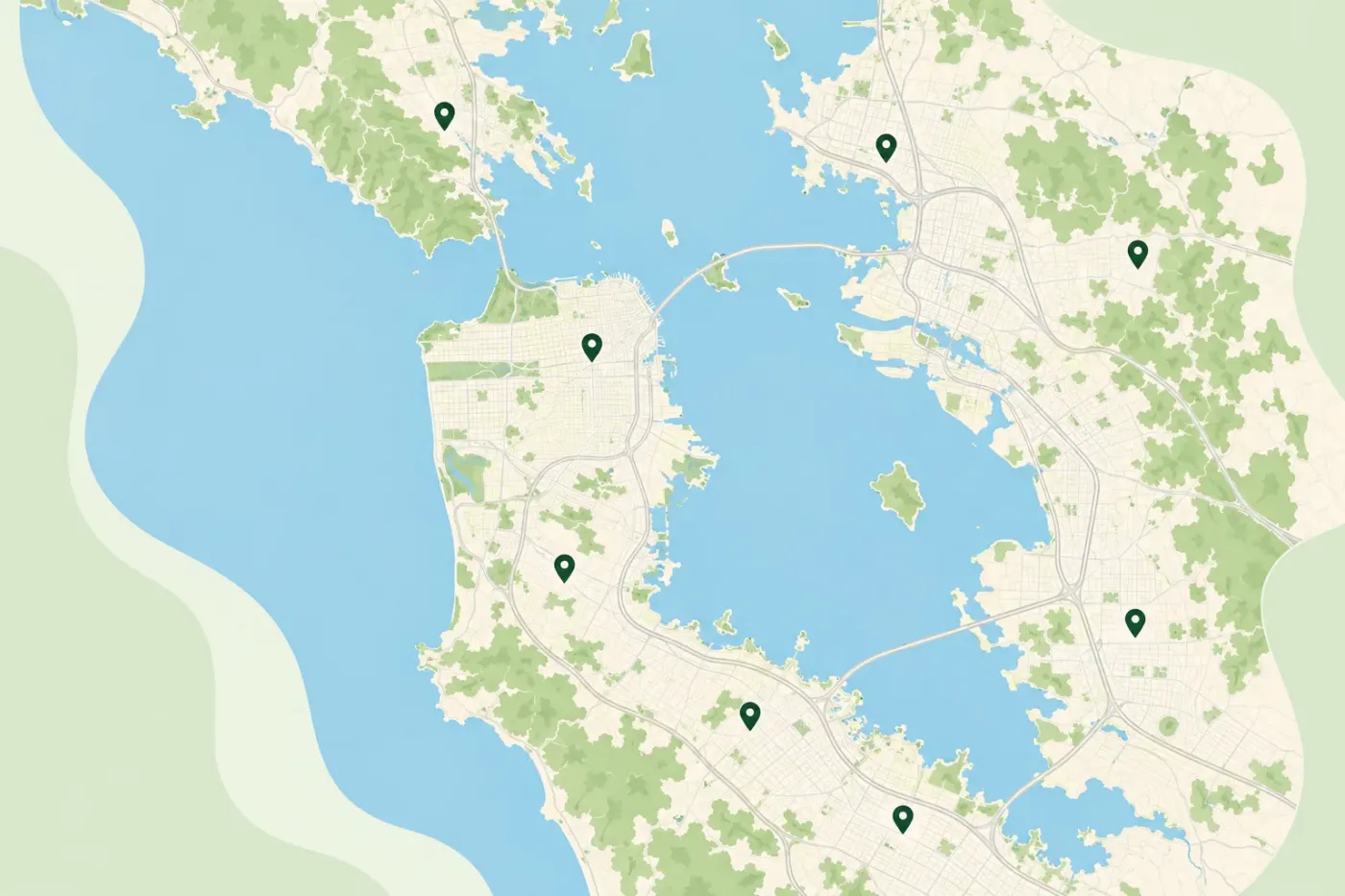

Nearby areas we also serve
Clients frequently operate across state and metro lines. We work throughout the region.

Ready to find out what AI could save your San Francisco business?
Book a free 30-minute consultation. Bring one workflow that eats your team’s week and we will tell you honestly whether automating it is worth the money.