AI cloud solutions that use the commitments you have already made
Our AI cloud solutions help you assess deployment within AWS, Azure or Google Cloud. We consider existing commitments, data requirements, procurement and operating costs before recommending a platform.
AI cloud solutions deploy artificial intelligence workloads on major cloud platforms using their managed AI services, AWS Bedrock and SageMaker, Azure OpenAI and Machine Learning, or Google Vertex AI. This keeps data within the customer’s own cloud account, uses existing commercial commitments, and inherits established security controls.
Adding a vendor when you already pay for the capability
Organizations with substantial cloud commitments frequently add a separate AI vendor, triggering a new security review, a new procurement cycle, a new data processing agreement, and spend that does not count toward existing commitments.
Meanwhile the same models are frequently available through the cloud platform they already run, inside the account and security perimeter their compliance team has already approved.
Deploy inside the perimeter you already have
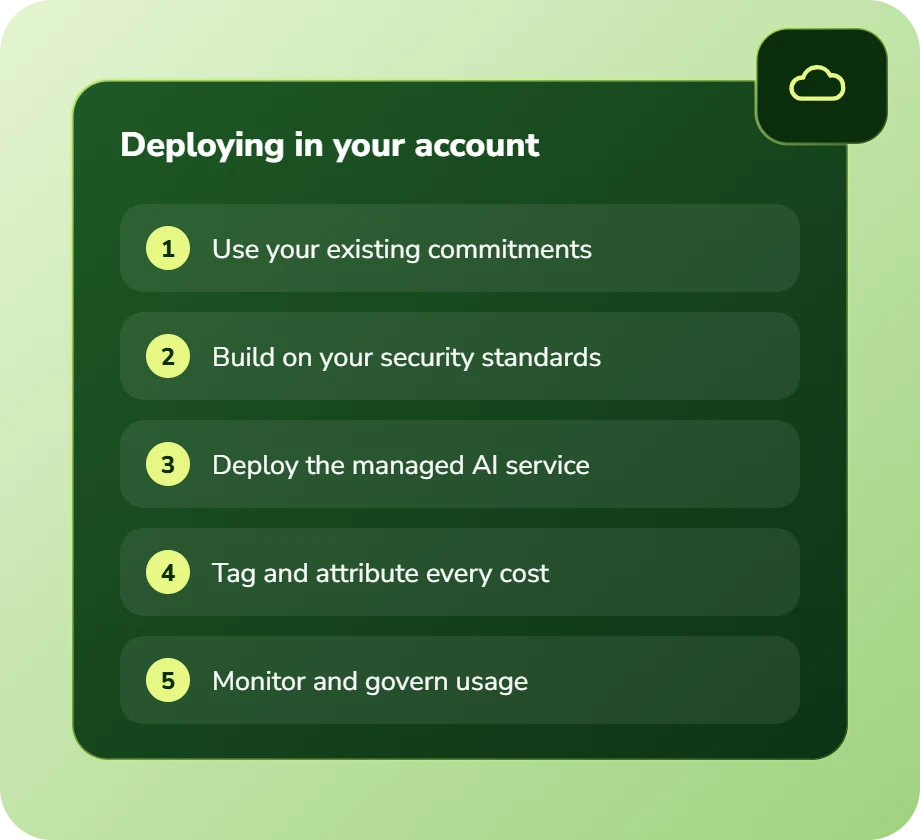
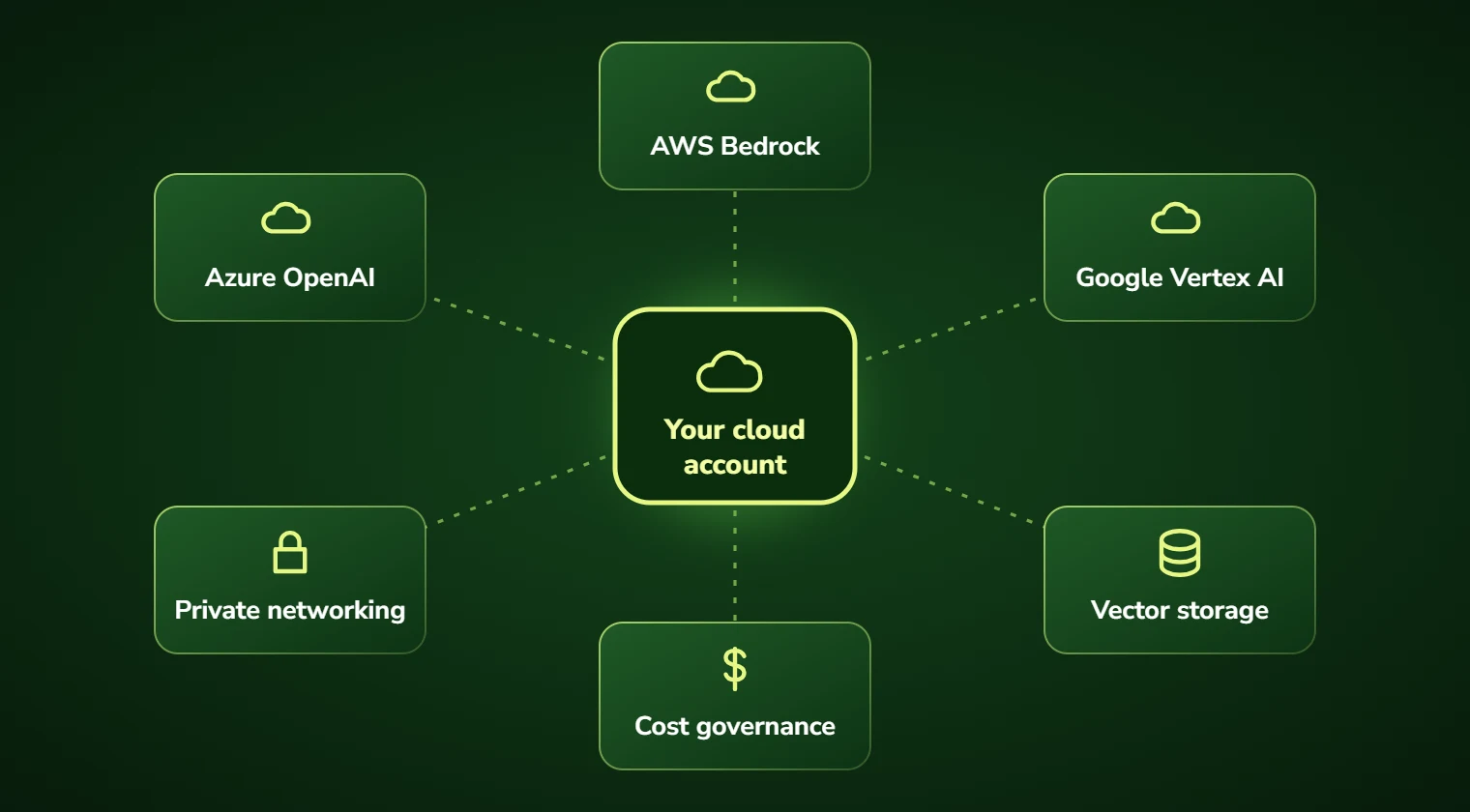
Managed AI services on AWS, Azure and Google Cloud run inside your own account, under your existing IAM and network controls, billed against commitments you have already made.
That removes a security review, a procurement cycle and a compliance question in one decision, which is frequently worth more than any marginal model capability difference.
AI cloud solutions: scope and deliverables
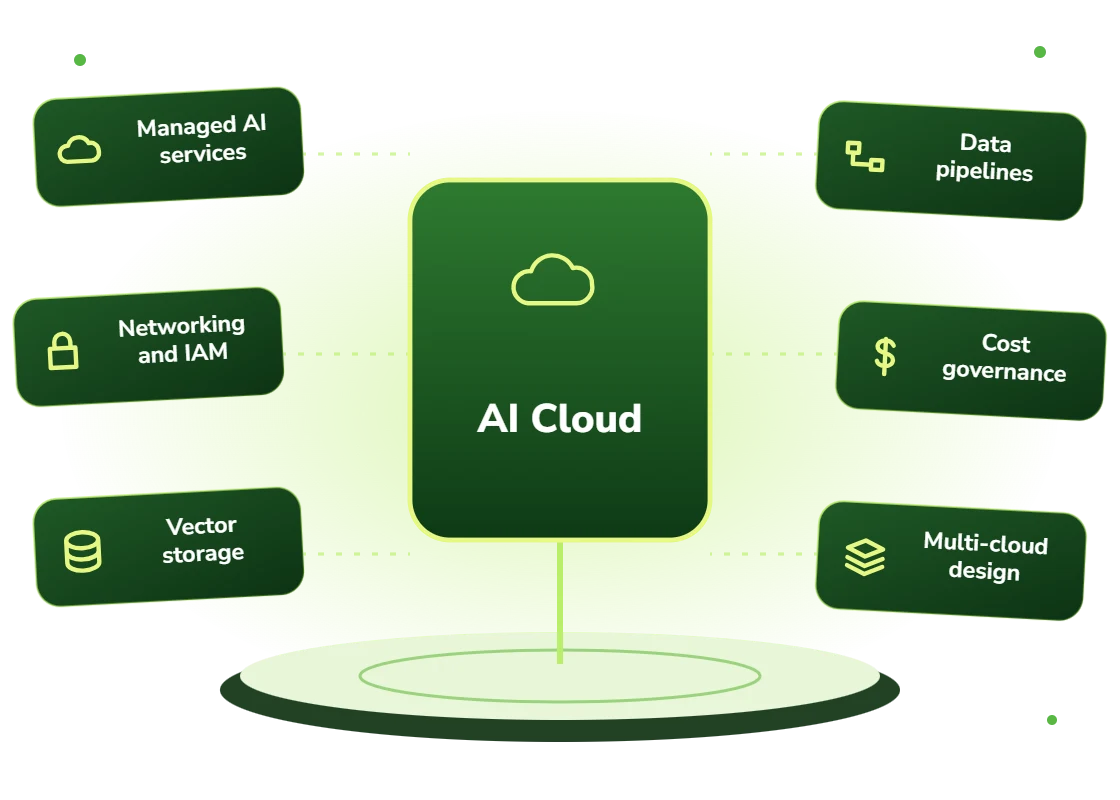
Platform AI services first: Bedrock, Azure OpenAI or Vertex AI provide model access inside your account with the platform’s own controls, logging and billing.
Then the supporting infrastructure: vector storage, data pipelines, serving and orchestration, built with the platform’s managed services where they fit and self-managed where they do not.
Security architecture matters particularly here: private networking, IAM scoping, encryption and audit logging integrated with what your organization already runs rather than bolted alongside.
And cost governance, because cloud AI spend is easy to accumulate invisibly across accounts and teams.
- Managed AI service deployment: Bedrock, Azure OpenAI, Vertex AI
- Private networking, IAM scoping and encryption integrated with your standards
- Vector storage and retrieval infrastructure within the platform
- Data pipelines using the platform’s own managed services
- Cost governance: tagging, attribution, budgets and alerting
- Multi-cloud and portability design where required
Who this suits
Organizations with meaningful cloud commitments or committed-use discounts, where routing AI spend through the platform has direct commercial value.
And regulated organizations whose compliance position is already established for their cloud provider, where using a separate AI vendor means reopening a settled question.
- Organizations with significant AWS, Azure or Google Cloud commitments
- Regulated companies whose cloud compliance position is already approved
- Teams whose data residency requirements rule out external AI vendors
- Enterprises where adding a vendor means a nine-month procurement cycle
- Companies wanting AI spend visible within existing cost governance
- Organizations standardizing AI deployment across business units
Benefits of AI cloud solutions
Spend against existing commitments
AI usage counts toward committed-use discounts rather than becoming separate vendor spend.
No new security review
Deployment inside an account and perimeter your security function has already approved.
Procurement already done
No new vendor onboarding, data processing agreement or contract negotiation cycle.
Data stays in your account
Processing within your own cloud boundary under your own IAM and network controls.
Unified cost governance
AI spend visible in the same tagging and attribution system as the rest of your infrastructure.
Familiar operations
Monitoring, logging and incident response using the tooling your team already operates.
Business challenges this solves
New vendor triggering full procurement
Nine-month cycles blocking AI adoption. Platform deployment uses existing agreements.
Security review from scratch
A new perimeter to assess. Deployment inside an approved account avoids it.
Spend outside commitments
AI costs not counting toward committed-use discounts. Platform routing captures them.
Data residency constraints
External vendors ruled out by compliance. Cloud deployment stays inside the boundary.
AI spend invisible
Costs accumulating across accounts untracked. Tagging and attribution makes them visible.
Inconsistent deployment by unit
Each team choosing differently. Platform standardization creates consistency.
Features and deliverables
Everything below is in scope on a standard engagement. Nothing here is an upsell discovered halfway through the build.
Platform service deployment
AWS Bedrock and SageMaker, Azure OpenAI and ML, or Google Vertex AI configured within your account.
Security architecture
Private networking, VPC endpoints, IAM scoping, encryption and audit logging integrated with your standards.
Vector and retrieval infrastructure
OpenSearch, pgvector on managed Postgres, or platform-native vector services depending on fit.
Data pipeline services
Managed pipeline services configured for AI workloads rather than assembling infrastructure from scratch.
Cost governance
Tagging strategy, per-workload attribution, budget alerts and anomaly detection integrated with existing cost tooling.
Infrastructure as code
Terraform or platform-native IaC so deployments are reproducible and reviewable.
Multi-region and resilience
Regional deployment for latency or residency, with failover design where availability requirements demand it.
Portability layer
Abstraction so platform choice remains reversible despite deep integration.
Technologies we use for AI cloud solutions
We are not tied to one vendor. Model and infrastructure choices are made on accuracy, cost per task, latency, and where your data is allowed to live.
Our AI development process
The same five stages on every engagement, so you always know what happens next and what you get at the end of it.
Discovery
We interview the people doing the work, map the workflow end to end, and audit the systems and data behind it.
AI Strategy
Every opportunity gets scored on cost to build, time to value, and annual savings, then ranked.
Pilot Build
We ship the top-ranked automation as a fixed-scope pilot so you see real output before committing further budget.
Implementation
Integration with your live systems, staff training, human-in-the-loop review gates, and a documented rollback path.
Optimization
Monthly accuracy reviews, prompt and retrieval tuning, and a written report on hours and dollars saved.
How long it takes
A typical first engagement, week by week. Complex integrations and regulated environments extend this, and we say so during discovery rather than after.
Discovery and scoping
Process observation, systems audit, data review, and a written estimate of cost and expected saving before anything is built.
Design sign-off
Architecture, data handling rules, review thresholds and success measures agreed in writing.
Build and integration
Development against your real data, connected to your live systems, with weekly demos rather than a single reveal.
Parallel run and testing
The system runs alongside the existing process so accuracy can be compared directly before anyone depends on it.
Launch and handover
Cutover with a rollback path, staff training, full documentation, then 30 days of included tuning.
Industries we deliver AI cloud solutions for
SaaS & Technology
AI features inside your product, support deflection, onboarding assistants, and usage analytics.
Financial Services
Document extraction, reconciliation, KYC support, and audit-ready reporting with full traceability.
Healthcare
Intake, prior authorization, clinical documentation, and revenue-cycle workflows built to respect HIPAA boundaries.
Insurance
First-notice-of-loss intake, claims triage, policy Q&A, and fraud signal detection.
Manufacturing
Quality inspection, maintenance prediction, supplier communication, and production scheduling.
Logistics & Supply Chain
Document processing, carrier communication, exception handling, and inventory rebalancing.
Retail & E-commerce
Product data enrichment, demand forecasting, support deflection, and personalized merchandising.
Education
Enrollment support, content generation, tutoring assistants, and administrative automation.
Real-world use cases
Bedrock deployment on AWS
Model access through Bedrock with data staying inside the AWS account and existing IAM controls.
Azure OpenAI for enterprises
OpenAI models within an Azure tenancy under existing enterprise agreement and compliance posture.
Vertex AI on Google Cloud
Gemini and other models processing BigQuery data without egress from the project.
Regulated workload deployment
AI within an already-approved compliance boundary rather than reopening the assessment.
Cost governance implementation
AI spend tagged, attributed and budgeted within existing FinOps practice.
Multi-cloud AI architecture
Workloads deployed across platforms with a portability layer maintaining flexibility.
Why choose DevSolutionsAI for AI cloud solutions
Business case before build
Every recommendation carries an estimated cost, timeline, and annual savings figure. If the math does not work, we say so before you spend.
Vendor-neutral by design
We resell nothing and take no platform commissions. Model and infrastructure choices are made on fit, cost, and your data-residency rules.
Fixed-scope pilots
The first engagement is a defined deliverable at a defined price, not an open-ended retainer that quietly grows each quarter.
Built for handover
You own the code, the prompts, the infrastructure, and the documentation. No lock-in to a proprietary wrapper you cannot leave.
Human-in-the-loop where it counts
Anything customer-facing, clinical, financial, or legal gets a review gate, a confidence threshold, and a logged audit trail.
Security reviewed early
Data flow diagrams, retention rules, and access boundaries are agreed in week one, not retrofitted after your security team objects.
Find out what AI cloud solutions would cost you, before you commit to anything
Every engagement is quoted after a short discovery, so you get a fixed written price built around your actual volumes rather than a rate card that assumes someone else’s business.
The first call is thirty minutes and free. Bring one workflow. We will tell you what it is likely costing you each year, roughly what automating it would take, and whether we think it is worth doing at all.
- A written savings estimate before any paid work
- Fixed scope and fixed price, agreed up front
- Full ownership of everything we build for you
- An honest recommendation when the numbers do not work
Figures are internal measurements across recent engagements, reported to every client monthly in writing.
Illustrative project scenario
Nine months of procurement avoided by using what they already had
Challenge. A financial services firm had an AI initiative blocked in procurement. Onboarding a new AI vendor required a full third-party risk assessment, a new data processing agreement and contract negotiation, with an estimated nine-month timeline that the business sponsor could not wait for.
What we built. Deployment through Azure OpenAI within their existing Azure tenancy and enterprise agreement, using IAM, private networking and audit logging already established and approved. The compliance question was whether Azure was approved for the data class, which it already was.
Outcome. The initiative reached production in eleven weeks rather than waiting nine months for vendor onboarding. AI spend counted toward existing Azure commitments. The security review was an extension of an approved architecture rather than an assessment of a new one.
Illustrative project scenario. The figures demonstrate how a project could be scoped and evaluated; they are not verified client results or an audited average.
What clients say about working with us
AI Cloud Solutions FAQs
Should we use a cloud platform or go direct to a model provider?
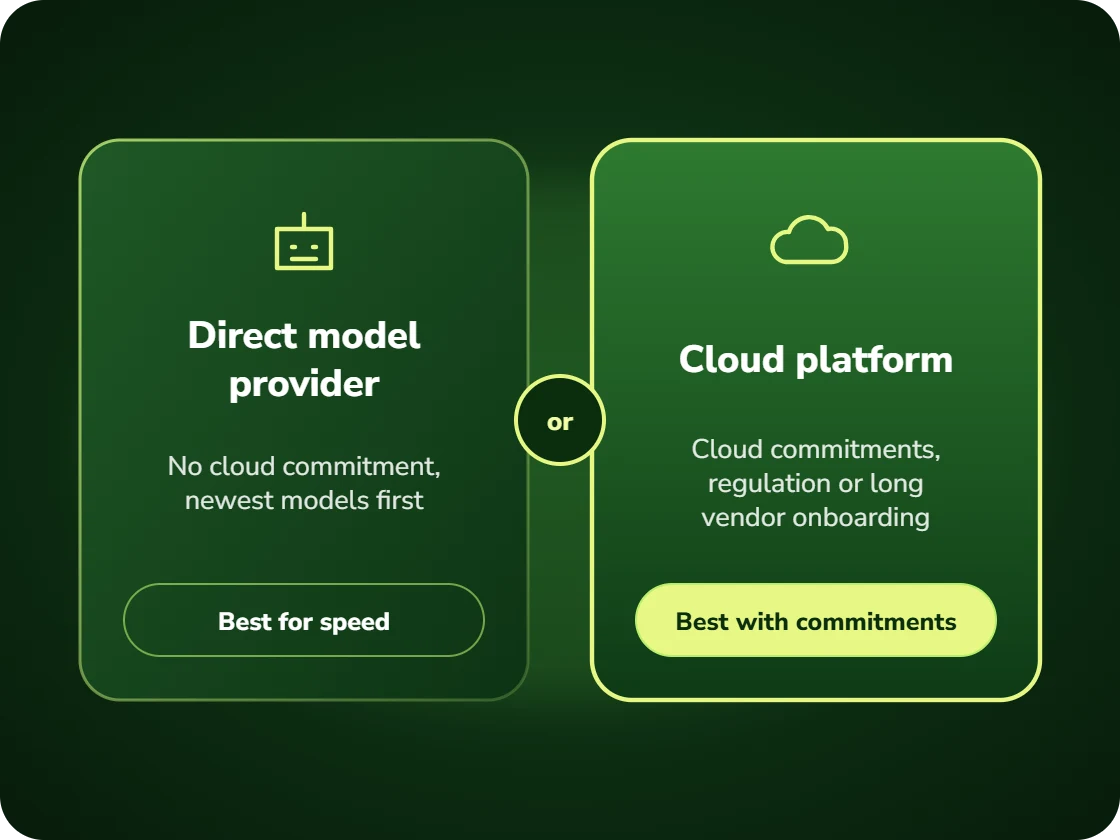
If you hold meaningful cloud commitments, are in a regulated industry, or have a lengthy vendor onboarding process, the platform route usually wins, not on capability but on procurement, compliance and commercial terms. On a recent engagement it turned a nine-month procurement block into an eleven-week delivery. If you have no cloud commitment and want the newest models immediately, direct API access is simpler.
Which cloud platform is best for AI?
Mostly the one your data already lives in. Adjacency to your data estate, your existing commitments and your approved compliance boundary matter more for most organizations than marginal model capability differences. AWS Bedrock offers the broadest model choice, Azure suits Microsoft-centric estates, and Vertex AI has strong BigQuery and Workspace adjacency.
Does data stay in our cloud account?
With the managed AI services, yes, processing happens inside your own account or tenancy, under your IAM and network controls, and the platforms’ terms state that data is not used to train their models. This is frequently the deciding factor for regulated organizations, because it means the compliance question is one they have already answered.
Do we lose access to the newest models?
Somewhat. Models typically reach cloud platforms weeks after direct API availability. Whether that matters depends on your use case, for most production workloads it does not, and the procurement and compliance advantages outweigh it. If you need frontier capability the day it releases, direct API access is the right choice.
How do you keep cloud AI costs under control?
Tagging and per-workload attribution from the start so spend is visible rather than accumulating invisibly across accounts, budget alerts and anomaly detection, and caching and model routing at the application layer. Cloud AI spend is particularly easy to lose track of because it appears within a much larger bill.
What does cloud AI deployment cost?
An architecture engagement covering platform selection, security design and cost projection runs $12,000 to $22,000 over two to three weeks. A full deployment with managed services, security, infrastructure as code and cost governance typically runs $38,000 to $80,000. Ongoing operations are available monthly.
Services that pair well with this one
Most clients combine two or three of these. We will tell you the right sequence during discovery.
Ready to scope your AI cloud solutions project?
Book a free 30-minute consultation. Bring one workflow and leave with a realistic estimate of what it would cost to automate and what it would save.