

AI services in Minneapolis: automation and consulting
Our AI services in Minneapolis focus on the records behind the Twin Cities’ largest employers. For example, that includes complaint files at medical device makers and broker letters at health insurers. It also covers vendor paperwork at retail head offices, as well as ingredient specifications at food companies. We work with Minneapolis teams remotely, over video, during U.S. business hours on Central time. To begin with, a free consultation ends with a written estimate of what the work would save.
Medical devices, member services and store support: the Minneapolis paperwork load
The Twin Cities economy leans on a handful of document-heavy sectors. For instance, medical device companies across the suburbs maintain complaint records, design history files and supplier quality data. Meanwhile, health insurers and benefits administrators answer member, employer and broker correspondence at volume. Several national retailers and food companies run corporate operations here, too. As a result, vendor setup, product specifications and store support tickets pile up in head offices.
Since July 31, 2025, the Minnesota Consumer Data Privacy Act has applied to many of these businesses. In particular, covered controllers must keep an inventory of the personal data they manage. Moreover, profiling can feed decisions with legal or similarly significant effects. In that case, consumers may question the result and learn the reason behind it.
Accordingly, AI services in Minneapolis should start by listing what personal data each automation reads. Therefore, we log every input and keep a person in charge of any decision about a customer.

Device, member and vendor tasks suited to AI services in Minneapolis
We start with work that is repetitive, well defined and easy to reverse. For instance, a medical device company in the northern suburbs might want complaint intake sorted faster. Likewise, a health plan might want first drafts of broker replies. In each case, quality, coverage and credit decisions stay with your staff. Meanwhile, the system handles the reading, sorting and drafting around them.
Document & Data Processing
Complaint forms, supplier certificates, grain contracts and vendor setup packets read into structured fields. Each value also links back to its source page.
Customer Response Automation
Assistants that answer routine member, broker or store questions from approved content. Otherwise, they hand the case to a person along with the full conversation.
Workflow Automation
Vendor onboarding, sample requests and complaint follow-ups connected across your ERP, CRM and quality system. That way, staff enter each detail only once.
Custom AI Agents
Agents that complete multi-step tasks, such as assembling a supplier onboarding file, within the approval limits your team sets.
Internal Knowledge Search
Quality procedures, benefit summaries and store operations manuals searchable in plain English. Every answer cites the document and version it came from, too.
Reporting Automation
Weekly complaint trends, correspondence backlogs or vendor setup status compiled from your systems, then explained in a short written summary.

Six Twin Cities sectors where document backlogs build up
Overall, these six sectors give our AI services in Minneapolis the most repeatable work to automate. Even so, fit depends on your own process, your data and the contracts or regulations you already operate under.
Medical Devices & Medtech
Complaint intake, design history file indexing and supplier quality paperwork for device makers. Quality engineers still decide what counts as a reportable event.
Health Insurance & Benefits
Broker questions, member letters and plan lookups for insurers and administrators, so that protected health data stays inside approved systems.
Retail Corporate Operations
Vendor onboarding and product data cleanup, as well as store support tickets, for retail head offices serving stores nationwide.
Food & Agribusiness
Ingredient specifications, allergen statements and grain contract paperwork for food and agribusiness firms, whereas food safety staff approve every match.
Banking & Payments
Procedure updates, dispute correspondence and policy search for banks, credit unions and payment companies. Specifically, each build fits the controls you already document.
Higher Education
Transfer credit requests, admissions inquiries and research administration paperwork for universities and colleges. In addition, staff can search policy manuals in plain English.

Good first automation projects for Minneapolis teams
Complaint File Triage
The system reads incoming complaint forms, emails and service notes, then sorts each one by product, failure mode and urgency. A quality engineer reviews every file and decides whether it is a reportable event. The system never makes that call.
Broker Inquiry Responses
Brokers ask the same plan and enrollment questions every renewal season. So the system drafts each reply from your current plan documents and cites the source. A benefits specialist approves the reply, and anything about an individual member’s claim goes straight to staff.
Vendor Setup Packet Review
New suppliers send tax forms, insurance certificates and compliance attestations in many formats. The system checks each packet against your onboarding checklist and lists what is missing. Afterward, a vendor management coordinator approves the record before it reaches the ERP.
Allergen Statement Review
The system compares supplier ingredient specifications and allergen declarations with your formulation records. Whenever a declaration is missing, expired or inconsistent, it flags the line. A food safety lead then decides whether to use the ingredient.
Procedure Update Mapping
When a regulator or card network publishes a rule change, the system maps it to the affected procedures. Then it drafts redlines for each one. Accordingly, a compliance officer reviews every proposed edit, and nobody publishes a change without that sign-off.
Transfer Credit Evaluation
The system reads transcripts and course descriptions, then matches each course to your existing equivalency tables. However, new or unclear matches go to a registrar or faculty reviewer. That person approves every evaluation before a student sees it.
From interview notes to a tuned system: Minneapolis delivery
Our AI services in Minneapolis follow five stages, and every session runs over video. Because Minneapolis shares our Central time zone, sessions fit anywhere from 9:00 AM to 7:00 PM, Monday to Friday.
Discovery
To begin with, we interview the people doing the work over video. We then map the process end to end and record every system and type of personal data it touches.
AI Strategy
After that, we score each opportunity on build cost, time to value and annual savings. We also flag any step that involves profiling, since Minnesota gives consumers specific rights there.
Pilot Build
Then we build the top-ranked automation as a fixed-scope pilot. As a result, your team reviews real output from its own documents before committing more budget.
Implementation
Following the pilot, we connect the system to your live tools and train staff over video. In addition, we document review gates, a rollback path and how your team escalates a data incident.
Optimization
Finally, we review accuracy every month and tune prompts and retrieval. A written report on hours saved follows each remote video session.
What clients say
AI services in Minneapolis: profiling rights, exemptions and pilots
Do you work with businesses in Minneapolis?
Yes. We provide AI services in Minneapolis to companies downtown, in St. Paul and across suburbs such as Bloomington, Eden Prairie and Plymouth. Delivery is fully remote from our base in Canterbury in the UK, so we do not visit offices or plants. Instead, discovery sessions, demos and training run over video, Monday to Friday, 9:00 AM to 7:00 PM Central. Conveniently, that is also Minneapolis time.
What does the Minnesota Consumer Data Privacy Act mean for AI that scores people?
It matters most when profiling supports decisions with legal or similarly significant effects. In that case, the consumer may question the result and be told the reason for the decision. They can also review the personal data used and, if it was wrong, have it corrected and the decision reevaluated. Consumers may opt out of that kind of profiling as well. Therefore, we design these systems so that a person can explain and revisit every outcome. Your counsel then confirms the details.
Is every Minneapolis company covered by the state privacy law?
No. The act generally covers businesses handling personal data of 100,000 or more Minnesota consumers. The threshold drops to 25,000 when over 25% of revenue comes from selling data. Some data and organizations are exempt, such as HIPAA-protected health information and insurance companies. Small businesses, as the SBA defines them, are exempt too, except for the act’s sensitive-data section. Separately, Minnesota’s breach notice law applies to any business that owns or licenses residents’ personal information, so we check both.
Can we pilot AI in one department before involving the whole company?
Yes. In fact, many AI services in Minneapolis engagements start that way, especially at large head offices. For example, a pilot might cover complaint intake for one product line, or broker replies for one plan. We quote each build at a fixed price before work starts, so you know the pilot’s cost up front. Then, if the results hold up, we extend the same setup to other teams instead of starting over.
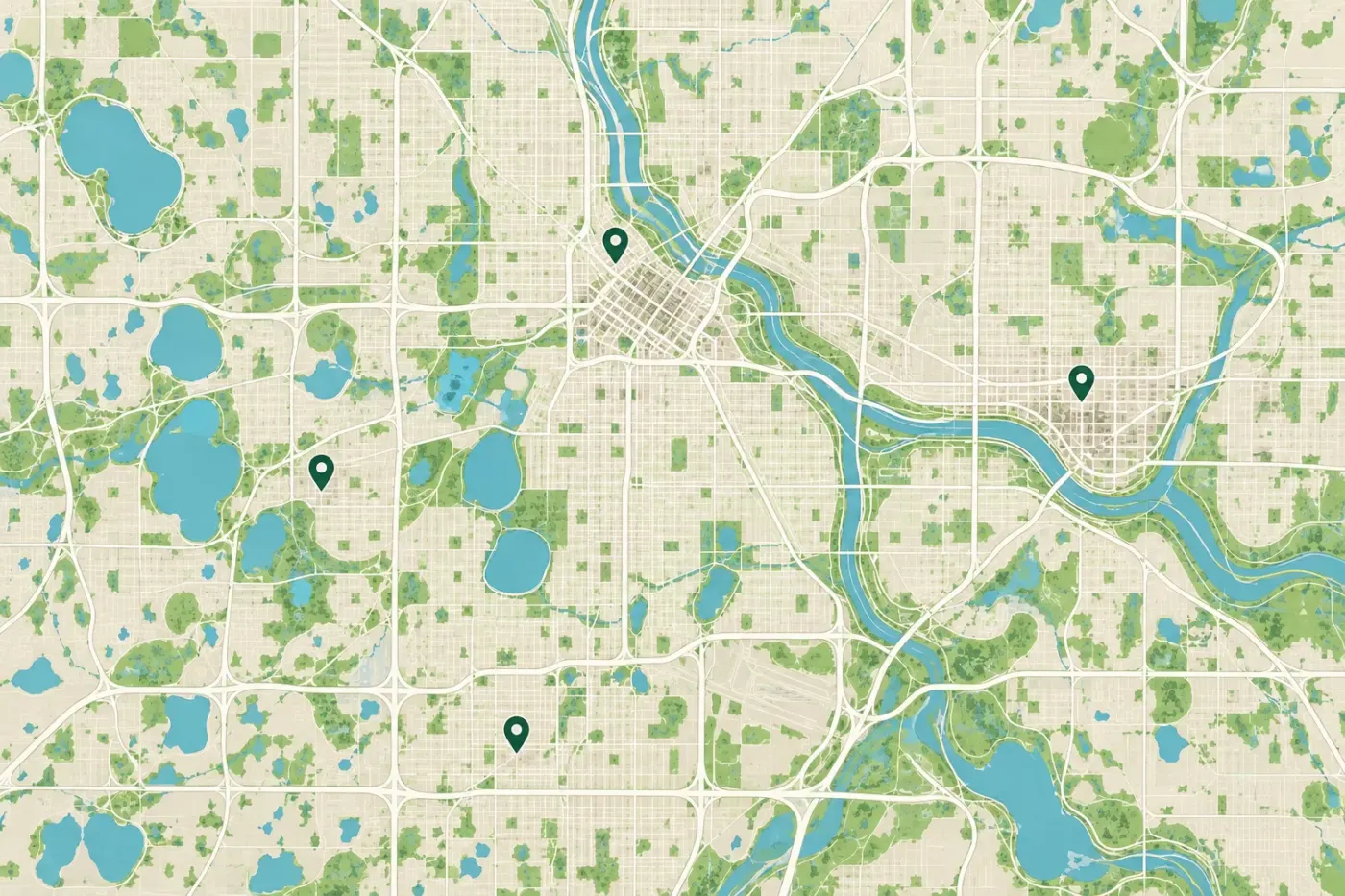

Nearby areas we also serve
Clients frequently operate across state and metro lines. We work throughout the region.

Ready to find out what AI could save your Minneapolis business?
Book a free 30-minute consultation. Bring one workflow that eats your team’s week and we will tell you honestly whether automating it is worth the money.