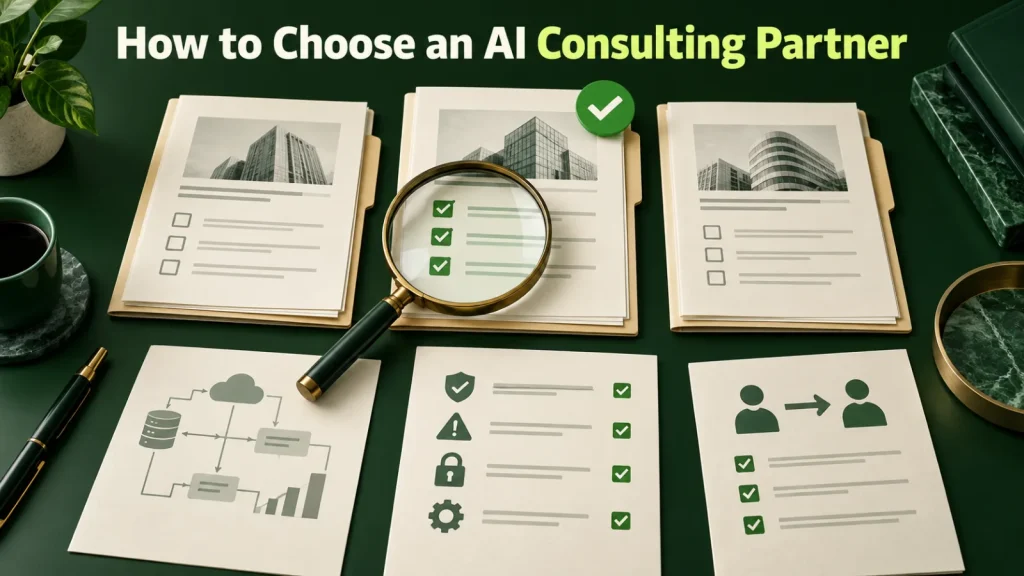
Choosing an AI consulting partner means examining how a firm scopes work, tests assumptions and plans handover. Use these questions to compare proposals and the evidence behind each recommendation.
The market has a signalling problem
The barrier to describing yourself as an AI consultancy is close to zero, and the surface presentation of a capable firm and an inexperienced one is nearly identical. Both have case studies, both name the same models, and both show a dashboard, so first impressions tell you little.
Instead, the differences appear in how they scope, what they refuse, and how they handle the parts of a project that are unglamorous. We wrote the questions below to surface that quickly.
That said, no single answer settles the choice. Look for a consistent pattern across all seven, because a capable AI consulting partner gives specific, slightly uncomfortable answers throughout.
Seven questions to ask an AI consulting partner
-
Tell me about a project you turned down
A firm with judgment has declined work before. If every inquiry is a fit for their capability, they are selling capacity rather than advice. Then listen for a specific reason rather than a general principle. For example, a firm might decline because the volume could never cover the running cost.
-
What happens to this system when it is wrong?
You want an immediate, structural answer: confidence thresholds, escalation paths, audit logging. Hesitation here means the team has not designed the failure modes, only hoped about them. In other words, ask to see the review queue, not just the happy path.
-
Who owns the code, prompts and models?
The correct answer is you. Anything else, particularly around prompts and fine-tuned models, creates a dependency that becomes expensive precisely when you want to leave.
-
What is the annual running cost?
They should answer in itemized terms: model usage, hosting, monitoring, support. Otherwise, a firm that has not modeled the run cost has not built enough of these to know. Also ask how that figure changes if your volume doubles.
-
Can we see it running on our data?
A short paid proof of concept on your real, messy inputs tells you more than any reference call. Reluctance usually means the demo depends on clean data rather than yours.
-
Who actually does the work?
Meet the engineers, not just the principal. Also ask what proportion is subcontracted and where. This is not snobbery, because it determines how quickly issues get resolved after launch.
-
What does support look like in month seven?
After all, model deprecations, API changes and process drift are certainties. Therefore, the answer should describe a maintenance arrangement, not an assurance that it will be stable.
Answers that should end the conversation
- Instant yes. “AI can automate that” said before anyone has looked at how the process works.
- Price before discovery. A fixed price quoted in the first meeting, without discovery. Such a price is either padded heavily or about to become a change-order relationship.
- No evaluation plan. No mention of evaluation or accuracy measurement anywhere in the proposal.
- Vague provider terms. Reluctance to name which model provider they use, or on what commercial terms.
- Percentages only. Case studies with percentages but no absolute numbers, no timeline and no named workflow.
- Ownership pushback. Any resistance to you owning the output.
How to compare AI consulting partner proposals
Once two or three proposals arrive, put them side by side against the same criteria. Otherwise, the firm with the best slides tends to win by default. So the scorecard below turns the seven questions into things you can check on paper.
| Criterion | Strong proposal | Weak proposal |
|---|---|---|
| Scope | Names one workflow and its volume | Lists broad use cases |
| Evaluation | Accuracy test on your data | Not mentioned |
| Failure handling | Thresholds, review queue, logs | “The model is very accurate” |
| Running cost | Itemized per year | Absent or “minimal” |
| Ownership | You own code and prompts | Licensed back to you |
| Support | Named maintenance arrangement | “Contact us if needed” |
For failure handling in particular, the NIST AI Risk Management Framework gives both sides a shared vocabulary. Equally, a firm that already thinks in those terms will find the conversation easy.
A selection process that takes weeks, not months
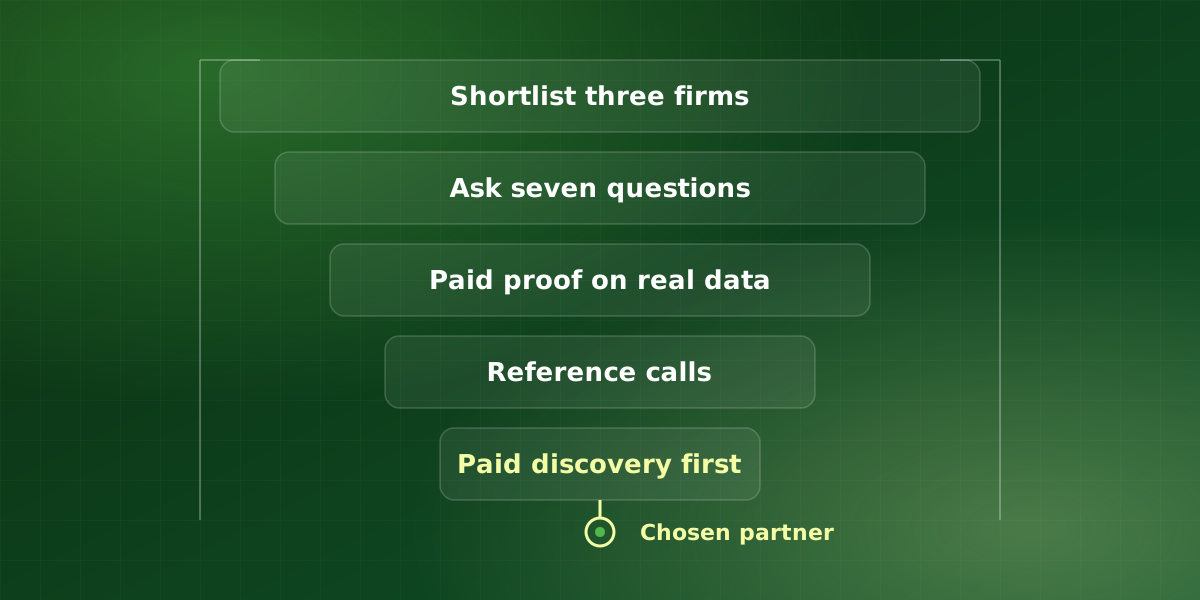
However, you do not need a long procurement exercise to choose well. In practice, this sequence filters out weak fits quickly while keeping your own time investment modest.
- Shortlist three firms. First, pick firms that have shipped your problem shape before. Three is usually enough to compare approaches without turning selection into a second job.
- Run the seven questions. Next, ask every firm the same questions in the same order, and take notes. As a result, you compare answers rather than impressions.
- Pay for a small proof on real data. Then ask your top one or two choices for a short paid test on your own inputs. Also include the awkward cases your team complains about most.
- Check references properly. Ask each reference what went wrong and how the firm responded. A reference who can describe a problem and its fix tells you far more than one who only praises.
- Start with paid discovery. Finally, sign for discovery before any build. That way you own a written specification even if you later choose a different AI consulting partner for delivery.
What a good AI consulting partner tells you early
A strong AI consulting partner will often say things you would rather not hear. For example, they may tell you the workflow is too small to justify a build, or that your data needs cleanup first. They may also recommend a report or a process change instead of AI.
At first, those answers can feel like lost momentum. However, they are exactly what you are paying for, because they prevent the failure patterns we describe in why AI projects fail. In short, a firm that agrees with everything is not consulting but selling.
Questions a good partner asks you
The evaluation runs both ways. In fact, the questions a firm asks in the first meeting reveal as much as its answers. A serious partner for AI consulting will usually want to know the following before talking about models.
- Volume. How many cases, documents or requests the workflow handles each week, and how that changes by season.
- Current cost. How many staff hours the process takes today, so the business case starts from a real number.
- Ownership. Who in the business owns the outcome and can make decisions when trade-offs appear.
- Data access. Where the inputs live, who controls access, and whether sample data can be shared safely.
- Success. Which single metric would tell you, in three months, that the project worked.
If a firm skips all of these and jumps straight to a demo, treat that as a signal. Conversely, a firm that asks them early is already doing the scoping work you are paying for.
Frequently asked questions
Should we choose a specialist or a generalist firm?
How important are certifications and partnerships?
Is offshore development a problem?
What should a first engagement look like?
Can we switch partners after discovery?
For implementation support, explore our AI consulting services or discuss your workflow in a free consultation.