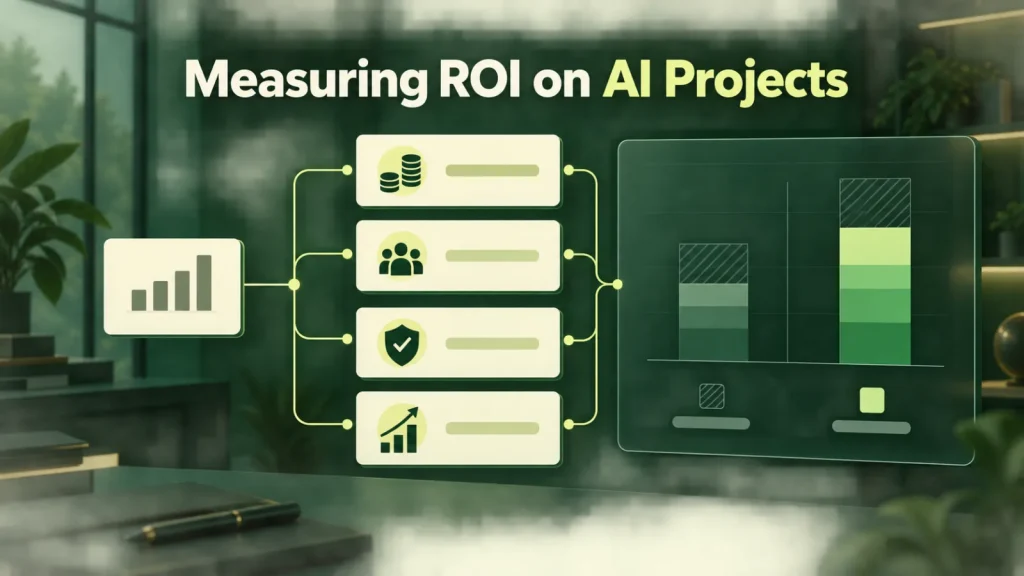
Measuring ROI on AI projects starts with a baseline and a clear definition of value. This guide separates recovered time from cash savings, avoided costs and other outcomes your business can verify.
The honest problem with ROI on AI projects
The standard AI business case multiplies hours saved by a loaded hourly rate and presents the product as savings. However, finance teams see through this immediately, and they are right to. Saving four hours a week across a team does not reduce payroll unless somebody leaves or a hire is avoided.
Still, that does not mean the value is imaginary. Instead, you have to state it in a form that survives scrutiny: cost avoided, revenue enabled, or risk reduced. Recovered time is the input, not the return.
In practice, credible ROI on AI projects comes from linking each claimed benefit to evidence finance already trusts. So the rest of this guide shows how to do that without overstating anything.
Four categories of return
Categorize every claimed benefit into one of these. Anything that does not fit is a soft benefit, so label it as such.
| Type | Example | How to evidence it |
|---|---|---|
| Cost avoided | Hire not made as volume grew | Headcount plan before and after |
| Cost removed | Vendor or license retired | Canceled contract |
| Revenue enabled | Faster response lifting conversion | Conversion rate, matched periods |
| Risk reduced | Fewer compliance exceptions | Exception count, audit findings |
Cost avoided is the most common genuine return in mid-market automation, and it is credible provided you can show the volume growth that would otherwise have required the hire.
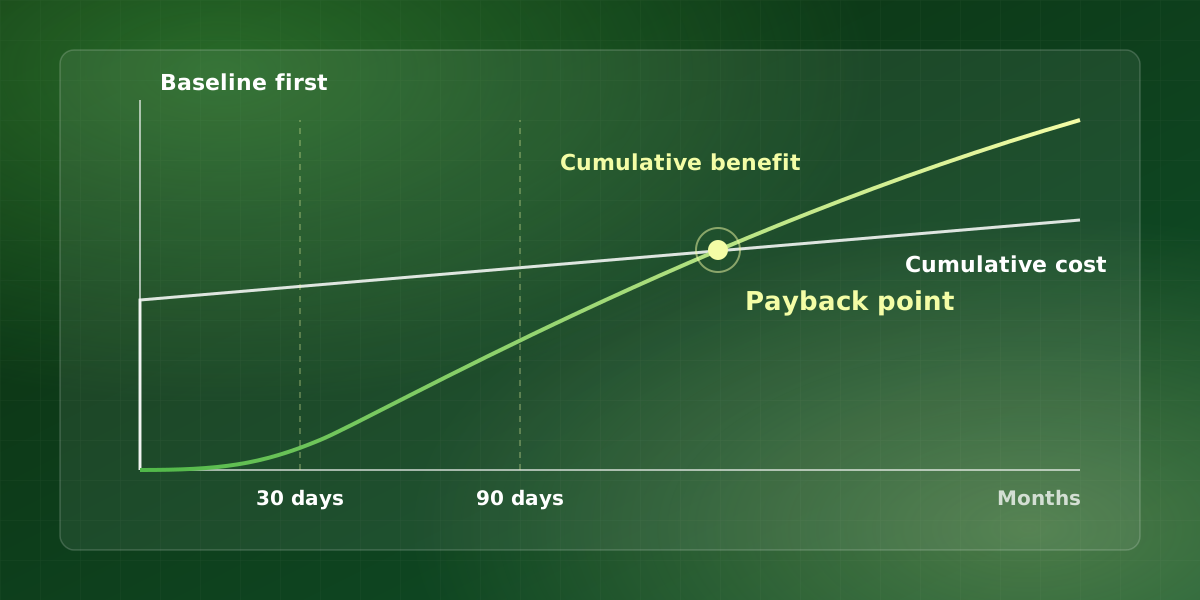
Measuring it properly
-
Baseline before you build
Measure the current state for at least two weeks before anything changes: volume, cycle time, error rate, hours. Reconstructing a baseline afterwards produces a number nobody trusts, including you.
-
Pick one primary metric
One number that decides whether this worked, agreed with the business owner in advance. Secondary metrics, by contrast, are for diagnosis rather than the verdict.
-
Account for the cost honestly
Build, model usage, hosting, monitoring, support, and the internal time spent on adoption and review. Internal time is the line teams most often omit, even though it is rarely small.
-
Re-measure at 30 and 90 days
First, the 30-day figure catches early problems. The 90-day figure is the one to report, because novelty effects and initial workarounds have settled by then.
-
State what the recovered time was used for
In other words, this is the step that converts an operational improvement into a financial claim. If the answer is “absorbed into the day”, say so and present the benefit as capacity rather than savings.
A worked example of ROI on AI projects
The figures below are hypothetical and exist only to show the arithmetic. Suppose an automation costs $30,000 to build and $500 a month to run, including model usage, hosting and support. Suppose also that volume growth would otherwise have required one extra hire at a fully loaded cost of $5,000 a month.
In that case, the net monthly benefit is $4,500, and payback arrives after roughly seven months. That is a cost-avoided claim, so the evidence is the headcount plan before and after. For the cost side, our breakdown of how much AI automation costs lists the line items to include.
Now, by contrast, change one assumption. If volume stays flat and nobody leaves, the same project saves no payroll at all. Instead, it creates capacity, and the honest report says what that capacity was used for. The project may still be worthwhile, but the case rests on backlog cleared or cycle time, not on savings.
When you need a loaded hourly rate for these estimates, the U.S. Bureau of Labor Statistics publishes Occupational Employment and Wage Statistics. Your own payroll data is better, though, because it reflects your actual costs.
How we set up measurement on our projects
We agree the measurement plan during discovery, before any build work starts. First, the business owner picks the primary metric and the threshold for success. Next, we capture the baseline from existing systems wherever possible, because manual time logs drift.
We also price the run cost from current provider rates, such as OpenAI’s published pricing, and then add a margin for volume growth. Finally, we schedule the 30-day and 90-day reviews before launch, so they happen even when everyone is busy.
A one-page ROI summary for AI projects
Finance teams rarely want a long deck, however. Instead, give them one page that answers these points plainly.
- Workflow and owner. What the automation does and who in the business is accountable for it.
- Baseline. Volume, cycle time, error rate and hours, measured before the build.
- Primary metric. The one number that decides success, with the threshold agreed in advance.
- Full cost. Build, run and internal time, shown separately so nothing hides.
- Benefit by category. Each claim tagged as cost avoided, cost removed, revenue enabled or risk reduced.
- Payback period. Months until cumulative benefit exceeds cumulative cost.
- Assumptions. Every estimate listed, so a reviewer can challenge it directly.
Overall, this format makes ROI on AI projects easy to audit, which is exactly what builds trust for the next proposal.
When the numbers disappoint
Sometimes the 90-day figure misses the threshold. When that happens, resist the urge to redefine the metric after the fact. Instead, check three things first. Did volume or staffing change during the period? Is the exception rate higher than testing suggested? Did staff actually adopt the new workflow, or are they still working around it?
Each answer points to a different fix. For example, a high exception rate usually calls for better edge-case handling, whereas low adoption calls for training or a workflow change. If none of these explains the gap, the honest call may be to stop. That outcome still has value, because it shows where ROI on AI projects is unlikely in your business and frees budget for a better candidate.
Common measurement errors
- Counting gross hours saved as net. Subtract the time spent reviewing exceptions and maintaining the system.
- Ignoring the learning period. The first month is usually worse than the baseline. Therefore, measuring there understates the result badly.
- Attributing everything to the automation. If headcount changed or volume shifted in the same period, the comparison is not clean and reporting it as clean damages credibility.
- Omitting internal cost. Your team’s time in discovery, testing and change management is real project cost.
- Reporting only the wins. Also include the workflows you assessed and rejected. As a result, the whole set of numbers becomes more believable.
Frequently asked questions
What is a good payback period for AI automation?
How do we value time saved if nobody leaves?
Should we count quality improvements?
Who should own the ROI measurement?
How often should we revisit the numbers after launch?
For implementation support, explore our AI consulting services or discuss your workflow in a free consultation.