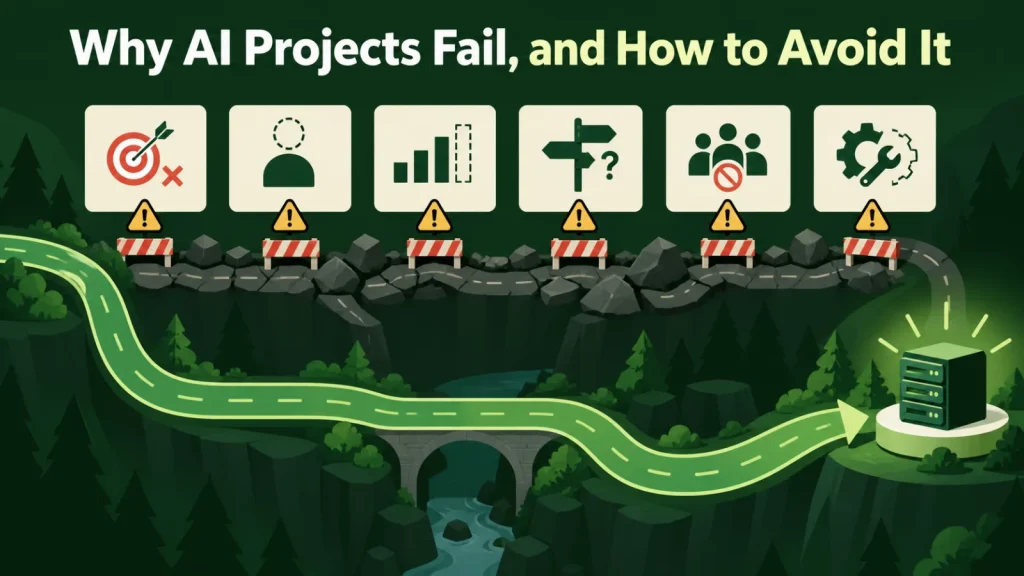
Understanding why AI projects fail helps you test the business case before committing to a build. Review these six failure patterns, from unclear ownership to missing maintenance, and the questions that can expose them early.
Why AI projects fail: the pattern behind the statistics
An AI pilot can work in a demonstration and still fail to become a useful production system. Yet when you read the post-mortems, the technical explanation is rarely the real one. The model performed adequately. Its integration worked. Even so, the project died.
What kills these projects is almost always a decision made before any code was written: the wrong problem, the wrong owner, or no agreed definition of success. Below, then, are the six patterns we see most, and the early warning sign for each.
In other words, the reasons why AI projects fail are usually visible in the proposal itself. That is good news, because a problem you can see before the build is cheap to fix. Once the build is underway, however, every fix costs more and feels more political.
The six failure patterns
-
1. Solving a problem nobody was paying for
The project automates something real but cheap. It works, but nobody can justify the running cost. Warning sign: the business case is expressed in percentages rather than hours or dollars.
-
2. No owner in the business
IT owns the build, while no operational leader owns the outcome. When adoption needs pushing, nobody has the standing to push. Warning sign: the steering group is entirely technical.
-
3. Success was never defined numerically
The pilot “goes well” but cannot be compared to anything, so the funding conversation becomes a matter of opinion. Warning sign: no baseline measurement exists from before the build.
-
4. The last 10% was never scoped
The demo handles the common cases. Edge cases, however, are where the staff time actually goes, and they were treated as a phase two that never got funded. Warning sign: the demo used clean sample data.
-
5. The people affected were told, not asked
The workflow changes under people who were not consulted, so they route around it. Six months later usage is near zero. Warning sign: nobody who does the task daily was interviewed during discovery.
-
6. Nobody owns it after launch
Models drift, systems change, and the workflow evolves. With no maintenance owner, quality degrades until people stop trusting it. Warning sign: the proposal has no line item for ongoing support.
What to do instead
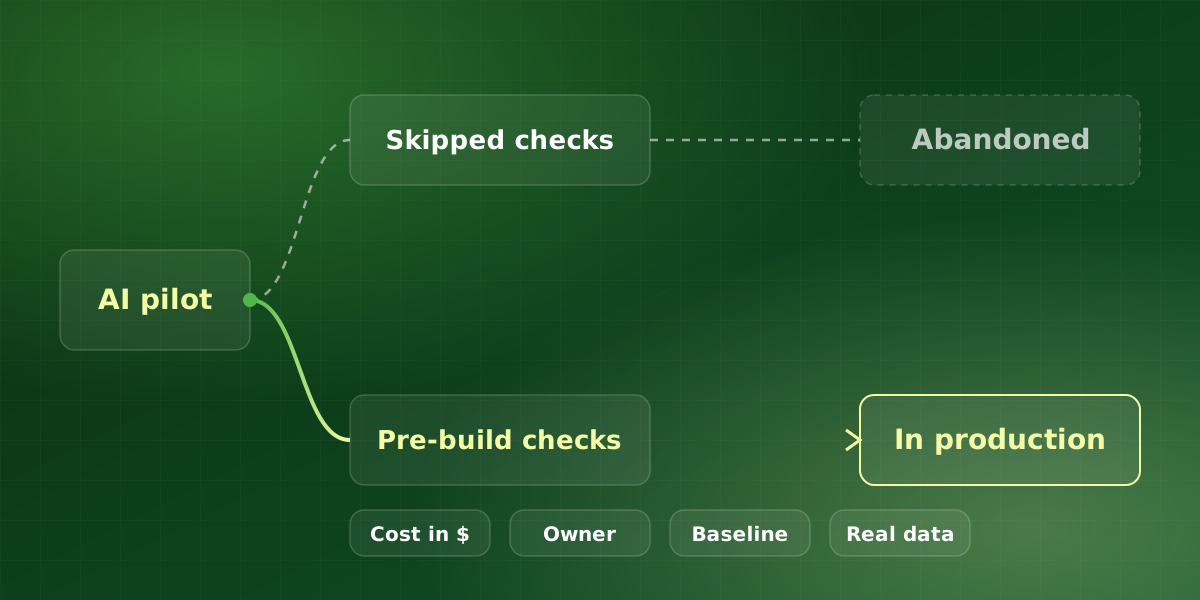
Each failure has a cheap preventive measure, all of which happen before the build:
- Price the workflow. Quantify the current cost of the workflow in hours and dollars before approving anything. If nobody can, that is the finding.
- Name the owner. Name a business owner with authority over the affected process, and put them, not IT, in front of the steering group.
- Record the baseline. Record the baseline metric before the build starts. This takes an afternoon and settles every later argument.
- Test on real data. Demand the demo run on your real, messy data. After all, a demo on clean samples tells you nothing about your edge cases.
- Ask the people who do the work. Interview the people who do the task. They will tell you where the exceptions are, and they also decide whether adoption happens.
- Budget for maintenance. Budget maintenance from day one based on monitoring, support, provider fees and expected changes. Otherwise, a system nobody maintains is a system you will replace.
How we test AI projects before they can fail
We built our discovery process around the reasons why AI projects fail, so each step targets one of the patterns above. In practice, it takes a few weeks and produces a written recommendation, including the option not to build.
- Put a price on the current process. First, we sit with the team and count volume, handling time and rework. Then we convert those hours into dollars using a cost figure finance agrees with. If the number is small, we say so early.
- Agree the owner and the decision rule. Next, the business owner signs off on one primary metric and a threshold. For example, the rule might be “proceed if review time per case falls by half.” That rule turns the pilot into a decision instead of a debate.
- Run a small test on real inputs. We then run the approach against a sample of real, messy cases, including the awkward ones staff flag in interviews. Google’s Rules of Machine Learning are also a useful companion read for teams that want an engineering view of this stage.
- Plan month seven before month one. Finally, we write down who monitors quality, who handles provider changes and what support costs per year. For a structured way to think about ongoing risk, the NIST AI Risk Management Framework gives teams a shared vocabulary.
A worked example: pricing the problem first
Consider a hypothetical team of five that each spend six hours a week resolving vendor invoice exceptions. That is 30 hours a week, or roughly 1,500 hours over a 50-week year. At an assumed loaded cost of $40 an hour, the workflow therefore costs about $60,000 a year. As a result, a build with a modest running cost can clearly justify itself against that figure.
Now compare a second hypothetical workflow that takes two hours a week across the whole team. That comes to about 100 hours a year, or roughly $4,000 at the same rate. Consequently, even a well-built system struggles to cover its own monitoring and support at that scale. As a result, it will look like a technical failure later, although the real problem was the choice of target.
This arithmetic explains a large share of why AI projects fail quietly: nobody did it before the kickoff. Our guide to measuring ROI on AI projects covers how to turn those hours into a claim finance will accept.
A pre-build checklist for spotting why AI projects fail
Use this table before you approve a build. Each row maps one reason why AI projects fail to the question that exposes it and the answer you want to hear.
| Pattern | Question to ask | Good answer |
|---|---|---|
| Cheap problem | What does this cost today? | Hours and dollars |
| No owner | Who owns the outcome? | A named operational leader |
| No baseline | What is the number now? | A measured figure |
| Unscoped edges | Did the demo use our data? | Yes, including exceptions |
| No consultation | Who did you interview? | The people doing the task |
| No maintenance | Who supports it in month seven? | A named owner and budget |
So if two or more rows lack a good answer, pause the project. Fixing those gaps usually takes days, whereas recovering a failed launch can take months.
Frequently asked questions
What is a realistic success rate for AI projects?
Should we run a pilot or go straight to production?
How do we get buy-in from staff who fear replacement?
What is the single biggest predictor of success?
How early can we tell that a project is in trouble?
For implementation support, explore our AI consulting services or discuss your workflow in a free consultation.